The Quebec Writers’ Federation hosted its 17th annual gala on November 18, 2015. Author Adam Leith Gollner opened the ceremony with this remarkable meditation on how a writer seesaws between isolation and community, and on what it means to be a writer, right here, right now.
Category: community
-
I Do Not Write Alone by Gina Roitman
Some people maintain that writing is a lonely business. In my experience, that’s not necessarily true. When I sit down to write, I am joined by a crowd of internal negative voices: the infernal censor, the cranky critic, and the whiner who keeps reminding me of all the other things I could or should be doing.
About once a month, however, I escape that crowd when I meet with my writing group to refresh my creative energies. I am not alone in this pursuit. Read the acknowledgements of first-time authors and you’re likely to find shout-outs to the people in their writing groups. For the past ten years, I have been a member of a critique group that meets to break bread, gossip, and review current work. It was with the help of this group that I crafted many of the pieces which appear in my book of nine linked short stories, Tell Me a Story, Tell Me the Truth.
The original group, which we eventually dubbed MontrealWrites, first met while taking a QWF workshop given by Ami Sands Brodoff. Ami laid down the rules for critiquing that we use to this day. Over the years, we have acknowledged our good fortune at coming together as we did. It was one of those remarkably synchronistic occasions: people of like minds but different talents found themselves, over the course of two months, sitting in a room together for two hours a week.
When the workshop session ended, eight of us did not want the experience to end. We had found a pleasant camaraderie despite the differences in our ages and styles. Initially, we thought we’d need a fearless leader to guide us but soon realized that we had all the skills and experience we needed. Some of us were good at analyzing the themes while others were meticulous about storylines.
In our original group, we had mostly short story writers as that was the focus of the workshop we had signed up for. However, as some members moved away or moved on and others came in, many of us explored other genres including children’s stories and picture books, personal essays, travel writing, screenwriting, poetry and, of course, novels.
Why does our group dynamic work so well? We are all blessed with a general lack of ego and we have ‘grown up’ together as writers. It is the love of the process, I believe, that nurtures our commitment to each other. As a result of reading so much of each other’s work, we have formed a collective memory from which to draw on when discussing any new work.
Elizabeth Ulin could be our poster child. Her story exemplifies how the influence of the group comes into play. She wrote a short story geared to middle grade children starring a young girl named Mitzi and a host of spiders. The group became so enamored with Mitzi that we suggested Liz might want to expand the short story to book length. In the end, she was accepted by the QWF Mentorship Program and turned Mitzi’s story into a screenplay. Elizabeth has now adapted three of her pieces for presentation at Centaur Theatre.
In my case, when a publisher indicated interest in my work, I made certain to have the group vet the material I had selected before sending it off. Their input was invaluable in keeping the linked stories relevant and on track.
The members of MontrealWrites continue to evolve as writers as well as friends. We work well as a team. We organized, publicized and orchestrated two public readings with great success. And even now, through all the exigencies of life – births, weddings, work deadlines and far-flung travel – we find it hard to let go of each other.
How we have grown together and challenged each other, and what we have accomplished as individuals as well as a group, give the lie to the “lonely-business” theory.
Gina Roitman is a writer, editor and author of the acclaimed short-story collection Tell Me a Story, Tell Me the Truth, and the co-producer, co-writer and subject of the award-winning documentary My Mother, the Nazi Midwife and Me. www.ginaroitman.com
Learn more about MontrealWrites by clicking here. MontrealWrites will be celebrating their 10th anniversary with readings from most of the group members at the next QWF membership schmoozer in May 2014. Date TBA soon.

MontrealWrites
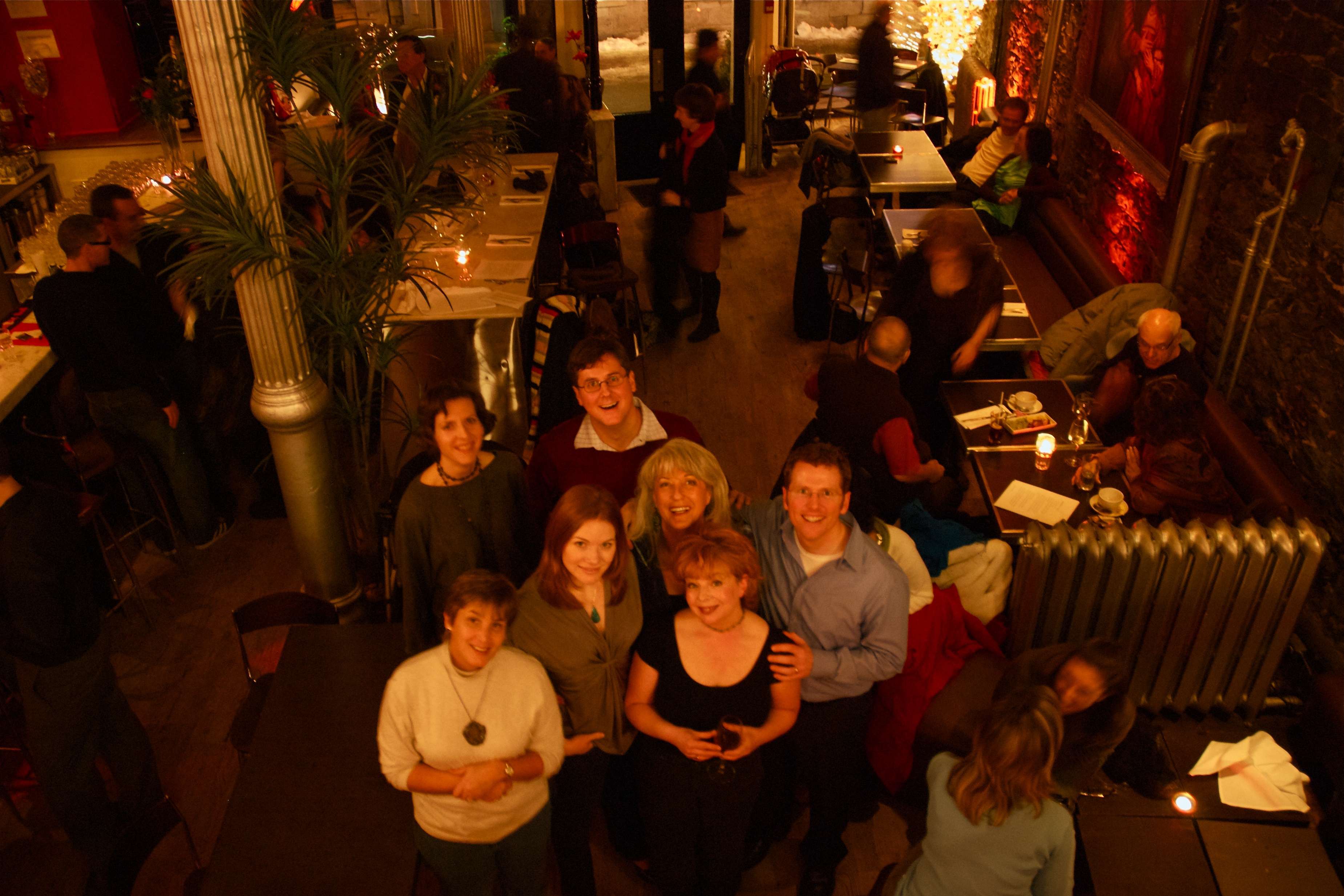
Pictured from left to right – Front row: Elizabeth Ulin, Sarah Lolley, Gina, Maggie Kathwaroon and Paul Edmond Robichaud;
Back row: Jane Affleck and Derek Webster.Do you write alone? Is writing is a lonely business?
Have you been part of a writing group? Why?
Not in one yet? Do you want to be?
QWF would be happy to help bring together people who are eager to start/join a writing group. Please contact Lori at admin@qwf.org if you’re interested.
-

Where We Meet: The QWF at 15 by Claire Holden Rothman
Writer Frances Brandow and I met in 2003 for coffee at the Brûlerie near the Université de Montréal, where one of her daughters was studying. She was small, with fading auburn hair and eyes the colour of cornflowers. Scottish looks, which surprised me because she lived in the Beauce region of Quebec.
We talked for two hours. About her short stories, and, as we grew comfortable, about her life. She was born in southern Ontario, where, one summer in her teens, she met a guy from Quebec. When she followed him back to his hometown soon afterward, she spoke only English. The winter I met her, some twenty years later, she was working as a translator. Apart from her fiction, her whole life was French.
Most of us writing in English in Quebec aren’t as isolated as Frances. In Montreal proper, around 19 percent of the population speaks English at home. Sizeable pockets of English speakers reside in the Townships and in western Quebec. But writers tend to be solitary. Often we need to be coaxed from our lairs.
And this is the genius of the Quebec Writers’ Federation. For fifteen years, it has been coaxing us non-stop into building a local English-language literary community. The writer from the Beauce was an early beneficiary, receiving help on a linked story collection the year the QWF mentorship program came into existence.
Imagine, for a moment, life without the QWF. In the mid-eighties, when I was trying to figure out how to make it as a writer, guidance was hard to find. I was working in an office by day and writing nights and weekends. Concordia University was the only place in Montreal offering English writing workshops, so that was where I went. Not for a degree, particularly. For community.
The QWF was born in the spring of 1998 out of the merger of QSPELL and FEWQ, two pre-existing groups promoting Quebec English-language literature and writers, respectively. It’s an astonishing success story. Currently, the QWF has around six hundred members. Every year more people join, and its activities keep pace. Writing workshops are the most popular, bolstering community and helping the established local writers who lead them pay rent. The mentorship program is fully subsidized, a blessing if you check out costs for similar programs at Humber College or elsewhere. Writers in the Community supports at-risk teens through a range of literary activities. Writers Out Loud showcases local talent at readings throughout the province.
The crowning jewel is, of course, the Gala. Every November, the QWF hands out $12,000 in prizes for Quebec’s best English books and translations. To mark this year’s 15th anniversary, the Gala will be held at the Virgin Mobile Corona Theatre on Notre-Dame, but the past several years it was held at the regal Lion d’Or. Last autumn, the hall was packed to capacity. Looking out at the sea of faces, master of ceremonies Josh Freed cracked a joke about Anglos convening on the corner of Papineau and Ontario – the heartland of French Montreal – to honour English words. It is a paradox. And most of us wouldn’t have it any other way.
Claire Holden Rothman’s new novel, My October, will be published next spring with Penguin Canada.
*This article has been modified to correct a factual error regarding QSPELL.