Tag: bookstore

  • Writing on the Edge—By Lise Weil

    Writing on the Edge—By Lise Weil

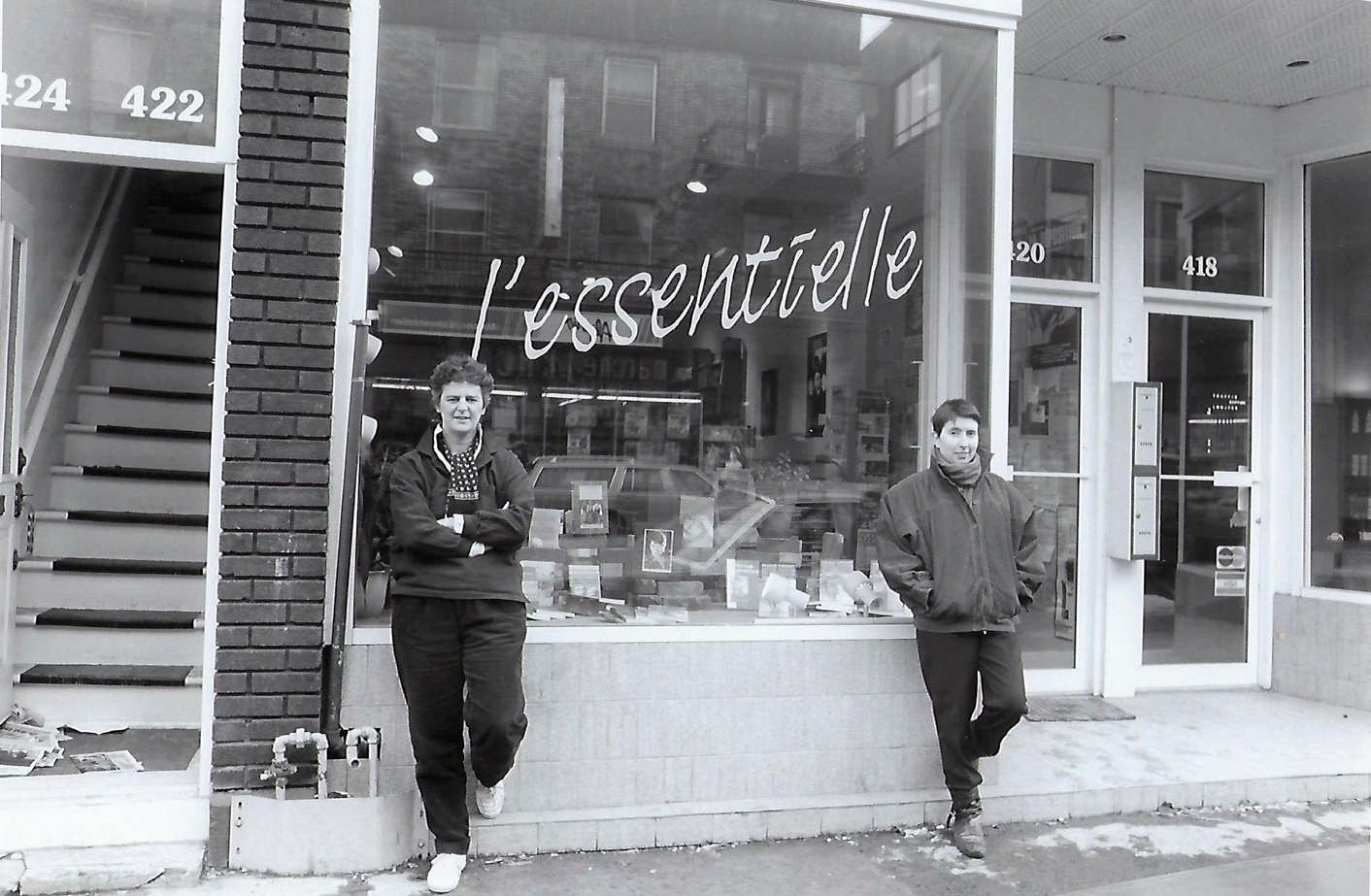
    Odette DesOrmeaux and Martine Huysmans, two members of the l’essentielle collective which also included Ariane Brunet and Harriet Ellenberger, 1988.

    Just over thirty years ago, in June of 1988, I drove up to Montreal from my home in Montague, Massachusetts to attend the Third International Feminist Book Fair. At the time I was editor of the feminist literary review Trivia: A Journal of Ideas; we had a table in the exhibit hall, alongside books, presses, and journals from all over the world. The Fair, housed on the Université de Montréal campus, was attended by some 8,000 people, featured over 300 authors, and hosted the largest gathering ever of Indigenous women writers from Canada. Coming off three days of head-spinning, exhilarating, often revelatory panels, readings and conversations, co-editor Linda Nelson and I decided to devote the next two issues of Trivia to the event.

    Trivia 13 focused on the feminist writers of Quebec and those influenced by them: Nicole Brossard, Gail Scott, Erín Moure, Louise Cotnoir, Michèle Causse (France), and Betsy Warland (BC).[i] The energy and vision of this community of feminist writers (which also included Louky Bersianik, France Théoret, Louise Dupré, and Daphne Marlatt) had provided much of the impetus for the Fair itself.[ii] In my editorial I attempted to name what it was about these writers that excited me so much. It had to do with their understanding of language as transgressive, and as material. With their exuberant flouting of genre boundaries—poetry becoming essay, fiction theory (“fiction/theory” – Brossard’s term)—all in deference to their insubordinate, uncooptable female bodies (“The breasts refuse”—Warland). And it had to do with the edge they/we were all on—as women claiming space for our own bodies and thoughts for the first time ever.

    Just over a year before the Book Fair I had driven up for the opening of the bilingual bookstore l’essentielle, a word Brossard coined in her epic poem “Sous la langue/Under Tongue.” A bilingual edition of that poem was being launched to mark the occasion. The little store on Rachel was spiffy, with hot pink shelves and track lighting. I remember women in dress shirts and bright scarves hoisting glasses of white wine. I remember Brossard and her translator Susanne de Lotbinière-Harwood taking turns reading the stanzas. On ne peut vas prévoir / You cannot foresee, each verse began, crescendoing as the lover’s mouth approached the body she desired, launching her into the unknown.

    You cannot foresee so suddenly leaning
    towards a face and wanting to lick the soul’s
    whole body till the gaze sparks with furies and yieldings. . . .
    Desire is all you see.

    And I remember walking into my study one Sunday morning not long after that launch to find Linda with Brossard’s chapbook in her lap, weeping. “We don’t write like this here,” she said. “No one writes like this here.” Eros: words embodied it in Quebec women’s writing. Words were marks of possibility, thrusting us out to a precipitous edge where nothing was foreknown… No, there was nothing like this in our feminist world. Plus the lesbians I hung with favoured jeans and flannels.

    Some two years after the Book Fair I moved to Montreal, in part drawn by that subversive brew of Quebec au féminin, wanting to be immersed in it (and yes, admittedly, wanting to be among women who dressed up for each other). Beneath all this was a desire to write… in order to do which I knew I needed to get away from the home that was Trivia’s operating base. But weaning myself from the role of editor and translator took more than a physical move. It was thirteen years before I found myself in the grip of a long writing project: a memoir that began—not surprisingly—as a meditation on lesbian desire and that chronicled a series of disastrous love adventures that drove me, heartbroken, to this foreign city where I finally learned to abide—in love, and in place. A QWF mentorship with Elaine Kalman Naves in 2003-4 was foundational to this project. It would take me another twelve years to complete the memoir, but I wrote some two-thirds of a first draft in those months. Elaine’s encouragement and her insight were just the spurs I needed.
    l'eugelionne2
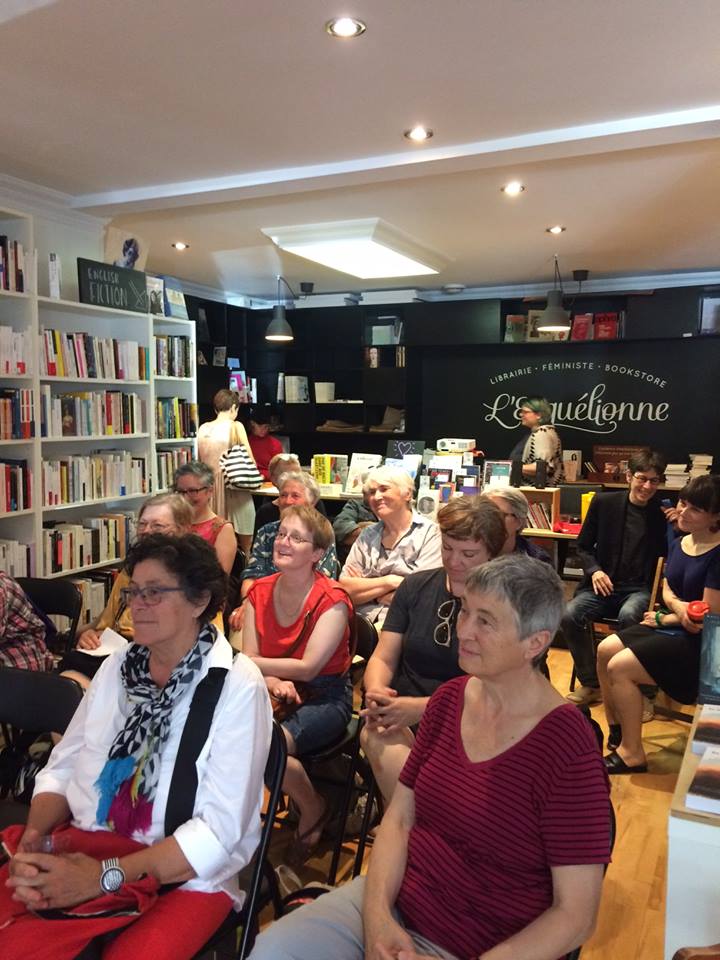
    Launch of “In Search of Pure Lust” at L’Euguélionne, June 2018.

    But it is also true that my memoir, In Search of Pure Lust, would not exist in its present form were it not for my immersion in Quebec au féminin (where the last section of the memoir is set) and its climate of formal permissiveness and political passion, its celebration of language as erotic. I imagine many literary products of this century, not only here in Quebec but throughout North America, owe a similar debt. So it’s both surprising and dismaying to me that nowadays in Anglophone literary contexts there is so little acknowledgement—or even knowledge—of these Quebec writers and their pioneering body of work. Even when the topic is formal innovation.[iii] Even in Montreal.[iv] At least here in Montreal, as of two years ago, we have a monument to this genealogy in the form of the bilingual feminist bookstore L’Euguélionne—named after Louky Bersianik’s kickass, visionary feminist novel. Long live L’Euguélionne!

    I can’t help longing for the kind of literary community that first drew me to this city, a locus for deep conversation revolving around a common cause that felt urgent enough to unite writers of different cultures and languages. What might that common cause be today? As global forces thrust us towards a darker precipitous edge, and an endless expanse of unforeseen. . . .


    Lisebookstore

    Lise Weil’s memoir, In Search of Pure Lust (Inanna Publications, 2018), is a finalist for an International Book Award and winner of an Ippy Award. Her essays, literary non-fiction, and translations have been published widely in Canada and the U.S. She was founder of the feminist review Trivia: A Journal of Ideas (1982-1991) and its online offshoot, Trivia: Voices of Feminism (2003-2011)She is currently editor of Dark Matter: Women Witnessing, which publishes writing and artwork created in response to an age of mass extinction and ecological collapseShe teaches in the Goddard College Graduate Institute. www.liseweil.com

    [i] Contributors to Trivia 14, “Language and Difference,” included Lee Maracle, Jeannette Armstrong, Gloria Anzaldua, and Jewelle Gomez. Copies of Trivia 13 and 14 can be ordered for $5 plus postage. lweil22@gmail.com

    [ii] Six of these writers met on Sundays every three months in Montreal to talk about feminism and theory. Theory, A Sunday (Belladonna, 2013), a recent translation of La théorie, un dimanche (1988), collects the writings that emerged from these conversations.

    [iii] See, e.g., Bending Genre: Essays on Creative Nonfiction (eds. Margot Singer and Nicole Walker, Bloomsbury, 2013). Much of the bending and unsettling described in these essays was being performed by the writers of Quebec and was addressed explicitly in Gail Scott’s “Shaping a Vehicle for Her Use” (Spaces Like Stairs, Women’s Press, 1989).

    [iv] Not even at a recent reading by a visiting Canadian author from a work of fiction titled Theory.

    Photo credits: Marik Boudreaul (header image); Favor Ellis (headshot)
  • A Connected World—By Christopher DiRaddo

    A Connected World—By Christopher DiRaddo

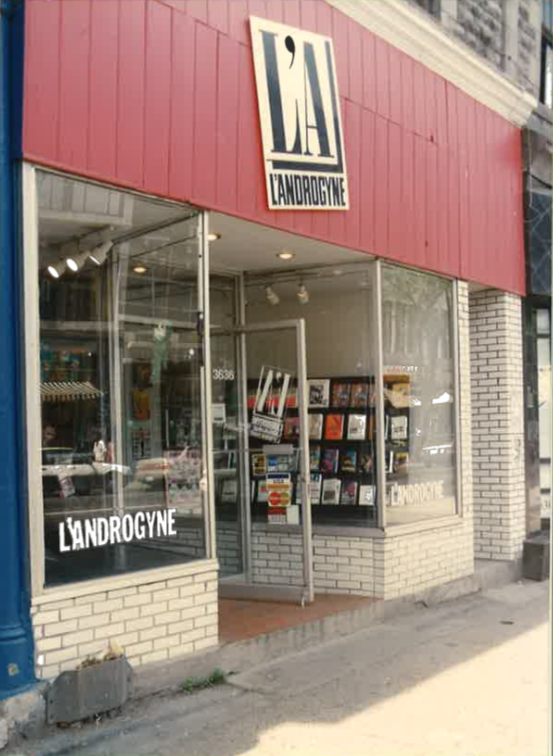
    Montreal’s gay, lesbian, and feminist bookstore, L’Androgyne, closed for good in 2002. At the time, I knew I was going to miss it, but even now, some seventeen years later, I still feel its loss.

    I don’t remember the first time I went inside, but I remember being nervous about it. Who would see me go in? And what would I find there? I still remember its address: 3636 St. Laurent. I remember its smell too: the books, the paper, the glue that held everything together. The place was small, a mere 1,200 square feet, with three rows of white bookshelves all built by hand. It was here where I discovered my favourite authors, where I first picked up copies of books by Armistead Maupin, Ethan Mordden, Sarah Schulman, Andrew Holleran, and Sarah Waters.

    It was also here where I found community. Where I made friends—France, David, and Johanne—all working behind the counter. I’d visit several times a week, if I could, leaving not only with books or magazines but with stories about real people’s lives and the places and events and collected history that were all a part of this exciting community I had just found. Before the Internet, a city’s LGBTQ bookstore was where you got your news. It was where you could pick up queer publications like Fugues or Xtra or the Guide, flyers for parties, maps for marches. And it was also a place where you could develop a crush among the stacks, where you could smile and flirt and finally meet others who shared your interests.

    Walking down the aisles, I’d sometimes imagine my own book on the shelves. At that time, I’d been writing for years with no indication that anything would ever come of it. How great would it be, I’d think, to see a book I had written alongside these legends (under D, somewhere between Delaney and Donoghue)? Sadly, I never got to know that feeling. By the time my first book was published, L’Androgyne was twelve years cold in the ground.

    I’m sure many of you can relate to losing your favourite bookstore. L’Androgyne was not the only one to lose out as the world moved online. For the LGBTQ community, though, there was a moment when the arrival of the Internet held such promise. It meant that people could have more access to resources and information (especially those who didn’t live in urban areas). It was a place where we could congregate easily, expand our networks, and make connections. Yet something authentic was lost. Gone was the human touch, the spontaneity, the chance for discovery, the surprise of the unknown. Sure, I could Google “new gay fiction” if I wanted to know what to read next. I could add “booklover” to my dating profile. But gone were the deep conversations, the quiet browsing, the raucous laughter, the looking for friends, lovers, and other limited editions in the aisles.

    When my book finally came out in 2014, I was disappointed there wasn’t a home for it. I did a few public readings in straight spaces, but rarely sold copies. There was no forum in Montreal for me to introduce my book to my community. And it wasn’t just me. All around I was seeing Canadian writers continuing to publish LGBTQ books and they too struggled to reach an audience.

    So, I decided to start my own reading series. I figured, if Montreal didn’t have an LGBTQ bookstore, I’d make one—at least for a few nights a year. Now, every two months, the Violet Hour takes place in a bar in Montreal’s gay village. And not just any bar, but Stock—a gay male strip club. Why a strip club? Because I wanted a place with a different energy, one where writers could feel like they could take risks with their work. I also wanted to host something in the village because that neighbourhood too had suffered from the shift online and I wanted to bring back some culture to the place that had given me life in my twenties. Above all, I wanted my series to be more like a party, more social. I wanted there to be music and drinks and fun and laughter. Like it was back in the good old days of L’Androgyne. I wanted to unite LGBTQ booklovers in one room and get them talking—about their favourite books, about their favourite writers, about themselves.

    To date, there have been more than twenty events and more than a hundred writers who have taken to the stage. That’s hundreds of new connections made between writer and audience. Montreal may not have a dedicated English-language LGBTQ bookstore anymore, but I’d like to think the Violet Hour is the next best thing. And I hope, as long as this country continues to publish LGBTQ literature, that I can provide it with a stage.


    unnamed

    Christopher DiRaddo is the author of The Geography of Pluto and president of the Quebec Writers’ Federation. You can find out more about future Violet Hour events here. The next event is at the Montreal Fringe Festival on June 5, 2019 at 6 p.m. (Mainline Theatre, 3997 St. Laurent).

    Photo credits: France Désilets (header banner), Paul Specht (headshot)

  • Literary Influences: E. L. Doctorow’s Lives of the Poets by John Goldbach

    Literary Influences: E. L. Doctorow’s Lives of the Poets by John Goldbach

    The first time I read E. L. Doctorow’s wonderful Lives of the Poets: A Novella and Six Stories (1984) was in early 2001, after picking up a used hardcover copy at City Lights Bookshop in London, Ontario, at 356 Richmond St. Not City Lights Bookstore, the famed bookstore in San Francisco, California, at 261 Columbus Ave—City Lights Bookshop (the one in London ON) is one of my favourite used bookstores ever, a small but dense and rich oasis of books and comics and records, etc.

    A few years later, after reading Slavoj Žižek’s Iraq: The Borrowed Kettle (2004), I reread Lives of the Poets. Much to my surprise, Žižek references Doctorow’s collection in his second book about 9/11 and its aftermath (namely, the illogic of the Bush administration’s reasons for invading Iraq). I was surprised to learn Žižek uses Doctorow’s collection as a sort of model. Žižek writes,

    The hidden literary model for this book is what I consider E. L. Doctorow’s masterpiece, the supreme exercise in literary post-modernism, far superior to his bestselling Ragtime, or Billy Bathgate: his Lives of the Poets: Six Stories and a Novella—six totally heterogeneous short stories (a son is set to the task of concealing his father’s death; a drowned child is callously handled by rescuers; a lonely schoolteacher is shot by a hunter; a boy witnesses his mother’s act of infidelity; a car explosion kills a foreign schoolgirl) accompanied by a novella which conveys the confused impressions of the day-to-day life of a writer in contemporary New York who, as we soon guess, is the author of the six stories. The charm of the book is that we can reconstruct the process of the artistic working-through of the raw material of this day-to-day life.

    As soon as I’d finished Iraq: The Borrowed Kettle, I reread Lives of the Poets, my engagement with the book deepening.

    I’ve read the Doctorow collection twice since then. About a decade later, in 2015, I used it as an oblique model for organizing a book of my own fiction, It Is an Honest Ghost, which consists of six stories and a novella (Hic et Ubique). There was something about how Doctorow’s stories stood alone—were “totally heterogeneous,” in Žižek’s words—but nevertheless informed one another, that I found haunting.

    My new collection was originally made up of eight stories and a novella but for myriad reasons I cut two stories, not the least of those reasons being for the sake of uniformity, a loose strange symmetry—a uniformity and symmetry impressed upon my mind by Doctorow.

    And then I read Lives of the Poets for a fourth time in July 2016, while working on this short appreciation. Lives of the Poets remains politically perspicacious, deeply insightful, and contemporary.

    Here’s Doctorow on US immigration, and mass migrations in general. The writer, the narrator of the novella, emerges from the NYC subway, and observes the new waves of immigrants to the city. He writes,

    Dear God, let them migrate, let my country be the last best hope. But let us make some distinctions here: The Irish, the Italians, the Jews of Eastern Europe, came here because they wanted a new life. They worked for the money to bring over their families. They said good riddance to the old country and were glad to be gone. They did not come here because of something we had done to them. The new immigrants are here because we have made their lands unlivable. They have come here to save themselves from us.

    Lives of the Poets continues to shed light on the present for me. Out of Doctorow’s impressive and celebrated oeuvre, it’s often overlooked. But it remains an insightful and inspiring collection, chock-a-block with strange echoes and resonances.


    KateHutchinson19webJohn Goldbach is the author of The Devil and the Detective (Coach Books, 2013), a novel, which was an Amazon Best Book of 2013; Selected Blackouts (Insomniac Press, 2009), a story collection; and, most recently, It Is an Honest Ghost (Coach House Books, 2016), a collection of six short stories and a novella (Hic et Ubique).

    Works Cited: Žižek, Slavoj. Iraq: the Borrowed Kettle. New York: Verso, 2004, p. 7.

    Photo: Kate Hutchinson (headshot)