Tag: Canada Council for the Arts

  • Why You Should Apply for a Canada Council Grant Every Year until You Die.—By Sherwin Tjia

    Why You Should Apply for a Canada Council Grant Every Year until You Die.—By Sherwin Tjia

    It is a truth universally acknowledged, that a writer in possession of a good idea, must be in want of a grant. Last year I was on a Canada Council granting jury, and it not only enlightened me as to how the whole process works, it also renewed my faith in the Canada Council in general, and in the granting process in particular.

    Over the years some of my writer friends had gotten the distinct impression that the Canada Council was this edifice of insiders. Those who got grants kept getting them, and those on the juries awarded grants to their writer friends. And this bitter conviction stopped many of them from applying. “I’m not going to win anyway, so why try?” It doesn’t help that by default, a writer’s life is an incessant litany of rejection.

    But after having been on the jury, I’m now convinced we all should apply annually. The truth is that just by applying you help all writers because the Council takes those numbers and brings them to the government to ask for more funding for future years. Even if unsuccessful, those applications demonstrate a clear need.

    Though I’ve applied and been rejected in the past, the biggest eye-opener for me was seeing just how high my chances of getting a grant had always been. Out of the 150 applications my jury read (including fiction, poetry, graphic novels, short stories, literary non-fiction, YA and kid’s books), fully forty writers, give or take, got grants. That’s a win rate of around twenty-six percent, or one in four. No lottery has ever been so generous.

    And that’s the thing. It is a lottery. You can’t control who’s on the jury. If their tastes don’t align with your proposal one year, you’ll just have to apply again the next. I’ve now seen firsthand how jurors agonize over their decisions. We champion the diamonds that are rough, hopeful that grant-sponsored time can polish a great idea. We eloquently counterpoint prevailing opinions. Various members bring unique insight from their respective specialties. And though we were all quite diverse (in terms of geography, language, gender, race, sexual orientation, and writing genres), more often than not I was surprised to discover how much we concurred on our final assessments.

    So take it from a fellow writer who is deeply skeptical and always expecting rejection: the Canada Council has your best interests at heart, and every year runs a lottery that you are uniquely qualified to enter. So enter!

    To help you, I have some advice to offer:

    DO START EARLY. The application is almost its own writing genre. It needs time to simmer. Go through at least several drafts. A friend should read it over. Any initial questions they have should be answered, because it’s likely the jury will harbour those same questions. Similarly, anything confusing should be re-written to be clear.

    DO BE STARTLINGLY ORIGINAL. Easier said than done, of course, but it pays to go far afield with your concept. If you have the misfortune to be the fourth applicant with a post-apocalyptic road trip underpinning your plot, the jury may be inclined to favour the best of the bunch.

    DON’T GET TUNNEL VISION ABOUT PITCHING JUST YOUR STORY. Discuss the larger impact of it on you and on the society it will go on to live in. Why does it matter to you? Is it personal? Will it matter to other people? Are there themes that will resonate in the larger world?

    If rejected, DO CALL THE CANADA COUNCIL. The program officer takes notes during the jury discussion of your project, and they’ll relay these to you. But only if you call them for feedback.

    If rejected, DO RE-APPLY the very next year. You may want to tweak the same application, or apply with a whole new project. But don’t not apply.

    If successful (yay!), APPLY THE VERY NEXT YEAR WITH ANOTHER PROJECT. Now, in the past, if you got a grant, you were prevented from applying again until your final report for that grant was submitted. But in the current system, you can apply every single year, even if you already got a grant and are currently working on something, as long as it’s for a new project, and there’s no overlap in the project dates you’re proposing.

    DO ALWAYS INCLUDE A SAMPLE FROM YOUR PROPOSED PROJECT. Even if you have a more refined short story that you think will show off your writing chops from a couple years back, take the time to also write up a small sample of the actual thing you’re pitching. It helps the jury see it. Juries are unkind to sample-less applications.

    And that’s it! Vow to apply every year. Think of it like voting, but you’re the candidate. It’s your civic duty to your art! The world needs all the odd and diverse projects it can get! Be the strange you want to see in the world.


    SherwinTjia_PLZdontcrop

    Sherwin Tjia is a Montreal-based writer and illustrator. Their latest book PLUMMET is a graphic novel about a woman who wakes up one day to find herself in freefall forever. It was named one of CBC Book’s 20 Best Graphic Novels of 2019. Their Choose-Your-Own-Adventure style book from the POV of a housecat, You Are a Cat!, published in 2011, was the winner of that year’s Expozine Award for best English Book, and has never been out of print. Their collection of 1,300 haikus, The World Is a Heartbreaker, was a finalist for the 2006 A.M. Klein Poetry Award. And their first graphic novel, The Hipless Boy, was a finalist for the Doug Wright Award for Best Emerging Talent, and also nominated for four Ignatz Awards.

    Photo credits: Sherwin Tija (header image & headshot)

  • Finding Perspective: Writing in the Dark at Berton House by Shelagh Plunkett

    Finding Perspective: Writing in the Dark at Berton House by Shelagh Plunkett

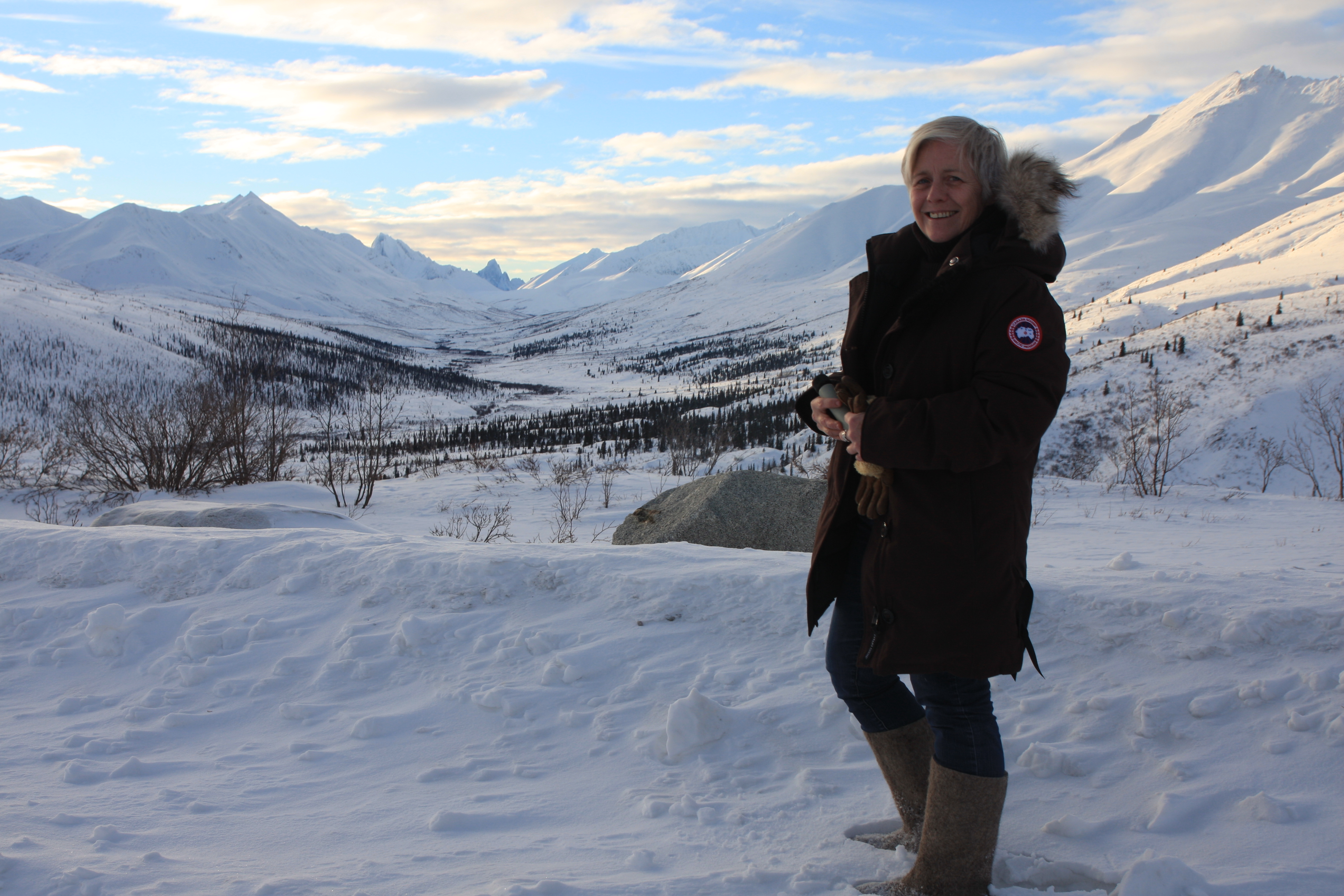
    On the wall above my desk in Montreal is a photograph taken in February at the Arctic Circle. The print is four feet wide by almost three feet high and foreground takes up most of that space. The horizon line is high on the print and marked by the Richardson mountains: white and treeless. It was -34C that day and my eyelashes froze together while I focussed the camera. In the foreground are the faint stains of a recent caribou kill, one hoof hidden amongst highbush cranberry and yellow grass poking out of the hard snow.

    ice lashes

    The perspective is deceiving. Trails of Black Spruce bisect the wide flat plain in middle distance and lead toward the base of the distant rounded mountains. Those peaks look close enough to touch, but they are many kilometres away.

    It is an image that encapsulates much of what I learned during my three-month residency at Berton House in Dawson City, Yukon.

    green over Berton House

    Berton House is owned and operated by the Writers’ Trust of Canada and each year four authors, supported by Canada Council grants, are chosen to spend three-month stints at the house. Residents do not have to teach or lecture, offer manuscript evaluation or coach emerging writers. In fact, they don’t even have to write while staying at the house. CanLit icon Pierre Berton, when gifting his house as a retreat, made that stipulation. He said, “the main purpose is not to let them write, but simply to give them time off from writing if they want it, or time off to think about writing or about the place they’re living in.” In the house are two binders of letters each resident has left for the next. Over the winter I spent a few hours reading what Lawrence Hill, Charlotte Gray, Joan Thomas, and the rest of the residents who’d come before me had to say. Some got a fair bit of work done. Others shut down Dawson’s bars nightly. Everyone left with something new: a stronger sense of their writing, the seed of a manuscript, suitcases of notes and ideas, friendships.

    swirl over 7th ave

    “The main purpose is not to let them write, but simply to give them time off from writing if they want it, or time off to think about writing or about the place they’re living in.”

    I landed in Dawson on December 23. When I stepped off the plane at 10:30 a.m. it was still too dark to see the tiny terminal building fifty feet away. My eyelashes froze—yeah, that happened a lot—and I immediately lost sight of my seatmate, a woman in a velour tracksuit who’d come to Dawson to “experience the Yukon winter.” Betty and Dan Davidson, part of the Berton House team, eventually found me in the crush of people inside the terminal. I was taken on a quick tour of town: “Here’s the curling rink. Do you curl?” I don’t. “Here’s the Anglican Church. Here’s the Baptist Church. Here’s the Catholic Church. Here’s the nondenominational worship house. Are you a churchgoer?” I am not.

    When they dropped me off at the house it was 12:30 p.m. and still too dark to see across the road. I watched the cloud of vapour left by their car’s tailpipe dissipate and sighed as the house settled around me, pipes banging as the heating system fired up. I was the seventy-fourth Berton House writer-in-residence, and I had the place all to myself. I didn’t know anyone living in that remote town. It would be dark for most of my stay (or so I was led to believe) and bitterly cold (or so it had been in the past). Alone in the cold and the dark, I would write reams.

    “I had the place all to myself. I didn’t know anyone living in that remote town.”

    The phone rang. I was invited to a Christmas Eve party and then to a Christmas potluck and then to a Boxing Day gathering and a New Year’s dinner. Did I know about the twice-weekly film festival screenings? Would I like to snowshoe up the Dome? Was I coming to the gallery opening and lecture next week?

    For a town of about 900 winter residents, Dawson was hard to keep up with.

    Initially the invitations arrived with an accompanying “don’t feel obliged, we know you’re here to write.” Initially, I agonized over the daily choices: write or hike, write or read, write or … and ground myself to a standstill over words that weren’t piling up. In my self-inflicted wracking I lost sight of why I write and nearly turned my prized three-month residency into the demise of my writing.

    “I agonized over the daily choices: write or hike, write or read, write or …”

    Raven angels

    But, at some point, I came to my senses and relearned something important. Perhaps it was the night I spent lying on my back on the frozen Yukon River hypnotized by the Northern Lights or while I was listening to Tr’ondëk Hwëch’in storytellers speak on the cultural importance of “story” or maybe when I stepped over the Arctic Circle. At some point I remembered that sometimes that thing which seems so close can’t be reached until one moves away from it.

    Sometimes to write good stories we have to stop trying to write.

    IMG_6713

    When I left Dawson the airport terminal was again packed, but this time I knew everyone. I came home with new friendships, more than one thousand photographs, and twenty-two thousand words towards a new book.


    IMG_5482

    Shelagh Plunkett is an award-winning writer and journalist living in Montreal. Her work has been published in various Canadian and American journals including The WalrusenRoute MagazineGeistThe Vancouver Sun and The Globe and Mail. In 2007 she won the CBC Literary Award for creative non-fiction and her memoir of growing up in Guyana and on Timor, Indonesia, The Water Here is Never Blue, was short listed for the Mavis Gallant Prize for Non-Fiction and the Concordia University First Book Prize. She has just returned south after three months in Dawson City, Yukon as the Writers’ Trust Berton House writer-in-residence and is now in the thick of a new manuscript tentatively titled Caught By All That’s Come Before. Follow Shelagh on Twitter and Instagram @shelaghplunkett. shelaghplunkett.wordpress.com

    Photos: Shelagh Plunkett

  • A Tale of Two Meetings by Lori Schubert

    Two hundred and fifty buzzing literati from across Canada – writers, storytellers, translators, booksellers, publishers, and directors of literary organizations – settled in at tables of ten in an underground conference room at the McGill New Residence. Around the perimeter were the impresarios of this unprecedented two-day extravaganza: the team from the Canada Council for the Arts. The ambitious goal of the gathering, dubbed the National Forum on the Literary Arts, was to establish a manageable handful of priorities for addressing the challenges facing the literary ecosystem. This seemed a worthy goal, but it quickly became apparent that the single greatest challenge was getting people to see themselves as members of a group with common interests rather than lobbyists for the segments of the community they represented. At the end of two days, we had a list of what must have been over a hundred “priorities,” so, as one fellow at my table put it, no priorities at all.

    A few weeks later, I headed off to Banff for another two-day conference, the National Summit of Writers’ Associations. This one brought together a more cohesive group, the directors of Canada’s provincial writers’ organizations, the Writers’ Union of Canada and the Writers’ Trust of Canada, who organized the event. The schmoozing was great, as it had been in Montreal. But more than that, we gloried in finding one another. Most of us had been working in silos, with no peers or mentors. Imagine the thrill of finding ourselves among “our peeps” for the first time, with hours and hours for in-depth discussion of what we do and how we do it. Imagine the relief of finally getting answers to those pesky questions we’d carried around for years; the pleasure of providing helpful suggestions to our less experienced colleagues. Every item on the agenda was apt. Every contact made promised concrete mutual benefits.

    And the payoffs have already begun to roll in: since returning to my desk, I’ve sent QWF’s “literary dinners” documentation to my new colleague in Saskatchewan, who is interested in setting up a similar fundraising initiative; I’ve answered an SOS from my New Brunswick counterpart, putting him in touch with a YA literature juror from Montreal when one of the people he’d lined up pulled out at the last minute; we’ve begun to talk about a 2016 national writers’ “super-conference” that would include other groups like the Canadian Society of Children’s Authors, Illustrators and Performers; the League of Canadian Poets; and the Professional Writers Association of Canada. We’ve also set up a calendar to share information about when our writers are traveling to each other’s provinces, a practice I hope will lead to more variety in QWF’s one-day workshop offerings as well as more out-of-town opportunities for our members to lead workshops and promote their new books.

    So what to make of the difference between these two conferences, both admirable in intention, but – to my mind, at least – miles apart in impact? My take-away is this: even in a group of people with similar values, it’s hard to let go of your own point of view and see yourself as a single cell of something larger. In Banff, we didn’t have to sacrifice anything to see anyone else’s point of view because it was our point of view. Each one of us immediately understood the mutual benefit of collaboration and everyone glowed with enthusiasm for building on what we’d started. But most of the time when we work in groups, we need to work hard to find the core of what unites us.

    Only then can we agree on priorities and begin to put them into action.

    In Banff for the National Summit of Writers’ Associations. Lori is in the back row, third from the right.


    A straggler who didn't want to take part in our ice-breaking activities in Banff
    A straggler who didn’t want to take part in our ice-breaking activities in Banff.


    Dawn in Banff.
    Dawn in Banff.


    The Professional Development Centre in Banff, where the delegates stayed and worked.
    The Professional Development Centre in Banff, where the delegates stayed and worked.


    What do you think should be the priorities when addressing the challenges facing the literary ecosystem today?

    Do you think “the literati” aren’t as good in business meetings because they often work alone?

    How can a group of people with different goals work together productively?


    Lori Schubert is the Executive Director of the Quebec Writers’ Federation.