Tag: Canada

  • Why You Should Apply for a Canada Council Grant Every Year until You Die.—By Sherwin Tjia

    Why You Should Apply for a Canada Council Grant Every Year until You Die.—By Sherwin Tjia

    It is a truth universally acknowledged, that a writer in possession of a good idea, must be in want of a grant. Last year I was on a Canada Council granting jury, and it not only enlightened me as to how the whole process works, it also renewed my faith in the Canada Council in general, and in the granting process in particular.

    Over the years some of my writer friends had gotten the distinct impression that the Canada Council was this edifice of insiders. Those who got grants kept getting them, and those on the juries awarded grants to their writer friends. And this bitter conviction stopped many of them from applying. “I’m not going to win anyway, so why try?” It doesn’t help that by default, a writer’s life is an incessant litany of rejection.

    But after having been on the jury, I’m now convinced we all should apply annually. The truth is that just by applying you help all writers because the Council takes those numbers and brings them to the government to ask for more funding for future years. Even if unsuccessful, those applications demonstrate a clear need.

    Though I’ve applied and been rejected in the past, the biggest eye-opener for me was seeing just how high my chances of getting a grant had always been. Out of the 150 applications my jury read (including fiction, poetry, graphic novels, short stories, literary non-fiction, YA and kid’s books), fully forty writers, give or take, got grants. That’s a win rate of around twenty-six percent, or one in four. No lottery has ever been so generous.

    And that’s the thing. It is a lottery. You can’t control who’s on the jury. If their tastes don’t align with your proposal one year, you’ll just have to apply again the next. I’ve now seen firsthand how jurors agonize over their decisions. We champion the diamonds that are rough, hopeful that grant-sponsored time can polish a great idea. We eloquently counterpoint prevailing opinions. Various members bring unique insight from their respective specialties. And though we were all quite diverse (in terms of geography, language, gender, race, sexual orientation, and writing genres), more often than not I was surprised to discover how much we concurred on our final assessments.

    So take it from a fellow writer who is deeply skeptical and always expecting rejection: the Canada Council has your best interests at heart, and every year runs a lottery that you are uniquely qualified to enter. So enter!

    To help you, I have some advice to offer:

    DO START EARLY. The application is almost its own writing genre. It needs time to simmer. Go through at least several drafts. A friend should read it over. Any initial questions they have should be answered, because it’s likely the jury will harbour those same questions. Similarly, anything confusing should be re-written to be clear.

    DO BE STARTLINGLY ORIGINAL. Easier said than done, of course, but it pays to go far afield with your concept. If you have the misfortune to be the fourth applicant with a post-apocalyptic road trip underpinning your plot, the jury may be inclined to favour the best of the bunch.

    DON’T GET TUNNEL VISION ABOUT PITCHING JUST YOUR STORY. Discuss the larger impact of it on you and on the society it will go on to live in. Why does it matter to you? Is it personal? Will it matter to other people? Are there themes that will resonate in the larger world?

    If rejected, DO CALL THE CANADA COUNCIL. The program officer takes notes during the jury discussion of your project, and they’ll relay these to you. But only if you call them for feedback.

    If rejected, DO RE-APPLY the very next year. You may want to tweak the same application, or apply with a whole new project. But don’t not apply.

    If successful (yay!), APPLY THE VERY NEXT YEAR WITH ANOTHER PROJECT. Now, in the past, if you got a grant, you were prevented from applying again until your final report for that grant was submitted. But in the current system, you can apply every single year, even if you already got a grant and are currently working on something, as long as it’s for a new project, and there’s no overlap in the project dates you’re proposing.

    DO ALWAYS INCLUDE A SAMPLE FROM YOUR PROPOSED PROJECT. Even if you have a more refined short story that you think will show off your writing chops from a couple years back, take the time to also write up a small sample of the actual thing you’re pitching. It helps the jury see it. Juries are unkind to sample-less applications.

    And that’s it! Vow to apply every year. Think of it like voting, but you’re the candidate. It’s your civic duty to your art! The world needs all the odd and diverse projects it can get! Be the strange you want to see in the world.


    SherwinTjia_PLZdontcrop

    Sherwin Tjia is a Montreal-based writer and illustrator. Their latest book PLUMMET is a graphic novel about a woman who wakes up one day to find herself in freefall forever. It was named one of CBC Book’s 20 Best Graphic Novels of 2019. Their Choose-Your-Own-Adventure style book from the POV of a housecat, You Are a Cat!, published in 2011, was the winner of that year’s Expozine Award for best English Book, and has never been out of print. Their collection of 1,300 haikus, The World Is a Heartbreaker, was a finalist for the 2006 A.M. Klein Poetry Award. And their first graphic novel, The Hipless Boy, was a finalist for the Doug Wright Award for Best Emerging Talent, and also nominated for four Ignatz Awards.

    Photo credits: Sherwin Tija (header image & headshot)

  • Copyright: What’s the Big Deal?— By Julie Barlow

    Copyright: What’s the Big Deal?— By Julie Barlow

    The Federal government is in the process of revising the Copyright Act. If you don’t think that matters to writers, think again.

    I’m always surprised to see blank stares on writers’ faces when I launch into a speech about copyright. Some of them aren’t clear why copyright really matters. Others aren’t sure what copyright even is. Fair enough—it’s not the sexiest topic in the writing world. But even if you don’t notice it, it’s fundamental to our business.

    Here’s why. I am a non-fiction author of six books and a magazine writer. To earn my living I sell the right to use my work, either to publishers who pay me advances and royalties or to magazines who pay me fees to publish my articles. For most of my twenty-five-year career, this revenue has constituted most of my income.

    Simply put, copyright law is what makes it possible for me to get paid for my work. The Oxford dictionary defines copyright as: “The exclusive and assignable legal right, given to the originator for a fixed number of years, to print, publish, perform, film, or record literary, artistic, or musical material.” That’s me—the originator. The Copyright Act is what legally makes my work mine as soon as I create it, and mine to sell.

    It sounds solid in principle, and I wish it was. Unfortunately, it’s getting harder and harder to enforce my copyright and get paid for it. So I jumped at the opportunity to attend a hearing hosted by the federal government’s Standing Committee on Industry, Science and Technology, held May 8 in downtown Montreal.

    First, let me explain why it’s getting harder to make money from copyright. The reason, in a nutshell, is the Internet and digitization. By making it easier to “publish” and “distribute” creative work, the Internet has made many, many consumers of culture think they should get what’s online for free. The ripple effect in the publishing industry has led to dramatically less revenue for publishers, magazines, and of course writers.

    “By making it easier to “publish” and “distribute” creative work, the Internet has made many, many consumers of culture think they should get what’s online for free.”

    Magazine revenues fell when advertisers turned to online outlets. So magazines are trying to increase their profits by demanding (and the word is not too strong) more copyright from writers, but for the same fee. Whereas the standard when I started publishing in 1995 was to sell first publication rights (giving the magazine the right to publish it once), I now have to sign contracts in which I hand over the right to resell my articles in any form, in any language, anywhere on the planet, sometimes for periods longer than the rest of my life. I used to resell my pieces, sometimes up to five times. Now that’s impossible. Some magazines have even demanded I give them “moral rights” to my work, which means they can alter my work any way they want without my permission – or even take my name off it (I don’t work for those ones).

    The case in book publishing is a little harder to explain. The industry as a whole is suffering from the forces of technology and book advances to authors are falling. When I Google my own work, I discover so many sites offering free (i.e., illegal) PDFs of my books that I can’t keep track of them anymore. And neither can my publisher.

    In 2012, the Conservative government recognized that the Internet and digital economy were changing the dynamics of publishing, so it set out to revise the Copyright Act, originally passed in 1921, to take digital realities into account. But the resulting revisions made it harder for both writers and publishers to earn money. The Act already stipulated situations when consumers don’t have to pay creators. For example, “fair dealing” allows you to share one of my articles with a friend for personal consumption without infringing my copyright. The 2012 revisions broadened fair dealing to include situations like “education.” The problem was, the revised Copyright Act didn’t stipulate how much of the work could be used without infringement. The result? Universities and schools across Canada have been refusing to pay fees for copies of my articles or excerpts from my books. Since 2013, the revenue that Access Copyright collects from universities, schools, and other institutions to distribute to writers has declined by 80 percent.

    As a writer, what do I want the government do to about this? I’m not expecting them to turn back the clock—the Copyright Act has to be adapted to work in the digital world. But most writers would agree that in this already difficult context, we deserve at least as much protection as we had before, not less.

    “As a writer, what do I want the government do to about this?”

    Today, the government appears to recognize the 2012 revision was a misstep. One committee member told me in private that the previous committee let copyright users like universities pretty much dominate the agenda during the last reform, while we creators had little say. So this year the government decided to go back to the drawing board and start by asking for our input.

    At the Standing Committee on Industry, Science and Technology meeting on May 8, about thirty-five creators spoke during the “open mic session.” We each got two minutes to make our case. The vast majority told their own variation on a common tale: over the last 20 years it’s become dramatically more difficult to earn money from our work because it’s harder to get anyone that should pay for the privilege of reading (writers’) or listening to (musicians’) or looking at (photographers’) work to actually pay for it.

    Creators are looking to the government to strengthen the copyright law so it protects our interests. For example, this means minimizing exceptions to fair dealing. I told the committee: “Some people own real estate and make money by selling it. I own copyright and make money by charging magazines and publishers for the right to publish my writing. Why would I be expected to donate my work for free to people who are making money using my work?” (Last time I checked, universities weren’t charities and professors didn’t work for free.)

    “Why would I be expected to donate my work for free to people who are making money using my work?”

    I actually feel a strange kinship with the taxi drivers and hotel owners out there whose livelihood is threatened by digital technology in the form of Uber and Airbnb. The difference, of course, is that the general public seems to get why taxi drivers and hotel owners ask for protection, whereas few understand how infringing on copyright takes money directly out of creators’ pockets.

    This time, I hope the government listens to creators. If they don’t, I’m not sure how we can be expected to make all the stuff people want to copy in the first place.

    I encourage other QWF members and all creators to draw on their own experience and submit a brief to the Standing Committee on Industry, Science and Technology, explaining why copyright is important to creators. Here’s the link.


    JulieBarlow_headshot

    Julie Barlow is a Montreal-based magazine writer and author of books on language and France, including her latest, The Bonjour Effect: The Secret Codes of French Conversation Revealed (St. Martin’s Press) and The Story of French, winner of the 2007 Mavis Gallant Prize for Non-Fiction. She teaches the Quebec Writers’ Federation workshop, Narrative Non-Fiction: Finding the Story Among the Facts. Visit her at nadeaubarlow.com.

    Photo credits: Nick Youngson CC BY-SA 3.0 Alpha Stock Images (header banner); Julia Marois (headshot)

  • A Book Fair to Emulate by Connie Guzzo McParland

    A Book Fair to Emulate by Connie Guzzo McParland

    Più libri più liberi: more books, more freedom. Unlike Frankfurt, London, or Torino, Rome’s book fair has been designed for small- and medium-sized publishers. Big fairs like Frankfurt can be overwhelming for a small publisher. You do meet a lot more people there, but by the end of it, it’s all a haze. As the publisher of Guernica Editions, I participated last December in the Rome fair’s Fellowship Program, an opportunity for foreign publishers to strike deals with Italian publishers.

    What did I learn? Bigger isn’t necessarily more productive.

    In the outskirts of Rome, Più libri più liberi’s 400-plus exhibitors were packed in a maze-like configuration in the Palazzo dei Congressi—an imposing marble building on the aptly-named Viale Della Letteratura. What makes this fair unique may be the smaller, more manageable scale that renders it less intimidating and more accessible to small independent publishers, but public attendance is huge and so are book sales. Più libri più liberi, which has been organized by the Association of Italian Publishers since 2002, has become an important event in Italy and Europe, and it receives a lot of press and attention. Held every year just before the Christmas shopping spree, it attracts 50,000 attendees over five days. Besides the book exhibits, this year there were over 1,000 participants in various events, some televised, all well-attended: readings, launches, and discussions with Italian and foreign authors, including Quebec’s Dany Laferrière, who was a featured author. As in Canada, children’s books are of great interest, as well as crime fiction and graphic novels, but the full range of literary genres is represented in Rome.

    “Bigger isn’t necessarily more productive.”

    I was one of sixteen foreign participants in the fellowship program. Others came from the USA, UK, Israel, Portugal, Turkey, Latvia, Poland, and Greece. Because we were put up in the same hotel in the centre of Rome, we shuttled back and forth and lunched together. It was easy to connect and network with each other, and meetings with Italian publishers were also pre-arranged by the organizers.

    As stated, the aim of the program is to promote internationalization of the Italian publishing industry, but there are opportunities for Canadian publishers to promote their own authors. Many Canadian publishers may not know that Italians read a lot more foreign authors in translation than we do in North America.

    In the past, while browsing in Italian bookstores, I had noticed the proliferation of translated foreign authors, both classic and contemporary. As I visited the various book kiosks at the Rome fair, I also noticed the many publishers who specialize in translations of work from particular niche regions: the Slavic countries, Chile, etc., with Canada seemingly underrepresented. For sure, bestselling Canadian authors are pitched in the more prestigious fairs like Torino and Bologna, but I believe that there are as-yet untapped opportunities for interesting exchanges between smaller publishers.

    At Più libri più liberi, there are big players represented by medium-sized publishers, but giant houses like Feltrinelli, Mondadori or Rizzoli aren’t here to overshadow independent publishers. The exhibitors are all given the same space and importance. No one dominates the scene.

    I don’t believe there’s anything like it here in Canada, apart from the Salon du Livre de Montréal, which caters to French-language publications. Just consider what happened to the Inspire Book Fair experiment in Toronto. When the first edition closed and the big conglomerates failed to renew their participation for the following year, the organizers were forced to cancel.

    “I don’t believe there’s anything like it here in Canada.”

    So what event looks after the interest of independent English-language publishers in Canada?

    The Rome Book Fair is not Frankfurt, but it serves independent publishers well. It puts them and their authors at the forefront during the busiest book buying season of the year, and gives them an opportunity to interact with their foreign counterparts. Canadian publishers’ organizations should take notice. This fair is one to emulate.


    connieguzzomcparlandheadshotConnie Guzzo McParland has a BA in Italian Literature and a Master’s degree in Creative Writing from Concordia University. Her first novel, The Girls of Piazza d’Amore, published in 2013 by Linda Leith Publishing, was shortlisted for the Concordia First Novel Award by the Quebec Writers’ Federation. The sequel, The Women of Saturn, will be published by Inanna Publications in April 2017. Since 2010, she has been co-director and president of Guernica Editions. She lives in Montreal. www.conniemcparland.com

    Photo credits: Sara Cervelli (top banner); Anthony Branco (author’s headshot)

  • Finding Perspective: Writing in the Dark at Berton House by Shelagh Plunkett

    Finding Perspective: Writing in the Dark at Berton House by Shelagh Plunkett

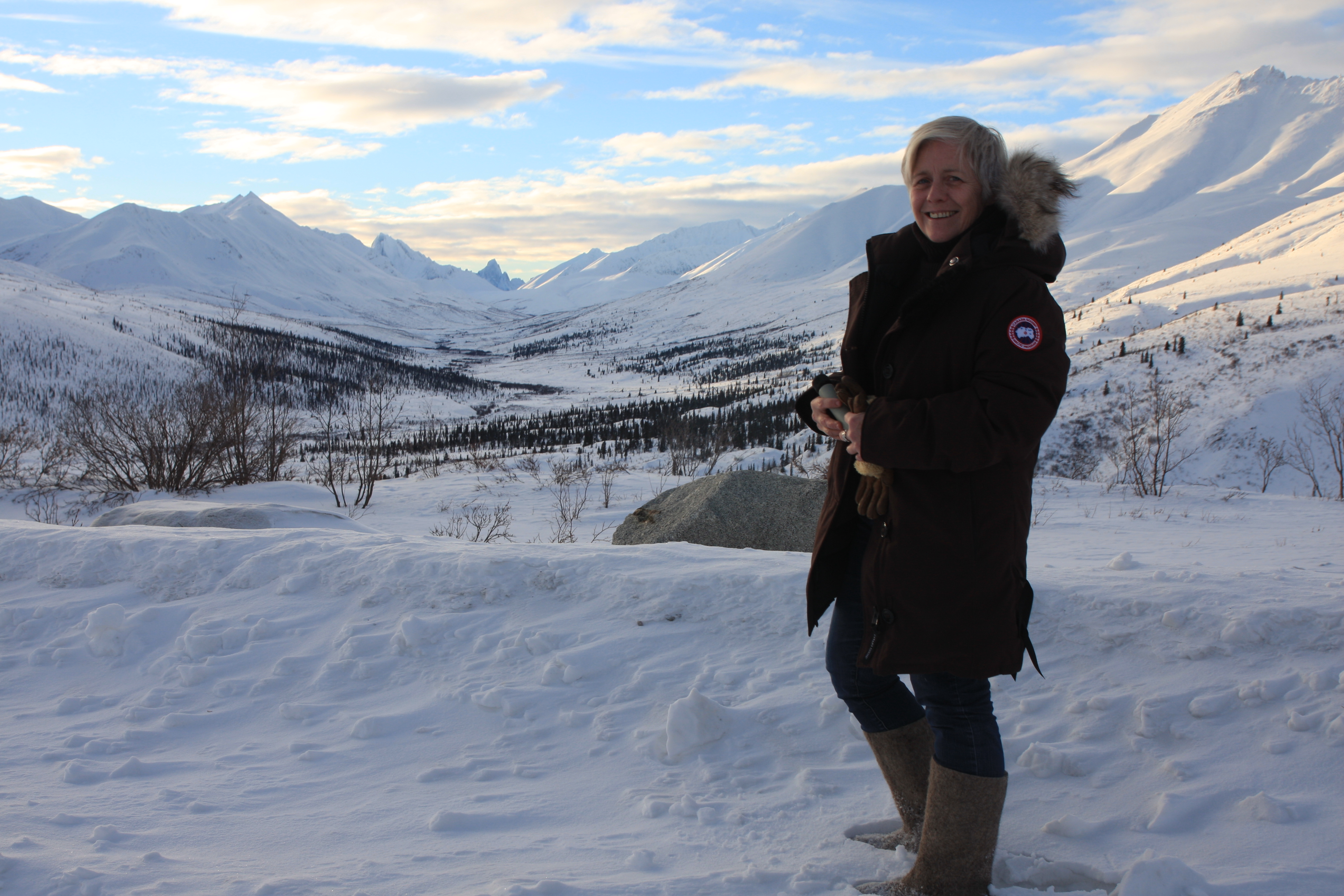
    On the wall above my desk in Montreal is a photograph taken in February at the Arctic Circle. The print is four feet wide by almost three feet high and foreground takes up most of that space. The horizon line is high on the print and marked by the Richardson mountains: white and treeless. It was -34C that day and my eyelashes froze together while I focussed the camera. In the foreground are the faint stains of a recent caribou kill, one hoof hidden amongst highbush cranberry and yellow grass poking out of the hard snow.

    ice lashes

    The perspective is deceiving. Trails of Black Spruce bisect the wide flat plain in middle distance and lead toward the base of the distant rounded mountains. Those peaks look close enough to touch, but they are many kilometres away.

    It is an image that encapsulates much of what I learned during my three-month residency at Berton House in Dawson City, Yukon.

    green over Berton House

    Berton House is owned and operated by the Writers’ Trust of Canada and each year four authors, supported by Canada Council grants, are chosen to spend three-month stints at the house. Residents do not have to teach or lecture, offer manuscript evaluation or coach emerging writers. In fact, they don’t even have to write while staying at the house. CanLit icon Pierre Berton, when gifting his house as a retreat, made that stipulation. He said, “the main purpose is not to let them write, but simply to give them time off from writing if they want it, or time off to think about writing or about the place they’re living in.” In the house are two binders of letters each resident has left for the next. Over the winter I spent a few hours reading what Lawrence Hill, Charlotte Gray, Joan Thomas, and the rest of the residents who’d come before me had to say. Some got a fair bit of work done. Others shut down Dawson’s bars nightly. Everyone left with something new: a stronger sense of their writing, the seed of a manuscript, suitcases of notes and ideas, friendships.

    swirl over 7th ave

    “The main purpose is not to let them write, but simply to give them time off from writing if they want it, or time off to think about writing or about the place they’re living in.”

    I landed in Dawson on December 23. When I stepped off the plane at 10:30 a.m. it was still too dark to see the tiny terminal building fifty feet away. My eyelashes froze—yeah, that happened a lot—and I immediately lost sight of my seatmate, a woman in a velour tracksuit who’d come to Dawson to “experience the Yukon winter.” Betty and Dan Davidson, part of the Berton House team, eventually found me in the crush of people inside the terminal. I was taken on a quick tour of town: “Here’s the curling rink. Do you curl?” I don’t. “Here’s the Anglican Church. Here’s the Baptist Church. Here’s the Catholic Church. Here’s the nondenominational worship house. Are you a churchgoer?” I am not.

    When they dropped me off at the house it was 12:30 p.m. and still too dark to see across the road. I watched the cloud of vapour left by their car’s tailpipe dissipate and sighed as the house settled around me, pipes banging as the heating system fired up. I was the seventy-fourth Berton House writer-in-residence, and I had the place all to myself. I didn’t know anyone living in that remote town. It would be dark for most of my stay (or so I was led to believe) and bitterly cold (or so it had been in the past). Alone in the cold and the dark, I would write reams.

    “I had the place all to myself. I didn’t know anyone living in that remote town.”

    The phone rang. I was invited to a Christmas Eve party and then to a Christmas potluck and then to a Boxing Day gathering and a New Year’s dinner. Did I know about the twice-weekly film festival screenings? Would I like to snowshoe up the Dome? Was I coming to the gallery opening and lecture next week?

    For a town of about 900 winter residents, Dawson was hard to keep up with.

    Initially the invitations arrived with an accompanying “don’t feel obliged, we know you’re here to write.” Initially, I agonized over the daily choices: write or hike, write or read, write or … and ground myself to a standstill over words that weren’t piling up. In my self-inflicted wracking I lost sight of why I write and nearly turned my prized three-month residency into the demise of my writing.

    “I agonized over the daily choices: write or hike, write or read, write or …”

    Raven angels

    But, at some point, I came to my senses and relearned something important. Perhaps it was the night I spent lying on my back on the frozen Yukon River hypnotized by the Northern Lights or while I was listening to Tr’ondëk Hwëch’in storytellers speak on the cultural importance of “story” or maybe when I stepped over the Arctic Circle. At some point I remembered that sometimes that thing which seems so close can’t be reached until one moves away from it.

    Sometimes to write good stories we have to stop trying to write.

    IMG_6713

    When I left Dawson the airport terminal was again packed, but this time I knew everyone. I came home with new friendships, more than one thousand photographs, and twenty-two thousand words towards a new book.


    IMG_5482

    Shelagh Plunkett is an award-winning writer and journalist living in Montreal. Her work has been published in various Canadian and American journals including The WalrusenRoute MagazineGeistThe Vancouver Sun and The Globe and Mail. In 2007 she won the CBC Literary Award for creative non-fiction and her memoir of growing up in Guyana and on Timor, Indonesia, The Water Here is Never Blue, was short listed for the Mavis Gallant Prize for Non-Fiction and the Concordia University First Book Prize. She has just returned south after three months in Dawson City, Yukon as the Writers’ Trust Berton House writer-in-residence and is now in the thick of a new manuscript tentatively titled Caught By All That’s Come Before. Follow Shelagh on Twitter and Instagram @shelaghplunkett. shelaghplunkett.wordpress.com

    Photos: Shelagh Plunkett

  • That Sense of Not Belonging by Adam Leith Gollner

    That Sense of Not Belonging by Adam Leith Gollner

    The Quebec Writers’ Federation hosted its 17th annual gala on November 18, 2015. Author Adam Leith Gollner opened the ceremony with this remarkable meditation on how a writer seesaws between isolation and community, and on what it means to be a writer, right here, right now.

    (more…)