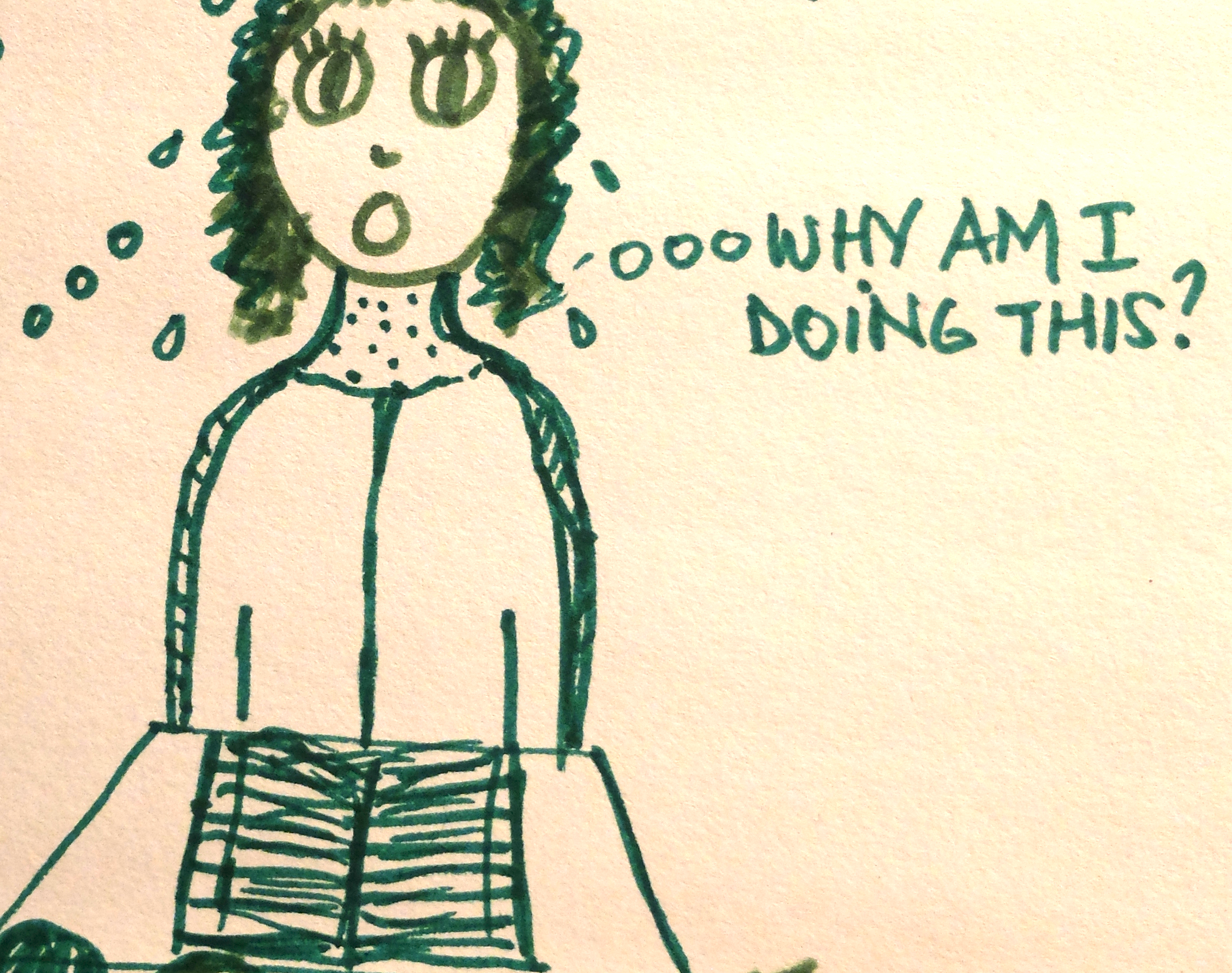
Giving public readings is crucial to establishing oneself as an emerging writer. After attending a diverse array of Quebec Writers’ Federation (QWF) workshops—from food and travel writing to literary fiction—it became clear that regardless of the writing genre, workshop leaders often proffered those same words of advice. For years, I avoided ‘open mic’ nights. I slid under the table when called upon to read. In my defense, I am not alone in the belief that any form of public speaking is nightmare-inducing—regardless of the circumstances. Introverted, I’d always hoped that becoming a writer would require less speaking and more silent solitude.
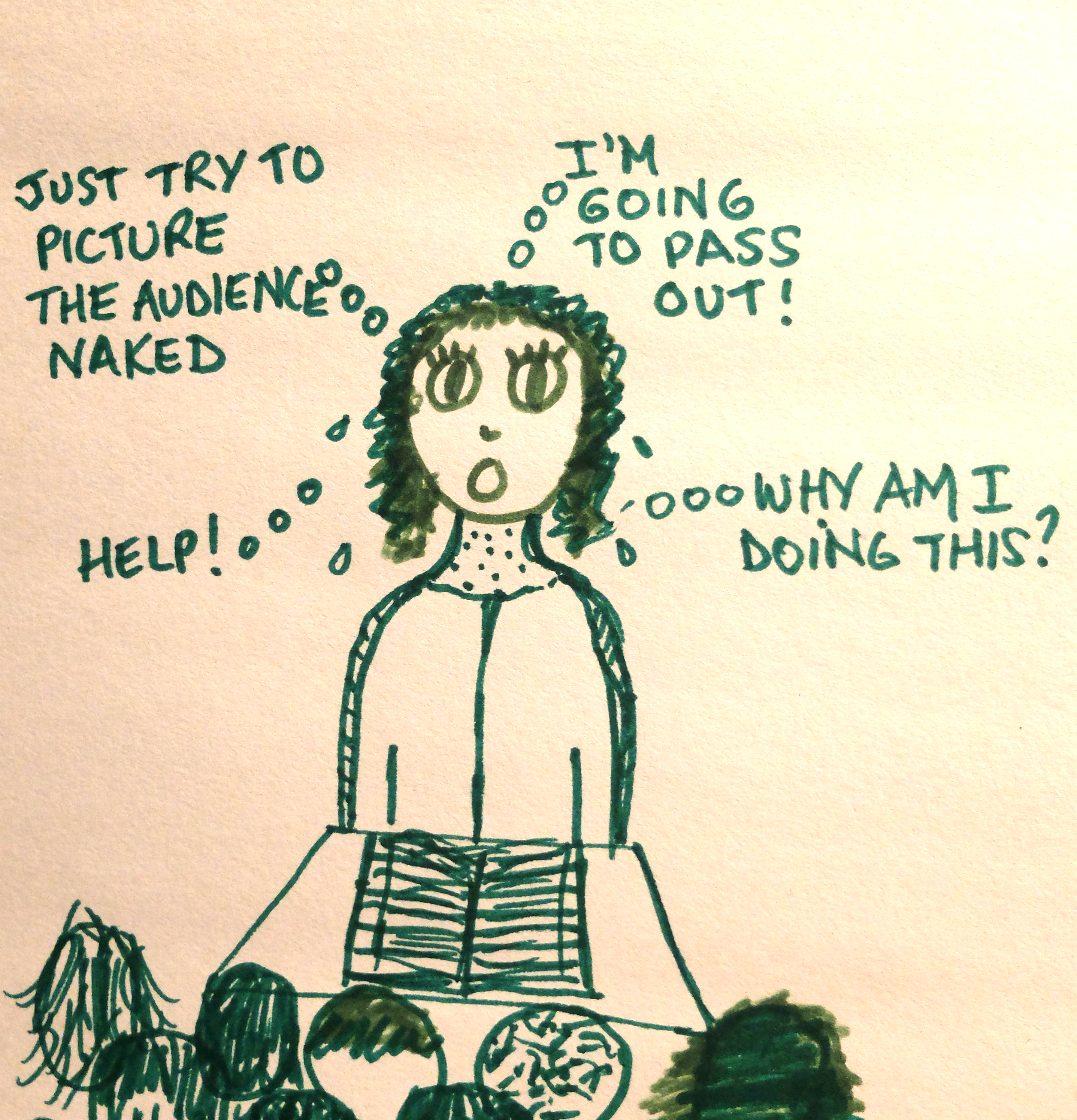 Unlike the act of writing, which allows for the deletion of words before they’re read, speaking before a live audience isn’t as forgiving. There’s no delete button one can press to make oneself disappear.
So, uncharacteristically, when one of my flash fiction pieces was recently published in the My Island, My City chapbook, I accepted the invitation to read it at a gala. Since proceeds from the event would benefit the QWF’s Writers in the Community program, I reasoned that service to the cause was far more important than my own aversion to public speaking.
As I was about to leave the house on the night of the gala, my face suddenly bloated like a pufferfish, my neck erupted in itchy hives, and my nose bled. Apparently, my anxiety about the reading was manifesting itself physically.
“How can you be nervous? It’s a flash fiction story that will take you forty-eight seconds to read!” my partner said after I’d gently dissuaded him from joining me. Why was I so nervous? I was honored to be involved in the charitable event!
Then, when a roadblock prevented my cab driver from turning on de Maisonneuve Boulevard, he stopped the car. “Walk from here!” he firmly suggested. Too anxiety-ridden to protest, I passively agreed. The moment I exited the vehicle, a freak snowstorm hit. Within seconds, my freshly-coiffed hair was drenched.
Along the closed street, massive pieces of concrete lay strewn about. People loitered, examining the detritus.
Inspired by the scene, I compiled mental notes for a future work of fiction.
I then realized that my imagination was partially to blame for my current state of anxiety—If not for my vivid imagination, I wouldn’t be compelled to write. If I didn’t write, I wouldn’t have to worry about giving public readings.
After wiping a snowflake from my eye, I discovered that my black mascara and eyeliner were not as waterproof as advertised.
Looking like a wet raccoon, I cut through Westmount Park, which was eerily desolate save for a lone teenaged boy smoking under a snow-covered gazebo.
I paused briefly to scratch my hives.
I reflected upon traumatic incidents from my past that contributed to my fear of appearing before an audience: during a figure skating competition in my teens, someone clapped after I completed a movement that was undeserving of applause. I scanned the audience, only to discover the culprit was my father. Distracted by his misplaced burst of applause, I fell. (Needless to say, I didn’t win that competition). From then on, I dissuaded (nay, banned) family members from attending any competitions or events that required me to appear in front of an audience. That longstanding ban has carried over to include my partner and friends.
When a recipe of mine was included in a cookbook, I was invited to prepare it on live TV during a pledge drive to benefit public television. Nervous during the shoot, I momentarily lost my ability to speak and instead, flapped my arms in a futile attempt to generate words.
Finally, I arrived at the gala venue. Soaking wet, freezing, hive-covered, my makeup smeared, my face bloated, and blood caking in my nose. While attempting to compose myself in the foyer of the church hall, I was shocked to see one of my friends enter the building. “Surprise!” she squealed upon seeing me. Moments later, another good friend showed up unexpectedly. Both explained that upon seeing my name in the ad, they’d reserved tickets to support me (and the cause)!
Chatting with them, I gradually felt my fear dissipate. Believing that friends and family were stress-inducing distractions had been a mistake. The opposite was true! Their supportive presence was comforting.
After my reading, I returned to sit with my friends in the audience, relieved that I hadn’t thoroughly embarrassed myself. Courtesy of the resulting adrenalin rush, I contemplated the advice of my writing mentors. I decided I would bravely endeavor to give public readings in the hopes of becoming an emerging writer.
My thoughts were interrupted when one of my friends gently tugged on my sleeve.
“Did you know that your sweater is on inside out?” she giggled.
 Renée Cohen is a freelance writer for numerous international charitable organizations. Her personal essays, prose, and flash fiction have appeared in Accenti Magazine, Prairie Fire, Litro UK, The Globe and Mail, the Montreal Gazette, Reader’s Digest, Zvona i Nari’s ZiN Daily, Croatia, and in numerous volumes of the Canadian Authors Association anthologies, in the My Island, My City chapbook, and elsewhere. Her artwork has been exhibited in group and solo shows and featured in Montreal Writes Literary Magazine, Headlight 22, 3Elements Review, Spadina Literary Review, Flash Frontier New Zealand, and Sonic Boom Journal (India). She recently won The Fieldstone Review’s Banner Art Competition.
Photo credits: Renée Cohen (header image); Y. Pelletier (headshot)

 April Ford is a genderfluid author living in Montreal, Quebec with her rescue family. Her fiction, poetry, and essays have appeared in print and online journals in Canada, the United States, Mexico, Germany, and Scotland. She is the recipient of a Pushcart Prize for her short story “Project Fumarase,” and has held fully-funded residencies at Virginia Center for the Creative Arts and Ucross Foundation. Her books include Death Is a Side-Effect: Poems (Frog Hollow Press, 2019) and the award-winning story collection, The Poor Children (SFWP, 2015). Her debut novel, Carousel, is forthcoming in Spring 2020 with Inanna Publications.

