Tag: humour

  • The Art of Embarrassing Oneself at Public Readings—By Renée Cohen

    The Art of Embarrassing Oneself at Public Readings—By Renée Cohen

    Giving public readings is crucial to establishing oneself as an emerging writer. After attending a diverse array of Quebec Writers’ Federation (QWF) workshops—from food and travel writing to literary fiction—it became clear that regardless of the writing genre, workshop leaders often proffered those same words of advice. For years, I avoided ‘open mic’ nights. I slid under the table when called upon to read. In my defense, I am not alone in the belief that any form of public speaking is nightmare-inducing—regardless of the circumstances. Introverted, I’d always hoped that becoming a writer would require less speaking and more silent solitude.
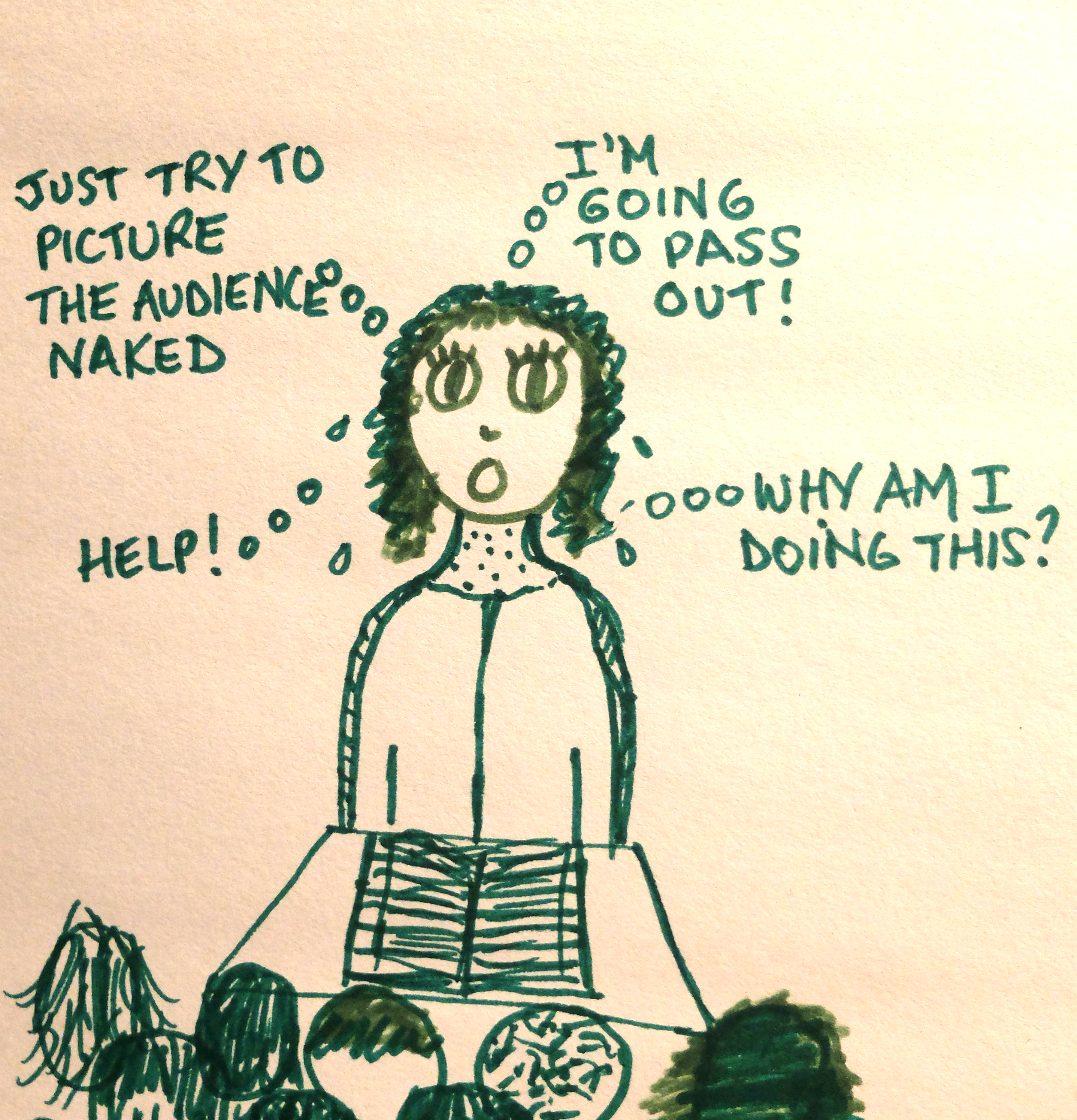
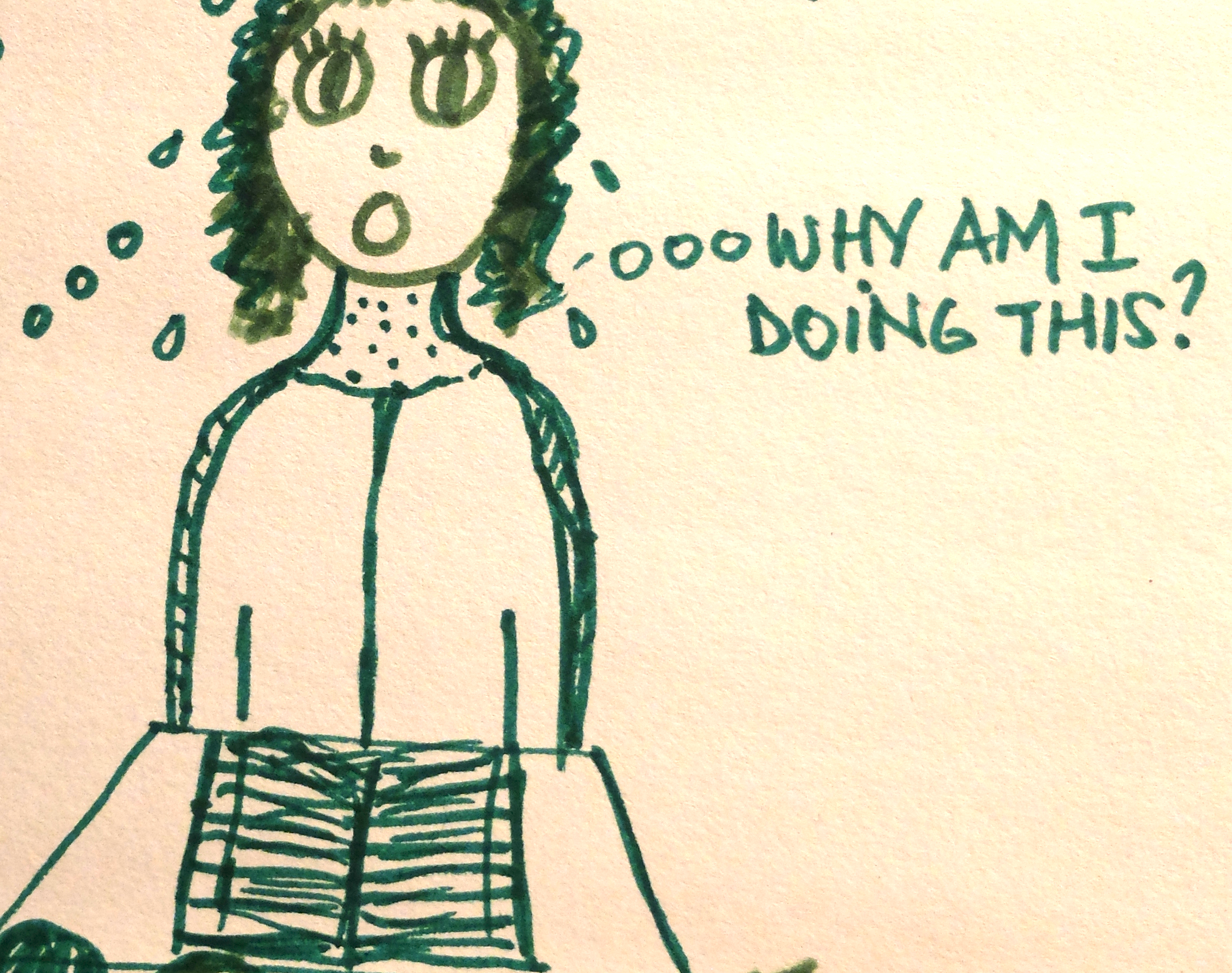
    *Embarrassment and Bloating Cartoon R. CohenUnlike the act of writing, which allows for the deletion of words before they’re read, speaking before a live audience isn’t as forgiving. There’s no delete button one can press to make oneself disappear.

    So, uncharacteristically, when one of my flash fiction pieces was recently published in the My Island, My City chapbook, I accepted the invitation to read it at a gala. Since proceeds from the event would benefit the QWF’s Writers in the Community program, I reasoned that service to the cause was far more important than my own aversion to public speaking.

    As I was about to leave the house on the night of the gala, my face suddenly bloated like a pufferfish, my neck erupted in itchy hives, and my nose bled. Apparently, my anxiety about the reading was manifesting itself physically.

    “How can you be nervous? It’s a flash fiction story that will take you forty-eight seconds to read!” my partner said after I’d gently dissuaded him from joining me. Why was I so nervous? I was honored to be involved in the charitable event!

    Then, when a roadblock prevented my cab driver from turning on de Maisonneuve Boulevard, he stopped the car. “Walk from here!” he firmly suggested. Too anxiety-ridden to protest, I passively agreed. The moment I exited the vehicle, a freak snowstorm hit. Within seconds, my freshly-coiffed hair was drenched.

    Along the closed street, massive pieces of concrete lay strewn about. People loitered, examining the detritus.

    Inspired by the scene, I compiled mental notes for a future work of fiction.

    I then realized that my imagination was partially to blame for my current state of anxiety—If not for my vivid imagination, I wouldn’t be compelled to write. If I didn’t write, I wouldn’t have to worry about giving public readings.

    After wiping a snowflake from my eye, I discovered that my black mascara and eyeliner were not as waterproof as advertised.

    Looking like a wet raccoon, I cut through Westmount Park, which was eerily desolate save for a lone teenaged boy smoking under a snow-covered gazebo.

    I paused briefly to scratch my hives.

    I reflected upon traumatic incidents from my past that contributed to my fear of appearing before an audience: during a figure skating competition in my teens, someone clapped after I completed a movement that was undeserving of applause. I scanned the audience, only to discover the culprit was my father. Distracted by his misplaced burst of applause, I fell. (Needless to say, I didn’t win that competition). From then on, I dissuaded (nay, banned) family members from attending any competitions or events that required me to appear in front of an audience. That longstanding ban has carried over to include my partner and friends.

    When a recipe of mine was included in a cookbook, I was invited to prepare it on live TV during a pledge drive to benefit public television. Nervous during the shoot, I momentarily lost my ability to speak and instead, flapped my arms in a futile attempt to generate words.

    Finally, I arrived at the gala venue. Soaking wet, freezing, hive-covered, my makeup smeared, my face bloated, and blood caking in my nose. While attempting to compose myself in the foyer of the church hall, I was shocked to see one of my friends enter the building. “Surprise!” she squealed upon seeing me. Moments later, another good friend showed up unexpectedly. Both explained that upon seeing my name in the ad, they’d reserved tickets to support me (and the cause)!

    Chatting with them, I gradually felt my fear dissipate. Believing that friends and family were stress-inducing distractions had been a mistake. The opposite was true! Their supportive presence was comforting.

    After my reading, I returned to sit with my friends in the audience, relieved that I hadn’t thoroughly embarrassed myself. Courtesy of the resulting adrenalin rush, I contemplated the advice of my writing mentors. I decided I would bravely endeavor to give public readings in the hopes of becoming an emerging writer.

    My thoughts were interrupted when one of my friends gently tugged on my sleeve.

    “Did you know that your sweater is on inside out?” she giggled.


    Pic. Cohen_Y. PelletierRenée Cohen is a freelance writer for numerous international charitable organizations. Her personal essays, prose, and flash fiction have appeared in Accenti MagazinePrairie Fire, Litro UK, The Globe and Mail, the Montreal Gazette, Reader’s DigestZvona i Nari’s ZiN Daily, Croatia, and in numerous volumes of the Canadian Authors Association anthologies, in the My Island, My City chapbook, and elsewhere. Her artwork has been exhibited in group and solo shows and featured in Montreal Writes Literary Magazine, Headlight 22, 3Elements Review, Spadina Literary Review, Flash Frontier New Zealand, and Sonic Boom Journal (India). She recently won The Fieldstone Review’s Banner Art Competition.

    Photo credits: Renée Cohen (header image); Y. Pelletier (headshot)

  • Dear Everyone I’ve Ever Known: Thank You. This Book Is Dedicated to You.—By April Ford

    Dear Everyone I’ve Ever Known: Thank You. This Book Is Dedicated to You.—By April Ford

    I’m two seasons away from the release of my debut novel. This will actually be my third book publication, yet there are elements of the publishing process that still intimidate me. Two I believe I’ve mastered by now are how to dedicate a book, and how to thank people who’ve helped me along the way—“mastered,” that is, until I start imagining how Person A might feel when she doesn’t see her name on the “Acknowledgements” page even though she treated me to coffee during a rough patch in my life, or when I finally admit I don’t want to dedicate my debut novel to my ex-husband even though, while we were married, I said I would.

    For all the slow writers out there like myself—and this isn’t counting the time it takes for a book to go through the publishing process—a lot can happen between the first and final drafts. It can be startling to see how these changes manifest on paper, especially if you’ve told someone you’re going to mention them in your book but you change your mind. So while you’re fantasizing about eloquent dedications and thorough acknowledgements (a fun and necessary exercise), why not keep a list to help you remember whom to thank and whom not to thank? There will always be someone’s name you add to the list and then remove. And then add again out of guilt. Seeing this name next to the ones you’re 100 percent certain you want to thank might clear your doubt. Update the list as needed, right up until the day your publisher asks for the final iteration. And do not to show it to anyone before your book is published. This is your list. Writing the book was your experience. You owe no explanation for why you did or didn’t thank someone, in the end.

    Being a writer means skillfully riding the constant waves of people’s ideas about what a writer is, does, and how we do it. For example, a past partner of mine used to urge me to write whenever I felt unhappy. He couldn’t seem to accept that it was the last thing on earth I wanted to do when I was troubled (it’s when I produce my most unsalvageable work), and he seemed truly dissatisfied by the fact that I don’t write every day. I wasn’t adhering to his vision of the writer’s life and how he might play a role in it—later to be thanked. It’s worth considering people’s motivations when you’re crafting dedications and acknowledgements. No matter how thoughtfully you execute those pages, there will always be someone who feels slighted for not receiving public recognition from you. While in your mind, all Person B did was occasionally ask you questions about the book you’d been writing “forever,” in Person B’s view, they supported you by expressing ongoing interest in your work (but mostly talked at length about themselves, their darling children, and their even darlinger Shih-Poo named Ackerly).

    Historically, the dedication page was a siren’s call to potential benefactors. Writers dedicated their works to significant public figures and sometimes even entire cities, with the goal of attracting funding for their future publishing endeavors. Today’s dedication page is more of a forum for displays of affection (“For my spouse and children: You are my life.”) or an opportunity for the author to give readers an intimate glimpse of their personality by acting as a micro-autobiography (“I dedicate this novel to my iguana, because why not?”). When it was time for me to dedicate my short story collection, my then-husband graciously helped me brainstorm (it didn’t make sense to dedicate the book to him, since I had started it years before we met). Together we came up with “for the poor children,” the title of the collection, which sets an ironic, somewhat glib tone—and as it turns out, I’m a somewhat glib person who uses irony to process the world around me.

    The “Acknowledgements” page is a demonstration of good literary citizenship. Here, you thank people by order of importance, starting with your agent (if you have one), editor, designer, publicist. Without these hardworking allies, your book would still be a MS Word file. You want to also mention sources of funding you received while you worked on the manuscript, public readings you gave from your book to be, extracts (poem, story, essay, chapter) that were published elsewhere, and peers who read and critiqued your work. Then you can start on that fantasy list you’ve been keeping! In the case of my forthcoming novel, I’m attempting to make amends for not dedicating it to my ex-husband by thanking him high up on the page, right after my publishing team and before everyone else. Were his feelings hurt when I first told him about my change of heart? Of course. We had a long conversation about it by telephone and this was when I gained a deeper appreciation for the responsibility that comes with writing dedication and acknowledgements pages: they’re meaningful and symbolic not only to the author but also to those mentioned—and to those not mentioned. 


    Nicolas01April Ford is a genderfluid author living in Montreal, Quebec with her rescue family. Her fiction, poetry, and essays have appeared in print and online journals in Canada, the United States, Mexico, Germany, and Scotland. She is the recipient of a Pushcart Prize for her short story “Project Fumarase,” and has held fully-funded residencies at Virginia Center for the Creative Arts and Ucross Foundation. Her books include Death Is a Side-Effect: Poems (Frog Hollow Press, 2019) and the award-winning story collection, The Poor Children (SFWP, 2015). Her debut novel, Carousel, is forthcoming in Spring 2020 with Inanna Publications. www.aprilfordauthor.com

    Photo credits: “Cliche: Have a Heart”by Carol (vanhookc) is licensed under CC BY-SA 2.0 (header image); Bernardo Fernandez, Verdun, Quebec, 2019 (headshot)

  • Gadfly at the Festival by Peter Richardson

    Gadfly at the Festival by Peter Richardson

    In the hospitality room at the Hôtel Gouverneurs in Trois-Rivières, you are greeted by two perky volunteers whose first question after introductions is: “Will you three be reading the French translations of your poems yourselves, or will you be requiring the services of a French reader?” Oh, my, you think. What translations? The hotel carpet begins to yaw under your chair. What was I thinking coming to a poetry festival in a city whose population is 97 percent French—without translations?

    Ahhh,” your hand goes up, feigning nonchalance, “I don’t have any translations with me.” The two other English-language poets and the volunteers swivel their heads in your direction as if you had just morphed into a large red crustacean whose claws and antennae waved merrily in their direction. “Can I give a short explanation of my poems in fluent French and then read them in English?” One of the cordial volunteers laces her fingers together and lowers her voice: “You see, people reserve restaurant tables months ahead to hear our guests read in French. It would be unfair, don’t you think, to subject them to English, when most people here rarely speak it?”

    How could you have not foreseen this eventuality? For the next twenty-four hours, you huddle with a hotel dictionary, churning out translations and cross-checking these with your translator sweetheart via long distance telephone. You thank fate that years before, you earned a university certificate in French-English translation. Although that hardly qualifies you as an ace in Gallic syntax, it limits the number of world-class howlers you’re likely to churn out. You are going to have to revise up to the wire. And once a reading is finished, there will be no stopping off for sparkling conversation with fellow scribes in downtown Trois-Rivières. It’ll be back to your room to crank out more translations. There are four readings a day in restaurants, bars, parks, and libraries; you’ll have to furnish two poems, four times a day.

    Accordingly, you show up for each venue as if this were a lark, your fraudulent grin assuring audiences that you’re dishing up the real thing, the slaved-over equivalents they’ve come to expect. The rest of the time you are a mole, looking up words like “dip” or “wobble” in a battered Robert-Collins. At readings, you unfold two sheets of spiral notebook paper and smile at your hash-marked, arrow-filled texts as if it were normal to achieve verbal legerdemain with the French versions overnight.

    You can’t point to the Russian poet, Evgeny Tchigrinne, huddling by the hotel elevator in a rumpled hockey team manager’s parka, and say to his interpreter companion: “It’s not fair. He should have to read his stuff in French too.” You can’t complain that Andrés Morales—one of the leading poetic lights in Chile, a man who also speaks Croatian and English—should be prevailed upon to read his translator’s French versions. His credentials precede him, and plus, with his dark suits, Brylcreemed hair, and killer smile, he is a serious candidate for the festival’s Mr. Cordiality Award.

    “At readings, you unfold two sheets of spiral notebook paper and smile at your hash-marked, arrow-filled texts as if it were normal to achieve verbal legerdemain with the French versions overnight.”

    The other English-language poets seem like consummate professionals. The Canadian geneticist-poet, Jan Conn, for instance, looks you straight in the face and says: “Months ago, I commissioned someone to translate twenty of my poems. I knew I’d have to have this stuff ready. I practiced it for weeks.” When she says this, you feel as though you’ve been transported back to that fourth-grade field trip to the Hayden Planetarium in New York City, where, standing in the cafeteria’s lunch line, you reached into your pants pocket for change and pulled out pebbles. Earlier in the day, while waiting for your mother to drive you to school, fearing you would miss the bus from school to the planetarium, you found yourself scooping up pebbles and chucking them by the handful, and some of these found their way into your pockets. But so what if you’ve spent a lifetime picking nickels out of the pebbles in your pockets?

    Does it stop you from making interesting acquaintances? No. And your readings manage to clear those imaginary telephone wires at the opposite end of an airfield that is a reader’s five minutes at the microphone. Your cloth-and-wire craft ascends. It swoops up to a reasonable height in the short runway’s space over the tilted beer glasses and stilled bar chatter and its undercarriage avoids calamity. But without good conversational French, without a chameleon-like ability to don an entertainer’s alter ego at brasserie readings, without a knack for chuckling your way through introductions which contain a reference to the dog-eared papers you clutch, you shudder to think how this forty-eight-hour period might have transpired, and how close you came to earning the title: Worst Anglo Festival Invitee Ever.


    IMG_1483Peter Richardson is the author of four collections of poetry: A Tinkers’ Picnic (1999), finalist for the Gerald Lampert Award; An ABC of Belly Work (2003), short-listed for the Acorn-Plantos Award; Sympathy for the Couriers (2007), winner of the QWF’s 2008 A. M. Klein Award; and Bit Parts for Fools (2013), which was short-listed for the Archibald Lampman Award. A retired airline worker, he lives in Gatineau, Quebec.

    Photo: Via Flickr; no changes made (top); Martine Chapdelaine (headshot)

    Peter Richardson, Jan Conn, and a small group of other authors will be reading on April 11, 2016 at the launch party of Vallum Magazine‘s Issue 13:3. The Brass Door Pub (2171 Crescent Street, Montreal), 7:30 p.m.