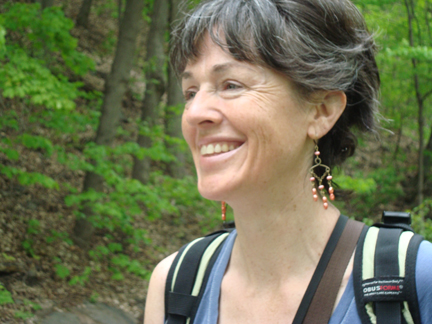
Tag: inspiration

  • Finding Perspective: Writing in the Dark at Berton House by Shelagh Plunkett

    Finding Perspective: Writing in the Dark at Berton House by Shelagh Plunkett

    On the wall above my desk in Montreal is a photograph taken in February at the Arctic Circle. The print is four feet wide by almost three feet high and foreground takes up most of that space. The horizon line is high on the print and marked by the Richardson mountains: white and treeless. It was -34C that day and my eyelashes froze together while I focussed the camera. In the foreground are the faint stains of a recent caribou kill, one hoof hidden amongst highbush cranberry and yellow grass poking out of the hard snow.

    ice lashes

    The perspective is deceiving. Trails of Black Spruce bisect the wide flat plain in middle distance and lead toward the base of the distant rounded mountains. Those peaks look close enough to touch, but they are many kilometres away.

    It is an image that encapsulates much of what I learned during my three-month residency at Berton House in Dawson City, Yukon.
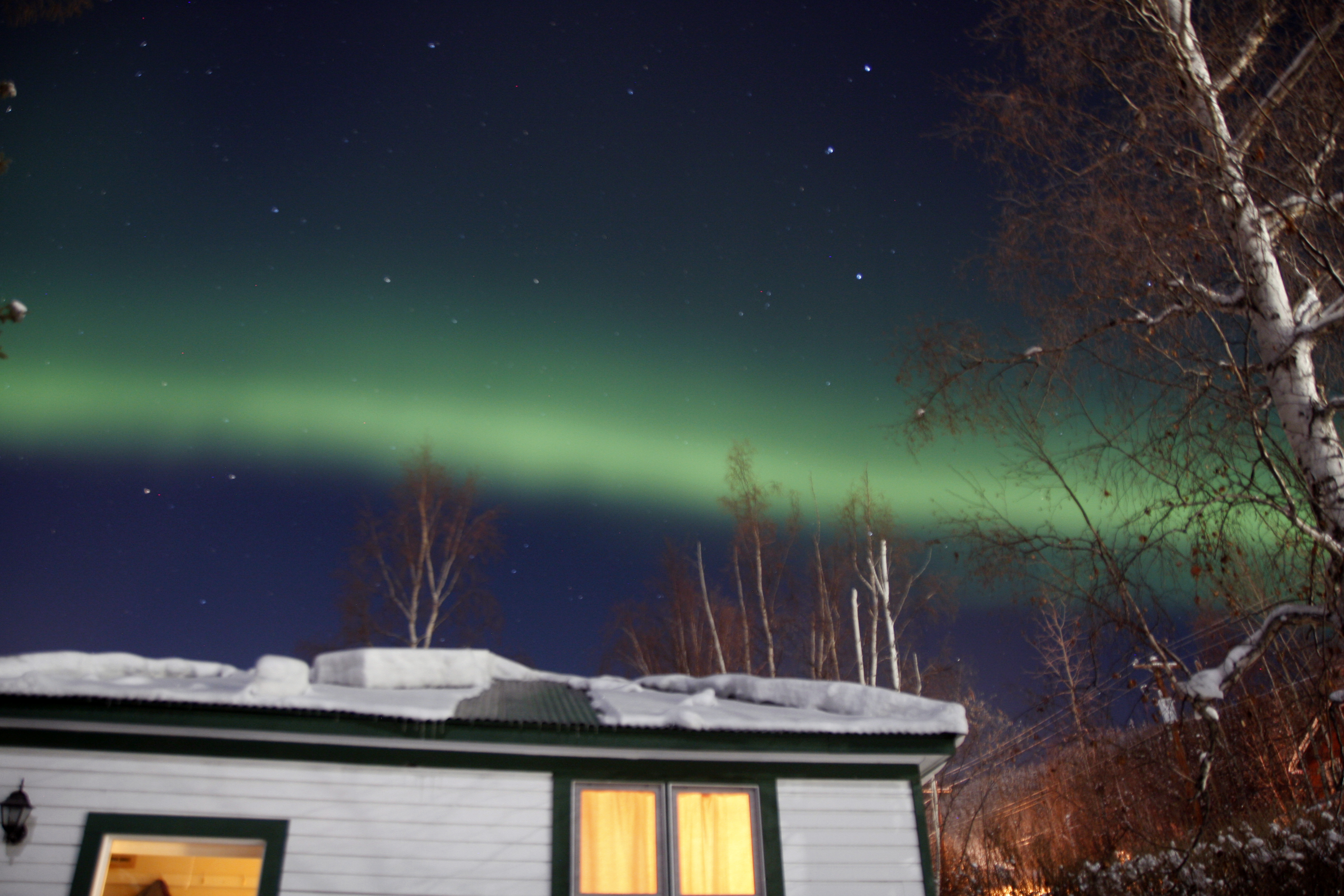
    green over Berton House

    Berton House is owned and operated by the Writers’ Trust of Canada and each year four authors, supported by Canada Council grants, are chosen to spend three-month stints at the house. Residents do not have to teach or lecture, offer manuscript evaluation or coach emerging writers. In fact, they don’t even have to write while staying at the house. CanLit icon Pierre Berton, when gifting his house as a retreat, made that stipulation. He said, “the main purpose is not to let them write, but simply to give them time off from writing if they want it, or time off to think about writing or about the place they’re living in.” In the house are two binders of letters each resident has left for the next. Over the winter I spent a few hours reading what Lawrence Hill, Charlotte Gray, Joan Thomas, and the rest of the residents who’d come before me had to say. Some got a fair bit of work done. Others shut down Dawson’s bars nightly. Everyone left with something new: a stronger sense of their writing, the seed of a manuscript, suitcases of notes and ideas, friendships.

    swirl over 7th ave

    “The main purpose is not to let them write, but simply to give them time off from writing if they want it, or time off to think about writing or about the place they’re living in.”

    I landed in Dawson on December 23. When I stepped off the plane at 10:30 a.m. it was still too dark to see the tiny terminal building fifty feet away. My eyelashes froze—yeah, that happened a lot—and I immediately lost sight of my seatmate, a woman in a velour tracksuit who’d come to Dawson to “experience the Yukon winter.” Betty and Dan Davidson, part of the Berton House team, eventually found me in the crush of people inside the terminal. I was taken on a quick tour of town: “Here’s the curling rink. Do you curl?” I don’t. “Here’s the Anglican Church. Here’s the Baptist Church. Here’s the Catholic Church. Here’s the nondenominational worship house. Are you a churchgoer?” I am not.

    When they dropped me off at the house it was 12:30 p.m. and still too dark to see across the road. I watched the cloud of vapour left by their car’s tailpipe dissipate and sighed as the house settled around me, pipes banging as the heating system fired up. I was the seventy-fourth Berton House writer-in-residence, and I had the place all to myself. I didn’t know anyone living in that remote town. It would be dark for most of my stay (or so I was led to believe) and bitterly cold (or so it had been in the past). Alone in the cold and the dark, I would write reams.

    “I had the place all to myself. I didn’t know anyone living in that remote town.”

    The phone rang. I was invited to a Christmas Eve party and then to a Christmas potluck and then to a Boxing Day gathering and a New Year’s dinner. Did I know about the twice-weekly film festival screenings? Would I like to snowshoe up the Dome? Was I coming to the gallery opening and lecture next week?

    For a town of about 900 winter residents, Dawson was hard to keep up with.

    Initially the invitations arrived with an accompanying “don’t feel obliged, we know you’re here to write.” Initially, I agonized over the daily choices: write or hike, write or read, write or … and ground myself to a standstill over words that weren’t piling up. In my self-inflicted wracking I lost sight of why I write and nearly turned my prized three-month residency into the demise of my writing.

    “I agonized over the daily choices: write or hike, write or read, write or …”

    Raven angels

    But, at some point, I came to my senses and relearned something important. Perhaps it was the night I spent lying on my back on the frozen Yukon River hypnotized by the Northern Lights or while I was listening to Tr’ondëk Hwëch’in storytellers speak on the cultural importance of “story” or maybe when I stepped over the Arctic Circle. At some point I remembered that sometimes that thing which seems so close can’t be reached until one moves away from it.

    Sometimes to write good stories we have to stop trying to write.
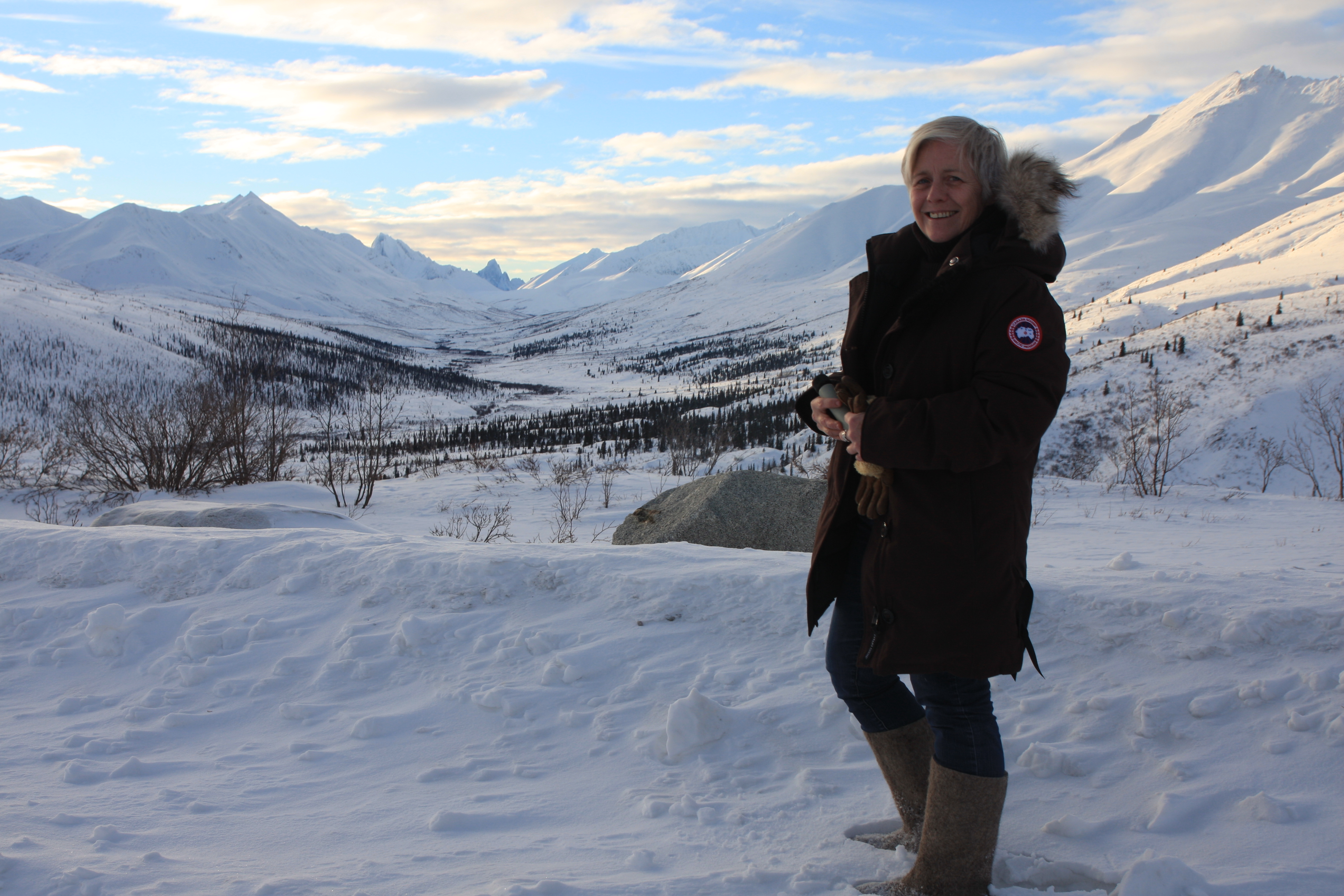
    IMG_6713

    When I left Dawson the airport terminal was again packed, but this time I knew everyone. I came home with new friendships, more than one thousand photographs, and twenty-two thousand words towards a new book.


    IMG_5482

    Shelagh Plunkett is an award-winning writer and journalist living in Montreal. Her work has been published in various Canadian and American journals including The WalrusenRoute MagazineGeistThe Vancouver Sun and The Globe and Mail. In 2007 she won the CBC Literary Award for creative non-fiction and her memoir of growing up in Guyana and on Timor, Indonesia, The Water Here is Never Blue, was short listed for the Mavis Gallant Prize for Non-Fiction and the Concordia University First Book Prize. She has just returned south after three months in Dawson City, Yukon as the Writers’ Trust Berton House writer-in-residence and is now in the thick of a new manuscript tentatively titled Caught By All That’s Come Before. Follow Shelagh on Twitter and Instagram @shelaghplunkett. shelaghplunkett.wordpress.com

    Photos: Shelagh Plunkett

  • A Café of One’s Own by Deborah Murray

    I love to write in the mornings. With breakfast finished and my son off to school, I look forward to playing with words, a turn of phrase, an unfolding story. Distraction, though, can thwart my best intentions.

    When I am about to sit down and write, I’ll do the dishes, the laundry or any other household task begging for my attention. Once I do sit down, the wobble of my chair or the pitter-patter echo of the toddler downstairs seeps deep into my consciousness. Distraction can be insidious. When settling in proves a dismal failure, I know to pack my bag and venture out to find inspiration at a local café.

    “Distraction can be insidious. When settling in proves a dismal failure, I know to pack my bag and venture out to find inspiration at a local café.”

    In my neighborhood, there are many cafés that fit the bill. There are independently run cafés for the “shop local” crowd, and fair-trade cafés for the environmentally conscious. Parisian-style cafés have their lure, and fast-food dark roasts vie with hip whipped lattes to quench any caffeine craving. One greasy spoon will let you while away a few hours with free refills if you order something to eat. There’s the cash-only café, another that refuses to offer Wi-Fi and a tiny patisserie that charges you 20% extra to sit in.

    I have days when I pass up more than one before walking in. I can even get inside and decide: no, not here, not today. Sometimes it’s the coffee: too bitter, too weak. Sometimes it’s the atmosphere, too trendy, too quiet, too empty, too full. But eventually, the pressure of time to get something, anything, written will suck me into the nearest door.

    To write in, I like a cafe with wooden floors, high ceilings and tables with ample space. Once committed, I make the place my own. I give myself over to a familiar wafting aroma. I order an Americano, no milk, no sugar please. I arrange my piping hot coffee and writing accoutrements on my “desk,” and then I take in the sounds around me. An espresso maker sputters and whirs to an undercurrent of percussion-driven electronic beats and the indiscernible vocalizations of a female singer. Voices murmur, mostly in French, some in English and a spattering of other languages, about travel plans, relationships in crisis, business.

    Distractions, yes, but I am not compelled to do anything about them. They become a backdrop, an entryway into an ongoing narrative. I listen to the tap-tapping sounds around me of others engaged in their own interior monologues and I, finally, begin mine.


    Deborah MurrayDeborah Murray is an editor and playwright’s assistant. Finding the time and means to write is her ongoing occupation.

  • Nature’s Way of Getting Books Written by Raquel Rivera

     A couple of years ago I was cycling around the ex-garbage dump that is the St-Michel Environmental Complex in Montreal North, collecting details for a scene in my novel.

    I pedaled across the street from the Complex’s Cirque du Soleil headquarters, and peered through the windows of the National Circus School. Inside was a highly padded gym-like space, full of pulleys and ropes – and some very fit teenagers. Not wanting to be taken for a peeping-creep, I dashed around to the front reception and asked if they offered tours.

    I attended the school’s open house the following week, hoping to gather useful tidbits to feather my scene’s nest. As it happens, I was also stepping into my next crazy-making topic of all-consuming passion: a creative non-fiction book for children, featuring the lives of students at the National Circus School. My next Great Idea.

    I surprised myself as I blustered my way into the institution through emails, meetings and follow-up proposals. They had a responsibility to share their story with the world, I insisted. The guilt-trip finally seemed to convince the school’s extremely busy (and intimidating) directors. They were swayed by my conviction: this was a Great Idea.

    Everyone will want to read about these young superheroes, facing down risk and their own limits every day. They’ll be charmed by the gaspésien who left home to pursue juggling. They’ll be impressed by that skinny little twelve-year-old who boards at the school, so he can train twenty hours a week in addition to his full academic schedule. Readers will gasp as the eighth-grader makes her first tightwire jump; they’ll wince as the cruel wire tries to bisect her feet. Ultimately, just like me, readers will be fascinated by an inside peek at the tremendous efforts these young people make so that their performances can look easy to the rest of us.

    Topsy-turvy
    Topsy-turvy: You don’t need to turn yourself inside-out trying to sell a beloved manuscript – it just feels that way sometimes.

    As I began my visits and interviews, “Why not?” seemed to be the motto of the school. It’s what they tell one another in response to every new and impossible notion. (Stand on your partner’s shoulders, jump into a back flip and land back on – why not? Now do it en pointe, in ballet toe-shoes – why not?)

    “Why not?” It’s what the aerial instructor said when I asked if someone like me (old and untrained) might learn rope. I signed up for aerial classes at my local community centre and, week after demoralizing week, was the sole student unable to pull herself off the ground. Yet somehow, when it was finally over, I signed up with a private trainer at a circus studio and carried on. If nothing else, my acrobatics training would make me better equipped to relay The Great Idea to a waiting world. Publishers would scramble for my original material, appreciating its historic value and the uplifting message that we may achieve the impossible, whatever that means to each of us. This Great Idea was a winner – a shoo-in.

    Now I’m thinking, passionate belief like this is just nature’s way of getting books written. I wish it got them published, too.

    But that’s the other part of the writing life: when I gain new perspective on The Great Idea. Over lunch, one editor speculated on the cost of producing my full-colour, fully illustrated Idea. Responses came in from more editors: “The circus school certainly seems like an interesting place,” (but no thanks). “I loved your proposal, but that wasn’t enough to convince the powers that be.” Passion died, and determination stepped up, struggling against quaking doubt. Would anyone want my Great Idea? Would it receive the blessings of timing and dumb luck that brought past manuscripts to print? Or had my portion of blessings run out?

    At this stage, keeping faith is huge: you have to believe that one day all this thinking and writing will be a real book. This requires that my ears and my mind stay open – and that I conserve effort, to avoid burnout. I listen to feedback; I try to be flexible because The Great Idea deserves to be among readers. But there’s any number of great ideas floating around out there, looking for a publisher. (Which is actually a comfort, when I’m feeling more mature.)

    throw2catchduotissu
    Julie gives Natalia a hand during warm-ups for RESET, the latest show by acrobatic troupe THROW2CATCH

    Maybe this pause in progress (I won’t call it a halt) is a necessary stage in the forging process. Maybe it will shape up my Idea and make it stronger. I remind myself of the reason these circus kids inspire me so – they push their limits, they never give up.

    After the latest rejection, I transformed disappointment, frustration and the urge to throw a hissy fit into a new series of emails. I sought publishing leads, editors’ names, introductions to agents – anything to get The Idea some notice. And it worked. I still don’t have a book contract, but I have more leads to pursue, and the support and interest of fellow writers. It’s enough; for now, it’s everything.


    raquelrivera_smRaquel Rivera is the author of three books for children, and the aspiring author of four more. Her author website is at www.imho-reviews.com/raquel. Photo credits: Raquel Rivera

  • Writing with the Body by Kathleen Winter

    Writing with the Body by Kathleen Winter

    When I finished writing my novel, Annabel, in 2010, I nearly lost the use of my legs. Between books I make things by hand: hats, collages, kegs of kimchi. So I went to the friperie looking for magpie materials – and found I couldn’t walk up the stairs.

    “They feel,” I told my doctor, “like planks of rotten wood instead of legs.” I’d been sitting with them wound around each other in a Celtic leg-knot for a couple of years while I wrote the book. I knew you were supposed to get up and move around and I thought I’d done so once in awhile, but apparently not enough.

    “There’s nothing,” said my doctor, “that can be done.” She gave me a look I was beginning to recognize as that of a youngish person pitying someone over the hill. Damn that, I thought: I’m never going to sit still again. I thought of the sixteen years I’d sat still through school and university, and the decades of sitting I’d done as a writer, and regretted it.

    I walked home, cleaned off my desk, and went outdoors again. I walked to Jean-Talon Market and down Boulevard St-Laurent and through the trees on Mont-Royal. I moved down to Verdun and started getting to know the river: herons and sumacs, willows and wind. Beavers gnawing and ducks upside down in the water and red-winged blackbirds screeching holes in the living daylight. Messages from the wild flying everywhere and into my body, ideas at every turn.

    I knew about ideas coming when you get up from your desk. Annabel would still be a dead manuscript under the bed if I hadn’t budged to make soup or take a shower or walk to the café. The most important metaphors and plot developments and the novel’s deepest psychological structures came to me “out of the blue” when I escaped from my desk. I’d made those escapes as last resorts, when sitting and thinking had brought me to the end of my tether. But now, trying to keep moving to heal my ruined legs, I realized movement might be my new first line of action as a writer: I could write with the body.

    I’ve always known writers walked. One of my favourite books is Journals of Dorothy Wordsworth, in which Dorothy and her brother cover hundreds of miles of heath before collapsing to devour boiled eggs or meat pie against boulders. So I started using every hour of daylight as my personal body-writing time. When November hit and I took out my Seasonal Affective Disorder lamp as I always do in order not to become marrow-deep dismal, I realized I didn’t need it anymore: striding around the riverbank and the city streets in the daylight hours means I have so many ideas gifted to me by the light and the environs that all I have to do is spend an hour or so standing up at home in the night, scribbling it all down. My legs, after months of this, have come back to life. If ideas or images come too fast when I’m moving about, I write or sketch them in my tiny notebook, standing up, in all weather.

    woman bus stop st viateur and parcman corner St. Viateur and Parc

    “If ideas or images come too fast when I’m moving about, I write or sketch them in my tiny notebook, standing up, in all weather.”

    Drawings by Kathleen Winter

    I’ve always felt the brain organizes and computes while writing, but the body is the place where story lives. I guess I just didn’t know until I nearly lost the use of my legs that I have to forget about sitting down in a chair altogether if I want to thrive, both as a writer and as a human. I used to have posted on my wall a quote from Eugenia Zukerman: “Apply your ass to the seat.” I guess maybe that works if you’re a virtuoso flautist. I ripped that quote down – and my ass is smaller now.


    Kathleen Winter’s novel Annabel was a #1 bestseller in Canada and has been translated worldwide. Her story collection boYs, edited by John Metcalf, won numerous awards. Her Arctic memoir Boundless (2014) was shortlisted for Canada’s Hilary Weston Writers’ Trust and RBC Taylor non-fiction prizes and has been sold internationally. The Freedom in American Songs (stories, Biblioasis) also came out in 2014. Born in the UK, Winter lives in Montreal after many years in Newfoundland. http://tinyurl.com/Kathleen-Winter