What do you do when a lot of the reality you portray in your fiction does not take place in English? Easy answer: you sprinkle your prose with words from other languages. As it turns out, this is not without its problems.
Growing up in India, I learned my first language, Marathi, at home. I was sent to an English school right from kindergarten, where I had also learned Hindi, the language of the state I lived in. In the Indian Constitution, Hindi and English are designated languages of the Central Government. Presently, India has twenty-one other “official” languages. Generally speaking, every time you cross a state boundary you are in another “language territory.”
English, though not my mother tongue, is nevertheless my “principal” language. I was in my twenties when I came across an essay by a Hong Kong-born writer of Chinese origin who described English as his principal language. I cannot thank him enough for giving me a way of describing the place of English in my life!
When I became a journalist, I worked for an English-language magazine in India. But I had always loved mixing languages, using non-English words when I spoke in English. As a writer, I exuberantly introduced some Hindi words into my English articles. This was around the time that Salman Rushdie “decolonized the English language,” as he put it, through the innovative use of multiple languages that included sprinkling Hindi and Urdu words throughout the English text of Midnight’s Children, his groundbreaking Booker Prize winner. He did not translate the words.
“But I had always loved mixing languages, using non-English words when I spoke in English.”
I, on the other hand, was immediately challenged by my editor when I employed Hindi words. She came from southern India and knew little Hindi. Reluctantly, she allowed me to retain a few words, with the English translation in brackets.
Fast forward to Canada in 2012. Guernica Editions had accepted my manuscript entitled Bombay Wali and other stories. Characteristically, the book contained some Hindi, Urdu, and Marathi words. I suggested putting an asterisk next to the words and explaining them in footnotes. My editor, Michael Mirolla, rightly protested. Some pages then would have had five asterisks or more! A solution was found by explaining a word here and there in the main text itself and adding a glossary explaining other words and phrases.
In my forthcoming novel, Land for Fatimah, the protagonist takes a posting in Kamorga, an imaginary east-African country. This time, I introduced a made-up language for Kamorga, and named it Morga. Despite knowing five other languages to some degree, Anjali, the Indo-Canadian protagonist, is struggling with Morga.
I used words in Morga in much of the dialogue. I italicised the “foreign” words and phrases and put the translations right next to them. For example: Kabari ani? How are you? Hoori. Good. Perhaps this is awkward and breaks the not-to-be meddled-with flow of the text. But to hell with it!
Why this insistence on using words from other languages? As I explain in a note on language in Land for Fatimah, “I strongly believe in using non-English words and phrases in my fiction to bring home to the reader, directly and tangibly, the fact that s/he is reading about a non-Anglo culture.”
“Why this insistence on using words from other languages?”
There is a much-quoted speech by Indian freedom fighter, Bal Gangadhar Tilak: “Swaraj (self rule) is my birthright and I shall have it.” This original quote has gone around translated as “Freedom is my birthright and I shall have it.”
Why couldn’t they have let the word “swaraj” be? Some might argue that keeping “swaraj” is awkward and unnecessary, and that freedom resonates more than self-rule. But such misquotation can be seen as a form of linguistic colonialism.
Inspired by Tilak, I have my own writerly warrior cry: multiple languages are my blessed heritage and reality, and I shall flaunt them! Back when I lived in India, I loved switching between English and Hindi in mid-sentence. Now that I live in Montreal, I use French words when speaking English. Old habits die hard!
I end Land for Fatimah’s note on language with these words: “Long live the diverse languages of the world! They bring us unfathomable riches.”
I would love feedback on how other writers deal with the use of non-English words in their text and how readers respond when they come across them. Thanks in advance. Merci. Shukriya.
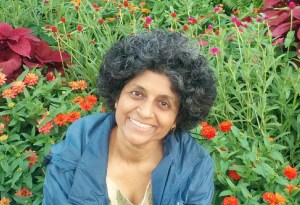 Veena Gokhale, an immigrant shape-shifter, started her career as a journalist in Bombay. This tough, tantalizing city inspired Bombay Wali and other stories, published by Guernica Editions in 2013. Veena first came to Canada on a fellowship, then came back again to do a master’s degree. After emigrating to Canada, she worked for non-profits. Land for Fatimah (to be published in 2018) is partly inspired by the two years she spent working in Tanzania. Veena has published fiction and poetry in anthologies and literary magazines and received writing and reading grants. veenago.com
Photo credit: Shawn Leishman (header banner)