Tag: literary

  • On Best-of Lists and How We Actually Read—By Genny Zimantas

    On Best-of Lists and How We Actually Read—By Genny Zimantas

    I am a big believer in lists. Grocery lists. To-do lists. Lists on phones and bits of envelopes and bills. Lists are satisfying to write, and even more satisfying to work through. But best-of lists, the kind of lists which flood journals and newspapers towards the end of each year, summarising “The 10 Best Books of 2019” or “The 100 Best Books of the 21st Century”—even though we’re only a fifth of the way through that century—are a pet peeve of mine.

    It’s no secret that yearly best-of lists are a marketing tool: for specific books, and publishers, and the journals or newspapers in which they appear. Few journalists, after all, can boast of having read every book they enumerate come December, let alone the thousands of other titles published in English and translated into English each year. The “best” books are usually chosen from an already shallow pool of previously successful titles, titles already supported by big marketing machines.

    That best-of lists so often equate financial success with literary value can be deflating, but my problem with best-of lists isn’t the “best” books themselves. It isn’t even whatever methods the list-makers use to arrive at their final selections. Instead, my issue with year-end best-of lists is how they dominate mainstream readerly conversation and keep us so focused on the immediate past—on the latest publishing triumph or controversy. To be clear: at this point in history, more books have been published than any of us could feasibly read in a dozen lifetimes. So why restrict our focus to the last year, or even fifty? Best-of lists help solve the problem of picking a next title out of overwhelming choice, but they distort perceptions of how we can (and do) read.

    In what I like to think of as defiance of market-driven, “of the moment” reading, booklovers around the world have come up with inspiring and invigorating criteria for deciding what to read next. UK-based reader and author Ann Morgan launched a project called “A Year of Reading the World” in 2012, embarking on a mission to read one book from each of the “196 independent countries—plus one extra territory chosen by blog visitors.” Making a similar readerly commitment the year he turned 25, Jerome Blanco decided to “stop reading white people,” in the process discovering more about himself, reorienting what he thought of as “real” literature, and revaluing his own work as a writer, too.

    These selection methods are, of course, restrictive in their own ways, and both readers relinquished complete adherence to their own rules after the periods in question. Both also maintained, however, that their reading habits were more open and varied after their readerly experiments than they had been before. Other bibliophiles set themselves more pointed challenges, like reading all of Proust during lockdown or responding to each of Emily Dickinson’s 1789 poems (from the Franklin variorum edition) online. Perhaps the most prominent rebellion against “best-of” reading, though, comes in the form of the counter list.

    Claiming to present “The Best Overlooked Books of 2019” or “The 13 Most Underrated Books of All Time,” counter lists seek to redress the presumed authority of yearly best-of lists and to expand our horizons beyond the already popular. They are, however, comparable to their more mainstream analogues in several key ways. Like year-end lists, they select and elevate specific titles. Also like year-end lists, they make an authoritative claim for quality, privileging not just books they identify as great, but books they claim are better than all the other great books. Counter lists thus fall into the same myopic trap: they claim objectivity and project a knowable universe of reading, where neither objectivity nor comprehensive knowledge exists.

    I’m not trying to suggest that best-of lists should be discarded, or even that we should shift our focus away from popular contemporary authors. We owe a certain responsibility, I think, to read work that is being produced now, to engage with our world and support living writers—especially writers from continually underrepresented backgrounds and marginalized groups. Best-of lists do, of course, bring attention to deserving new titles, and so have an important role to play. But a list, any list, is first and foremost a way to collect and categorize information, to make that information seem manageable, finite, knowable, known. Fortunately, if overwhelmingly, that just isn’t how the catalogue of 21st-century reading works.

    So, this year, I’ve started making my own lists, of books I want to read but also of new routes to discovery: talking to independent bookstore owners, and librarians, and friends; reading non-list articles; consulting catalogues from local small presses; seeking out books written in languages I’ve never read in translation before. I’ll be looking for books I can share with hundreds of thousands of other readers around the world, but also books few other people have read, books from two thousand years ago and books written this year, but from perspectives unlike my own. Best-of lists are fine, of course, but books are just so much cooler than “best.”
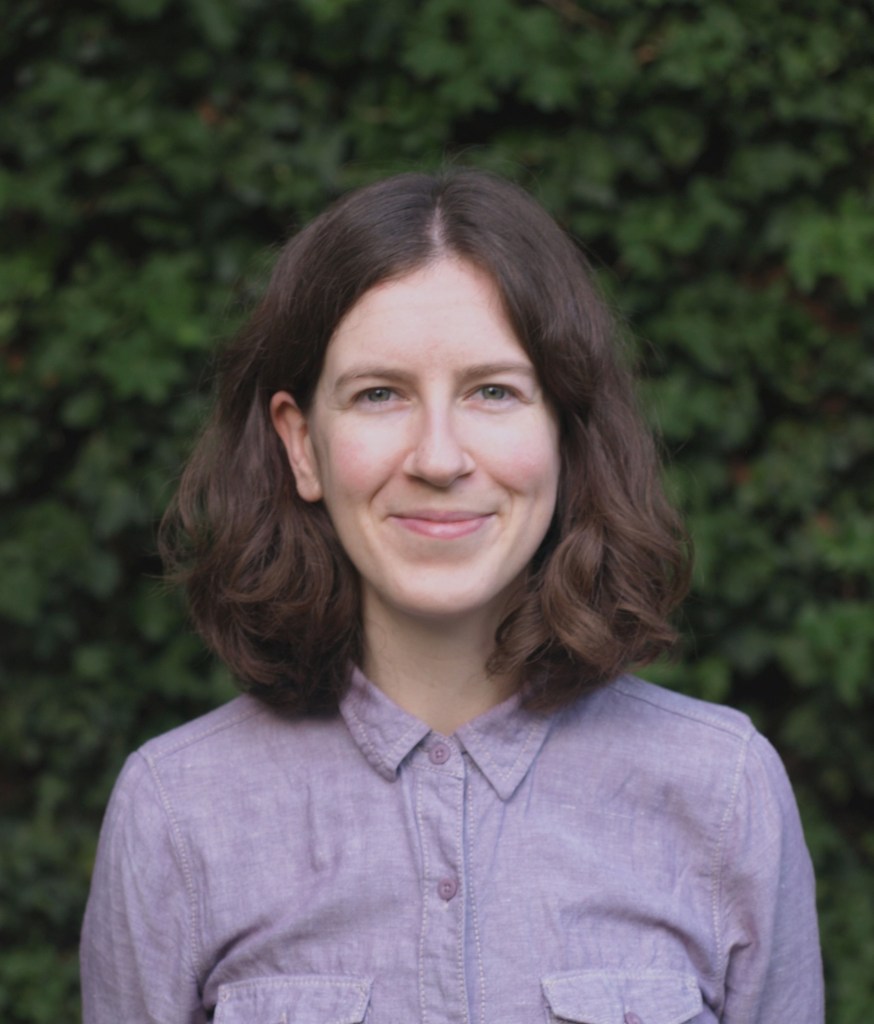

    Genevieve Zimantas is a writer and educator from Montreal whose poems and essays have appeared in journals across North America. She holds degrees from McGill University, Dalhousie University, and the University of Cambridge. In 2018, she was pleased to have been selected as the QWF’s poetry mentee and had the privilege of working with poet Peter Richardson. She now lives and reads in the United Kingdom.

    Photo credit: Lewis Weinberger
  • Writing on the Edge—By Lise Weil

    Writing on the Edge—By Lise Weil

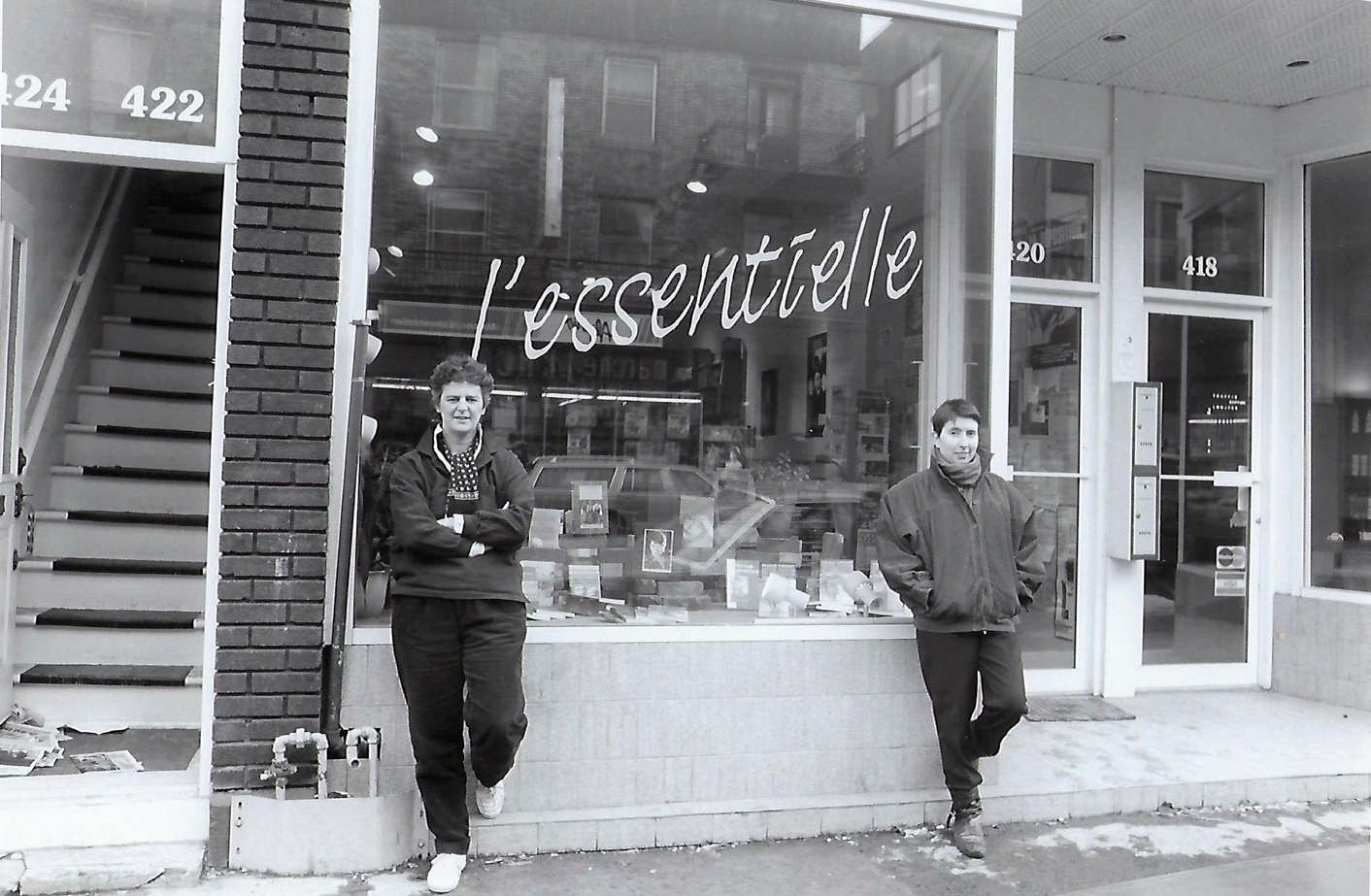
    Odette DesOrmeaux and Martine Huysmans, two members of the l’essentielle collective which also included Ariane Brunet and Harriet Ellenberger, 1988.

    Just over thirty years ago, in June of 1988, I drove up to Montreal from my home in Montague, Massachusetts to attend the Third International Feminist Book Fair. At the time I was editor of the feminist literary review Trivia: A Journal of Ideas; we had a table in the exhibit hall, alongside books, presses, and journals from all over the world. The Fair, housed on the Université de Montréal campus, was attended by some 8,000 people, featured over 300 authors, and hosted the largest gathering ever of Indigenous women writers from Canada. Coming off three days of head-spinning, exhilarating, often revelatory panels, readings and conversations, co-editor Linda Nelson and I decided to devote the next two issues of Trivia to the event.

    Trivia 13 focused on the feminist writers of Quebec and those influenced by them: Nicole Brossard, Gail Scott, Erín Moure, Louise Cotnoir, Michèle Causse (France), and Betsy Warland (BC).[i] The energy and vision of this community of feminist writers (which also included Louky Bersianik, France Théoret, Louise Dupré, and Daphne Marlatt) had provided much of the impetus for the Fair itself.[ii] In my editorial I attempted to name what it was about these writers that excited me so much. It had to do with their understanding of language as transgressive, and as material. With their exuberant flouting of genre boundaries—poetry becoming essay, fiction theory (“fiction/theory” – Brossard’s term)—all in deference to their insubordinate, uncooptable female bodies (“The breasts refuse”—Warland). And it had to do with the edge they/we were all on—as women claiming space for our own bodies and thoughts for the first time ever.

    Just over a year before the Book Fair I had driven up for the opening of the bilingual bookstore l’essentielle, a word Brossard coined in her epic poem “Sous la langue/Under Tongue.” A bilingual edition of that poem was being launched to mark the occasion. The little store on Rachel was spiffy, with hot pink shelves and track lighting. I remember women in dress shirts and bright scarves hoisting glasses of white wine. I remember Brossard and her translator Susanne de Lotbinière-Harwood taking turns reading the stanzas. On ne peut vas prévoir / You cannot foresee, each verse began, crescendoing as the lover’s mouth approached the body she desired, launching her into the unknown.

    You cannot foresee so suddenly leaning
    towards a face and wanting to lick the soul’s
    whole body till the gaze sparks with furies and yieldings. . . .
    Desire is all you see.

    And I remember walking into my study one Sunday morning not long after that launch to find Linda with Brossard’s chapbook in her lap, weeping. “We don’t write like this here,” she said. “No one writes like this here.” Eros: words embodied it in Quebec women’s writing. Words were marks of possibility, thrusting us out to a precipitous edge where nothing was foreknown… No, there was nothing like this in our feminist world. Plus the lesbians I hung with favoured jeans and flannels.

    Some two years after the Book Fair I moved to Montreal, in part drawn by that subversive brew of Quebec au féminin, wanting to be immersed in it (and yes, admittedly, wanting to be among women who dressed up for each other). Beneath all this was a desire to write… in order to do which I knew I needed to get away from the home that was Trivia’s operating base. But weaning myself from the role of editor and translator took more than a physical move. It was thirteen years before I found myself in the grip of a long writing project: a memoir that began—not surprisingly—as a meditation on lesbian desire and that chronicled a series of disastrous love adventures that drove me, heartbroken, to this foreign city where I finally learned to abide—in love, and in place. A QWF mentorship with Elaine Kalman Naves in 2003-4 was foundational to this project. It would take me another twelve years to complete the memoir, but I wrote some two-thirds of a first draft in those months. Elaine’s encouragement and her insight were just the spurs I needed.

    l'eugelionne2
    Launch of “In Search of Pure Lust” at L’Euguélionne, June 2018.

    But it is also true that my memoir, In Search of Pure Lust, would not exist in its present form were it not for my immersion in Quebec au féminin (where the last section of the memoir is set) and its climate of formal permissiveness and political passion, its celebration of language as erotic. I imagine many literary products of this century, not only here in Quebec but throughout North America, owe a similar debt. So it’s both surprising and dismaying to me that nowadays in Anglophone literary contexts there is so little acknowledgement—or even knowledge—of these Quebec writers and their pioneering body of work. Even when the topic is formal innovation.[iii] Even in Montreal.[iv] At least here in Montreal, as of two years ago, we have a monument to this genealogy in the form of the bilingual feminist bookstore L’Euguélionne—named after Louky Bersianik’s kickass, visionary feminist novel. Long live L’Euguélionne!

    I can’t help longing for the kind of literary community that first drew me to this city, a locus for deep conversation revolving around a common cause that felt urgent enough to unite writers of different cultures and languages. What might that common cause be today? As global forces thrust us towards a darker precipitous edge, and an endless expanse of unforeseen. . . .


    Lisebookstore

    Lise Weil’s memoir, In Search of Pure Lust (Inanna Publications, 2018), is a finalist for an International Book Award and winner of an Ippy Award. Her essays, literary non-fiction, and translations have been published widely in Canada and the U.S. She was founder of the feminist review Trivia: A Journal of Ideas (1982-1991) and its online offshoot, Trivia: Voices of Feminism (2003-2011)She is currently editor of Dark Matter: Women Witnessing, which publishes writing and artwork created in response to an age of mass extinction and ecological collapseShe teaches in the Goddard College Graduate Institute. www.liseweil.com

    [i] Contributors to Trivia 14, “Language and Difference,” included Lee Maracle, Jeannette Armstrong, Gloria Anzaldua, and Jewelle Gomez. Copies of Trivia 13 and 14 can be ordered for $5 plus postage. lweil22@gmail.com

    [ii] Six of these writers met on Sundays every three months in Montreal to talk about feminism and theory. Theory, A Sunday (Belladonna, 2013), a recent translation of La théorie, un dimanche (1988), collects the writings that emerged from these conversations.

    [iii] See, e.g., Bending Genre: Essays on Creative Nonfiction (eds. Margot Singer and Nicole Walker, Bloomsbury, 2013). Much of the bending and unsettling described in these essays was being performed by the writers of Quebec and was addressed explicitly in Gail Scott’s “Shaping a Vehicle for Her Use” (Spaces Like Stairs, Women’s Press, 1989).

    [iv] Not even at a recent reading by a visiting Canadian author from a work of fiction titled Theory.

    Photo credits: Marik Boudreaul (header image); Favor Ellis (headshot)