Tag: new

  • Writing Fiction in the Age of Artificial Intelligence—By Duncan Hart Cameron

    Writing Fiction in the Age of Artificial Intelligence—By Duncan Hart Cameron

    Has it all been for nothing? 

    All of the hours that I have spent in front of my computer, rising at dawn to be at my station, pounding out stories, working through the fear of not being good enough, of not being able to put something great on the page, something that is part of me, that is me. The scrawls in my notebook, the daydreaming when I walk. The small steps and incremental gains. The steady getting there.

    All for naught.

    Because ChatGPT or something like it—an artificial intelligence—will one day write a poem or a short story or even a novel that is as compelling as one of my own. Somewhere, a bunch of programmers are laughing at me: “You think what you do is special? I can make an app for that.” And they have.

    So why should I bother to write at all?

    Because it is not just about the result or the finished product. Not even close. I’m sitting here, holding one of my books in my hand, an anthology of short stories that I helped edit and to which I contributed. I admire the cover that took so many hours to format and the font that we debated for far too long. I flip to my piece, about falling in love in Paris while on exchange, and I remember when I wrote it. The feeling of gliding across the keyboard because I was on a roll. The delight I took in capturing a tender, painful moment in my life in words. Giving it existence and conveying it to others.

    The process I went through to publish the story imbued the entire project with meaning, like looking down a trail that you have hiked and taking pride in the work that it required to get there. That sweaty, joyful glow. The trail is just a trail, a path in the woods, until you have walked every foot of its length. Then it becomes something more. Something that is part of you. Imagine being plunked down at the end and looking back. Would you feel the same pride? Of course not. The trail would be meaningless, and your only relationship would be with the shortcut. (Which, in the case of AI, is very short indeed!) Likewise, a book is not just the words on the page. It is the physical manifestation of our grit and our pain and our faith. It is a symbol of our effort to impose meaning on our lives. Because that is what writing does. It gives us purpose. I know where I will be tomorrow morning and the morning after. I organize my social life, my diet, my sleep, and my family time around this central goal. There is clarity and comfort in that, not to mention satisfaction. I don’t think us writers can imagine living any other way.

    And what about the reader? Reading is about the writer, not just about the book. We read to be entertained, sure, but we also read to have a kind of communion with the author. We want to hear their voice in our minds and to know what they know. We want to taste their insight and their imagination and their courage. A bot could theoretically write a book like One Day in the Life of Ivan Denisovich or The Gulag Archipelago. But would those bot-made pieces really have the same meaning as Aleksandr Solzhenitsyn’s work, published after having spent eight years in a Russian prison? Of course not.

    Incidentally, ChatGPT can “write” in the style of Solzhenitsyn, or Ernest Hemingway, or Jane Austen, because their books already exist. It is essentially a massive synthesizer of existing data, improved by constant refinement of its answers to prompts, and it predicts what is likely to be the next sentence based on billions of previously written texts. Without authors (without us!) producing real work, Chat GPT, and other AI models like it, have nothing to say.

    And that’s the core of it, isn’t it? You can’t untether art from the world. Art is inextricably linked to human experience and to human will. Otherwise, what the heck is it? Writing is not plagiarizing thoughts and feelings, it is confronting our own inadequacy, our fears, our yearnings and spilling it on the page in a way that resonates with others. The catalyst is empathy, which links the reader and the writer together. Bots do not know what it is like to lose a loved one or to suffer rejection or to yearn for revenge. Only humans do. And it is that knowledge that readers seek when they open a book. 

    In the end, bots will produce cool stuff, even great stuff, things we could never have imagined before (check out DALL-E); but writers will continue to write, and readers will continue to read human work, because the process itself makes the act and the result meaningful. If anything, we will start to see more novels that explore the ways that AI intersects with and changes art, rather than rendering that art extinct.

    As that unfolds, you know where I’ll be. In front of my computer toiling away, or daydreaming on a walk.
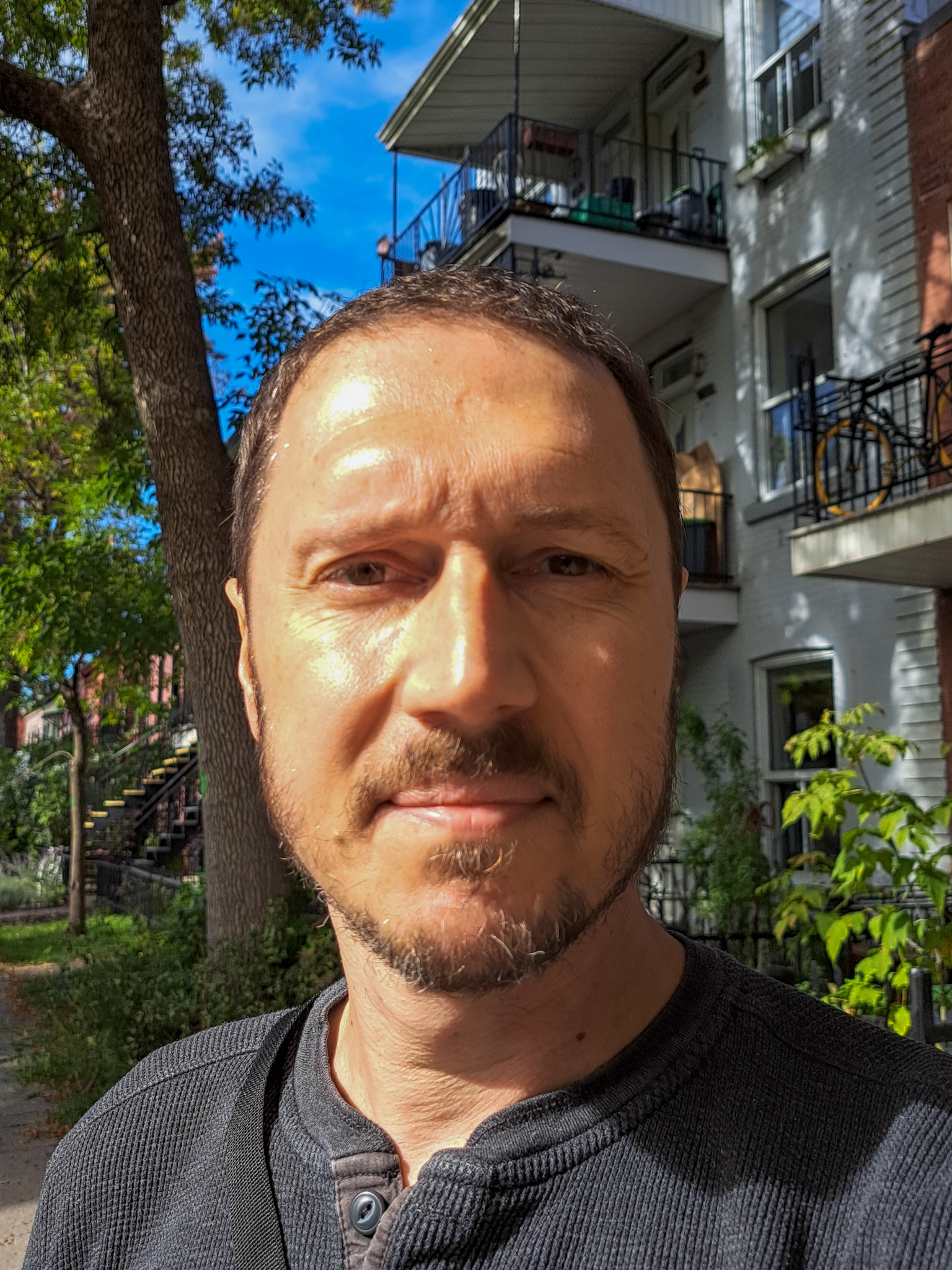

    Duncan Hart Cameron has taught college-level philosophy in Quebec for over twelve years. Born in Ontario, he lived in BC before moving to Montreal in 2001 to pursue a Master’s in Philosophy. A passionate writer and editor, he recently helped found Les éditions comme au vingtièmea bilingual literary review and independent publisher focused on supporting emerging writers, poets, and screenwriters living in Montreal and the Laurentians. His first novella, Eclipsed, is set to appear in the Fall of 2023 and explores the hold that our past can have on our present, especially in our most intimate relationships.

    Photos: Loz Pycock via Flickr (header banner); Duncan Hart Cameron (headshot)

  • Changing the Scenery to Refresh Your Writing—By Kate Hammer

    Changing the Scenery to Refresh Your Writing—By Kate Hammer


    There’s a bit of writing advice that I receive a lot: treat writing like your full-time job, sit down at the same time and place everyday, train your brain to be creative. I’ve heard it again and again, because it works. 

    For others, I’m assuming. 

    I’ve never been able to hold down a routine. Consistency makes my skin crawl, so I’ve had to find another way to inspire creativity and meet deadlines. By changing where you write, you change the way you write: it becomes varied, rooted in distinct experiences, and tonally original. And when was the last time you complained about writing too dynamically?

    Being in a different place can help our stories feel easier, inspire us to notice more, and make returning to our writing place a whole new experience. It can be as small as changing the direction of your desk, or as big as a weekend away without a whisper of internet connection. Or, you can uproot your entire life and move across an ocean.

    At the end of 2020, I moved to Scotland for a writing Master’s. I’d lived in Montreal for a few years, the longest I’d settled down anywhere for a decade, and was starting to get the itch. I was aware moving in the middle of a pandemic wouldn’t be easy, but I also knew it was the challenge I needed. Not only did I instantly become an outsider, but all the habits I’d labeled as normal in myself became something to scrutinize, something of interest.

    Without meaning to, we put our surroundings into everything we write. Maybe the sun is shining, you’ve just had an argument, or you’ve been given an eclectic mug that you know the protagonist of your story would also have; we are sponges that ooze plot. Now, I’m not trying to convince anyone to move halfway across the world like I did, but I am trying to inspire you to get out of your comfort zone. 

    Perhaps it is sitting outside, acting like a tourist in your own city, or treating yourself to a cafe that you’d normally walk past. It can be directly useful, such as visiting the same city as your character, or discovering a hobby by chance that you never thought they’d be into. 

    As soon as I landed in the UK, I knew my brain was aware in a whole new way, and I have the journal entries to prove it. From the roads never being wide enough for two cars, to the public walking paths taking you through fields of sheep who think you have food and charge towards you with impressive speed. I was learning again how I react under pressure; meeting new types of people with traits that could easily be given to characters; feeling the familiar stress of not immediately belonging.

    Putting ourselves in different environments makes us think differently about our stories, and our characters. As much as you know them on paper, knowing what they’d notice in an all-night pharmacy at 1 a.m., or who else would be there, is another matter entirely. You’re reconnecting with your world, and observing the behaviours of strangers as they unknowingly walk through your homework. Those real character actions aren’t something you can buy with money, only with your time. 

    It can take a lot of energy, to suddenly be aware of what’s around you again, or to take on new places, but alongside a healthy relationship with discomfort comes a balanced connection with rejection. As writers with a list of submission dates, we need to practice resilience against the vulnerability and fear of the job.

    The best part of switching up your space, however, is coming back home. Whenever I return to Canada, to my family farm, to my writing desk, I see everything all over again. Not as if for the first time, but I notice different things, items I’ve forgotten to look for. It’s that nostalgia of returning somewhere that makes you comfortable. I guarantee you’d describe your living room in a whole new way if you went a few days without seeing its walls, its stained carpet, how the afternoon sunshine has faded the couch.

    Changing your writing space may not always go well, but this is part of the magic: we’re rarely lost for words when complaining. Every experience feeds into your writing and characters in unexpected ways. 

    Remember that writing isn’t always putting words on paper. Even if you don’t get a lot of work done, changing the scenery can be an excuse for a vacation, a walk, or a redecoration. It’s how we turn ourselves into our own best editors, looking at things in a whole new way, as a slightly different person. And if you need to move to the UK to do that, I’ll be here to support you. 


    Kate Hammer is a writer, producer, and performer born in Canada, and living in Scotland. An award-winning playwright, director, and published writer, Kate constantly strives to create community representation in order to tell the stories that need to be heard. They now work in television development and are publishing a non-fiction book later this year called, Bruce Willis is My Dad. They are a queer, neurodivergent creator who never forgets their goat farming heritage. katethehammer.com

    Photos: Monstera via Pexels; Jeremy Cabrera (headshot)

  • On Best-of Lists and How We Actually Read—By Genny Zimantas

    On Best-of Lists and How We Actually Read—By Genny Zimantas

    I am a big believer in lists. Grocery lists. To-do lists. Lists on phones and bits of envelopes and bills. Lists are satisfying to write, and even more satisfying to work through. But best-of lists, the kind of lists which flood journals and newspapers towards the end of each year, summarising “The 10 Best Books of 2019” or “The 100 Best Books of the 21st Century”—even though we’re only a fifth of the way through that century—are a pet peeve of mine.

    It’s no secret that yearly best-of lists are a marketing tool: for specific books, and publishers, and the journals or newspapers in which they appear. Few journalists, after all, can boast of having read every book they enumerate come December, let alone the thousands of other titles published in English and translated into English each year. The “best” books are usually chosen from an already shallow pool of previously successful titles, titles already supported by big marketing machines.

    That best-of lists so often equate financial success with literary value can be deflating, but my problem with best-of lists isn’t the “best” books themselves. It isn’t even whatever methods the list-makers use to arrive at their final selections. Instead, my issue with year-end best-of lists is how they dominate mainstream readerly conversation and keep us so focused on the immediate past—on the latest publishing triumph or controversy. To be clear: at this point in history, more books have been published than any of us could feasibly read in a dozen lifetimes. So why restrict our focus to the last year, or even fifty? Best-of lists help solve the problem of picking a next title out of overwhelming choice, but they distort perceptions of how we can (and do) read.

    In what I like to think of as defiance of market-driven, “of the moment” reading, booklovers around the world have come up with inspiring and invigorating criteria for deciding what to read next. UK-based reader and author Ann Morgan launched a project called “A Year of Reading the World” in 2012, embarking on a mission to read one book from each of the “196 independent countries—plus one extra territory chosen by blog visitors.” Making a similar readerly commitment the year he turned 25, Jerome Blanco decided to “stop reading white people,” in the process discovering more about himself, reorienting what he thought of as “real” literature, and revaluing his own work as a writer, too.

    These selection methods are, of course, restrictive in their own ways, and both readers relinquished complete adherence to their own rules after the periods in question. Both also maintained, however, that their reading habits were more open and varied after their readerly experiments than they had been before. Other bibliophiles set themselves more pointed challenges, like reading all of Proust during lockdown or responding to each of Emily Dickinson’s 1789 poems (from the Franklin variorum edition) online. Perhaps the most prominent rebellion against “best-of” reading, though, comes in the form of the counter list.

    Claiming to present “The Best Overlooked Books of 2019” or “The 13 Most Underrated Books of All Time,” counter lists seek to redress the presumed authority of yearly best-of lists and to expand our horizons beyond the already popular. They are, however, comparable to their more mainstream analogues in several key ways. Like year-end lists, they select and elevate specific titles. Also like year-end lists, they make an authoritative claim for quality, privileging not just books they identify as great, but books they claim are better than all the other great books. Counter lists thus fall into the same myopic trap: they claim objectivity and project a knowable universe of reading, where neither objectivity nor comprehensive knowledge exists.

    I’m not trying to suggest that best-of lists should be discarded, or even that we should shift our focus away from popular contemporary authors. We owe a certain responsibility, I think, to read work that is being produced now, to engage with our world and support living writers—especially writers from continually underrepresented backgrounds and marginalized groups. Best-of lists do, of course, bring attention to deserving new titles, and so have an important role to play. But a list, any list, is first and foremost a way to collect and categorize information, to make that information seem manageable, finite, knowable, known. Fortunately, if overwhelmingly, that just isn’t how the catalogue of 21st-century reading works.

    So, this year, I’ve started making my own lists, of books I want to read but also of new routes to discovery: talking to independent bookstore owners, and librarians, and friends; reading non-list articles; consulting catalogues from local small presses; seeking out books written in languages I’ve never read in translation before. I’ll be looking for books I can share with hundreds of thousands of other readers around the world, but also books few other people have read, books from two thousand years ago and books written this year, but from perspectives unlike my own. Best-of lists are fine, of course, but books are just so much cooler than “best.”


    Genevieve Zimantas is a writer and educator from Montreal whose poems and essays have appeared in journals across North America. She holds degrees from McGill University, Dalhousie University, and the University of Cambridge. In 2018, she was pleased to have been selected as the QWF’s poetry mentee and had the privilege of working with poet Peter Richardson. She now lives and reads in the United Kingdom.

    Photo credit: Lewis Weinberger