
I’m two seasons away from the release of my debut novel. This will actually be my third book publication, yet there are elements of the publishing process that still intimidate me. Two I believe I’ve mastered by now are how to dedicate a book, and how to thank people who’ve helped me along the way—“mastered,” that is, until I start imagining how Person A might feel when she doesn’t see her name on the “Acknowledgements” page even though she treated me to coffee during a rough patch in my life, or when I finally admit I don’t want to dedicate my debut novel to my ex-husband even though, while we were married, I said I would.
For all the slow writers out there like myself—and this isn’t counting the time it takes for a book to go through the publishing process—a lot can happen between the first and final drafts. It can be startling to see how these changes manifest on paper, especially if you’ve told someone you’re going to mention them in your book but you change your mind. So while you’re fantasizing about eloquent dedications and thorough acknowledgements (a fun and necessary exercise), why not keep a list to help you remember whom to thank and whom not to thank? There will always be someone’s name you add to the list and then remove. And then add again out of guilt. Seeing this name next to the ones you’re 100 percent certain you want to thank might clear your doubt. Update the list as needed, right up until the day your publisher asks for the final iteration. And do not to show it to anyone before your book is published. This is your list. Writing the book was your experience. You owe no explanation for why you did or didn’t thank someone, in the end.
Being a writer means skillfully riding the constant waves of people’s ideas about what a writer is, does, and how we do it. For example, a past partner of mine used to urge me to write whenever I felt unhappy. He couldn’t seem to accept that it was the last thing on earth I wanted to do when I was troubled (it’s when I produce my most unsalvageable work), and he seemed truly dissatisfied by the fact that I don’t write every day. I wasn’t adhering to his vision of the writer’s life and how he might play a role in it—later to be thanked. It’s worth considering people’s motivations when you’re crafting dedications and acknowledgements. No matter how thoughtfully you execute those pages, there will always be someone who feels slighted for not receiving public recognition from you. While in your mind, all Person B did was occasionally ask you questions about the book you’d been writing “forever,” in Person B’s view, they supported you by expressing ongoing interest in your work (but mostly talked at length about themselves, their darling children, and their even darlinger Shih-Poo named Ackerly).
Historically, the dedication page was a siren’s call to potential benefactors. Writers dedicated their works to significant public figures and sometimes even entire cities, with the goal of attracting funding for their future publishing endeavors. Today’s dedication page is more of a forum for displays of affection (“For my spouse and children: You are my life.”) or an opportunity for the author to give readers an intimate glimpse of their personality by acting as a micro-autobiography (“I dedicate this novel to my iguana, because why not?”). When it was time for me to dedicate my short story collection, my then-husband graciously helped me brainstorm (it didn’t make sense to dedicate the book to him, since I had started it years before we met). Together we came up with “for the poor children,” the title of the collection, which sets an ironic, somewhat glib tone—and as it turns out, I’m a somewhat glib person who uses irony to process the world around me.
The “Acknowledgements” page is a demonstration of good literary citizenship. Here, you thank people by order of importance, starting with your agent (if you have one), editor, designer, publicist. Without these hardworking allies, your book would still be a MS Word file. You want to also mention sources of funding you received while you worked on the manuscript, public readings you gave from your book to be, extracts (poem, story, essay, chapter) that were published elsewhere, and peers who read and critiqued your work. Then you can start on that fantasy list you’ve been keeping! In the case of my forthcoming novel, I’m attempting to make amends for not dedicating it to my ex-husband by thanking him high up on the page, right after my publishing team and before everyone else. Were his feelings hurt when I first told him about my change of heart? Of course. We had a long conversation about it by telephone and this was when I gained a deeper appreciation for the responsibility that comes with writing dedication and acknowledgements pages: they’re meaningful and symbolic not only to the author but also to those mentioned—and to those not mentioned.
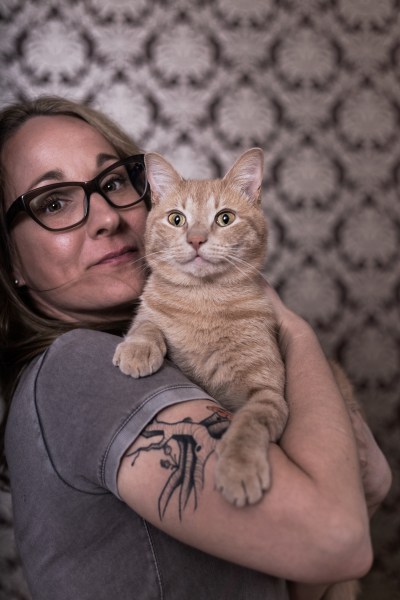 April Ford is a genderfluid author living in Montreal, Quebec with her rescue family. Her fiction, poetry, and essays have appeared in print and online journals in Canada, the United States, Mexico, Germany, and Scotland. She is the recipient of a Pushcart Prize for her short story “Project Fumarase,” and has held fully-funded residencies at Virginia Center for the Creative Arts and Ucross Foundation. Her books include Death Is a Side-Effect: Poems (Frog Hollow Press, 2019) and the award-winning story collection, The Poor Children (SFWP, 2015). Her debut novel, Carousel, is forthcoming in Spring 2020 with Inanna Publications. www.aprilfordauthor.com
Photo credits: “Cliche: Have a Heart”by Carol (vanhookc) is licensed under CC BY-SA 2.0

 (header image); Bernardo Fernandez, Verdun, Quebec, 2019 (headshot)


