Tag: Publisher

  • On Best-of Lists and How We Actually Read—By Genny Zimantas

    On Best-of Lists and How We Actually Read—By Genny Zimantas

    I am a big believer in lists. Grocery lists. To-do lists. Lists on phones and bits of envelopes and bills. Lists are satisfying to write, and even more satisfying to work through. But best-of lists, the kind of lists which flood journals and newspapers towards the end of each year, summarising “The 10 Best Books of 2019” or “The 100 Best Books of the 21st Century”—even though we’re only a fifth of the way through that century—are a pet peeve of mine.

    It’s no secret that yearly best-of lists are a marketing tool: for specific books, and publishers, and the journals or newspapers in which they appear. Few journalists, after all, can boast of having read every book they enumerate come December, let alone the thousands of other titles published in English and translated into English each year. The “best” books are usually chosen from an already shallow pool of previously successful titles, titles already supported by big marketing machines.

    That best-of lists so often equate financial success with literary value can be deflating, but my problem with best-of lists isn’t the “best” books themselves. It isn’t even whatever methods the list-makers use to arrive at their final selections. Instead, my issue with year-end best-of lists is how they dominate mainstream readerly conversation and keep us so focused on the immediate past—on the latest publishing triumph or controversy. To be clear: at this point in history, more books have been published than any of us could feasibly read in a dozen lifetimes. So why restrict our focus to the last year, or even fifty? Best-of lists help solve the problem of picking a next title out of overwhelming choice, but they distort perceptions of how we can (and do) read.

    In what I like to think of as defiance of market-driven, “of the moment” reading, booklovers around the world have come up with inspiring and invigorating criteria for deciding what to read next. UK-based reader and author Ann Morgan launched a project called “A Year of Reading the World” in 2012, embarking on a mission to read one book from each of the “196 independent countries—plus one extra territory chosen by blog visitors.” Making a similar readerly commitment the year he turned 25, Jerome Blanco decided to “stop reading white people,” in the process discovering more about himself, reorienting what he thought of as “real” literature, and revaluing his own work as a writer, too.

    These selection methods are, of course, restrictive in their own ways, and both readers relinquished complete adherence to their own rules after the periods in question. Both also maintained, however, that their reading habits were more open and varied after their readerly experiments than they had been before. Other bibliophiles set themselves more pointed challenges, like reading all of Proust during lockdown or responding to each of Emily Dickinson’s 1789 poems (from the Franklin variorum edition) online. Perhaps the most prominent rebellion against “best-of” reading, though, comes in the form of the counter list.

    Claiming to present “The Best Overlooked Books of 2019” or “The 13 Most Underrated Books of All Time,” counter lists seek to redress the presumed authority of yearly best-of lists and to expand our horizons beyond the already popular. They are, however, comparable to their more mainstream analogues in several key ways. Like year-end lists, they select and elevate specific titles. Also like year-end lists, they make an authoritative claim for quality, privileging not just books they identify as great, but books they claim are better than all the other great books. Counter lists thus fall into the same myopic trap: they claim objectivity and project a knowable universe of reading, where neither objectivity nor comprehensive knowledge exists.

    I’m not trying to suggest that best-of lists should be discarded, or even that we should shift our focus away from popular contemporary authors. We owe a certain responsibility, I think, to read work that is being produced now, to engage with our world and support living writers—especially writers from continually underrepresented backgrounds and marginalized groups. Best-of lists do, of course, bring attention to deserving new titles, and so have an important role to play. But a list, any list, is first and foremost a way to collect and categorize information, to make that information seem manageable, finite, knowable, known. Fortunately, if overwhelmingly, that just isn’t how the catalogue of 21st-century reading works.

    So, this year, I’ve started making my own lists, of books I want to read but also of new routes to discovery: talking to independent bookstore owners, and librarians, and friends; reading non-list articles; consulting catalogues from local small presses; seeking out books written in languages I’ve never read in translation before. I’ll be looking for books I can share with hundreds of thousands of other readers around the world, but also books few other people have read, books from two thousand years ago and books written this year, but from perspectives unlike my own. Best-of lists are fine, of course, but books are just so much cooler than “best.”

    Genevieve Zimantas is a writer and educator from Montreal whose poems and essays have appeared in journals across North America. She holds degrees from McGill University, Dalhousie University, and the University of Cambridge. In 2018, she was pleased to have been selected as the QWF’s poetry mentee and had the privilege of working with poet Peter Richardson. She now lives and reads in the United Kingdom.

    Photo credit: Lewis Weinberger
  • Copyright: What’s the Big Deal?— By Julie Barlow

    Copyright: What’s the Big Deal?— By Julie Barlow

    The Federal government is in the process of revising the Copyright Act. If you don’t think that matters to writers, think again.

    I’m always surprised to see blank stares on writers’ faces when I launch into a speech about copyright. Some of them aren’t clear why copyright really matters. Others aren’t sure what copyright even is. Fair enough—it’s not the sexiest topic in the writing world. But even if you don’t notice it, it’s fundamental to our business.

    Here’s why. I am a non-fiction author of six books and a magazine writer. To earn my living I sell the right to use my work, either to publishers who pay me advances and royalties or to magazines who pay me fees to publish my articles. For most of my twenty-five-year career, this revenue has constituted most of my income.

    Simply put, copyright law is what makes it possible for me to get paid for my work. The Oxford dictionary defines copyright as: “The exclusive and assignable legal right, given to the originator for a fixed number of years, to print, publish, perform, film, or record literary, artistic, or musical material.” That’s me—the originator. The Copyright Act is what legally makes my work mine as soon as I create it, and mine to sell.

    It sounds solid in principle, and I wish it was. Unfortunately, it’s getting harder and harder to enforce my copyright and get paid for it. So I jumped at the opportunity to attend a hearing hosted by the federal government’s Standing Committee on Industry, Science and Technology, held May 8 in downtown Montreal.

    First, let me explain why it’s getting harder to make money from copyright. The reason, in a nutshell, is the Internet and digitization. By making it easier to “publish” and “distribute” creative work, the Internet has made many, many consumers of culture think they should get what’s online for free. The ripple effect in the publishing industry has led to dramatically less revenue for publishers, magazines, and of course writers.

    “By making it easier to “publish” and “distribute” creative work, the Internet has made many, many consumers of culture think they should get what’s online for free.”

    Magazine revenues fell when advertisers turned to online outlets. So magazines are trying to increase their profits by demanding (and the word is not too strong) more copyright from writers, but for the same fee. Whereas the standard when I started publishing in 1995 was to sell first publication rights (giving the magazine the right to publish it once), I now have to sign contracts in which I hand over the right to resell my articles in any form, in any language, anywhere on the planet, sometimes for periods longer than the rest of my life. I used to resell my pieces, sometimes up to five times. Now that’s impossible. Some magazines have even demanded I give them “moral rights” to my work, which means they can alter my work any way they want without my permission – or even take my name off it (I don’t work for those ones).

    The case in book publishing is a little harder to explain. The industry as a whole is suffering from the forces of technology and book advances to authors are falling. When I Google my own work, I discover so many sites offering free (i.e., illegal) PDFs of my books that I can’t keep track of them anymore. And neither can my publisher.

    In 2012, the Conservative government recognized that the Internet and digital economy were changing the dynamics of publishing, so it set out to revise the Copyright Act, originally passed in 1921, to take digital realities into account. But the resulting revisions made it harder for both writers and publishers to earn money. The Act already stipulated situations when consumers don’t have to pay creators. For example, “fair dealing” allows you to share one of my articles with a friend for personal consumption without infringing my copyright. The 2012 revisions broadened fair dealing to include situations like “education.” The problem was, the revised Copyright Act didn’t stipulate how much of the work could be used without infringement. The result? Universities and schools across Canada have been refusing to pay fees for copies of my articles or excerpts from my books. Since 2013, the revenue that Access Copyright collects from universities, schools, and other institutions to distribute to writers has declined by 80 percent.

    As a writer, what do I want the government do to about this? I’m not expecting them to turn back the clock—the Copyright Act has to be adapted to work in the digital world. But most writers would agree that in this already difficult context, we deserve at least as much protection as we had before, not less.

    “As a writer, what do I want the government do to about this?”

    Today, the government appears to recognize the 2012 revision was a misstep. One committee member told me in private that the previous committee let copyright users like universities pretty much dominate the agenda during the last reform, while we creators had little say. So this year the government decided to go back to the drawing board and start by asking for our input.

    At the Standing Committee on Industry, Science and Technology meeting on May 8, about thirty-five creators spoke during the “open mic session.” We each got two minutes to make our case. The vast majority told their own variation on a common tale: over the last 20 years it’s become dramatically more difficult to earn money from our work because it’s harder to get anyone that should pay for the privilege of reading (writers’) or listening to (musicians’) or looking at (photographers’) work to actually pay for it.

    Creators are looking to the government to strengthen the copyright law so it protects our interests. For example, this means minimizing exceptions to fair dealing. I told the committee: “Some people own real estate and make money by selling it. I own copyright and make money by charging magazines and publishers for the right to publish my writing. Why would I be expected to donate my work for free to people who are making money using my work?” (Last time I checked, universities weren’t charities and professors didn’t work for free.)

    “Why would I be expected to donate my work for free to people who are making money using my work?”

    I actually feel a strange kinship with the taxi drivers and hotel owners out there whose livelihood is threatened by digital technology in the form of Uber and Airbnb. The difference, of course, is that the general public seems to get why taxi drivers and hotel owners ask for protection, whereas few understand how infringing on copyright takes money directly out of creators’ pockets.

    This time, I hope the government listens to creators. If they don’t, I’m not sure how we can be expected to make all the stuff people want to copy in the first place.

    I encourage other QWF members and all creators to draw on their own experience and submit a brief to the Standing Committee on Industry, Science and Technology, explaining why copyright is important to creators. Here’s the link.


    JulieBarlow_headshot

    Julie Barlow is a Montreal-based magazine writer and author of books on language and France, including her latest, The Bonjour Effect: The Secret Codes of French Conversation Revealed (St. Martin’s Press) and The Story of French, winner of the 2007 Mavis Gallant Prize for Non-Fiction. She teaches the Quebec Writers’ Federation workshop, Narrative Non-Fiction: Finding the Story Among the Facts. Visit her at nadeaubarlow.com.

    Photo credits: Nick Youngson CC BY-SA 3.0 Alpha Stock Images (header banner); Julia Marois (headshot)

  • Don’t Blink by Marianne Ackerman

    Don’t Blink by Marianne Ackerman

    Choosing a book title and cover is a lot like naming a baby. Quite a few people tend to weigh in, so the process can be a serious source of anxiety. Yet somehow, once you settle, the choice seems obvious.

    In the case of my new short story collection, Mankind and Other Stories of Women, the title was spontaneous. The title story, “Mankind,” first saw the light of day last Christmas as a monologue directed by Harry Standjofski, performed by the wonderful Leni Parker at Centaur Theatre’s annual Urban Tales event. For Leni’s character, a lonely woman enduring Christmas Eve with her box of wine and chocolate, the word mankind is a euphemism for the scent of a man. It’s very much a woman’s story. So are the other nine, hence the title. I made a conscious effort to focus on women this time after my last collection, Holy Fools + 2 Stories (Guernica 2014), was full of male characters—puzzling, since I thought I’d won the struggle over the animus-domination of my imagination ages ago.

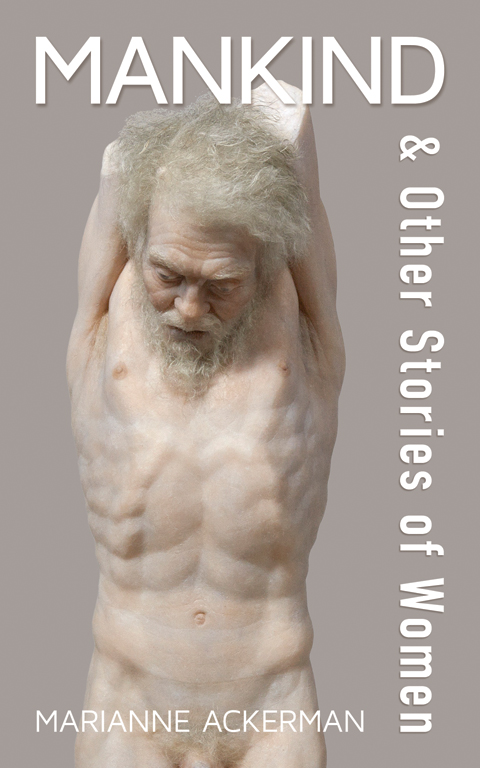
    The cover was not obvious. On a brief trip to Calgary in April, I discovered an amazing sculptor at the Trépanier Baer Gallery. Walking through the door, I was hit by the super elongated shape of a very thin, nearly naked corpse behind glass: Evan Penny’s Homage to Holbein, an eerie rendering in silicone and real hair of a Christ-like figure, almost fourteen feet long and chillingly life-like. My first thought was, this work belongs at the entrance to a church. It’s a religious experience.

    Days later, the images were still strong. Perusing the gallery website, I settled on Marsyas (Model), a twenty-four-inch high sculpture of a male torso, inspired by a Greek statue, which was part of the exhibition. Covers are traditionally the publisher’s domain, with input from the author. But I’ve known my publisher Mike Mirolla for a long time. I know he’s a dark soul. He loved the image immediately. Thus began the dance by which a raw visual idea and text become one.

    I could not explain why that image worked with my stories, which tend to be airy, urban, sometimes playful, and, some people say, funny. Maybe the figure’s vulnerability, resistance or air of fatalism speak to the tragic thread found in all comedy. As I revised the manuscript for publication, I found myself working him into the first story, “Mina,” which is about a friendship of rivalry and complicity between two women, their creative struggle, and one crazy night.

    mankind-final-cover

    “As I revised the manuscript for publication, I found myself working him into the first story…”

    After the normal back and forth, designer David Moratto’s concept was finalized. I slapped the cover up on Facebook, eagerly announcing my forthcoming fall book. It was mid-winter. The response was pretty well total negativity. Some of my dearest friends, smart people, said it was awful, scary, repellent. Nobody would touch this book!

    I was not prepared. I threw myself on the bed, lamenting once again my weakness for getting over-involved in practically everything. Now I’d have to face Mike and David with bad news, not to mention the gallerist, Yves Trépanier, and the artist, whose work I love.

    Mike did not share my panic attack, but held back. Yves did not. “Don’t listen to them! It’s a strong cover,” he barked via email. “You were right the first time. Don’t blink.”

    “The response was pretty well total negativity. Some of my dearest friends, smart people, said it was awful, scary, repellent. Nobody would touch this book!”

    Next to my control freakishness, impulsiveness is probably my greatest flaw. Here was somebody I respected telling me to trust my impulse. I looked at the cover again. At the other options I was trying to like. I asked Yves what his wife thought. He assured me she loved it. So I decided to take his advice, remain faithful to my first impulse. Well, except for a last-minute tussle over (ahem) how much “cleavage” should appear below my name. I did not want readers to be distracted by a dangling sack of flesh.

    Now that a stack of books is sitting on the dining room table, I can’t imagine a better cover than Evan Penny’s classy, classical all-too-human torso. I have no idea what readers will think, how it will affect their desire to pick up this book. But the baby isn’t mine any more. It is thoroughly herself.


    Mankind and Other Stories of Women will be launched along with three other local titles from Guernica Editions at Montreal’s Atwater Library (1200 Atwater Ave.) on Thursday, September 29, 6 p.m. The event is co-sponsored by the QWF. Click here for more information on the launch.

    ma-for-qwf-piece-sept-7

    Marianne Ackerman writes plays and novels. marianneackerman.com

    Photo credits: Photo of Evan Penny’s Marsyas Model (2016) courtesy of Evan Penny, and Kevin Baer – TrépanierBaer Gallery; Lesley McCubbin (headshot)

  • Nature’s Way of Getting Books Written by Raquel Rivera

     A couple of years ago I was cycling around the ex-garbage dump that is the St-Michel Environmental Complex in Montreal North, collecting details for a scene in my novel.

    I pedaled across the street from the Complex’s Cirque du Soleil headquarters, and peered through the windows of the National Circus School. Inside was a highly padded gym-like space, full of pulleys and ropes – and some very fit teenagers. Not wanting to be taken for a peeping-creep, I dashed around to the front reception and asked if they offered tours.

    I attended the school’s open house the following week, hoping to gather useful tidbits to feather my scene’s nest. As it happens, I was also stepping into my next crazy-making topic of all-consuming passion: a creative non-fiction book for children, featuring the lives of students at the National Circus School. My next Great Idea.

    I surprised myself as I blustered my way into the institution through emails, meetings and follow-up proposals. They had a responsibility to share their story with the world, I insisted. The guilt-trip finally seemed to convince the school’s extremely busy (and intimidating) directors. They were swayed by my conviction: this was a Great Idea.

    Everyone will want to read about these young superheroes, facing down risk and their own limits every day. They’ll be charmed by the gaspésien who left home to pursue juggling. They’ll be impressed by that skinny little twelve-year-old who boards at the school, so he can train twenty hours a week in addition to his full academic schedule. Readers will gasp as the eighth-grader makes her first tightwire jump; they’ll wince as the cruel wire tries to bisect her feet. Ultimately, just like me, readers will be fascinated by an inside peek at the tremendous efforts these young people make so that their performances can look easy to the rest of us.

    Topsy-turvy
    Topsy-turvy: You don’t need to turn yourself inside-out trying to sell a beloved manuscript – it just feels that way sometimes.

    As I began my visits and interviews, “Why not?” seemed to be the motto of the school. It’s what they tell one another in response to every new and impossible notion. (Stand on your partner’s shoulders, jump into a back flip and land back on – why not? Now do it en pointe, in ballet toe-shoes – why not?)

    “Why not?” It’s what the aerial instructor said when I asked if someone like me (old and untrained) might learn rope. I signed up for aerial classes at my local community centre and, week after demoralizing week, was the sole student unable to pull herself off the ground. Yet somehow, when it was finally over, I signed up with a private trainer at a circus studio and carried on. If nothing else, my acrobatics training would make me better equipped to relay The Great Idea to a waiting world. Publishers would scramble for my original material, appreciating its historic value and the uplifting message that we may achieve the impossible, whatever that means to each of us. This Great Idea was a winner – a shoo-in.

    Now I’m thinking, passionate belief like this is just nature’s way of getting books written. I wish it got them published, too.

    But that’s the other part of the writing life: when I gain new perspective on The Great Idea. Over lunch, one editor speculated on the cost of producing my full-colour, fully illustrated Idea. Responses came in from more editors: “The circus school certainly seems like an interesting place,” (but no thanks). “I loved your proposal, but that wasn’t enough to convince the powers that be.” Passion died, and determination stepped up, struggling against quaking doubt. Would anyone want my Great Idea? Would it receive the blessings of timing and dumb luck that brought past manuscripts to print? Or had my portion of blessings run out?

    At this stage, keeping faith is huge: you have to believe that one day all this thinking and writing will be a real book. This requires that my ears and my mind stay open – and that I conserve effort, to avoid burnout. I listen to feedback; I try to be flexible because The Great Idea deserves to be among readers. But there’s any number of great ideas floating around out there, looking for a publisher. (Which is actually a comfort, when I’m feeling more mature.)

    throw2catchduotissu
    Julie gives Natalia a hand during warm-ups for RESET, the latest show by acrobatic troupe THROW2CATCH

    Maybe this pause in progress (I won’t call it a halt) is a necessary stage in the forging process. Maybe it will shape up my Idea and make it stronger. I remind myself of the reason these circus kids inspire me so – they push their limits, they never give up.

    After the latest rejection, I transformed disappointment, frustration and the urge to throw a hissy fit into a new series of emails. I sought publishing leads, editors’ names, introductions to agents – anything to get The Idea some notice. And it worked. I still don’t have a book contract, but I have more leads to pursue, and the support and interest of fellow writers. It’s enough; for now, it’s everything.


    raquelrivera_smRaquel Rivera is the author of three books for children, and the aspiring author of four more. Her author website is at www.imho-reviews.com/raquel. Photo credits: Raquel Rivera