Tag: tools

  • Writing Fiction in the Age of Artificial Intelligence—By Duncan Hart Cameron

    Writing Fiction in the Age of Artificial Intelligence—By Duncan Hart Cameron

    Has it all been for nothing? 

    All of the hours that I have spent in front of my computer, rising at dawn to be at my station, pounding out stories, working through the fear of not being good enough, of not being able to put something great on the page, something that is part of me, that is me. The scrawls in my notebook, the daydreaming when I walk. The small steps and incremental gains. The steady getting there.

    All for naught.

    Because ChatGPT or something like it—an artificial intelligence—will one day write a poem or a short story or even a novel that is as compelling as one of my own. Somewhere, a bunch of programmers are laughing at me: “You think what you do is special? I can make an app for that.” And they have.

    So why should I bother to write at all?

    Because it is not just about the result or the finished product. Not even close. I’m sitting here, holding one of my books in my hand, an anthology of short stories that I helped edit and to which I contributed. I admire the cover that took so many hours to format and the font that we debated for far too long. I flip to my piece, about falling in love in Paris while on exchange, and I remember when I wrote it. The feeling of gliding across the keyboard because I was on a roll. The delight I took in capturing a tender, painful moment in my life in words. Giving it existence and conveying it to others.

    The process I went through to publish the story imbued the entire project with meaning, like looking down a trail that you have hiked and taking pride in the work that it required to get there. That sweaty, joyful glow. The trail is just a trail, a path in the woods, until you have walked every foot of its length. Then it becomes something more. Something that is part of you. Imagine being plunked down at the end and looking back. Would you feel the same pride? Of course not. The trail would be meaningless, and your only relationship would be with the shortcut. (Which, in the case of AI, is very short indeed!) Likewise, a book is not just the words on the page. It is the physical manifestation of our grit and our pain and our faith. It is a symbol of our effort to impose meaning on our lives. Because that is what writing does. It gives us purpose. I know where I will be tomorrow morning and the morning after. I organize my social life, my diet, my sleep, and my family time around this central goal. There is clarity and comfort in that, not to mention satisfaction. I don’t think us writers can imagine living any other way.

    And what about the reader? Reading is about the writer, not just about the book. We read to be entertained, sure, but we also read to have a kind of communion with the author. We want to hear their voice in our minds and to know what they know. We want to taste their insight and their imagination and their courage. A bot could theoretically write a book like One Day in the Life of Ivan Denisovich or The Gulag Archipelago. But would those bot-made pieces really have the same meaning as Aleksandr Solzhenitsyn’s work, published after having spent eight years in a Russian prison? Of course not.

    Incidentally, ChatGPT can “write” in the style of Solzhenitsyn, or Ernest Hemingway, or Jane Austen, because their books already exist. It is essentially a massive synthesizer of existing data, improved by constant refinement of its answers to prompts, and it predicts what is likely to be the next sentence based on billions of previously written texts. Without authors (without us!) producing real work, Chat GPT, and other AI models like it, have nothing to say.

    And that’s the core of it, isn’t it? You can’t untether art from the world. Art is inextricably linked to human experience and to human will. Otherwise, what the heck is it? Writing is not plagiarizing thoughts and feelings, it is confronting our own inadequacy, our fears, our yearnings and spilling it on the page in a way that resonates with others. The catalyst is empathy, which links the reader and the writer together. Bots do not know what it is like to lose a loved one or to suffer rejection or to yearn for revenge. Only humans do. And it is that knowledge that readers seek when they open a book. 

    In the end, bots will produce cool stuff, even great stuff, things we could never have imagined before (check out DALL-E); but writers will continue to write, and readers will continue to read human work, because the process itself makes the act and the result meaningful. If anything, we will start to see more novels that explore the ways that AI intersects with and changes art, rather than rendering that art extinct.

    As that unfolds, you know where I’ll be. In front of my computer toiling away, or daydreaming on a walk.

    Duncan Hart Cameron has taught college-level philosophy in Quebec for over twelve years. Born in Ontario, he lived in BC before moving to Montreal in 2001 to pursue a Master’s in Philosophy. A passionate writer and editor, he recently helped found Les éditions comme au vingtièmea bilingual literary review and independent publisher focused on supporting emerging writers, poets, and screenwriters living in Montreal and the Laurentians. His first novella, Eclipsed, is set to appear in the Fall of 2023 and explores the hold that our past can have on our present, especially in our most intimate relationships.

    Photos: Loz Pycock via Flickr (header banner); Duncan Hart Cameron (headshot)

  • Keep Calm, Shut Up, and Write—By Lea Beddia

    Keep Calm, Shut Up, and Write—By Lea Beddia

    One full-time teaching job (hybrid online teaching included), three school-aged children (complete with homework, lunches and the occasional emotional meltdown), and one pandemic (anxiety I never thought I’d have, a bonus). Add a house to help maintain, and there’s no time for a creative outlet. It’s enough to turn me into a Netflix zombie. You may be busy like me, but even if you’re not, you may find your creativity stifled, vacuum-packed, and freeze-dried during this whole soul-sucking, stay-at-home-and-don’t-come-out situation. The state of the world is so real, yet surreal and heart-breaking, that my aspirations for all my wonderful ideas and plots are twisted up with anxiety, sleeplessness, and an obsession with watching the news. Enter Shut Up and Write.

    Shut up and Write: the name says it all. We really just shut up and write, for twenty-five minutes at a time followed by five-minute breaks. I don’t know about other writers, but in twenty-five minutes of absolute silence, with nothing but focus and my fingers tapping away, I’m more productive than during a full weekend in front of the television with my kids on my lap spilling popcorn all over me. It’s such a great stress-reliever to know I’m prioritizing myself ahead of my to-do list. I commit to be present when all my best-laid schemes have gone awry, and it’s the only chance for the stories swarming my head.

    I myself never attended the in-person sessions. I live an hour out of the city, and taking a Saturday morning away from busy mom life was not feasible. But since the sessions have moved online, we’re only limited to the distance our laptop charges will allow us to roam. I started attending after my QWF mentorship ended last June. I was so close to finishing what I had started and needed a little extra push to get my manuscript done. The result, for me: a manuscript completed and queries written.

    More importantly for my soul and morale, however, are these tenacious people, who like me, are ignoring real life for a little while to meet online and pursue personal or professional writing. Every time I sign up for a session, there’s this excitement: I’m going to see other people, and they’ll be writing, because their writing is important to them, too!

    I miss meeting with my writing critique group: an ensemble of talented, funny women who I met during a workshop, now almost two years ago. We still keep in touch, but each of us admits to lacking the energy and/or time for our writing, because “How can I not place my family, health, work, fresh air, and rabbit hole of online shopping ahead of writing?”

    SUAW is my antidote to isolation. I have something to look forward to in a time with no appointments or visits. I’ve found a community of writers willing to have my face in a two-inch square on their screen for two and a half hours a few Saturdays a month. Loneliness is at bay when I write during these sessions. There’s camaraderie in knowing we’re all struggling for time to be creative. I am grateful for the connections I’ve made.

    In our five minutes off, we chat, and in a short time, we share what we’re working on, or talk about recipes and make each other laugh. We’re all starving for positive human connections to people with a common interest and here it is, at my fingertips! When those five minutes are up, I’m like a superhero, relinquishing the destructive powers of procrastination because I’ve got twenty-five minutes to make the rest of my story shine, or at least get it from my head to my screen. Good enough.

    We may all be “Zoomed-out” and tired of hearing “You’re on mute” or “Can you mute yourself, please?” But to be honest, I kind of like it when someone forgets to turn off their mic and I can hear their keyboard clicking. It’s not a race, but it gets me going every time.


    Lea Beddia is a high school teacher, writer for young adults, and mom of three. She grew up in Montreal and now lives in the woods, on top of a mountain. She’s published short stories for young and old and you can find her work @LeaBeddia or www.leabeddia.com. In her free time (those rare, glorious moments), you can find her with her nose in a book, tuning everything out.

    Photo credits: Header banner is licensed under CC BY-NC-SA 2.0; Sarah Fortin Photographe (headshot)

  • What If Your Computer Listened to You?—By Mariam S. Pal

    What If Your Computer Listened to You?—By Mariam S. Pal

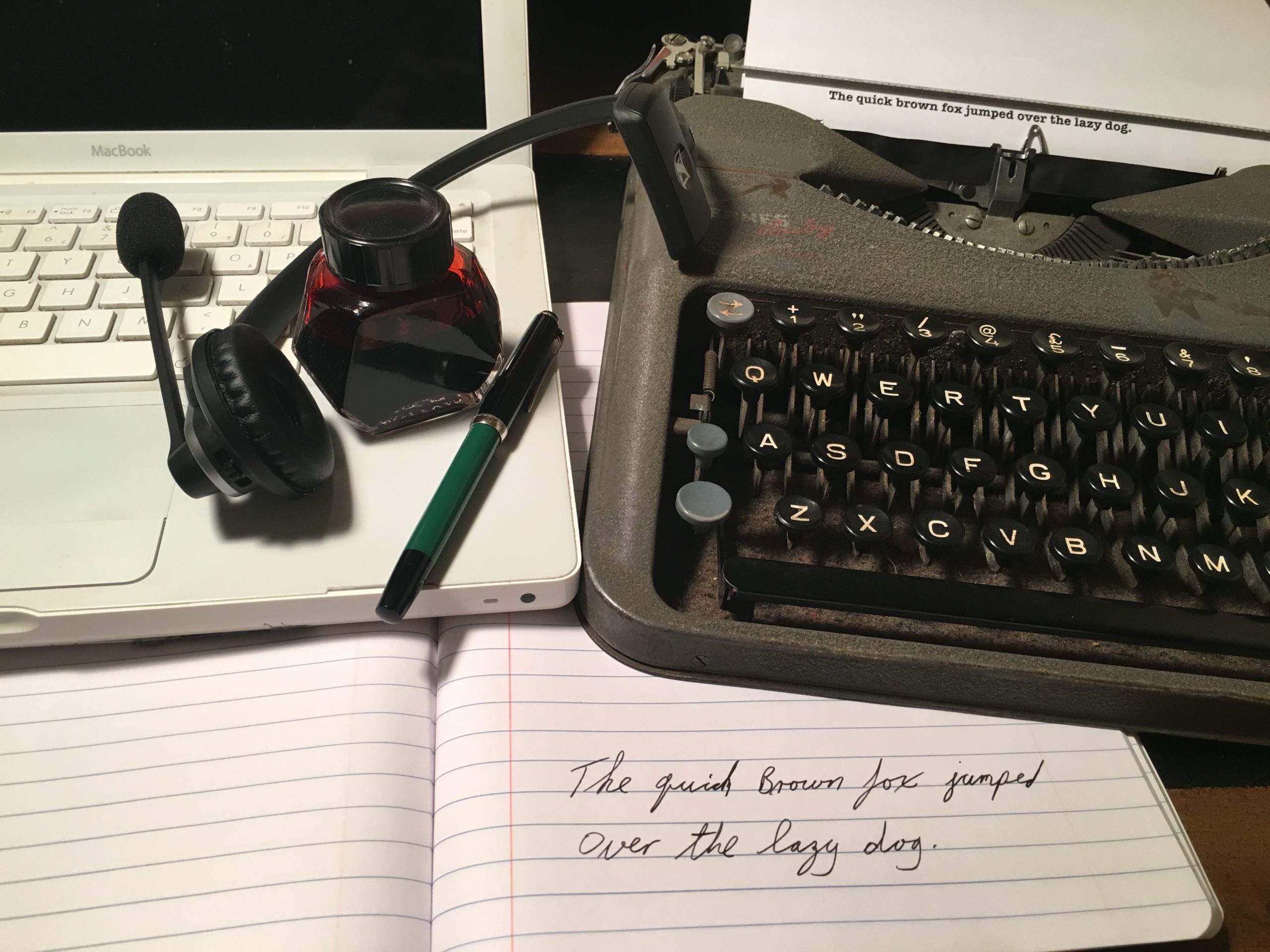
    “New line numeral one period space cap that the quick brown fox jumped over the lazy dog bold lazy dog exclamation mark.” My telephone rings. “Go to sleep,” I say to my computer, and the cute little green mic on its screen turns blue and shuts off. I answer my phone: “Hello?”

    It’s a typical day in my sunny second-floor home office. Headset on, I look like a faraway call-centre worker whose thankless task is to explain why your suitcase is in Montevideo. But I’m not calming cranky customers; I’m writing by dictation. I turned off my mic before answering the phone because otherwise, my conversation would have ended up as text on my screen.

    When I write, I don’t scrawl with a pen or pencil, hunt and peck on a keyboard, or even bang away on a typewriter. I slide on a headset, say “Wake up,” and start yakking at my computer. My voice recognition software converts speech to email messages, text in Word, and more. Line by line, paragraph by paragraph, my writing silently scrolls onto the screen every few seconds. I’ve been working like this for about fifteen years; chronic repetitive movement injuries forced me to look into alternatives to typing.

    I use Dragon Naturally Speaking, one of several voice recognition programs available to writers. It costs about the same as a couple of trips to the physiotherapist. If prescribed by a physician, voice recognition software is a tax-deductible medical expense. Google Docs, Windows 10, and Apple have similar features for free. All are based on the same technology.

    Leaning back in my swivel chair, feet up on my desk, I feel like Don Draper in Mad Men, dictating a letter. Unlike Don Draper, I don’t have a secretary, so I need to tell my computer where to add commas and what to capitalize. The first sentence of this essay, in “dictate-speak,” is what I would need to say in order to have the following text appear on my screen:

    1. The quick brown fox jumped over the lazy dog!

    Verbal commands allow me to switch the mic off or on, add punctuation, capitalize or underline. Don’t like the last sentence? Say, “Scratch that!” It’s erased. Want to change a word? Say, “Correct that!” then select one of several numbered options or type in your change.

    When trained for the user’s voice, my dictation software is 95 percent accurate. It’s important to use a good quality headset and to enunciate clearly. This makes it easier for the program to understand you.

    All this technology is great but it can drive you nuts. Despite repeatedly adding “Amritsar,” a city in India, to the dictation vocabulary, I still find “Emirates are” merrily spelled out on my screen. Argh! In my experience, homonyms are handled better: “four” and “fore” are rarely confused.

    Dictating changed my writing process. Once I got used to talking to my computer, I realized that I wrote for longer stretches of time. I was physically comfortable and relaxed. Writing was definitely easier and faster. Liberating my hands freed my mind to think more creatively. Like most of us, I speak faster than I type or write by hand. The words poured out of my mouth onto the screen. It was thrilling. I could finally get the ideas, descriptions, and dialogues swirling in my head onto the page and Dragon kept up with me. Once my words were on the screen I rewrote and refined them.

    At first, some of my dictated text sounded like emails or text messages. I used too many contractions and my sentences were either too long or too short. Colons, semicolons, and other punctuation from written English were noticeably absent. Eventually, I got better at verbalizing in a written style. I’ve developed a habit of working from an outline composed of key words or points. This keeps my dictation focused.

    If typing is painful, then it might be time to look into voice recognition. I caution that dictation is not the solution for everybody. If you write mainly in cafés or libraries, you probably don’t want the world to hear your masterpiece. Also, your microphone will pick up other voices, which will end up as gibberish on the page. Bilingual writers should know that voice recognition programs can only distinguish one language at a time. If you’re writing about going to a “5 à 7” or a dépanneur, you’ll have to enter these words manually.

    I love writing by dictation but sometimes low-tech is best. Simple corrections to dictated text are easiest typed in manually. And when I send a personal note or write the occasional cheque, I go no-tech and enjoy the tactile pleasure of writing: with a fountain pen, filled with ink from a glass bottle.


    fullsizerender 2

    Mariam S. Pal’s essays have been published in the Montreal Gazette, the Ottawa Citizen, The Globe and Mail, Le DevoirThe Times of India and The Hindu. She is completing a memoir about being Pakistani-Canadian. A recently published excerpt is available at http://south85journal.com/issues/spring-summer-2018/non-fiction/behind-the-walls. Mariam has an M.A. in Economics and B.C.L./LL.B. degrees in law, both from McGill University. She is semi-retired. Mariam and her headset live in NDG.

    Photo credits: Mariam S. Pal (header banner); Eli Krantzberg (headshot)