Tag: translation

  • All Languages / Languages All—By Rachel McCrum

    All Languages / Languages All—By Rachel McCrum

    “Les langues sont toutes les mêmes lorsqu’elles tournent ensemble.”

    —Danny Plourde

    “All languages are the same when they’re in tune.”

    —translated by Antonio D’Alfonso

    “Languages all come together when they’re dancing.”

    —same line, translated by Martha Tremblay-Vilao
    LesNuitsAmerindiennes
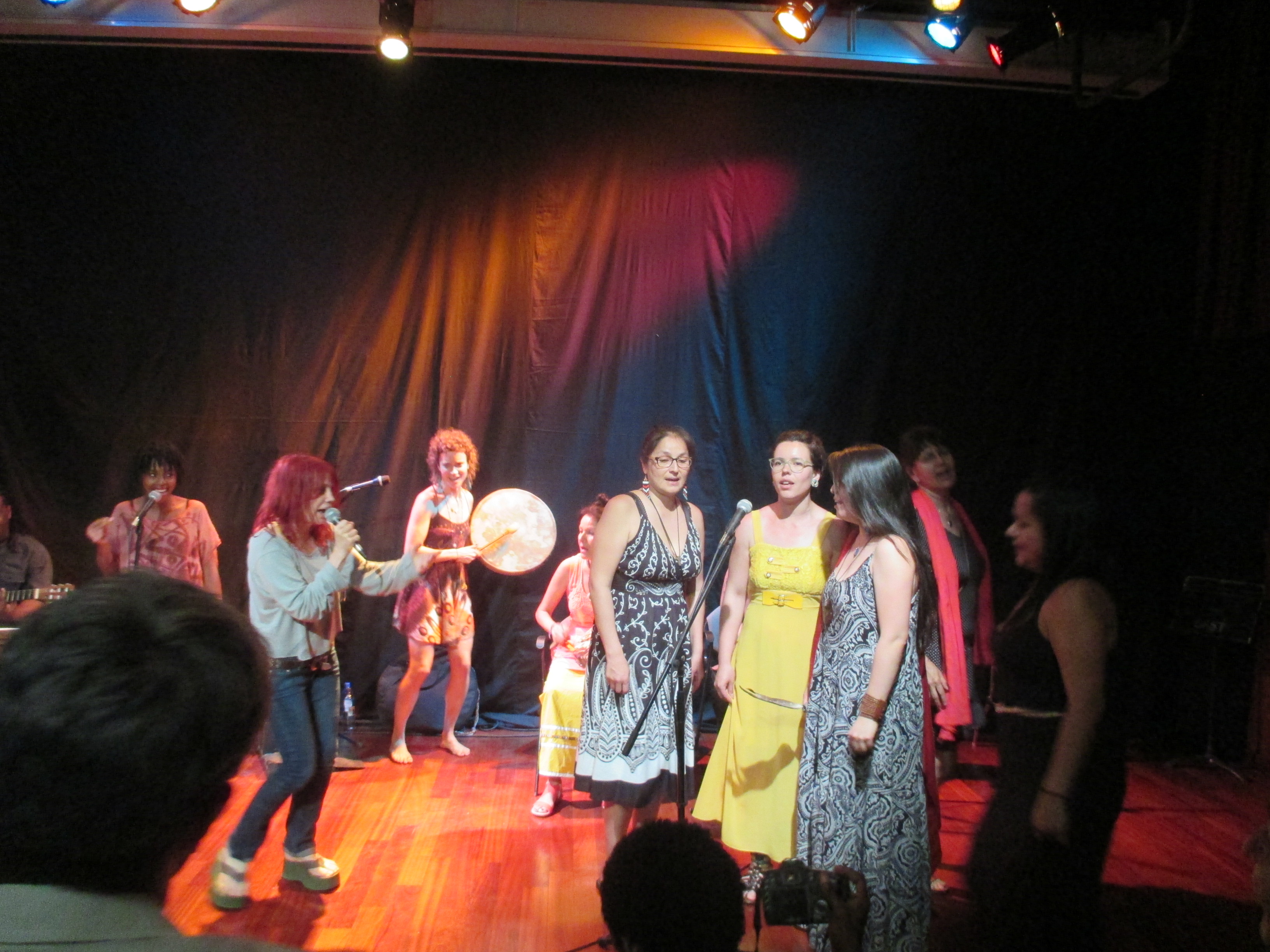
    Les nuits amérindiennes, Port-au-Prince Haiti, May 2015. Performers include: Chloé Sainte-Marie, Moe Clark, Marie-Andrée Gill, Rita Mestokosho, Natasha Kanapé Fontaine, Naomi Fontaine.

    What’s the point of going to see a poetry show if you can’t understand the text? And yet—there it is. That galvanizing, pure communication of the concerns, the beauty, the specificity of another language. The most joyful expression of it that I’ve seen so far was at an unforgettable night with the inzync Poetry sessions in Stellenbosch, South Africa. At least five of South Africa’s eleven official languages were represented onstage, with whispered translations offered by audience members to their neighbours, and whoops of recognition along the way.

    I wanted more.

    Port-au-Prince, May 2015

    I’m nearly the sole Anglophone, and definitely the only Northern Irish, at Les nuits amérindiennes, a festival of First Nations poets and artists in Port-au-Prince, Haiti, curated by the inimitable Rodney Saint-Éloi of Montreal-based publishing house Mémoire d’encrier. The Indigenous poets from Quebec include Joséphine Bacon, Guy Siou Durand, Tomson Highway, Virginia Pésémapéo Bordeleau, Louis-Karl Picard, Natasha Kanapé Fontaine, Moe Clark, Marie-Andrée Gill, and Naomi Fontaine. I’ve been sent by the Edinburgh International Book Festival to meet with Joséphine, Natasha, and Naomi for a collaborative project. This is my introduction to Canadian, to québécois, to Indigenous literature. I have no idea what’s going on, and I can barely understand anyone (my Belfast schoolgirl French being wholly inadequate in the circumstances). But at the shows, I’m electrified by the performance and the politics, the unself-consciousness, the self-awareness, the clear-eyed passion, the trickster craftiness—and well-honed craft—of the various artists.

    Nobody really understands why I’m there either, although it’s not that important—this isn’t about me. But I’m not that good at sitting on the sidelines and I’m desperate to communicate, somehow. At the second late-night session at Café Yanvalou, I sidle up to Rodney and ask, haltingly, if I can take a turn at the microphone. The words will be in English, but it’s the only thing I can think of to do. I sweat through a couple of poems, with halting introductions in French. I talk about my mother, and the sea. It works. I cannot speak, but I can extend words. The connection is made. These will become lifelong friends (and in one case, the love of my life, and the beginning of my journey to Montreal).

    Edinburgh, December 2016

    I am finishing up six years in Edinburgh, Scotland, which has mostly been consumed and absorbed with poetry, performance, promoting events, teaching workshops. It’s been a fantastic life. I have been incredibly lucky, starting from the gritty basics of open mic nights and running shows, and ending up being able to make a living, a good living, from all this. I love my community, I love my work, I love, more than anything, what happens when people get on a stage with their words, and speak them to an audience. And I’m leaving it.

    Even I’m not entirely sure why, except that there is love on the other side of the Atlantic. And there is a chance, a real chance to follow this thread of poetry and of performance, and try to understand how, if one cannot follow the sense of the words in an art form that bases its craft on the finer points of language, one can still be so affected by multilingual performances. In Quebec, my native language—which I have spent the last few years learning how to wield as a poet—becomes one among many.

    Montreal, November 2018

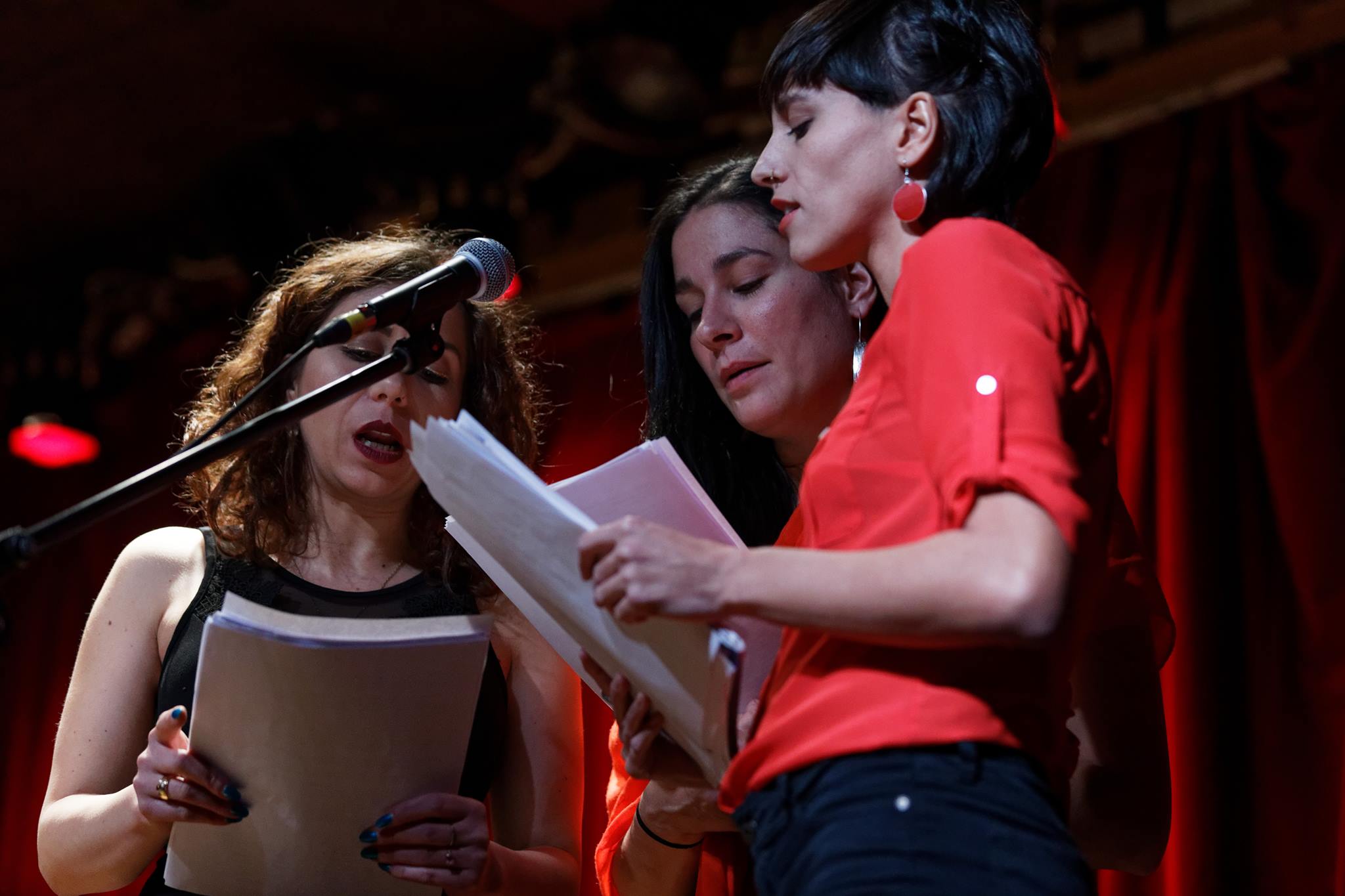
    I’m at Langues liées // Linked Tongues in La Sala Rossa, Boulevard Saint Laurent, Montreal. It’s the opening event of the Mile End Poets’ Festival, and there are ten poets on stage. There are ten languages on the stage. Aside from French and English, there is Arabic, Creole, Korean, Innu-aimun, Italian, Occitan, Persian, Portuguese, Spanish, and Wolof. These are mother tongues, and father tongues; languages of politics, of home, of love.

    Languages talk of their own concerns, at once specific and universal. Martha Tremblay-Vilão sings saudade, the Portuguese longing for a past or a home that no longer exists. Hossein Sharang talks of Iran, of democracy, of the impossibility of a country of eighty-two million terrorists. David Bouchet asks—in Wolof, with the aid of cue cards (and his fellow poets): “Where are you, who are you, how are you?” Marcela Huerta performs the stiltedness, then fluidity, of learning English as the daughter of Chilean refugees.

    The audience doesn’t understand everything that is being said, but there are ripples of comprehension when a new language is presented. There is a table of Arabic speakers, another of Portuguese. Maëlle Dupon’s mother is in the audience to hear her perform in Occitan; another supporter, a Haitian friend of Maëlle’s, is blown away when his ears catch the Creole of Chloé Savoie-Bernard.

    In La Sala Rossa, the last impressions are of joy. Of something ventured and something gained. Of respect. Everyone on that stage can do something that no one else can. They’ve worked for this show, they’ve risked, they’ve listened to one another, translated, called out and responded. And we’re here, and we will listen.


    RachelMcCrum_headshot

    Rachel McCrum is a poet, performer, and promoter—and also the Membership & Communications Co-ordinator of the Quebec Writers’ Federation.* She is originally from Northern Ireland, and has performed and taught poetry in Greece, South Africa, Haiti, Canada, and around the UK. She lived in Edinburgh, Scotland, from 2010 to 2016, where she was the inaugural BBC Scotland Poet-in-Residence, a recipient of an RLS Fellowship, and the co-host of cult spoken word cabaret Rally & Broad. Her first book, The First Blast To Awaken Women Degenerate, was published in 2017. She has lived in Montreal since January 2017, where she co-directs (with Ian Ferrier) the Mile End Poets’ Festival and curates the bilingual poetry performance series, Les Cabarets Bâtards.

    *As an employee of the QWF, Rachel has waived the fee for this article.

    Photo credits: Michael Kovacs (header image, showing Maëlle Dupon, Uasheshkun Bacon, and Martha Tremblay-Vilão reading in Occitan, Innu-aimun, and Portuguese at Langues liées // Linked Tongues); Rachel McCrum (top image); Ryan McGoverne (headshot)

  • The Joyous Sea of Words—by Erín Moure

    The Joyous Sea of Words—by Erín Moure

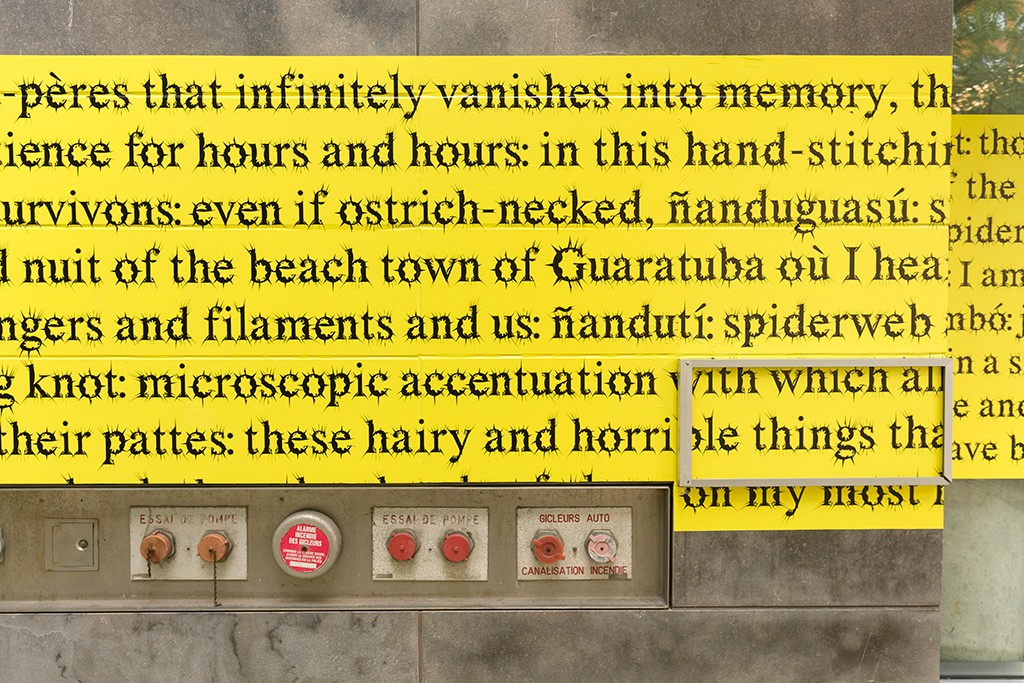
    “one dusk après une autre I sit ici on this sofa diagonal to the window, and in sitting it’s presque as if everything’s crumbling into bits: cramps in the guts: setting sun weaving humid nuances: spaces from où move déjà les occupations cérémoniales of light and lune: between the crowns of sombreros or entre les durs vides of the fig tree that devastate into shadow and suspicion in the crépuscule of the sea resort: figuier, couronne, sombreros: la ancestral speech of fathers and grands-pères that infinitely vanishes into memory, they entertain all speech et tricot: these Guaraní voices simplement eternalize as they go on weaving: ñandu: there is no better fabric than the web des feuilles tissées all together, ñándu, together and between the arabesques that, symphonique, interweave, checkerboard of green and bird et chant, in the happy amble of a freedom: ñanduti: ñandurenimbó:”

    — Excerpt from Paraguayan Sea

    1504277468990On the evening of November 9, 2017, there was sheer delight on all sides at Concordia University’s FOFA Gallery in Montreal, where the public gathered with me, artist Andrew Forster, and renowned translation theorist and researcher Sherry Simon to talk about Forster’s outdoor exhibition, Mer paraguayenne / Paraguayan Sea. For months, the EV building at the corner of Ste. Catherine and Mackay streets has been wrapped with wide, yellow banners holding words from Wilson Bueno’s Paraguayan Sea, in my translation. The bright colour of the banners and the strangeness of Forster’s barbed font attract the attention of passersby to words in three languages.

    Forster, a longtime creator of design works and mixed-genre, public access art, teaches part-time at Concordia. He created a font that seems to have an excess of serifs, that looks almost like barbed wire and seems to needle the viewer. The text on the banners is from the late Brazilian writer Wilson Bueno’s novel, Mar Paraguayo—famed in South America—which I recently translated from the original Portuñol (a mixture of Portuguese and Spanish) and Guaraní (an Indigenous and official language in Paraguay).

    Translating this novel was a daring act. How to translate a mixed-language book into English? Well, by translating into mixed languages, of course—into a “mixelated” English. I ended up producing a polylingual text incorporating French, English, and Guaraní. And what better place to do that than in Montréal, a ville francophone majeure that deliciously contaminates all the other languages brought to it?

    At the event, I read for five minutes from my translation of Paraguayan Sea and talked about how languages change the mouth, and how, therefore, reading from a mixed-language book confounds the accent, creating an aural sound event that is unexpected every time. It is as if my mouth were a public hubbub and not mine, as if my mouth belonged now to language itself and not to me and my Erín brain.

    Forster spoke about his work of art, and the way he chose to “turn Bueno’s language toward the street,” via my translation. He wanted Bueno’s text to flow there, to make a building vibrate with language that interpellates the passersby. He asks: “How does this viscera of poetic language compete with all the other words of advertising and branding on the street?” The text, he noted, is not simply bilingual, or trilingual, but moves in and out of three different languages, making one meaning coalesce, then shatter, then re-form. As such, the banners reflect not an official politics or policy of language, but a lived and creative amalgam of language and meaning, one reflective of Montréal’s urban multiplicity. Forster quoted art critic Stephen Horne, who says in an as-yet unpublished essay that my collaborative work with Forster resists and protests not meaning (for it overflows with meaning) but “proper meaning.” It’s an unruly text that Wilson Bueno created in Brazil, and now we can embrace it as ours.

    Forster spoke too of creating the font, and how the project was funded. For it was funded not by the agencies that fund laboratories far from the street, but in great measure by the part-time faculty association at Concordia, CUPFA—which believes in art and language as well as in collective agreements. The banners, Forster noted, even become part of the view from inside the Pharmaprix drugstore across the street.

    We heard comments from folks who’d seen the work from taxis, and, amazingly, there were two people from Paraguay present. They had come because the Guaraní language called to them from the street.

    “: here I sit: ñandu: to inflect into the crochèterie my ñanduti renderings: ñandutimichĩ: smallest ti-fleur that persists with the needle barely for the excruciating patience of a few hours: in these sutures, salt clocks, that keep themselves smeared with the fluctuating couleurs du coucher du soleil that play themselves out in les automnes de maintenant: here ñandu: an opacity of feeling: je m’assois: assise: ñandu: my cancerish word is s’asseoir: me voir: ñandu: winter more than automne panique autumn: ñandu: what is the secret of identité entre these deux things absolument distinctes: spiders and scorpions?”

    — Excerpt from Paraguayan Sea

    1504277528360Ñandutí, said Valeria, a Montréal architect from Paraguay, I saw nothing else but the word “ñandutí” and I thought: “What is this word doing here? How did it get here?” It is not usual to see Guaraní in Montreal. She googled the word and Concordia together, found out about the event, and came. She spoke of the significance of the fabric and lace known as “ñandutí,” how it weaves seven-million Paraguayans together, and how amazing it was to see its weft embracing English and French in Montréal.
    It’s one of the joys of translation that, as a translator, I can bring a work into my community and convoke other people into the flow of words that is also a sea of language containing us all. In this case, though, Paraguayan Sea, in my translation, was published in the USA, not Canada. Canadian literary small presses rarely publish translations of works by foreigners, even if translated by Canadians, because they are not able to use their Canada Council funding in such cases to offset the cost of publishing and marketing. As a result, it is difficult to invite Canadian-chosen and translated works across borders to join us in book form. This time, it was an artist (Andrew Forster), a university (Concordia), a fine arts gallery (FOFA), and a part-time teachers’ association (CUPFA) who invited the words of Wilson Bueno across that final border. To be with all of us.


    erin-moure_authorphotoErín Moure is a poet and translator. She has published over 30 books of poetry, essays, memoir, and translations from French, Spanish, Galician, and Portuguese. She lives in Montreal.
    Author’s note: Thanks to the FOFA Gallery, Concordia professor Sherry Simon, Montréal artist Vida Simon, Paraguayan poet Christian Kent, Chilean poet Andrés Ajens, Brazilian poet and editor Claudio Daniel, the spirits of Wilson Bueno and Nestór Perlonguer, and above all Andrew Forster, all of whom are now joined in the beautiful web of language to which Wilson Bueno convokes us, urging us to move across borders, languages, genres, and genders, to delight in literature and reading and life.

    Andrew Forster’s exhibition, Mer paraguayenne / Paraguayan Sea, is held at the FOFA gallery until December 8, 2017 (FOFA Courtyard, intersection of Ste. Catherine and Mckay streets).

    Visit the Nightboat Books web page to learn more about Erín Moure’s translation of Wilson Bueno’s Paraguayan Sea.

    Photo credits: Guy L’Heureux (yellow banners); Terence Byrnes (author’s headshot)

  • Gadfly at the Festival by Peter Richardson

    Gadfly at the Festival by Peter Richardson

    In the hospitality room at the Hôtel Gouverneurs in Trois-Rivières, you are greeted by two perky volunteers whose first question after introductions is: “Will you three be reading the French translations of your poems yourselves, or will you be requiring the services of a French reader?” Oh, my, you think. What translations? The hotel carpet begins to yaw under your chair. What was I thinking coming to a poetry festival in a city whose population is 97 percent French—without translations?

    Ahhh,” your hand goes up, feigning nonchalance, “I don’t have any translations with me.” The two other English-language poets and the volunteers swivel their heads in your direction as if you had just morphed into a large red crustacean whose claws and antennae waved merrily in their direction. “Can I give a short explanation of my poems in fluent French and then read them in English?” One of the cordial volunteers laces her fingers together and lowers her voice: “You see, people reserve restaurant tables months ahead to hear our guests read in French. It would be unfair, don’t you think, to subject them to English, when most people here rarely speak it?”

    How could you have not foreseen this eventuality? For the next twenty-four hours, you huddle with a hotel dictionary, churning out translations and cross-checking these with your translator sweetheart via long distance telephone. You thank fate that years before, you earned a university certificate in French-English translation. Although that hardly qualifies you as an ace in Gallic syntax, it limits the number of world-class howlers you’re likely to churn out. You are going to have to revise up to the wire. And once a reading is finished, there will be no stopping off for sparkling conversation with fellow scribes in downtown Trois-Rivières. It’ll be back to your room to crank out more translations. There are four readings a day in restaurants, bars, parks, and libraries; you’ll have to furnish two poems, four times a day.

    Accordingly, you show up for each venue as if this were a lark, your fraudulent grin assuring audiences that you’re dishing up the real thing, the slaved-over equivalents they’ve come to expect. The rest of the time you are a mole, looking up words like “dip” or “wobble” in a battered Robert-Collins. At readings, you unfold two sheets of spiral notebook paper and smile at your hash-marked, arrow-filled texts as if it were normal to achieve verbal legerdemain with the French versions overnight.

    You can’t point to the Russian poet, Evgeny Tchigrinne, huddling by the hotel elevator in a rumpled hockey team manager’s parka, and say to his interpreter companion: “It’s not fair. He should have to read his stuff in French too.” You can’t complain that Andrés Morales—one of the leading poetic lights in Chile, a man who also speaks Croatian and English—should be prevailed upon to read his translator’s French versions. His credentials precede him, and plus, with his dark suits, Brylcreemed hair, and killer smile, he is a serious candidate for the festival’s Mr. Cordiality Award.

    “At readings, you unfold two sheets of spiral notebook paper and smile at your hash-marked, arrow-filled texts as if it were normal to achieve verbal legerdemain with the French versions overnight.”

    The other English-language poets seem like consummate professionals. The Canadian geneticist-poet, Jan Conn, for instance, looks you straight in the face and says: “Months ago, I commissioned someone to translate twenty of my poems. I knew I’d have to have this stuff ready. I practiced it for weeks.” When she says this, you feel as though you’ve been transported back to that fourth-grade field trip to the Hayden Planetarium in New York City, where, standing in the cafeteria’s lunch line, you reached into your pants pocket for change and pulled out pebbles. Earlier in the day, while waiting for your mother to drive you to school, fearing you would miss the bus from school to the planetarium, you found yourself scooping up pebbles and chucking them by the handful, and some of these found their way into your pockets. But so what if you’ve spent a lifetime picking nickels out of the pebbles in your pockets?

    Does it stop you from making interesting acquaintances? No. And your readings manage to clear those imaginary telephone wires at the opposite end of an airfield that is a reader’s five minutes at the microphone. Your cloth-and-wire craft ascends. It swoops up to a reasonable height in the short runway’s space over the tilted beer glasses and stilled bar chatter and its undercarriage avoids calamity. But without good conversational French, without a chameleon-like ability to don an entertainer’s alter ego at brasserie readings, without a knack for chuckling your way through introductions which contain a reference to the dog-eared papers you clutch, you shudder to think how this forty-eight-hour period might have transpired, and how close you came to earning the title: Worst Anglo Festival Invitee Ever.


    IMG_1483Peter Richardson is the author of four collections of poetry: A Tinkers’ Picnic (1999), finalist for the Gerald Lampert Award; An ABC of Belly Work (2003), short-listed for the Acorn-Plantos Award; Sympathy for the Couriers (2007), winner of the QWF’s 2008 A. M. Klein Award; and Bit Parts for Fools (2013), which was short-listed for the Archibald Lampman Award. A retired airline worker, he lives in Gatineau, Quebec.

    Photo: Via Flickr; no changes made (top); Martine Chapdelaine (headshot)

    Peter Richardson, Jan Conn, and a small group of other authors will be reading on April 11, 2016 at the launch party of Vallum Magazine‘s Issue 13:3. The Brass Door Pub (2171 Crescent Street, Montreal), 7:30 p.m.

  • Hadassah Arms and Other Quandaries: Translating Cultures by Anna Leventhal

    Hadassah Arms and Other Quandaries: Translating Cultures by Anna Leventhal

    douce-sweet

    In early 2015, I stood in front of a window at Renaud-Bray, looking at a poster that was taller than I was. The poster had my name on it – it was the cover of the French translation of my first book. More than amazement, more than excitement, I felt bemused. This isn’t my book, I thought. Is this my book? Ceci n’est pas mon livre.

    Translation seems to be on everyone’s langue these days, with Kim Thuy’s translated Ru winning Canada Reads, several new translations of Nelly Arcan hot off the presses, and a renewed curiosity about cultural hybridity in the air. The ethical and aesthetic considerations of moving between languages seem like fertile ground for conversations we ought to be having, especially in Quebec.
     

    “Translation seems to be on everyone’s langue these days””


    When I found out that there would be a French translation of my newly published book, I was thrilled; as a transplanted Winnipegger, I felt it implied a level of acceptance in a city where I’m still considered “an outside eye” after fifteen years. I was excited to think that my stories, most of which are set in Montreal, would be accessible to the roughly two-thirds of the city’s population that read in French. But the work of translation isn’t just about making stories accessible. It’s about making them legible: creating a context so that they don’t just exist in another language, they live in it.

    In Neil Smith’s funny and pointed column on this blog from February 2013, he writes about the dangers of translating English Montreal into France-French, where, as he says, a dépanneur becomes chez l’Arabe and câlisse becomes putain de merde. The result: a work that’s as absurd as Duddy Kravitz sipping Earl Grey and exclaiming “jolly good, old fellow!” There was no danger of this for my book, as its translator, Daniel Grenier, is a Québécois writer. Any fears I had were laid to rest when I saw he had titled one story “Un hostie de câlisse de gâteau” (“A Goddamn Fucking Cake”). It’s a richly Québécois translation, a translation full of pis and vinegar. Grenier gamely took on an exhausting number of puns, cultural references, word-plays, and dumb inside jokes, and made them legible to a Franco-Québec audience.

    Some of the equations were simple, he told me. One of my friends wondered how the translator would handle a sign held by an environmental protestor that read ASBESTOS? ASWORSTOS! Easy, Grenier responded: AMIANTE? ENNEMIANTE! He turned a porn star named Iona Dildo into Jaymon Dildo and some misread graffiti from AUNT to FLOTTE. He may have been having almost too much fun.

    But there were complications. At one point, Grenier wrote me to ask about the expression “Hadassah arms.” How to go about making it legible for a Québécois audience?

    Now, even among Jews, “Hadassah arms” isn’t especially well-known. It’s a mean and fairly misogynistic way of naming that particular upper-arm sag/jiggle – so called because Hadassah, a Zionist women’s organization, mainly consists of older women. But it’s not a Jewish term that’s been popularized, like chutzpah or schlemiel. I know it because my friend’s dad used to tell us to lay off the Doritos or we’d end up with Hadassah arms. It may have been specific to her family; I’ve never heard it since. But I stole it for a family I was writing about, because I liked the specificity of it, the suggestion of a family joke or family mythology. Grenier could either do some creative idioming and write “bras style-Hadassah” or something like that, or find a new way of saying it that would make the image clear, but lose the Jewishness of the phrase.

    So what to do? Keep the image, lose the Jewish? Or the other way around?

    How important is it to make your work accessible to an audience unfamiliar with your culture, whether it be ethnic, geographic or social? Do you want your readers to immerse themselves in a warm bath or a cold lake? In a sense this is what writers are always doing: walking the line between over-explaining your characters’ world, and letting the world speak for itself.


    “How important is it to make your work accessible to an audience unfamiliar with your culture, whether it be ethnic, geographic or social?”

     
    In the end, I told Grenier that, in this case, the image was more important. I didn’t want readers to trip over an unfamiliar word and fall out of the story’s world; there would be other opportunities for them to be seduced by unfamiliar expressions and identities.

    The solution? Les gras de bingo. Equally mean, and equally evocative, but of a slightly different family than the one I wrote. In a small way, my characters lost a bit of their identity, and were given a new one, as though they had passed through the Ellis Island of literature. This, I’ve decided, is what I love about translation. My book; not my book. My city; not my city. A beautifully imperfect balance.


    Anna LeventhalAnna Leventhal‘s short story collection Sweet Affliction was published in 2014 (Invisible Publishing). It won the 2014 Quebec Writers’ Federation Concordia University First Book Award, and the French translation (Douce détresse) came out in 2015 with Marchand de feuilles. She lives in Montréal.