
“one dusk après une autre I sit ici on this sofa diagonal to the window, and in sitting it’s presque as if everything’s crumbling into bits: cramps in the guts: setting sun weaving humid nuances: spaces from où move déjà les occupations cérémoniales of light and lune: between the crowns of sombreros or entre les durs vides of the fig tree that devastate into shadow and suspicion in the crépuscule of the sea resort: figuier, couronne, sombreros: la ancestral speech of fathers and grands-pères that infinitely vanishes into memory, they entertain all speech et tricot: these Guaraní voices simplement eternalize as they go on weaving: ñandu: there is no better fabric than the web des feuilles tissées all together, ñándu, together and between the arabesques that, symphonique, interweave, checkerboard of green and bird et chant, in the happy amble of a freedom: ñanduti: ñandurenimbó:”
— Excerpt from Paraguayan Sea
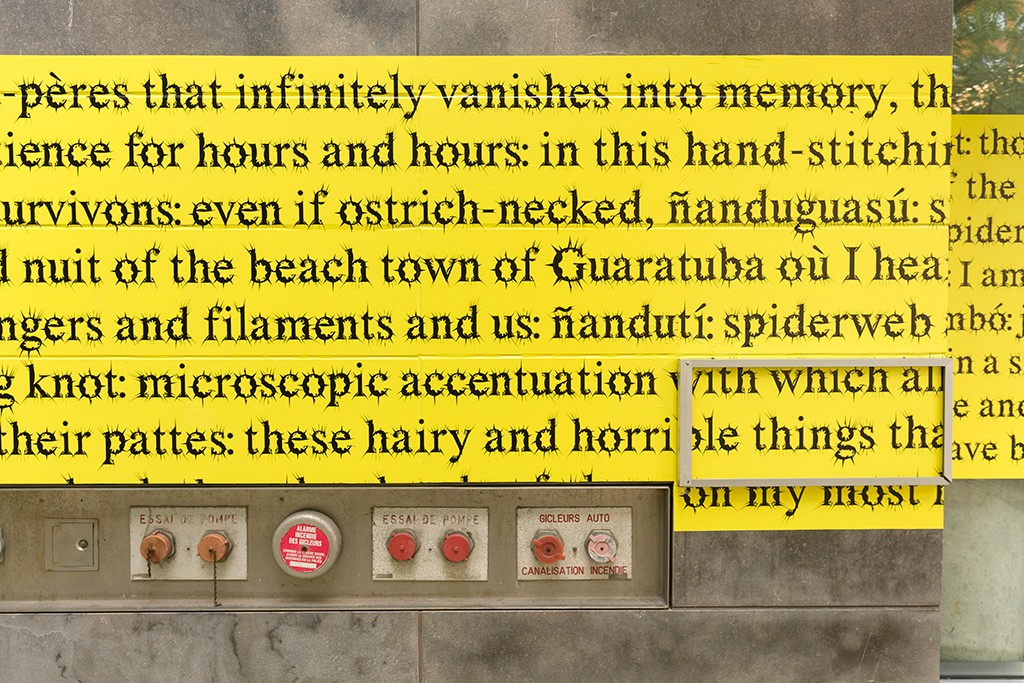 On the evening of November 9, 2017, there was sheer delight on all sides at Concordia University’s FOFA Gallery in Montreal, where the public gathered with me, artist Andrew Forster, and renowned translation theorist and researcher Sherry Simon to talk about Forster’s outdoor exhibition, Mer paraguayenne / Paraguayan Sea. For months, the EV building at the corner of Ste. Catherine and Mackay streets has been wrapped with wide, yellow banners holding words from Wilson Bueno’s Paraguayan Sea, in my translation. The bright colour of the banners and the strangeness of Forster’s barbed font attract the attention of passersby to words in three languages.
Forster, a longtime creator of design works and mixed-genre, public access art, teaches part-time at Concordia. He created a font that seems to have an excess of serifs, that looks almost like barbed wire and seems to needle the viewer. The text on the banners is from the late Brazilian writer Wilson Bueno’s novel, Mar Paraguayo—famed in South America—which I recently translated from the original Portuñol (a mixture of Portuguese and Spanish) and Guaraní (an Indigenous and official language in Paraguay).
Translating this novel was a daring act. How to translate a mixed-language book into English? Well, by translating into mixed languages, of course—into a “mixelated” English. I ended up producing a polylingual text incorporating French, English, and Guaraní. And what better place to do that than in Montréal, a ville francophone majeure that deliciously contaminates all the other languages brought to it?
At the event, I read for five minutes from my translation of Paraguayan Sea and talked about how languages change the mouth, and how, therefore, reading from a mixed-language book confounds the accent, creating an aural sound event that is unexpected every time. It is as if my mouth were a public hubbub and not mine, as if my mouth belonged now to language itself and not to me and my Erín brain.
Forster spoke about his work of art, and the way he chose to “turn Bueno’s language toward the street,” via my translation. He wanted Bueno’s text to flow there, to make a building vibrate with language that interpellates the passersby. He asks: “How does this viscera of poetic language compete with all the other words of advertising and branding on the street?” The text, he noted, is not simply bilingual, or trilingual, but moves in and out of three different languages, making one meaning coalesce, then shatter, then re-form. As such, the banners reflect not an official politics or policy of language, but a lived and creative amalgam of language and meaning, one reflective of Montréal’s urban multiplicity. Forster quoted art critic Stephen Horne, who says in an as-yet unpublished essay that my collaborative work with Forster resists and protests not meaning (for it overflows with meaning) but “proper meaning.” It’s an unruly text that Wilson Bueno created in Brazil, and now we can embrace it as ours.
Forster spoke too of creating the font, and how the project was funded. For it was funded not by the agencies that fund laboratories far from the street, but in great measure by the part-time faculty association at Concordia, CUPFA—which believes in art and language as well as in collective agreements. The banners, Forster noted, even become part of the view from inside the Pharmaprix drugstore across the street.
We heard comments from folks who’d seen the work from taxis, and, amazingly, there were two people from Paraguay present. They had come because the Guaraní language called to them from the street.
“: here I sit: ñandu: to inflect into the crochèterie my ñanduti renderings: ñandutimichĩ: smallest ti-fleur that persists with the needle barely for the excruciating patience of a few hours: in these sutures, salt clocks, that keep themselves smeared with the fluctuating couleurs du coucher du soleil that play themselves out in les automnes de maintenant: here ñandu: an opacity of feeling: je m’assois: assise: ñandu: my cancerish word is s’asseoir: me voir: ñandu: winter more than automne panique autumn: ñandu: what is the secret of identité entre these deux things absolument distinctes: spiders and scorpions?”
— Excerpt from Paraguayan Sea
 Ñandutí, said Valeria, a Montréal architect from Paraguay, I saw nothing else but the word “ñandutí” and I thought: “What is this word doing here? How did it get here?” It is not usual to see Guaraní in Montreal. She googled the word and Concordia together, found out about the event, and came. She spoke of the significance of the fabric and lace known as “ñandutí,” how it weaves seven-million Paraguayans together, and how amazing it was to see its weft embracing English and French in Montréal.
It’s one of the joys of translation that, as a translator, I can bring a work into my community and convoke other people into the flow of words that is also a sea of language containing us all. In this case, though, Paraguayan Sea, in my translation, was published in the USA, not Canada. Canadian literary small presses rarely publish translations of works by foreigners, even if translated by Canadians, because they are not able to use their Canada Council funding in such cases to offset the cost of publishing and marketing. As a result, it is difficult to invite Canadian-chosen and translated works across borders to join us in book form. This time, it was an artist (Andrew Forster), a university (Concordia), a fine arts gallery (FOFA), and a part-time teachers’ association (CUPFA) who invited the words of Wilson Bueno across that final border. To be with all of us.
 Erín Moure is a poet and translator. She has published over 30 books of poetry, essays, memoir, and translations from French, Spanish, Galician, and Portuguese. She lives in Montreal.
Author’s note: Thanks to the FOFA Gallery, Concordia professor Sherry Simon, Montréal artist Vida Simon, Paraguayan poet Christian Kent, Chilean poet Andrés Ajens, Brazilian poet and editor Claudio Daniel, the spirits of Wilson Bueno and Nestór Perlonguer, and above all Andrew Forster, all of whom are now joined in the beautiful web of language to which Wilson Bueno convokes us, urging us to move across borders, languages, genres, and genders, to delight in literature and reading and life.
Andrew Forster’s exhibition, Mer paraguayenne / Paraguayan Sea, is held at the FOFA gallery until December 8, 2017 (FOFA Courtyard, intersection of Ste. Catherine and Mckay streets).
Visit the Nightboat Books web page to learn more about Erín Moure’s translation of Wilson Bueno’s Paraguayan Sea.
Photo credits: Guy L’Heureux (yellow banners); Terence Byrnes (author’s headshot)
 Peter Richardson