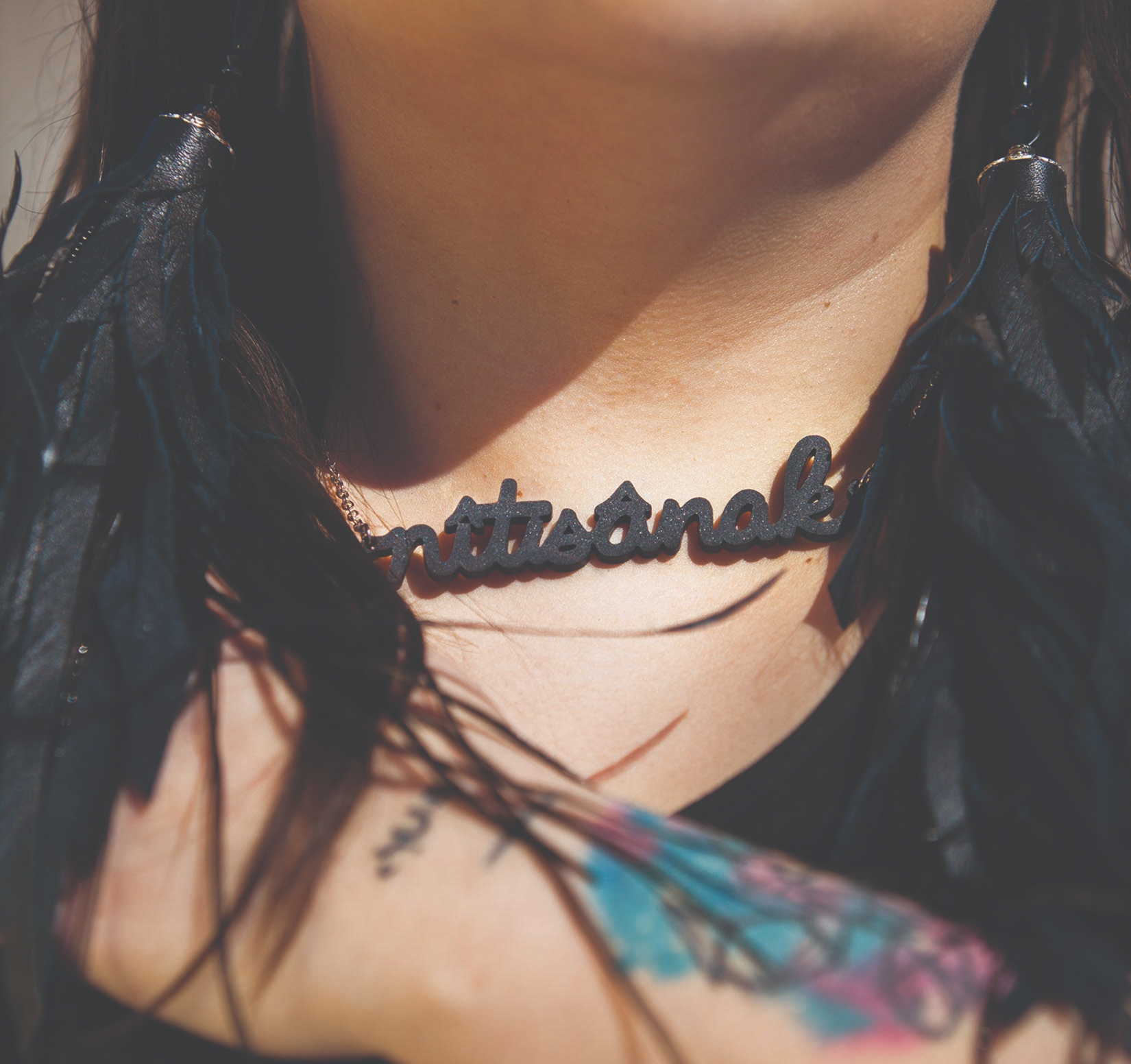
Recently, I was lucky enough to sit on a panel with fellow writers Erín Moure and Will Aitken. During the question period, an audience member asked: Is it ethical to write, publish, and profit off books that include accounts of personal traumas? An interesting question, indeed, and one that Indigenous writers are often pressed to answer.
Having just published my first creative non-fiction collection, nîtisânak, through Metonymy Press, I’m no stranger to weighing the ethics of writing about myself, and my relations, embodying various forms of trauma. I’m especially conscious of the vulnerable states some of my Indigenous relations live in, a fact that remains ever in the back of my mind when I write creative non-fiction. I’m also interested in the role that audiences play in how trauma-based writing is received. I would argue, even, that the audience—the reader—has a great deal of responsibility in how Indigenous trauma is perceived.
As a thought experiment, I will draw examples from the ethics associated with publishing personal traumas in the recently-released television series based on a Shirley Jackson novel, The Haunting of Hill House. It tells the story of the Crain children, who grew up in (spoiler alert) a haunted house, experiencing various traumas culminating in their mother’s suicide one supernatural night. Oldest son Steven has made millions selling books depicting the now infamous murder trial against his father, after his mother’s death was presumed a homicide.
Steven does not gain consent from the family members whose trauma he depicts. He also describes trauma he has not himself experienced. Viewers learn it was actually the other siblings who saw everything that happened that night, while Steven was fast asleep. What Steven depicts, as his sister would later tell him, is wholly untrue. He takes liberties with many events that occurred, fabricating his own account based on bits of information he has gathered over the years. It is not just that he publishes experiences that are inaccurate and not his own, but that the people who experienced them are still working through their understanding of what did happen. Steven’s publication of his fabricated version of events only further exacerbates the siblings’ already fragile states.
Yet Steven’s stories are presented as authoritative truth. Understanding “truth” in this context means understanding positionality. When Steven goes to visit a fan, she is enamoured by Steven’s celebrity. She assures him he did the right thing by publishing and asks when the next book will come out. Steven’s authority is assumed.
The Crains’ story is supernatural fiction. But for Indigenous peoples in Canada, the embodied traumas of colonialism can be a daily experience—not unusual, just a facet of everyday life. When Indigenous narratives are described as “traumatic,” I wonder: whose truths are we centering as the consciousness of Canada’s literary canon? Whose authorities, whose “truths” are deemed true, and whose are not?
In reply to the question, Is it ethical to publish (Indigenous) trauma, I would ask: trauma to whom? Who gauges what constitutes trauma? Now, are we talking about the ethics of writing about trauma, or the ethics of writing about Indigenous lives? Because, the lives of Indigenous peoples might seem traumatic to a largely white audience. What some might call trauma is just what we call life. So are we just not allowed to write our lives? Some of the power I feel comes through in my own writing, and that of my peers, is the biting wit we can tell our stories with despite what some might call “trauma.” As I told the audience member who asked about trauma, there are so many Indigenous narratives that haven’t been told because of the overwhelming whiteness of CanLit, as Vivek Shraya termed it.
The literary industry and Canadian publics are constantly, and especially, denying the truths of Indigenous women. McClelland & Stewart recently garnered negative media when it was uncovered that they had censored a portion of Maria Campbell’s Half-Breed that described her account of being raped by a Mountie. The ethics of Indigenous peoples writing their own lives is constantly called into question because of a normalized culture of paternalism in publishing when dealing with Indigenous stories. A white-coded lens propagates the assumption that Indigenous peoples are not equipped to make judgments about what stories are ethical to tell, and what stories might be harmful to tell, because their lives are positioned as inherently traumatic. Colonial actors such as ethics boards, in the supposed interest of Indigenous peoples, are seen as better equipped to make authoritative judgments regarding Indigenous knowledge and knowledge production about Indigenous communities than Indigenous communities themselves. All this denies Indigenous peoples self-determined representation. Indigenous peoples internalize that their truths are not, indeed, true.
Indigenous writing forces Canadian literary communities to confront the question of whose truth is witnessed as authoritative truth, and whose truths are not considered truth at all, because they negate a naturalized colonial and capitalist order in Canada (and Canadian publishing). Questions about the ethics of publishing trauma are seldom asked about fiction writing, though many a fiction writer has smarmed to me over cocktails, It’s all non-fiction darling, we just change the names. I remember reading Joseph Boyden’s The Orenda for the first time, taken aback at the incredibly violent, traumatic, and disturbing depictions of exploitative Indigenous trauma. But, because it was fiction, because it was in the name of literary writing, somehow it was presumed ethically above board. The Orenda is an example of the literary aesthetic of trauma written for a voyeuristic, non-Indigenous audience. It should come as no surprise, then, that it remains one of the most successful works of “Indigenous” fiction in Canada.
I won’t say that writing about trauma is always black and white. In my book nîtisânak, I was very thoughtful about the narratives I did include. In fact, a lot of it deals with working through my relationships with my white relations. That said, it would be nice to have the kind of conversations I want to about my work, not just from the perspective of the aesthetic trauma that CanLit so loves. Because I’m not trying to write about trauma. I’m just trying to write about what it’s like to be in this body. I’m just trying to write a beacon of light for all the other poor, queer, prairie NDNs trying to survive into the Indigenous future.
As I wrote in my book: Don’t mistake my words for trauma porn, because this is just how it went down for us. If these stories can’t be told without yt* tears being shed, that’s not my problem. No, my trauma is not a commodity, but my story doesn’t always have to be uplifting, resurgent, or revolutionary to be my truth, either.
* “Yt” is an abbreviation for the word “white.”
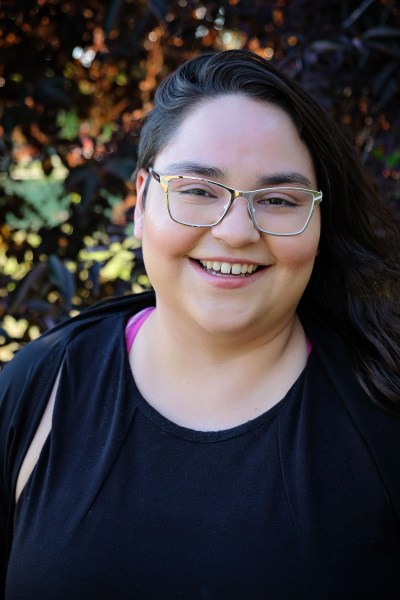
Lindsay Nixon is a Cree-Métis-Saulteaux curator, award-nominated editor, award-nominated writer, and McGill Art History Ph.D. student. They currently hold the position of Editor-at-Large for Canadian Art. Nixon’s first book, nîtisânak, is out now through Metonymy Press.
Photo credits: Dayna Danger (header image); Jackson Ezra (headshot)

 Licia Canton is the author of the short story collection Almond Wine and Fertility (2008), published in Italy as Vino alla mandorla e fertilità (2015). She is also a literary translator and founding editor-in-chief of Accenti Magazine. She has published personal and critical essays and edited nine books. She mentors emerging writers, journalists, and editors. She holds a Ph.D. from Université de Montréal and a Master’s from McGill University. See her profile in