Header image: Letters sent to Caroline Vu by her Vietnamese friends in the 1970s.
By some incredible stroke of good luck, I was invited last spring to Étonnants Voyageurs, France’s prestigious international literary festival. On top of a speaker fee, I would be reimbursed for my hotel, food and transportation. To my surprise, I was to appear on the same panel as the famous Dany Laferrière. I wondered if some FrenchLit assistant organizer hadn’t mistaken me for Kim Thuy.
“Dany Laferrière of l’Académie française fame! What will I say next to him? I’ll look like a dummy. Maybe I shouldn’t go…” I told my friend Lisa.
“Nahhh, go,” Lisa said.
“But… I’ll sound so stupid in my half-baked French! I hate public speaking,” I protested.
“Yeah, you’ll appear simplistic next to the pros. So what? Nobody will remember your mumbling the next day. But Facebook photos of you with Dany? That’s gold. They’ll live forever on the internet. Smoke and mirrors, that’s what counts…”
“You’re clever,” I said.
“I didn’t do an MBA for nothing,” Lisa replied.
I took my friend’s advice, said ‘yes’ to the invitation and went home to practice my French. Immediately I felt like a professional impostor.
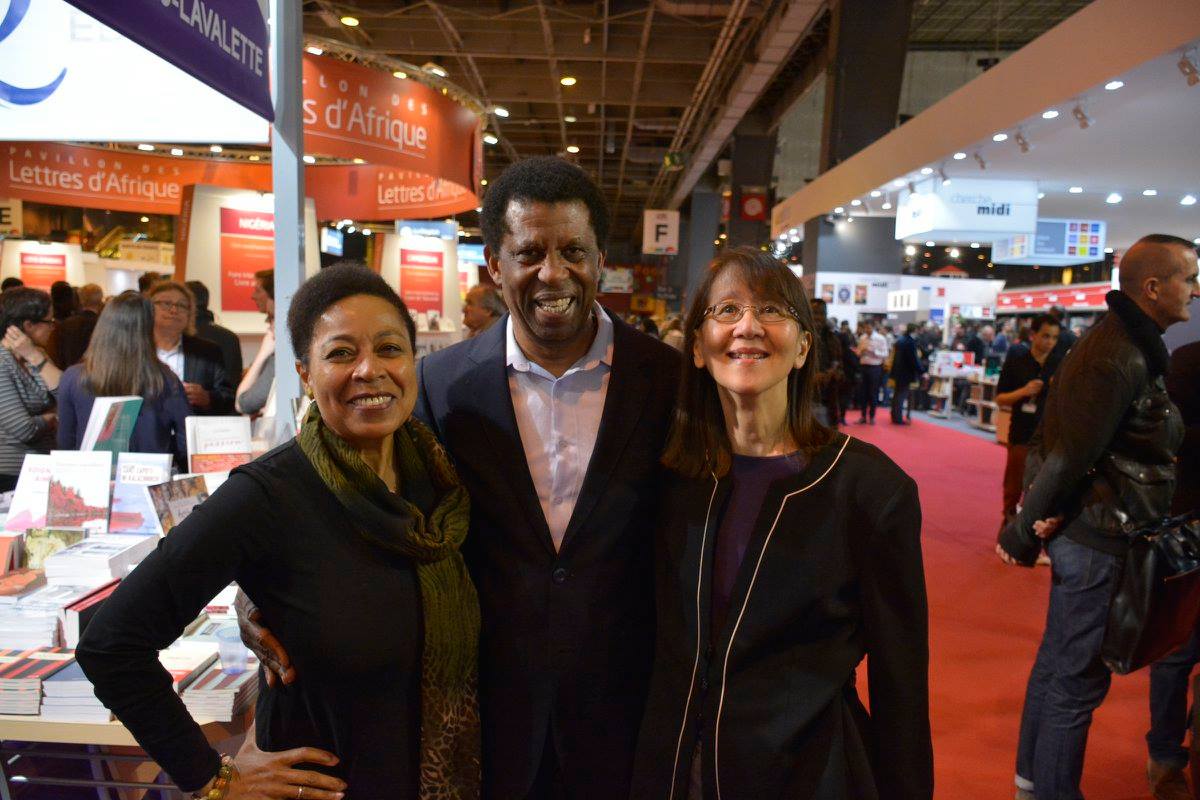
Étonnants Voyageurs, held each spring in the beautiful seaside town of Saint-Malo, is a festival to behold. Book lovers come from all over France and French-speaking countries to hear their favourite authors. In town, I had a large room overlooking the Atlantic. I was invited to champagne lunches. I met interesting writers from Canada and France. The sun shone throughout our stay. Yet I was restless—couldn’t sleep at night, was nervous during the day. I dreaded public speaking so much, I even thought about skipping the panels. “Sore throat, lost my voice… laryngitis. Can’t come, sorry…” I could use that as an excuse. Being a doctor, I could even give myself a medical note.
Of course I didn’t give myself a fake medical note. I did show up for the panels. Dany was accommodating both on stage and behind the scenes. To put me at ease, he made a friendly joke about shy authors. It was one of those rare moments when I actually laughed on stage.
I don’t remember much of what was asked of me on those panels or how I answered. Only one question stayed with me. It was a question I have been asked in the past: How did I start writing fiction?
To this question, some of my co-panellists mentioned being influenced by their father’s extensive library. Or a teacher’s encouragement. Numerous classical authors were named as sources of inspiration. Then the host turned to me: “How did you start writing? Which authors inspired you, Caroline?” Many authors had, but in my nervous state I couldn’t name anyone. I gulped, then decided to stick to the same narrative I’ve told friends.
I was eleven when I left my native country of Vietnam. It was during the height of the war. Overnight we went from chaotic, war-torn Saigon to a quiet Connecticut town. I should’ve been grateful for the change, but somehow I wasn’t. Not speaking a word of English, knowing nothing of American culture, I was lost. I was at an age when the sense of belonging seemed more important than the dangers of war. And in that small Connecticut school, I simply didn’t belong. So I hung on to the memory of old friendships. Daily I longed for the bond I once had with childhood friends still living in a ravaged Vietnam. My weekly letters to them eventually became exercises in obfuscation. Not wanting to burden them with my laments of loneliness, I made up stories of trading barrettes with popular girls, of throwing Frisbees to blond boys, of excelling in team sports. In reality, I’d spent my free time watching others play. In reality, I’d only heard “Boo!” in gym class since I could never grasp the strange rules of baseball.
Those letters to old friends were pure fantasy, I said. An eleven-year-old impostor, that was me. That was how I started writing fiction, I told the host. Some members of the audience nodded in sympathy while others smiled. I guess I didn’t do too badly.
That narrative about writing make-believe letters home is mostly true. I know I exaggerated some parts, but now I’ve forgotten which ones. With time I’ve come to believe wholly in my tale. A little varnish on the truth can’t hurt a good story—I’ve succeeded in convincing myself.
“Once an impostor, always an impostor,” I told Lisa with shame upon my return home from Saint-Malo.
“But aren’t all novelists impostors? Always concocting fake stories to lure readers? Always trying to milk some tears or laughter? Don’t worry!” Lisa exclaims.
“Hmmm…”
“Great Facebook photos with Dany, by the way! I’ve already shared them on Twitter…”
Ahhh, MBA-ers, what would we impostors do without them?

Caroline Vu was born in Vietnam and left her native country at the age of eleven. She moved to Canada after spending two years in the US. Caroline’s first novel, Palawan Story (Deux Voiliers Publishing) won the Canadian Author Association’s Fred Kerner prize in 2016. That novel was also a finalist for the Quebec Writers’ Federation’s Concordia University First Book Prize. Palawan Story was translated into French (Éditions de la Pleine Lune) in 2017 and was a finalist for the 2018 Blue Metropolis Diversity Prize. Her second novel, That Summer in Provincetown (Guernica Editions) has also been translated into French (Éditions de la Pleine Lune). Caroline currently works as a family physician in a community health clinic in Montreal.
Photo credits: Caroline Vu (header image); Courtesy of Éditions de la Pleine Lune (at Paris Livre); Marc-Antoine Zouéki (headshot)