Tag: voice

  • What If Your Computer Listened to You?—By Mariam S. Pal

    What If Your Computer Listened to You?—By Mariam S. Pal

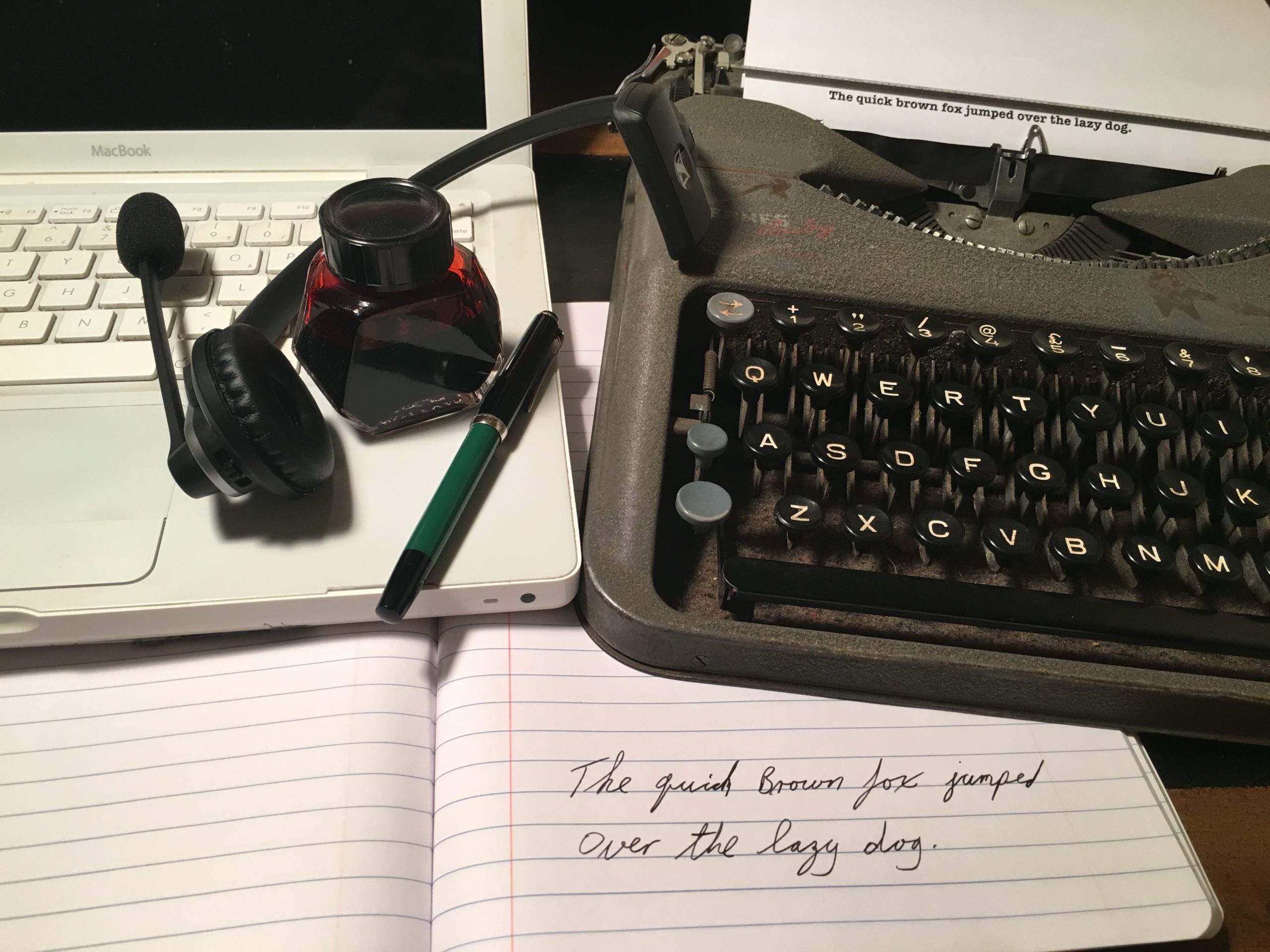
    “New line numeral one period space cap that the quick brown fox jumped over the lazy dog bold lazy dog exclamation mark.” My telephone rings. “Go to sleep,” I say to my computer, and the cute little green mic on its screen turns blue and shuts off. I answer my phone: “Hello?”

    It’s a typical day in my sunny second-floor home office. Headset on, I look like a faraway call-centre worker whose thankless task is to explain why your suitcase is in Montevideo. But I’m not calming cranky customers; I’m writing by dictation. I turned off my mic before answering the phone because otherwise, my conversation would have ended up as text on my screen.

    When I write, I don’t scrawl with a pen or pencil, hunt and peck on a keyboard, or even bang away on a typewriter. I slide on a headset, say “Wake up,” and start yakking at my computer. My voice recognition software converts speech to email messages, text in Word, and more. Line by line, paragraph by paragraph, my writing silently scrolls onto the screen every few seconds. I’ve been working like this for about fifteen years; chronic repetitive movement injuries forced me to look into alternatives to typing.

    I use Dragon Naturally Speaking, one of several voice recognition programs available to writers. It costs about the same as a couple of trips to the physiotherapist. If prescribed by a physician, voice recognition software is a tax-deductible medical expense. Google Docs, Windows 10, and Apple have similar features for free. All are based on the same technology.

    Leaning back in my swivel chair, feet up on my desk, I feel like Don Draper in Mad Men, dictating a letter. Unlike Don Draper, I don’t have a secretary, so I need to tell my computer where to add commas and what to capitalize. The first sentence of this essay, in “dictate-speak,” is what I would need to say in order to have the following text appear on my screen:

    1. The quick brown fox jumped over the lazy dog!

    Verbal commands allow me to switch the mic off or on, add punctuation, capitalize or underline. Don’t like the last sentence? Say, “Scratch that!” It’s erased. Want to change a word? Say, “Correct that!” then select one of several numbered options or type in your change.

    When trained for the user’s voice, my dictation software is 95 percent accurate. It’s important to use a good quality headset and to enunciate clearly. This makes it easier for the program to understand you.

    All this technology is great but it can drive you nuts. Despite repeatedly adding “Amritsar,” a city in India, to the dictation vocabulary, I still find “Emirates are” merrily spelled out on my screen. Argh! In my experience, homonyms are handled better: “four” and “fore” are rarely confused.

    Dictating changed my writing process. Once I got used to talking to my computer, I realized that I wrote for longer stretches of time. I was physically comfortable and relaxed. Writing was definitely easier and faster. Liberating my hands freed my mind to think more creatively. Like most of us, I speak faster than I type or write by hand. The words poured out of my mouth onto the screen. It was thrilling. I could finally get the ideas, descriptions, and dialogues swirling in my head onto the page and Dragon kept up with me. Once my words were on the screen I rewrote and refined them.

    At first, some of my dictated text sounded like emails or text messages. I used too many contractions and my sentences were either too long or too short. Colons, semicolons, and other punctuation from written English were noticeably absent. Eventually, I got better at verbalizing in a written style. I’ve developed a habit of working from an outline composed of key words or points. This keeps my dictation focused.

    If typing is painful, then it might be time to look into voice recognition. I caution that dictation is not the solution for everybody. If you write mainly in cafés or libraries, you probably don’t want the world to hear your masterpiece. Also, your microphone will pick up other voices, which will end up as gibberish on the page. Bilingual writers should know that voice recognition programs can only distinguish one language at a time. If you’re writing about going to a “5 à 7” or a dépanneur, you’ll have to enter these words manually.

    I love writing by dictation but sometimes low-tech is best. Simple corrections to dictated text are easiest typed in manually. And when I send a personal note or write the occasional cheque, I go no-tech and enjoy the tactile pleasure of writing: with a fountain pen, filled with ink from a glass bottle.

    fullsizerender 2

    Mariam S. Pal’s essays have been published in the Montreal Gazette, the Ottawa Citizen, The Globe and Mail, Le DevoirThe Times of India and The Hindu. She is completing a memoir about being Pakistani-Canadian. A recently published excerpt is available at http://south85journal.com/issues/spring-summer-2018/non-fiction/behind-the-walls. Mariam has an M.A. in Economics and B.C.L./LL.B. degrees in law, both from McGill University. She is semi-retired. Mariam and her headset live in NDG.

    Photo credits: Mariam S. Pal (header banner); Eli Krantzberg (headshot)

  • The Art of Mentorship: An Interview with Robert Edison Sandiford

    The Art of Mentorship: An Interview with Robert Edison Sandiford

    Every couple of weeks, Robert Edison Sandiford calls me from Barbados. Robert is one of this year’s QWF fiction mentors, and I am his protégé. We’ve made arrangements to speak at 5 p.m. via Skype so this interview would feel more face-to-face. At 5:10, we still have no audio so he switches from his desktop to his laptop. At 5:25 the recording app on my phone stops working. At 5:37 we decide we’ll have to hobble back and forth between the computers, a phone, and another phone app to somehow make it work. Afterwards, when it’s all sorted, he says: “Well, there’s a lesson about tenacity.”

    Robert was born in Montreal to Barbadian parents. He is the author of nine books that range in form from short and long fiction to memoir, graphic novels, and erotica. Over a period of four months, he’s worked with me on my own collection of stories and we’ve talked about many things: process and voice, the German writer Jenny Erpenbeck, and how baking helps to reduce stress. Robert answers my questions below.

    —Pamela Hensley

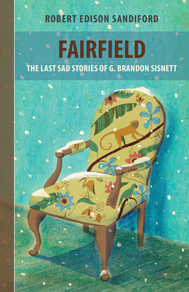
    Fairfield Cover

    PAMELA HENSLEY

    Let’s start with a quote from Fairfield, your most recent collection of short stories. In reference to engaging fiction, you say: “All that matters… is the individual and the moment.” Can you expand on that?

    ROBERT EDISON SANDIFORD

    In the context of the collection, it had to do with making the most of art. It had to do with knowing when something is ready or when an artist has what it takes. It comes from a quote by Matthew Arnold [“For the creation of a masterwork… two powers must concur, the power of the man and the power of the moment, and the man is not enough without the moment”]. How do you know when you’ve got what it takes? All we are is who we are and the talent that we have. My contention is that most people are a little better than they think they are. They can do better than they’ve done.

    HENSLEY

    Besides being a mentor, you’re an editor and teacher. How does one turn a good manuscript into a great one? Or a good writer into a great writer?

    SANDIFORD

    There has to be that spark within the work itself, or within the writer. There has to be something inside that person already that lends itself to greatness. And it may depend on how we define greatness. There are a lot of artists, not just writers, people who never enjoyed recognition while they were alive or young enough to enjoy it. So there’s that question again, of the individual and the moment and the individual and talent. There are certain things you can teach people to make them better writers but that sort of greatness, that may also depend on them.

    HENSLEY

    In Fairfield, a fictional editor writes that the character G. Brandon Sisnett borrowed from other authors, including one from Montreal who wrote Caribbean fiction on the themes of “familial loss and managing the pain of living.” Which are themes that recur in your work. Would you like to talk about theme?

    SANDIFORD

    I’m curious about theme. Both of us are writing from a particular place. Germany finds its way into your stories, as well as Canada. For me, it’s Barbados and Canada. Theme is distinct from subject matter but they inform each other. I write out of where I am but also where I come from. I do believe that all writing is regional, in a sense. People talk about things being universal but I think it goes to honesty. If you write in a way that is honest, the regional will get you to the universal. Someone will pick up the story halfway around the world and say, “I relate.”


    “There are certain things you can teach people to make them better writers but that sort of greatness, that may also depend on them.”


    HENSLEY

    Is place a detail?

    SANDIFORD

    Place is a necessary detail: your characters have got to be somewhere. But it’s more than that. It’s a space in which you invite the reader to share an experience. It’s about learning, actually. If I write about a particular place, I want you to feel that place. I want you to experience it as if you were actually there. Unless having a non-descript setting is important to telling the story, then why have this non-descript thing? I get the answer, “But I want it to be universal.” I just say, “Stop. What you may be doing is taking out the necessary edges that people need to relate to the story even more.”


    “I do believe that all writing is regional, in a sense. People talk about things being universal but I think it goes to honesty. If you write in a way that is honest, the regional will get you to the universal.”


    HENSLEY

    What’s the difference between style and voice?

    SANDIFORD

    Style and voice tend to be synonymous. But to make a differentiation, when writers are starting out I like to talk about approach. I used to talk about style but I think writers get confused. They say, “But the way I put it down is a style. I like to use all these ellipses when I write, that’s my style.” And I say, “No, that’s more of an approach and it may even be a bad approach.” Style is something that you develop over time. Voice is all those things combined. It’s reading a work and recognizing who it is. Ultimately, it’s telling a story in a particular way. It can’t be told by anybody else.

    HENSLEY

    You published your first story collection more than 20 years ago. Does it get any easier?

    SANDIFORD

    Hell, no! Publishing is more difficult now than it was before. Coming up with a story, I don’t know that that gets any easier. What gets easier, maybe, is knowing what works and what doesn’t. But I wake up every morning doing what I do and I have no regrets. Ever. That’s a hell of a thing to be able to say.


    On June 4, the 2017 QWF mentors and mentees will present new writing at the annual public reading in Montreal. Click here for more information.

    Rob Profile, ACA Painting BackgroundRobert Edison Sandiford is the author of nine books, most recently Fairfield: The Last Sad Stories of G. Brandon Sisnett. He is the founder, with the poet Linda M. Deane, of the cultural forum ArtsEtc Inc. A recipient of Barbados’ Governor General’s Award for his fiction and the Harold Hoyte Award for newspaper editing, he has also worked as a teacher and video producer.


    Pamela Hensley is new to Montreal, having relocated once again after returning from Germany to Ontario. She was selected to participate in the 2017 QWF Mentorship program and is currently attending her first QWF workshop. You can read her stories in Canadian journals, including The Dalhousie Review and EVENT magazine, and are invited to hear her read with other QWF mentees at The Comedy Nest, Montreal Forum on Sunday, June 4 at 2 pm.


    Photo credits: Pamela Hensley (top banner); Aeryn Sandiford (Sandiford headshot); Gordon Hensley (Hensley headshot)