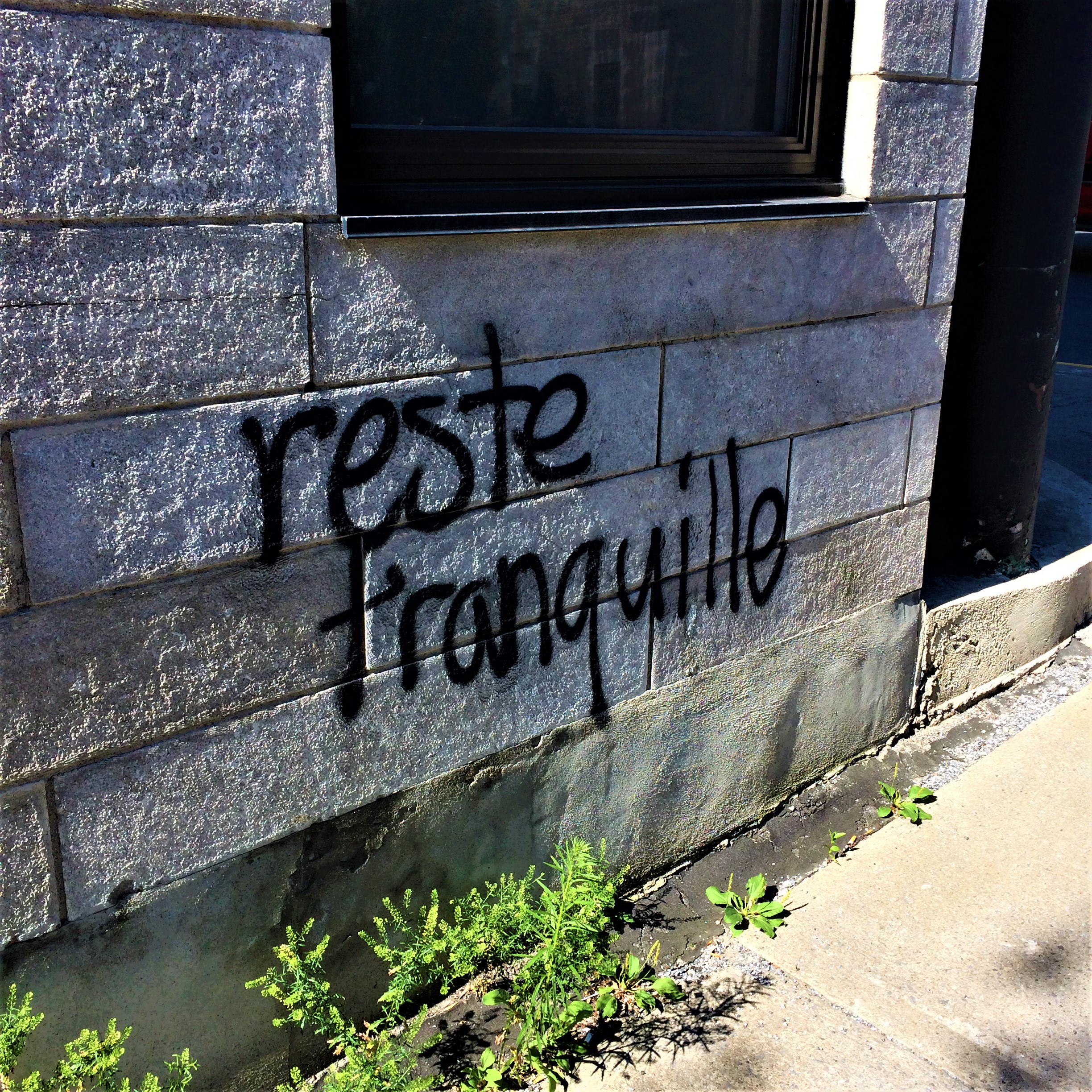
A DIALOGUE. Persons: John Arthur and Pal.
Scene: A deck in Hochelaga-Maisonneuve, one summer day.
JOHN ARTHUR: Would you like some more kombucha? No? … Hey, I’ve got a little story for you. A while ago, I submitted one of my monologues to a theatre festival where I was hoping to perform it. The comment I got back from the Artistic Director was that the show had too few words in it, relative to the show’s length. He estimated, based on the word count, that the show should take thirty-five minutes, but I’d indicated that it takes sixty minutes in performance, and he said that twenty-five minutes of non-verbal action is too much. Can you believe that?
PAL: Well, yeah. I mean, people are busy these days. If you give them silence, they’ll just start checking their phones. How many words was it, anyway?
JOHN ARTHUR: According to the appropriately named Word, it was 4,522.
PAL: So, that’s a lot of words. Get them out, and let your audience get on their way. Don’t be precious! Everyone has their story to tell, opinions to deliver. But you don’t need to milk it. Get your message across, and then make room for others.
JOHN ARTHUR: But … First of all, I’m not delivering opinions. It’s a piece of theatre.
PAL: That’s fine, but there’s a point to it, I imagine. You just need to make your point without dragging things out.
JOHN ARTHUR: Why does everyone assume that everything has to have a point?
PAL: You’re a writer, yeah? So when you sit down to write, you must have some point you want to get across.
JOHN ARTHUR: I have something to communicate, yes. But it’s not necessarily a “point,” as you call it. I’m not a journalist.
PAL: Okay, let’s say you have an imaginative notion—how’s that?—an imaginative notion to transmit. So, in the monologue you were just telling me about, you had—what was it?—4,522 words by which to transmit that notion. That’s a lot of words! There’s no need to then drag it out—
JOHN ARTHUR: If you say “drag it out” one more time! Anyway, all this “dragging out,” as you call it, is what is otherwise known as Life.
PAL: Oh no, please, don’t get all metaphysical on me, it’s ten o’clock in the morning. What I’m saying is, words have meanings. You’re a writer, so express your meaning in words and then leave it at that, don’t dr—
JOHN ARTHUR: Oh no, stop! Words, words, words!! It’s not all about the words. There’s another way of looking at this. Look, if that artistic director is right, and my monologue features twenty-five minutes where I’m not speaking, then that means a group of people who mostly don’t know one another are sitting in a darkened room together in quasi-silence for twenty-five minutes. When else does that ever happen?
[Silence.]
PAL: Look, I’m sorry that guy didn’t want your show. But I don’t really understand what point you’re making here.
JOHN ARTHUR: The point I’m making, since you’re so fond of “points,” is that we’re drowning in words. As a society, we are gasping for air, desperately thrashing around for a glimpse of the sun as we go under, dragged down beneath a tidal wave of words. Listen, back in about 1999, an editor I worked with raised tired eyes from her computer screen one afternoon and said to me wryly, “I’ve just been dealing with my e-mails. God help us, there is not a thought these days that is allowed to go unexpressed!” That was twenty years ago she said that, and all we were dealing with then was e-mail. Now it’s social media, smartphones, apps, and they’re all talking to us all the time, in words. We have words coming out of our mouths and entering our ears, we’ve got earbuds stuck in our ears to replace some words with other words, we’re writing like mad in the virtual world, tweets, posts, blogs, vlogs. Everybody’s a writer! We’ve got words seeping out of our—
PAL: Don’t be vulgar.
JOHN ARTHUR: No, but honestly, how many more words do we need?
PAL: Right! So don’t do your show at all. That’s 4,522 fewer words in the world.
JOHN ARTHUR: But I’m a writer-performer! And also an editor. I live by words.
PAL: Sweetie, you’re getting all worked up and not making any sense. So you’re a writer and you want to make words. But, you insist, there are too many words in the world. So what can I do to help you? You seem to be at an impasse. Would you like some lemonade?
JOHN ARTHUR: I guess what I’m asking is, are we simply aiming to cram as many words into our lives—into the available time, be it sixty minutes or sixty years—as possible? Or does silence (or, at the very least, word-free time) have a place? I just think that maybe, in 2020, one should have an opinion about this—especially if one is a writer. As writers, maybe we have a responsibility to write less and better, and even to think sometimes about what maybe doesn’t need to be expressed in words. What opinion or thought or observation can we just let sit, without formulating it in prose and then putting it out there? Do people really need to know that I thought Call Me By Your Name was a shitty film? Centuries ago, Saint John of the Cross wrote to a correspondent: “It was not from want of will that I have refrained from writing to you, for truly do I wish you all good; but because it seemed to me that enough has been said already to effect all that is needful, and that what is wanting is not writing or speaking—whereof ordinarily there is more than enough—but silence and work.”
[Silence.]
PAL: Um … did you just deliver a fairly lengthy quote from Saint John of the Cross?
JOHN ARTHUR: I did.
PAL: Do people even do that in real life?
JOHN ARTHUR: No, but in literature they do.
PAL: Okay … So, we’ll just sit with that, then, shall we?
JOHN ARTHUR: Why not?
[Silence, broken only by the bells of the church of Très-Saint-Nom-de-Jésus.]
NOTE: This dialogue was inspired by the form used by Oscar Wilde in “The Critic as Artist.” It may or may not have actually taken place.

John Arthur Sweet usually writes words that he expects to speak, as opposed to words he hopes others will read. In other words, he is a monologist and occasional spoken word poet. If we were living normal lives, he would currently be in England, performing at three theatre festivals. As it is, his last full-length show (Running to Saint Sebastian) was last year, at the Montreal Fringe, and before that, at the Prague Fringe (where he has performed four shows). He is a regular invited artist at Words and Music, most recently for a live-streaming edition in May. www.johnarthursweet.online
Photo credits: John Arthur Sweet


 Licia Canton is the author of the short story collection Almond Wine and Fertility (2008), published in Italy as Vino alla mandorla e fertilità (2015). She is also a literary translator and founding editor-in-chief of Accenti Magazine. She has published personal and critical essays and edited nine books. She mentors emerging writers, journalists, and editors. She holds a Ph.D. from Université de Montréal and a Master’s from McGill University. See her profile in