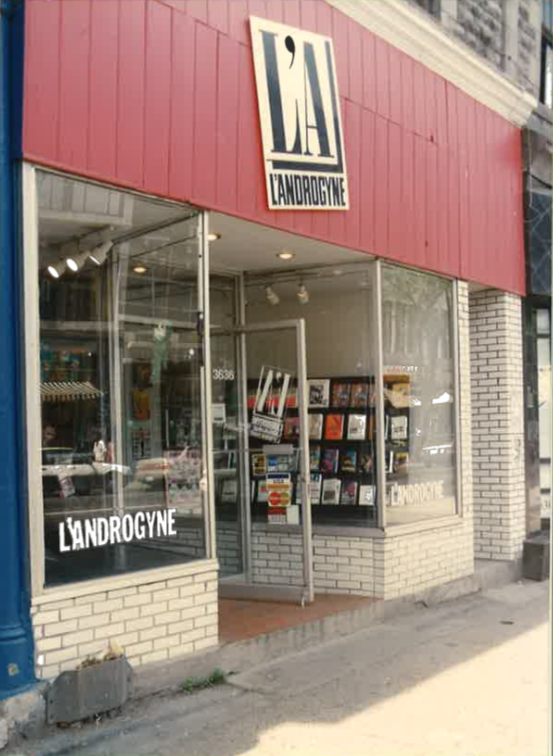
Montreal’s gay, lesbian, and feminist bookstore, L’Androgyne, closed for good in 2002. At the time, I knew I was going to miss it, but even now, some seventeen years later, I still feel its loss.
I don’t remember the first time I went inside, but I remember being nervous about it. Who would see me go in? And what would I find there? I still remember its address: 3636 St. Laurent. I remember its smell too: the books, the paper, the glue that held everything together. The place was small, a mere 1,200 square feet, with three rows of white bookshelves all built by hand. It was here where I discovered my favourite authors, where I first picked up copies of books by Armistead Maupin, Ethan Mordden, Sarah Schulman, Andrew Holleran, and Sarah Waters.
It was also here where I found community. Where I made friends—France, David, and Johanne—all working behind the counter. I’d visit several times a week, if I could, leaving not only with books or magazines but with stories about real people’s lives and the places and events and collected history that were all a part of this exciting community I had just found. Before the Internet, a city’s LGBTQ bookstore was where you got your news. It was where you could pick up queer publications like Fugues or Xtra or the Guide, flyers for parties, maps for marches. And it was also a place where you could develop a crush among the stacks, where you could smile and flirt and finally meet others who shared your interests.
Walking down the aisles, I’d sometimes imagine my own book on the shelves. At that time, I’d been writing for years with no indication that anything would ever come of it. How great would it be, I’d think, to see a book I had written alongside these legends (under D, somewhere between Delaney and Donoghue)? Sadly, I never got to know that feeling. By the time my first book was published, L’Androgyne was twelve years cold in the ground.
I’m sure many of you can relate to losing your favourite bookstore. L’Androgyne was not the only one to lose out as the world moved online. For the LGBTQ community, though, there was a moment when the arrival of the Internet held such promise. It meant that people could have more access to resources and information (especially those who didn’t live in urban areas). It was a place where we could congregate easily, expand our networks, and make connections. Yet something authentic was lost. Gone was the human touch, the spontaneity, the chance for discovery, the surprise of the unknown. Sure, I could Google “new gay fiction” if I wanted to know what to read next. I could add “booklover” to my dating profile. But gone were the deep conversations, the quiet browsing, the raucous laughter, the looking for friends, lovers, and other limited editions in the aisles.
When my book finally came out in 2014, I was disappointed there wasn’t a home for it. I did a few public readings in straight spaces, but rarely sold copies. There was no forum in Montreal for me to introduce my book to my community. And it wasn’t just me. All around I was seeing Canadian writers continuing to publish LGBTQ books and they too struggled to reach an audience.
So, I decided to start my own reading series. I figured, if Montreal didn’t have an LGBTQ bookstore, I’d make one—at least for a few nights a year. Now, every two months, the Violet Hour takes place in a bar in Montreal’s gay village. And not just any bar, but Stock—a gay male strip club. Why a strip club? Because I wanted a place with a different energy, one where writers could feel like they could take risks with their work. I also wanted to host something in the village because that neighbourhood too had suffered from the shift online and I wanted to bring back some culture to the place that had given me life in my twenties. Above all, I wanted my series to be more like a party, more social. I wanted there to be music and drinks and fun and laughter. Like it was back in the good old days of L’Androgyne. I wanted to unite LGBTQ booklovers in one room and get them talking—about their favourite books, about their favourite writers, about themselves.
To date, there have been more than twenty events and more than a hundred writers who have taken to the stage. That’s hundreds of new connections made between writer and audience. Montreal may not have a dedicated English-language LGBTQ bookstore anymore, but I’d like to think the Violet Hour is the next best thing. And I hope, as long as this country continues to publish LGBTQ literature, that I can provide it with a stage.

Christopher DiRaddo is the author of The Geography of Pluto and president of the Quebec Writers’ Federation. You can find out more about future Violet Hour events here. The next event is at the Montreal Fringe Festival on June 5, 2019 at 6 p.m. (Mainline Theatre, 3997 St. Laurent).
Photo credits: France Désilets (header banner), Paul Specht (headshot)


 April Ford’s fiction has appeared in Grain, New Madrid, SAND, Atticus Review, and elsewhere. Her story “Project Fumarase” is featured in the 2016 Pushcart Prize anthology. Her debut story collection, The Poor Children, was released worldwide in 2015 by SFWP, and her debut novel, Carousel, is forthcoming in 2019 with Inanna Publications. April has spent time at Virginia Center for the Creative Arts as a Robert Johnson Fellow, and at Ucross Foundation as a Writer in Residence. She lives in Montreal and is Associate Publisher of SFK Press in Atlanta, Georgia.
 Carly Rosalie Vandergriendt is a Montreal-based writer and translator whose work has appeared in Prairie Fire, Matrix, The Malahat Review, The Fiddlehead, Room, PRISM International,and elsewhere. Her story “Resurfacing” was recently shortlisted for the Carter V. Cooper Short Fiction Prize. Carly is a recent graduate of the University of British Columbia’s Optional-Residency Master of Fine Arts in Creative Writing program, and is currently working on a short story collection titled Playing the Man. Visit her at



 Robert Edison Sandiford is the author of nine books, most recently Fairfield: The Last Sad Stories of G. Brandon Sisnett. He is the founder, with the poet Linda M. Deane, of the cultural forum

 Joshua Levy splits his time between Montreal, Canada, and Lisbon, Portugal. He is grateful to the QWF for their support over the years and has participated in eight QWF writing workshops to improve his craft. Joshua is a winner of the 2010 QWF Quebec Writing Competition and was longlisted for the 2007 competition. He has had poetry published in Carte Blanche, told stories live at Blue Metropolis for This Really Happened, and written for QWF Writes. Joshua has been published by the Oxford University Press, Véhicule Press, Maisonneuve, Vallum, The Feathertale Review, The Rumpus, and The Malahat Review. He is a regular storyteller on CBC Radio and recently received a grant from the Canada Council for the Arts to write a memoir.
 Susan Pinker is a Montreal-based psychologist, writer and columnist for the Wall Street Journal. Her most recent book is The Village Effect.
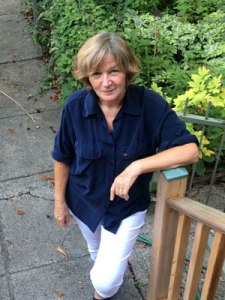

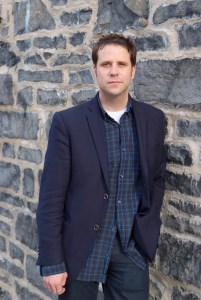 John Goldbach is the author of The Devil and the Detective (Coach Books, 2013), a novel, which was an Amazon Best Book of 2013; Selected Blackouts (Insomniac Press, 2009), a story collection; and, most recently, It Is an Honest Ghost (Coach House Books, 2016), a collection of six short stories and a novella (Hic et Ubique).