Tag: fiction

  • Writing Through Grief—By Louise Penny

    Writing Through Grief—By Louise Penny

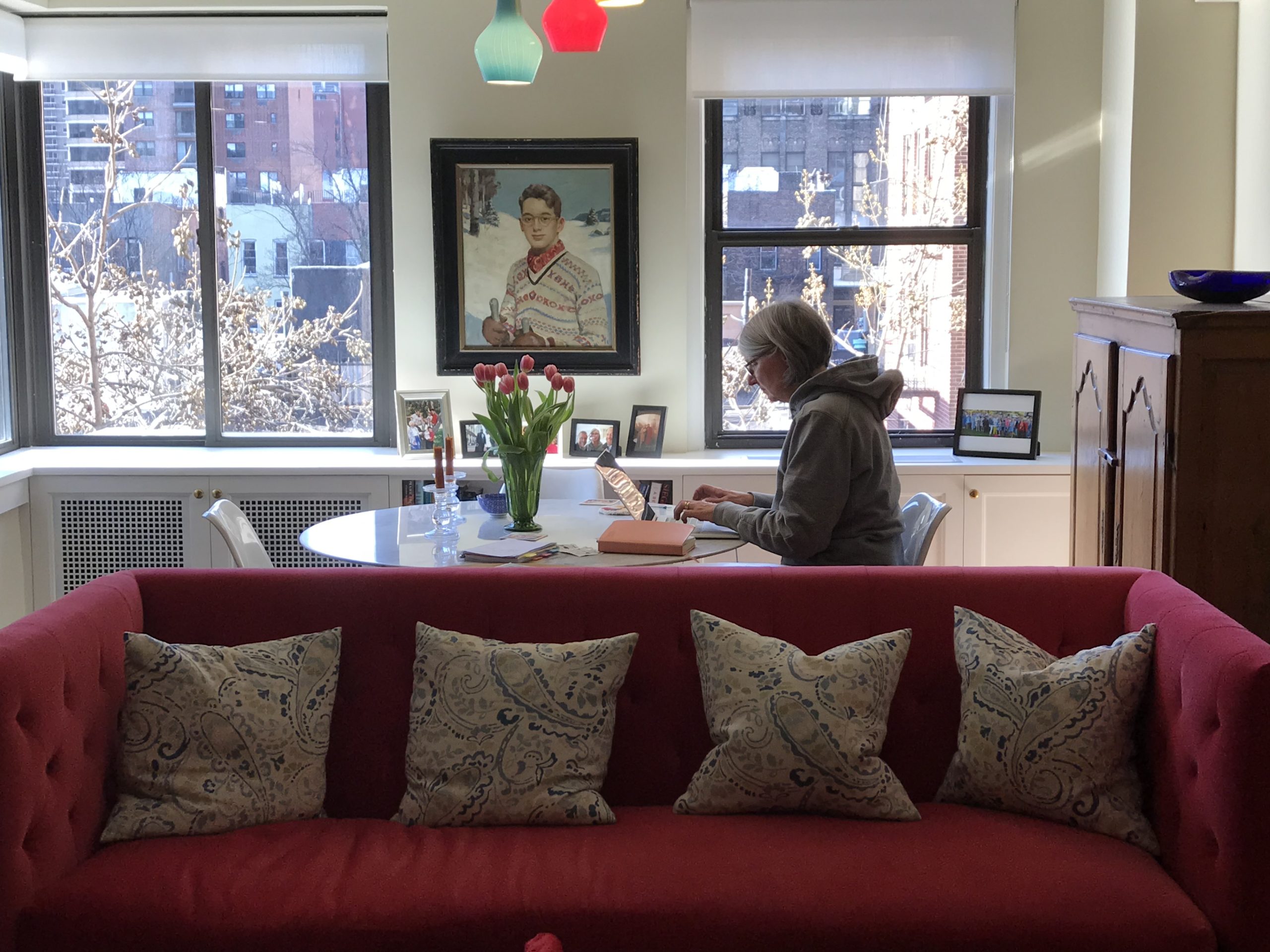
    Louise Penny writes at her dining table. (Photo by Lise Page)


    A funny thing happened on my way to not writing a book.

    I started writing.

    The truth is, I’ve known since I began writing that if my husband Michael died, I couldn’t continue with the Chief Inspector Gamache mystery series. Not simply because he was the inspiration for Armand Gamache, and it would be too painful, but because he’s imbued every aspect of the books. The writing, the promotion, the conferences, the travel, the tours. He was the first to read a new book, and the last to criticize. Always telling me it was great, even when the first draft was quite clearly merde.

    When Michael died peacefully at home in September 2016, I was pretty well spent. Physically, emotionally, and creatively. In French the saying is, tu me manques. Which means ‘I miss you’, but actually, literally, translates into ‘You are missing from me.’ That’s how it felt. Michael was missing from me.

    How could I go on when half of me was missing? I could barely get out of bed.

    I just could not face writing another book. And if I forced myself, the result would be a betrayal of all the previous books, the characters, the world of Three Pines. Of me. It would be a sad way to ruin what I’d created. I’d be writing because I had to, not because I wanted to.

    Now, sometimes, it’s true, a writer just has to sit down, and do it. That’s often the case with me. Some days I’d much rather eat gummy bears and watch The Crown than write. But this would have been different. This would have been going through the motions. Forcing the characters, chocking out some lame plot. My readers deserved better.

    So I spoke to my wonderful agent, and broke the news that I just didn’t think I could write a book. I just didn’t have it in me. I was too tired. Too broken. I’d mend, I knew that. But right then? No. She was wonderful, completely understanding and supportive. And then she had to tell the publishers. She did. And they were fabulous. They agreed that they’d rather have no Gamache book than a crappy one.

    And so, that was the plan.

    I was going to take a year off, to regroup and catch my breath after Michael died. That might have been a lie. In my heart I knew I could never write Gamache again. (And, sadly, would have to give back the next advance.)

    But then, something happened. A few months later, I found myself sitting at the dining table, where I always write. My golden retriever Bishop lying beside me, fireplace on, café au lait in my Vive Gamache mug… opening the laptop.

    I began having ideas—not the usual sort of thoughts of food and vacation, but actual book ideas. Armand began stirring. They all did. I could see them again. Hear them again.

    And I wanted to be with them again.

    I think my desire for distance was not just about exhaustion, but also because Armand was, and always will be, so associated with Michael. I just needed quiet time, to come to terms.

    And then, there he was again.

    I wish I could describe for you the joy I felt. And feel.

    So I quietly, without telling anyone, began writing again. A little at first. Then more, and more. 

    I wrote two words: Armand Gamache

    Then the next day I wrote: slowed his car to a crawl

    And the next day: then stopped on the snow-covered secondary road.

    But I didn’t dare tell anyone. In case I stopped writing. Or the book took a very, very long time to write. The publishers had no idea I was writing. It wasn’t until six months later that I told them. But even then, I warned them the book might not be ready in time. My agent was magnificent. Telling me not to worry. To take whatever time I needed. Stop writing, if I needed.

    And that was all I needed, to keep going.

    I really gave myself permission to just let go and explore.

    I discovered, again, how much I love to write. And, again, what a harbour it is. What would I do with my days otherwise? There are, after all, only so many episodes of Outlander.

    And so Kingdom of the Blind was born. It is the child that was never going to be. But happened. My love child.

    I began the book not with sadness. Not because I had to, but with joy. Because I wanted to. My heart was light. Even as I wrote about some very dark themes, it was with gladness. With relief. That I got to keep doing this.

    Far from leaving Michael behind, he became even more infused in the books. All the things we had together came together. Love, companionship, friendship. His integrity. His courage. Laughter.

    I realized, too, that the books are far more than Michael. Far more than Gamache. They’re the common yearning for community. For belonging. They’re about kindness, acceptance. Gratitude. They’re not so much about death, as life. And the consequences of the choices we make.


    Photo by Mikaël Theimer

    Louise Penny is an international award winning and bestselling author whose books have hit #1 on the New York TimesUSA TODAY, and Globe and Mail (Toronto) lists. Her Chief Inspector Armand Gamache novels, published by Minotaur Books, an imprint of the St. Martin’s Publishing Group, have been translated into thirty-one languages. In 2017, she received the Order of Canada for her contributions to Canadian culture. Louise Penny lives in Knowlton, Quebec. www.louisepenny.com
  • Writing, Mothering, and the Wild In-Between—By Gillian Sze

    Writing, Mothering, and the Wild In-Between—By Gillian Sze

    My first reading of Maurice Sendak’s Where the Wild Things Are was as a parent. Growing up, I somehow managed to miss this childhood classic, which I now recognize as surprising given its widespread popularity. I was given the book as a gift when I was pregnant with my son, and even then I didn’t read it until after he was born. I kept it safe, waiting on a bookshelf along with the other picture books we received.  

    After my son was born, we were advised that it was never too early to start reading to him. We filled those tiny periods when he was awake with reading. I reacquainted myself with books I hadn’t picked up in years: Mercer Mayer, Robert Munsch, Margaret Wise Brown, Eric Carle. My husband, who took the advice to heart, started with Beezus and Ramona, Charlotte’s Web, and The Hobbit. (It took weeks but we eventually completed them in small increments.) Included in our stack was, of course, Where the Wild Things Are. 

    I was struck by the sparsity of the opening pages of text, words just hanging on their own like Sapphic fragments, sentences spilling across pages. With each page turn, the white frames of the illustrations shrink, the images fill up each page until we follow Max into his dream. When Max announces the commencement of the wild rumpus, what follows is three illustrated spreads of the boy reigning over the beasts. Time passes on those pages, without a single word in sight. 

    *

    When I entered motherhood, I simultaneously found myself entering a period of wild wordlessness. Bleary eyed, I was keenly aware of time and sleep. I saw time racing along as my son filled out his onesies. I saw time cherished as much as it was squandered as I lay beneath my sleeping son, not daring to move lest he wake up again for the thousandth time. I saw time slipping away as more (if not all) of it became devoted to caring for him. I oscillated between too little time (his naps were either short or nonexistent) and too much (nursing in the dark, exhausted and impatient as each passing minute stole from what was left of my own slumber). Moreover, I struggled with how to use my time as both a writer and a mother—the former of which I had identified with for much, much longer. I didn’t know how to fill—or not fill—that time with words as I once had. 

    Sendak’s illustrative spreads in the middle of Where the Wild Things Are remind me of what Anne Carson says about the middle section of To the Lighthouse. Carson describes Woolf’s book as “a novel that falls asleep for twenty-five pages in the middle” (22). Set at night, Part II of To the Lighthouse is entitled “Time Passes,” and describes the changes that affect the characters, their lives, and the house. As the characters in both Sendak’s and Woolf’s works go through their necessary transformations, I realized how possible it was to hold these books and sense Time passing both in words, as Woolf had written, and wordlessness, as Sendak had drawn.  

    In truth, I didn’t know how to “read” those illustrations when I flipped to them with my son. At first I felt compelled to fill the silence with my own commentary, and so I did. “Howling at the moon! (page flip) Swinging! (page flip) Marching!” Eventually, I learned just to observe my son take in the pages, looking at the images without my input.

    However which way Time moved (Mr. Ramsey stumbling in grief along a passage, or little Max riding triumphantly on a wild thing, or my son letting go of the table edge for his first steps), it just did. My anxiety about never writing again lived along with me through those day naps and night feedings. I accepted that becoming a mother meant having to lose myself as a writer. This primal and sleepy period of adjusting to a new person was tinged with mourning. My husband, supportive if exasperated, would remark on my melodrama. But at the time it felt true. It’s only now as my son is approaching six and his toddler-sister is starting to sleep through the night, that I recognize this tumultuous era as something transformative for me as a writer. I think of Carson’s wise assertion of the chapter “Time Passes”: “Virginia Woolf offers us, through sleep, a glimpse of a kind of emptiness that interests her. It is the emptiness of things before we make use of them, a glimpse of reality prior to its efficacy” (23). 

    Words, much like Max voyaging towards wakefulness, eventually “sailed back over a year and in and out of weeks and through a day.” It may have taken a little longer, but we arrived together… changed, relieved, and a little sleepier. 

    Works Cited 

    Carson, Anne. Decreation. Vintage Canada, 2005. 

    Sendak, Maurice. Where the Wild Things Are. Fiftieth Anniversary ed., Harper Collins, 2013.


    Gillian Sze is the author of multiple poetry books, including Peeling RambutanRedrafting Winter, and Panicle, which were finalists for the QWF’s A.M. Klein Prize for Poetry. Her forthcoming prosimetrical collection, Quiet Night Think, explores the early shaping of a writer, the creative process, and motherhood, and will be published next spring with ECW Press. Since becoming a mother, Gillian has started writing picture books and has two books forthcoming with Philomel Books (Penguin Random House USA). Her first picture book, The Night Is Deep and Wide, was recently released in March. www.gilliansze.com

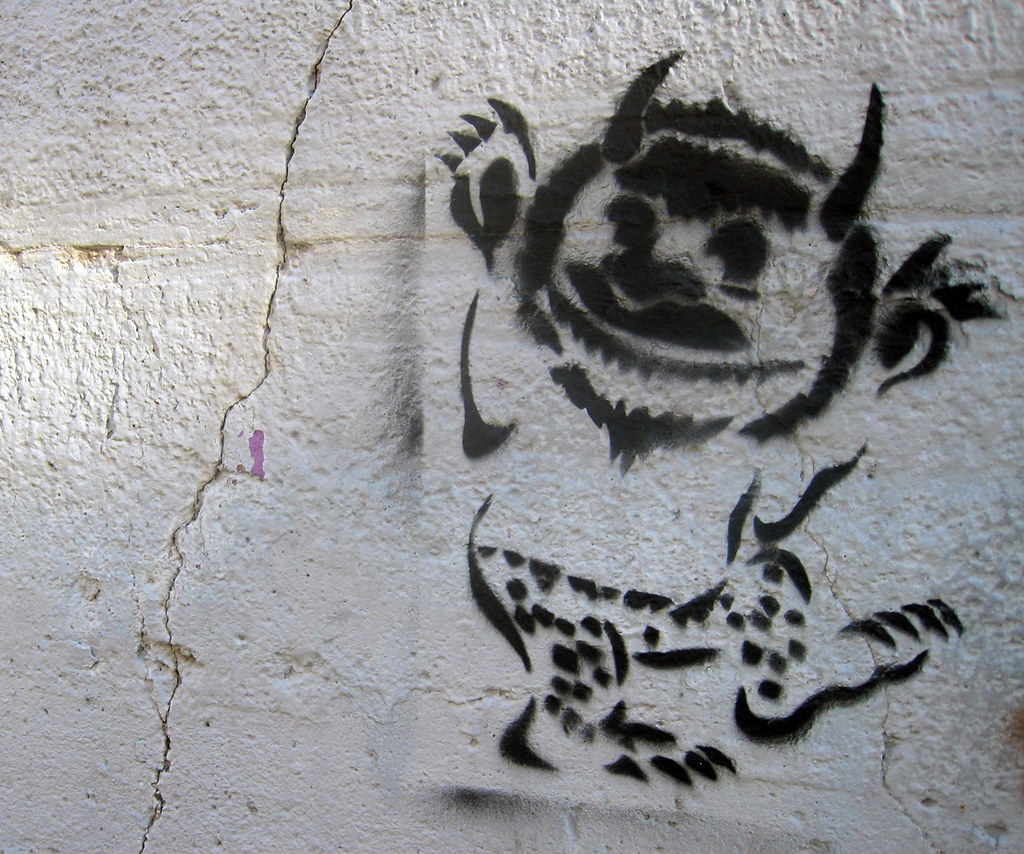
    Photo credit: “Where the Wild Things Are” by Skinned Mink is licensed under CC BY-SA 2.0 (header banner); Nadia Zheng (headshot)

  • From Tragedy to a Book—By Catherine McKenzie

    From Tragedy to a Book—By Catherine McKenzie

    I’ve always thought of writers as magpies—we’re known for thievery, and that’s often what we do. We steal little parts of life, sometimes from our own experiences, but often from other people. A conversation overheard in a restaurant. A fight observed in the street. A line of dialogue said by a friend. We’re always collecting, gathering, storing so that we can use what we’ve gathered later, at the appropriate time. Sometimes the connection in the finished work is obvious and sometimes more tenuous, but if you know where to look it’s there.

    This happened to me in a direct way a year and a half ago when my brother-in-law’s mother was suddenly diagnosed with brain cancer and given six weeks to live. The whole family was shocked and saddened, me included. We’d all spent a lot of time together over the years, and she was a vibrant woman in her late sixties who seemed to have boundless energy. How could she be gone so fast?

    As I watched this real-life tragedy play out, my writer’s brain started cataloguing things and asking myself questions. For instance: faced with the same stark deadline, would I spend time going through my things and giving them away? Or would I speed away to a beach somewhere and leave the sifting to others? Would I make a general announcement on social media or through email, or leave it as a family secret that would come as a shock to many once the inevitable happened? Would I try to investigate how this had happened to me—what had been missed, how had it progressed so quickly—or put down my questioning brain and let it all go? And most importantly, was six weeks enough time to leave the world at peace, or was that impossible?

    This is what it’s like to be a writer! Or at least, this writer. In all of these questions, an idea formed. I write suspense, so what was the suspense twist to this premise—a woman given six weeks to live? I researched glioblastoma and found that in some cases, it might be linked to exposure to certain toxins. Aha! Maybe this woman—this theoretical woman, not the sweet woman I knew—had been exposed to a toxin. And maybe this exposure had been on purpose. Maybe someone wanted to get rid of her and they’d tried to poison her? But the poisoning hadn’t worked and here she was, a year later, with an unintended consequence? Interesting, interesting. The idea was sticky—it stayed with me—but, to be honest, it scared me. Was spinning a book out of something so close to me wrong? Was it the right way to honor her? I struggled with that.

    But I also had to propose some book ideas to my new editor. I had two—another idea that I’d been thinking of for longer that was more fleshed out, and SIX WEEKS TO LIVE. I sent them off, and soon I heard back. Oddly, another one my editor’s writers had a similar idea to my “other idea” and she’d already approved that. But she was intrigued by Six Weeks. Write that one, she said. So, I started to. Nervously. I came up with the plot—a woman trying to solve her own murder before she passed away. I added suspects to her life—a soon-to-be ex-husband, her adult daughters. I made sure to make my main character as different from the real woman as possible. In fact, by the time the manuscript was done, the only similarity between them was the diagnosis. But the book was for her. Because of her. I wanted to honor that. I dedicated the book to her, and I let my brother-in-law know what the book was about. He was gracious—as he always is—but part of me still wonders if he’s truly okay with it. 

    But this is what writers do. We’re magpies. We steal things. Hopefully what we give back is enough compensation.


    Catherine McKenzie was born and raised in Montreal, Canada. A graduate of McGill in History and Law, Catherine practiced law for twenty years before leaving the practice to write full time. An avid runner, skier and tennis player, she’s the author of numerous bestsellers including Hidden, Fractured, The Good Liar, and I’ll Never Tell. Her works have been translated into multiple languages and The Good Liar, You Can’t Catch Me and I’ll Never Tell have all been optioned for development into television series.

    Visit her online at www.catherinemckenzie.com, on Facebook at http://www.facebook.com/catherinemckenzieauthor, on Instagram at @CatherineMcKenzieAuthor and on Twitter @CEMckenzie1

    Six Weeks to Live publishes April 20, 2021 in Canada. Join Catherine for the Canadian launch! Event Link: https://www.facebook.com/events/276347913828110

    Photo credit: Jyrki Salmi (header banner)

  • Keep Calm, Shut Up, and Write—By Lea Beddia

    Keep Calm, Shut Up, and Write—By Lea Beddia

    One full-time teaching job (hybrid online teaching included), three school-aged children (complete with homework, lunches and the occasional emotional meltdown), and one pandemic (anxiety I never thought I’d have, a bonus). Add a house to help maintain, and there’s no time for a creative outlet. It’s enough to turn me into a Netflix zombie. You may be busy like me, but even if you’re not, you may find your creativity stifled, vacuum-packed, and freeze-dried during this whole soul-sucking, stay-at-home-and-don’t-come-out situation. The state of the world is so real, yet surreal and heart-breaking, that my aspirations for all my wonderful ideas and plots are twisted up with anxiety, sleeplessness, and an obsession with watching the news. Enter Shut Up and Write.

    Shut up and Write: the name says it all. We really just shut up and write, for twenty-five minutes at a time followed by five-minute breaks. I don’t know about other writers, but in twenty-five minutes of absolute silence, with nothing but focus and my fingers tapping away, I’m more productive than during a full weekend in front of the television with my kids on my lap spilling popcorn all over me. It’s such a great stress-reliever to know I’m prioritizing myself ahead of my to-do list. I commit to be present when all my best-laid schemes have gone awry, and it’s the only chance for the stories swarming my head.

    I myself never attended the in-person sessions. I live an hour out of the city, and taking a Saturday morning away from busy mom life was not feasible. But since the sessions have moved online, we’re only limited to the distance our laptop charges will allow us to roam. I started attending after my QWF mentorship ended last June. I was so close to finishing what I had started and needed a little extra push to get my manuscript done. The result, for me: a manuscript completed and queries written.

    More importantly for my soul and morale, however, are these tenacious people, who like me, are ignoring real life for a little while to meet online and pursue personal or professional writing. Every time I sign up for a session, there’s this excitement: I’m going to see other people, and they’ll be writing, because their writing is important to them, too!

    I miss meeting with my writing critique group: an ensemble of talented, funny women who I met during a workshop, now almost two years ago. We still keep in touch, but each of us admits to lacking the energy and/or time for our writing, because “How can I not place my family, health, work, fresh air, and rabbit hole of online shopping ahead of writing?”

    SUAW is my antidote to isolation. I have something to look forward to in a time with no appointments or visits. I’ve found a community of writers willing to have my face in a two-inch square on their screen for two and a half hours a few Saturdays a month. Loneliness is at bay when I write during these sessions. There’s camaraderie in knowing we’re all struggling for time to be creative. I am grateful for the connections I’ve made.

    In our five minutes off, we chat, and in a short time, we share what we’re working on, or talk about recipes and make each other laugh. We’re all starving for positive human connections to people with a common interest and here it is, at my fingertips! When those five minutes are up, I’m like a superhero, relinquishing the destructive powers of procrastination because I’ve got twenty-five minutes to make the rest of my story shine, or at least get it from my head to my screen. Good enough.

    We may all be “Zoomed-out” and tired of hearing “You’re on mute” or “Can you mute yourself, please?” But to be honest, I kind of like it when someone forgets to turn off their mic and I can hear their keyboard clicking. It’s not a race, but it gets me going every time.


    Lea Beddia is a high school teacher, writer for young adults, and mom of three. She grew up in Montreal and now lives in the woods, on top of a mountain. She’s published short stories for young and old and you can find her work @LeaBeddia or www.leabeddia.com. In her free time (those rare, glorious moments), you can find her with her nose in a book, tuning everything out.

    Photo credits: Header banner is licensed under CC BY-NC-SA 2.0; Sarah Fortin Photographe (headshot)

  • Realists of a Larger Reality (Or Why I Read and Write Science Fiction)—By J. DeLeskie

    Realists of a Larger Reality (Or Why I Read and Write Science Fiction)—By J. DeLeskie

    I started reading science fiction young, before realizing it wasn’t suitable material for a girl with aspirations of fitting in with her fourth-grade contemporaries. It was the genre my dad and older brother favoured, and the surfaces of my childhood home were littered with paperbacks with lurid covers: a dinosaur riding an ichthyosaur across the desert (Jack Chalker’s Midnight at the Well of Souls); or a humanoid cat glowering over a worried-looking, two-headed tripod (Larry Niven’s Ringworld). Who could resist opening these books to see what tales lay inside? Not I.

    I soon discovered that the sex scenes in these books were way more interesting than the chaste kissing and petting the kids at Sweet Valley High were up to (albeit in a Dürer’s Rhinoceros sort of way; in retrospect, many of these old-school SF authors did not appear to possess firsthand knowledge of female anatomy or— you know—the actual mechanics of sex). Soon I was hooked, and not just for the salacious content. When the reality of being an introverted, slightly awkward kid attending Catholic school in rural Ontario became unbearable, I’d escape to Arrakis and lose myself in the messianic journey of Maud’Dib, or follow the adventures of a resurrected Richard Burton (the explorer, not the actor) as he searched for the source of the great river on Riverworld.

    By my teens, I contained within me an archive of worlds, characters, concepts, and stories that enriched my life immeasurably. The trade-off—a sense of not quite existing on the same planet as many of my peers—was worth it, even if it didn’t always feel that way. Not only did science fiction provide escape, it was an antidote for religious indoctrination, challenging the conservative, Catholic vision of the world I had been raised to accept as my own. My allegiance was to a universe far bigger and weirder than anything Christian dogma could encompass.  

    At some point in my early twenties, however, I stopped reading science fiction. I lost patience with the flat characters, clunky prose, and outright misogyny that typifies so much of the genre. My reading began to veer toward realism and non-fiction. In retrospect, I think I was trying to accept the world as it was, to put away childish things. I went to law school, got married, had kids, and embarked on a career as a corporate lawyer. I felt I no longer had the luxury of questioning the world as it was; my job as an adult was to succeed according to its metrics.

    Yet gradually, as my kids grew older and began asking the thorny questions that kids ask, I started to wonder if my acceptance of things had gone, perhaps, too far. It took a few years, but I managed to find my way out of the corporate cul de sac. And slowly, I found science fiction again. I rekindled a childhood love for Ursula K. Le Guin and was dazzled by her ability to imagine less destructive ways of organizing society. I read Octavia Butler for the first time and was astonished by her depiction of society collapsing into a racialized dystopia— and then being rebuilt, one community at a time. These authors and others—Marge Piercy, Kim Stanley Robinson, Corey Doctorow, Karel Čapek, etc.—eroded the shell of cynicism I’d formed over my conscience by insisting that there was nothing inevitable about environmental degradation, white supremacy, capitalism or misogyny.

    Thus, when I decided to try my hand at writing, it was science fiction that called to me. I’m now in final revisions of my first novel, Everclear, a coming-of-age story set in the near future in northern Quebec. The act of imagining this future feels laden with responsibility, and I’m attempting to construct this story with great care. I believe firmly that our words bring potential worlds into being.

    In her brilliant and fearless acceptance speech at the 2014 National Book Awards, Ursula K. Le Guin put out a call to “realists of a larger reality” who “see alternatives to how we live now and can see through our fear-stricken society […] to other ways of being, and even imagine some real grounds for hope.” The call is increasingly being answered by Indigenous, Black, and LGBTQIA writers of science fiction such as jaye simpson, Cherie Dimaline, Nnedi Okorafor, and N.K. Jemison— writers who, because of their lived experiences, assemble the pieces of our shared reality in unexpected ways. To me, this is the opposite of escapism; it’s an invitation to see the world with new eyes and answer the moral imperative this vision affords us. This is why I read science fiction, and why I write it: not to escape this world, but to re-imagine it.

    And, of course, for the cringy sex scenes.

    Suggested Reading List

    Love After the End: An Anthology of Two-Spirit & Indigiqueer Speculative Fiction, edited by Joshua Whitehead, 2020

    The Dispossessed: An Ambiguious Utopia, by Ursula K. Le Guin, 1974

    Woman on the Edge of Time, by Marge Piercy, 1976

    The Parable of the Sower, by Octavia Butler, 1993

    Ministry for the Future, by Kim Stanley Robinson, 2020


    Jennifer DeLeskie is a former lawyer and new writer, currently revising a draft of her first novel. Her non-fiction piece, “April 2, 2020,” will appear in Chronicling the Days (Guernica Editions), forthcoming in Spring 2021. Jennifer volunteers on the board of the Quebec Writers’ Federation.

    Photo credits: Header banner is licensed under CC BY-SA 2.0; Annabel Simons (headshot)

  • Writer’s Block in the Time of Corona—By Carolyn Marie Souaid

    Writer’s Block in the Time of Corona—By Carolyn Marie Souaid

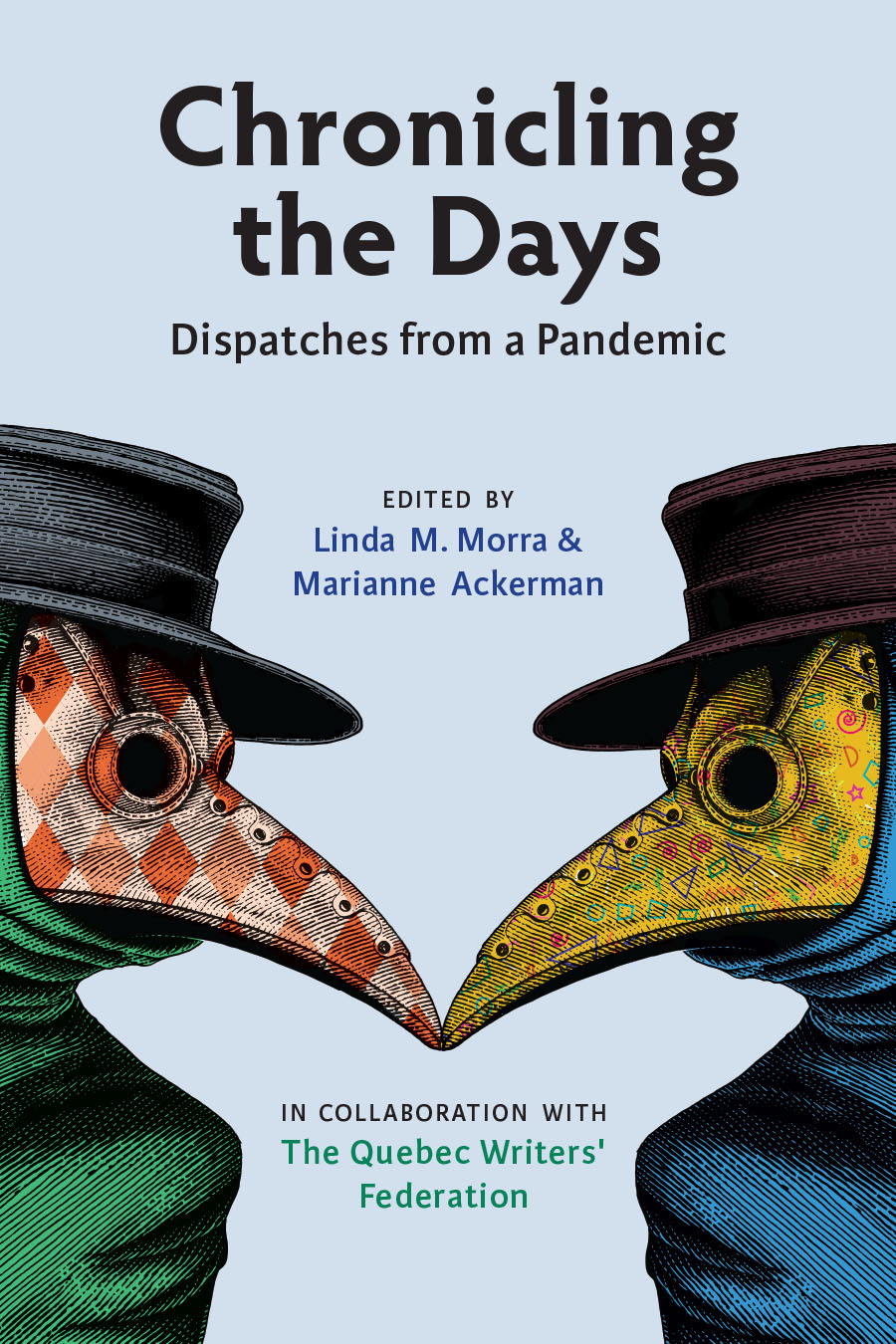
    In April 2020, we invited writers in Quebec to submit a story of a single day during the strange, uneasy time of coronavirus and pandemic, of social distancing and self isolation, of lockdown and quarantine.

    We’re thrilled to announce that these stories have been gathered in Chronicling the Days: Dispatches from a Pandemic (Guernica Press). To learn more and buy the book, please visit https://www.guernicaeditions.com/title/9781771836579.

    Please also join us on the QWF FB Community page, and let the authors know if their words resonated.

    In mid-March, COVID-19 was getting out of hand, according to Premier Legault. There was too much handholding, not enough handwashing. I was sent home on a paid, two-week hiatus while they rejigged my job to allow me to work from the confines of my condo.

    Wait, what?

    To read the rest of the story, please support our community and check out Chronicling the Days: Dispatches from a Pandemic

  • The Honeymoon Phase—By Ann Cavlovic

    The Honeymoon Phase—By Ann Cavlovic

    Someone with two decades of experience getting critiques of their writing shouldn’t curl into a ball after an editor’s comments, right?

    Then why, after receiving a developmental edit on my first attempt at a novel, did I find myself in such a pit of despair? (Yes, that pit, that ball; I was every cliché imaginable.)

    The simplest explanation involves basic math: a novel is about twenty times the length of a short story, so you have twenty times the problems to fix. On top of this, the stakes for me were especially high: I’d taken a year off work to complete the draft on a small grant, and circumstances left me a single mother, all of which necessitated a weekly budget of $330. Just my son’s weekly piano lessons cost $50.

    After taking this big leap and working so hard, I wanted accolades. Instead, the editor posed neutral questions that my anxious mind could easily un-neutralize: ‘What governed your decision to include character X?’ became ‘Why did you even write this useless asshole?’ She didn’t trust the perceptions of the character whose purpose was to explore the nature of human perception, which sent me into an epistemological head explosion about my own perceptions. Sure, many of us ignore positive feedback and focus on the negative (and I hold a PhD in Catastrophizing). This cognitive distortion comes readily when the things working well are described in one page, and the things that aren’t take up fifteen.

    It wasn’t so much like I felt this editor had seen me naked. It was as if she’d seen me naked upon return from a ten-day backwoods camping trip and offered logical and helpful observations like: ‘Have you considered taking a shower?’ and ‘But first perhaps another go with some toilet paper?

    Naturally, my first inclination was to troll the editor on the internet to find evidence of her incompetence. Instead, I rediscovered her facility for insight, nuance, and skilful prose. Dammit.

    Yet as I followed the advice of friends and allowed myself a break, ideas started popping up in my mind. How to fix this. How I really could cut that. Yes of course that part was misleading. And I really have no idea how to deal with that subplot but perhaps it will become clear after I fix fifty other problems. These were the kind of blind spots my critique circle might have pointed out on a short story too. Maybe, after such a long period of isolation, I was out of the feedback-receiving habit?

    Now my draft manuscript sits on my desk in a neat pile, with dozens of paperclips—all red, I have my standards!—holding together scenes that have literally been cut and collated over months of arduous writing, reworking, and organizing. The day I got back to work, I glanced at my manuscript, and realized the little bubble of joy I’d cradled in my bosom during the brief honeymoon between completion and feedback had popped.

    But it probably had to. When I initiated my de-catastrophization protocol and mulled over places to begin, I saw how the editor’s interventions saved me from spending more energy in fruitless directions. I need that energy, because there is a lot, a whole lot, of work still to be done. Instead of resentment or embarrassment, I’m starting to feel appreciation and even something close to affection for this woman I’ve never even met in person. A stranger who’s seen my work, by necessity, at an earlier stage than I’d ever shared work before. There’s a strange intimacy to this.

    Speaking of intimacy, I met a wonderful man when finalizing the draft (which is, by the way, not ideal timing for a wannabe novelist, but I’ll take it). Months in, we are still in our honeymoon phase and I am enjoying it fully. Surprisingly, I see that phase more positively than ever, whether it’s for a manuscript or a partner. You need it. You need to build up a reserve of good feelings to get you through the work to come.

    Looking at my manuscript now, I realize maybe it was okay how stupidly in love I was. Maybe my delusional vision that my first draft would turn out like a fifth draft wasn’t all bad. Maybe, in part, I needed my delusion to get me through.

    Some relationships break down. Some manuscripts never get published. Don’t even try to tell me it’s the journey, not the destination; to deny the cost of failure is to deny the courage involved in trying. But with both my manuscript and my new relationship, deep down I have a strong sense of potential. So I will again pour my heart into both, with all the attendant hard work and brutal vulnerability.


    Headshot1 - AnnCavlovic - Irvine2017-crop all black

    Ann Cavlovic’s fiction and creative non-fiction have appeared in EventThe FiddleheadThe Globe and Mail, Little Bird Stories, PRISM international, Room, SubTerrain, the anthology This Place a Stranger (Caitlin Press), and elsewhere. She wrote Emissions: A Climate Comedy, which won “Best in Fest” at the 2013 Ottawa Fringe theatre festival. If the heart-pouring works, her novel Count on Me will one day see the light of day. Find her in the Gatineau Hills and at: anncavlovic.com.

    Photo credits: Ann Cavlovic (header image); David Irvine (headshot)

  • The Art of Embarrassing Oneself at Public Readings—By Renée Cohen

    The Art of Embarrassing Oneself at Public Readings—By Renée Cohen

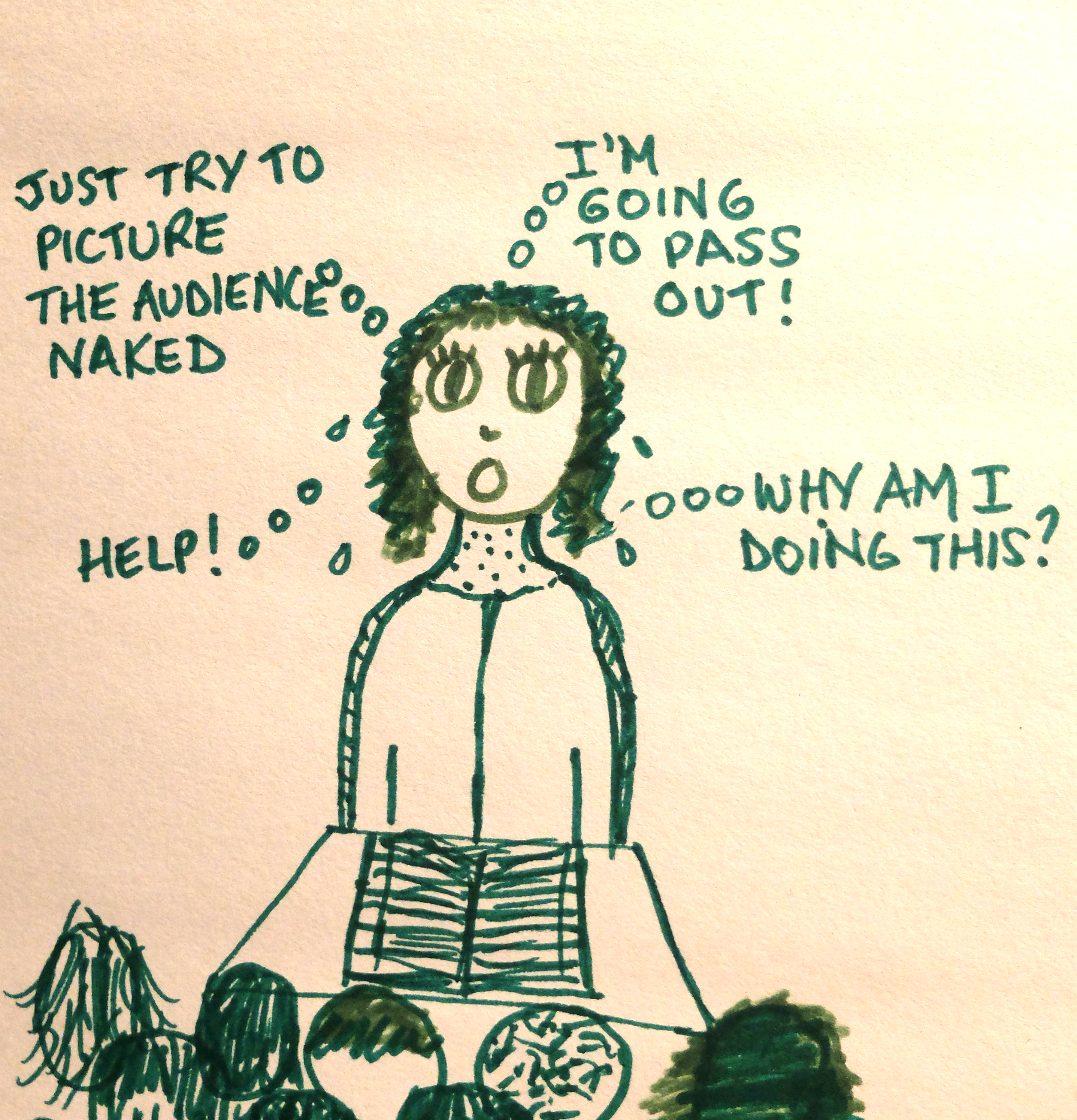
    Giving public readings is crucial to establishing oneself as an emerging writer. After attending a diverse array of Quebec Writers’ Federation (QWF) workshops—from food and travel writing to literary fiction—it became clear that regardless of the writing genre, workshop leaders often proffered those same words of advice. For years, I avoided ‘open mic’ nights. I slid under the table when called upon to read. In my defense, I am not alone in the belief that any form of public speaking is nightmare-inducing—regardless of the circumstances. Introverted, I’d always hoped that becoming a writer would require less speaking and more silent solitude.

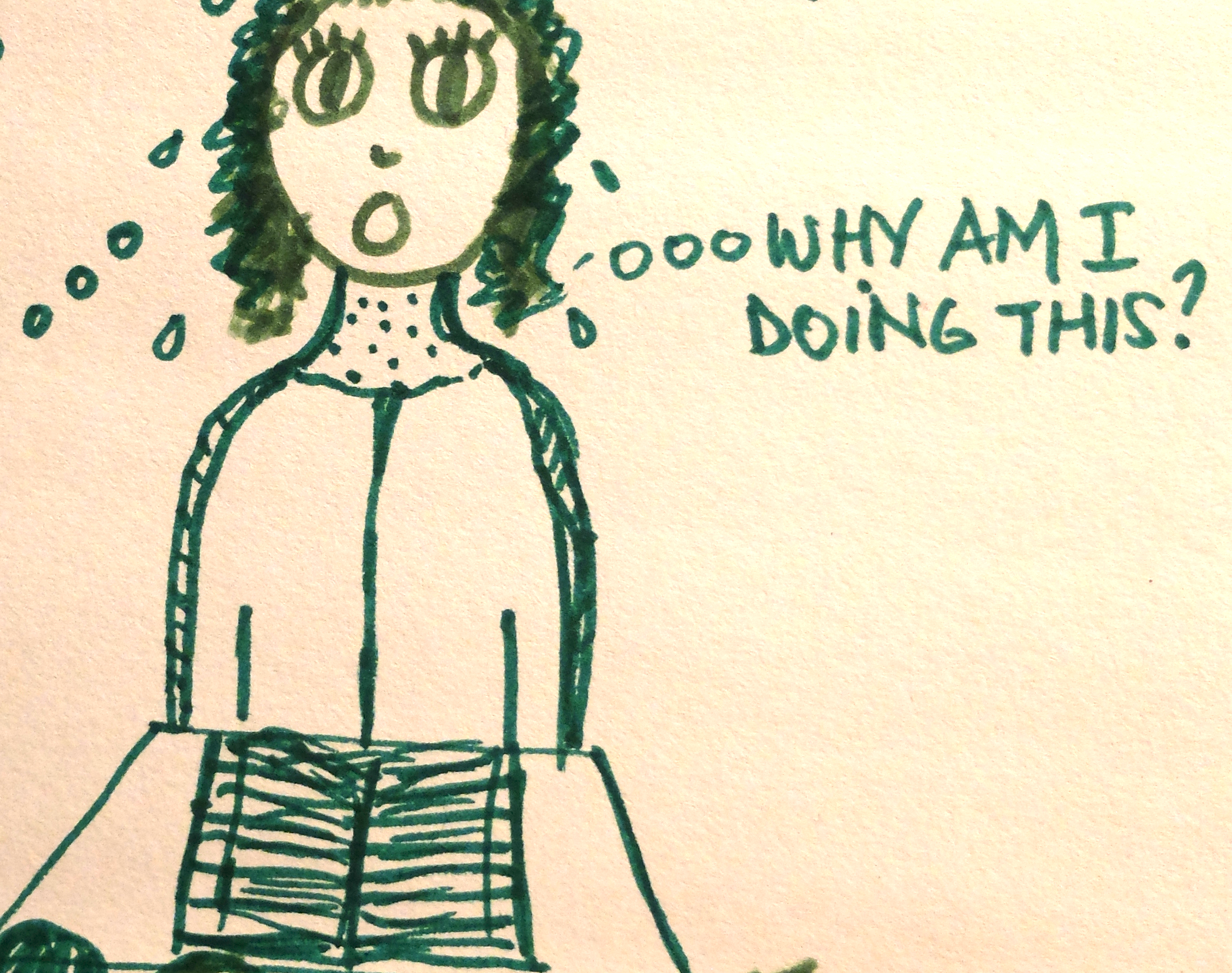
    *Embarrassment and Bloating Cartoon R. CohenUnlike the act of writing, which allows for the deletion of words before they’re read, speaking before a live audience isn’t as forgiving. There’s no delete button one can press to make oneself disappear.
    So, uncharacteristically, when one of my flash fiction pieces was recently published in the My Island, My City chapbook, I accepted the invitation to read it at a gala. Since proceeds from the event would benefit the QWF’s Writers in the Community program, I reasoned that service to the cause was far more important than my own aversion to public speaking.

    As I was about to leave the house on the night of the gala, my face suddenly bloated like a pufferfish, my neck erupted in itchy hives, and my nose bled. Apparently, my anxiety about the reading was manifesting itself physically.

    “How can you be nervous? It’s a flash fiction story that will take you forty-eight seconds to read!” my partner said after I’d gently dissuaded him from joining me. Why was I so nervous? I was honored to be involved in the charitable event!

    Then, when a roadblock prevented my cab driver from turning on de Maisonneuve Boulevard, he stopped the car. “Walk from here!” he firmly suggested. Too anxiety-ridden to protest, I passively agreed. The moment I exited the vehicle, a freak snowstorm hit. Within seconds, my freshly-coiffed hair was drenched.

    Along the closed street, massive pieces of concrete lay strewn about. People loitered, examining the detritus.

    Inspired by the scene, I compiled mental notes for a future work of fiction.

    I then realized that my imagination was partially to blame for my current state of anxiety—If not for my vivid imagination, I wouldn’t be compelled to write. If I didn’t write, I wouldn’t have to worry about giving public readings.

    After wiping a snowflake from my eye, I discovered that my black mascara and eyeliner were not as waterproof as advertised.

    Looking like a wet raccoon, I cut through Westmount Park, which was eerily desolate save for a lone teenaged boy smoking under a snow-covered gazebo.

    I paused briefly to scratch my hives.

    I reflected upon traumatic incidents from my past that contributed to my fear of appearing before an audience: during a figure skating competition in my teens, someone clapped after I completed a movement that was undeserving of applause. I scanned the audience, only to discover the culprit was my father. Distracted by his misplaced burst of applause, I fell. (Needless to say, I didn’t win that competition). From then on, I dissuaded (nay, banned) family members from attending any competitions or events that required me to appear in front of an audience. That longstanding ban has carried over to include my partner and friends.

    When a recipe of mine was included in a cookbook, I was invited to prepare it on live TV during a pledge drive to benefit public television. Nervous during the shoot, I momentarily lost my ability to speak and instead, flapped my arms in a futile attempt to generate words.

    Finally, I arrived at the gala venue. Soaking wet, freezing, hive-covered, my makeup smeared, my face bloated, and blood caking in my nose. While attempting to compose myself in the foyer of the church hall, I was shocked to see one of my friends enter the building. “Surprise!” she squealed upon seeing me. Moments later, another good friend showed up unexpectedly. Both explained that upon seeing my name in the ad, they’d reserved tickets to support me (and the cause)!

    Chatting with them, I gradually felt my fear dissipate. Believing that friends and family were stress-inducing distractions had been a mistake. The opposite was true! Their supportive presence was comforting.

    After my reading, I returned to sit with my friends in the audience, relieved that I hadn’t thoroughly embarrassed myself. Courtesy of the resulting adrenalin rush, I contemplated the advice of my writing mentors. I decided I would bravely endeavor to give public readings in the hopes of becoming an emerging writer.

    My thoughts were interrupted when one of my friends gently tugged on my sleeve.

    “Did you know that your sweater is on inside out?” she giggled.


    Pic. Cohen_Y. PelletierRenée Cohen is a freelance writer for numerous international charitable organizations. Her personal essays, prose, and flash fiction have appeared in Accenti MagazinePrairie Fire, Litro UK, The Globe and Mail, the Montreal Gazette, Reader’s DigestZvona i Nari’s ZiN Daily, Croatia, and in numerous volumes of the Canadian Authors Association anthologies, in the My Island, My City chapbook, and elsewhere. Her artwork has been exhibited in group and solo shows and featured in Montreal Writes Literary Magazine, Headlight 22, 3Elements Review, Spadina Literary Review, Flash Frontier New Zealand, and Sonic Boom Journal (India). She recently won The Fieldstone Review’s Banner Art Competition.

    Photo credits: Renée Cohen (header image); Y. Pelletier (headshot)

  • Writers: The Truth Can Set You Free—By Tamara Jong

    Writers: The Truth Can Set You Free—By Tamara Jong

    Ma was so many things; a Jehovah’s Witness preacher, an alcoholic with a troubled past, and an avid reader, poet, and writer. When she was sober she was engaged, a bright star in our neighborhood and religious community. But then she was also a yeller: when she kicked her sisters out of her life, she literally cut them out of any photos she had. Ma would punish me because I chatted in class, ate pumpkin seeds during Halloween, and was sent to the corner by the teacher. Lying wasn’t an option to save my own hide.

    TamaraJongreadingyouth
    A younger Tamara Jong.

    I escaped by reading fiction. Little Bear by Else Holmelund Minarik was an early favorite for me. In the first set of stories, little bear’s mum makes him clothes when he is cold and throws him a birthday party. Nine-year-old Pippi Longstocking took me on all her adventures with her monkey Mr. Nilsson on the South Seas. Although she was parentless, she seemed resilient and nothing could stop her. I related to A Wrinkle in Time’s Meg: she never seemed to fit in anywhere and was devoted to her father; my dad was my idol until Ma kicked him out for his infidelities. I moved on to the worlds of the Brontës and Austen, where I felt safe and where the ending always seemed to work out. I would write and draw pictures of my stories and plays. There was no such thing as writer’s block.

    My first attempt at writing fiction as an adult came under the guise of autobiographical fiction. I mixed up truth and fiction so no one would know that it was mostly me I was writing about. My story was about Keaton, a suicidal fourteen-year-old. Keaton’s angelic mother worked all the time, made a hell of a bunch of tea, and didn’t really know her kid or see her for who she was. Keaton wrote lousy poetry, had a bestie, and obsessively liked a boy named Josh. She ended up getting help after being hospitalized, taking anti-depressants, and undergoing extensive therapy. I wrote it after my own stint in the hospital after a suicide attempt. But there were truths missing in the story that I couldn’t write down yet. I made the father the alcoholic and the mother a loving TV mom, a cardboard cut-out of a mother. There was nothing about religion anywhere. Then I got stalled and didn’t work on it.

    Things didn’t really click for me until two year later, when I decided to try out a non-fiction writing course with Ayelet Tsabari. God, she made me fall in love with it. I wrote and wrote and wrote. I couldn’t stop. The words came easier than in fiction for me. The only things that interfered with my writing were my day job and sleep. Ayelet introduced me to her stories and so many other great diverse writers and made me realize that there were so many ways to spin a story.

    I took a second course with her, and then another. It was the first time I had written about being a Jehovah’s Witness and my parents, my siblings, and our lives. Once I had a taste for non-fiction, I didn’t want to let go. I started reading less fiction and more non-fiction. I submitted to contests and literary magazines, and revised my stories. When my creative non-fiction piece, “Father Hallowed Be Thy Name” got accepted at RicepaperMagazine, I was ecstatic. Ayelet encouraged me to write a memoir. I had only started writing non-fiction in her classes and she believed in me! Something had started shifting for me.

    In an earlier creative writing class, I had written fiction about a Catholic girl who got pregnant, a dog called Jehovah, and Medusa. Nothing was really wrong with those stories but they lacked a depth of what I really wanted to say. They were starting points that were necessary for me to get where I had to go. Testing out the waters until I could go in myself, immerse myself in the work.

    I realized I had been hiding behind fiction so no one would know about my real life and who I was. What if others judged my life choices or no one wanted to read my stories, or they thought that I had nothing original to say? I was terrified of people’s reactions. I had been so good at hiding my trauma. When I was penning fiction, I could take those risks. After all, it was imaginary. No one would ever know it really happened.

    When I shelved the idea of writing a fiction novel, non-fiction stories emerged in its place. I’ve been working with them for months now, reading them, revising them, losing and finding Ma, collecting our stories together. Non-fiction freed me to tell my real-life story on the page in a way that fiction couldn’t. When I was growing up fiction had protected me by letting me escape in stories, to live another’s narrative.


    Tamara_Jongph_Photo_Credit_Charles _MarschuetzTamara Jong is a Montreal-born mixed-race writer of Chinese and European ancestry. Her work has appeared in Ricepaper, Room, carte blanche, The New Quarterly, Invisible Publishing, and Body & Soul: Stories for Skeptics and Seekers. She is a graduate of The Writer’s Studio (Simon Fraser University) and recently had her piece “Thanks for All the Lice, Pharaoh” longlisted in The New Quarterly’s 2019 Edna Staebler Personal Essay Contest. You can find her on Twitter @bokchoygurl.
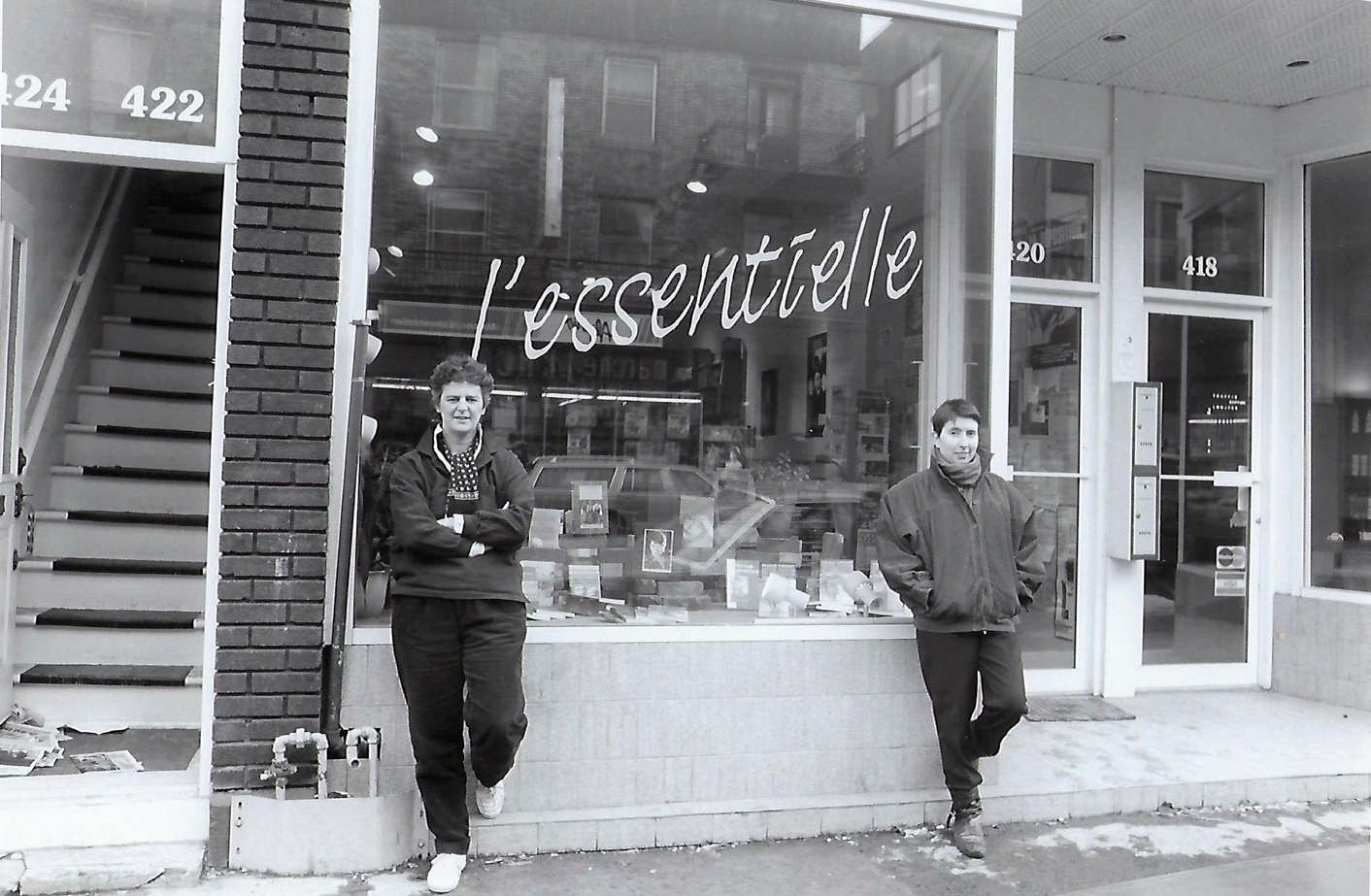
    Photo credits: Tamara Jong (header image); Charles Marschuetz (headshot)

  • Writing on the Edge—By Lise Weil

    Writing on the Edge—By Lise Weil

    Odette DesOrmeaux and Martine Huysmans, two members of the l’essentielle collective which also included Ariane Brunet and Harriet Ellenberger, 1988.

    Just over thirty years ago, in June of 1988, I drove up to Montreal from my home in Montague, Massachusetts to attend the Third International Feminist Book Fair. At the time I was editor of the feminist literary review Trivia: A Journal of Ideas; we had a table in the exhibit hall, alongside books, presses, and journals from all over the world. The Fair, housed on the Université de Montréal campus, was attended by some 8,000 people, featured over 300 authors, and hosted the largest gathering ever of Indigenous women writers from Canada. Coming off three days of head-spinning, exhilarating, often revelatory panels, readings and conversations, co-editor Linda Nelson and I decided to devote the next two issues of Trivia to the event.

    Trivia 13 focused on the feminist writers of Quebec and those influenced by them: Nicole Brossard, Gail Scott, Erín Moure, Louise Cotnoir, Michèle Causse (France), and Betsy Warland (BC).[i] The energy and vision of this community of feminist writers (which also included Louky Bersianik, France Théoret, Louise Dupré, and Daphne Marlatt) had provided much of the impetus for the Fair itself.[ii] In my editorial I attempted to name what it was about these writers that excited me so much. It had to do with their understanding of language as transgressive, and as material. With their exuberant flouting of genre boundaries—poetry becoming essay, fiction theory (“fiction/theory” – Brossard’s term)—all in deference to their insubordinate, uncooptable female bodies (“The breasts refuse”—Warland). And it had to do with the edge they/we were all on—as women claiming space for our own bodies and thoughts for the first time ever.

    Just over a year before the Book Fair I had driven up for the opening of the bilingual bookstore l’essentielle, a word Brossard coined in her epic poem “Sous la langue/Under Tongue.” A bilingual edition of that poem was being launched to mark the occasion. The little store on Rachel was spiffy, with hot pink shelves and track lighting. I remember women in dress shirts and bright scarves hoisting glasses of white wine. I remember Brossard and her translator Susanne de Lotbinière-Harwood taking turns reading the stanzas. On ne peut vas prévoir / You cannot foresee, each verse began, crescendoing as the lover’s mouth approached the body she desired, launching her into the unknown.

    You cannot foresee so suddenly leaning
    towards a face and wanting to lick the soul’s
    whole body till the gaze sparks with furies and yieldings. . . .
    Desire is all you see.

    And I remember walking into my study one Sunday morning not long after that launch to find Linda with Brossard’s chapbook in her lap, weeping. “We don’t write like this here,” she said. “No one writes like this here.” Eros: words embodied it in Quebec women’s writing. Words were marks of possibility, thrusting us out to a precipitous edge where nothing was foreknown… No, there was nothing like this in our feminist world. Plus the lesbians I hung with favoured jeans and flannels.

    Some two years after the Book Fair I moved to Montreal, in part drawn by that subversive brew of Quebec au féminin, wanting to be immersed in it (and yes, admittedly, wanting to be among women who dressed up for each other). Beneath all this was a desire to write… in order to do which I knew I needed to get away from the home that was Trivia’s operating base. But weaning myself from the role of editor and translator took more than a physical move. It was thirteen years before I found myself in the grip of a long writing project: a memoir that began—not surprisingly—as a meditation on lesbian desire and that chronicled a series of disastrous love adventures that drove me, heartbroken, to this foreign city where I finally learned to abide—in love, and in place. A QWF mentorship with Elaine Kalman Naves in 2003-4 was foundational to this project. It would take me another twelve years to complete the memoir, but I wrote some two-thirds of a first draft in those months. Elaine’s encouragement and her insight were just the spurs I needed.

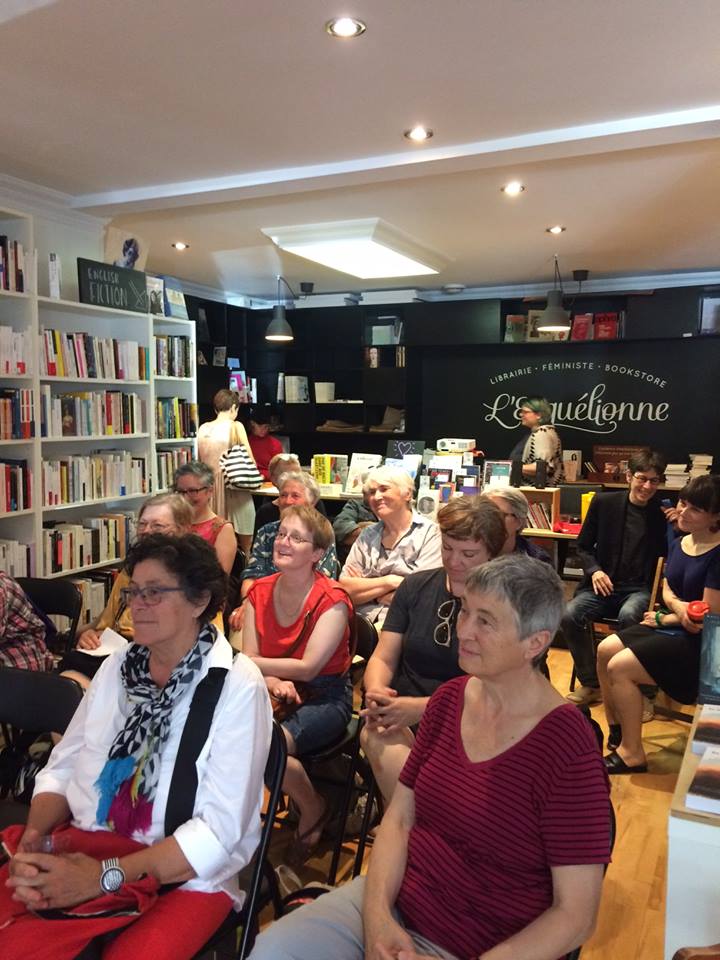
    l'eugelionne2
    Launch of “In Search of Pure Lust” at L’Euguélionne, June 2018.

    But it is also true that my memoir, In Search of Pure Lust, would not exist in its present form were it not for my immersion in Quebec au féminin (where the last section of the memoir is set) and its climate of formal permissiveness and political passion, its celebration of language as erotic. I imagine many literary products of this century, not only here in Quebec but throughout North America, owe a similar debt. So it’s both surprising and dismaying to me that nowadays in Anglophone literary contexts there is so little acknowledgement—or even knowledge—of these Quebec writers and their pioneering body of work. Even when the topic is formal innovation.[iii] Even in Montreal.[iv] At least here in Montreal, as of two years ago, we have a monument to this genealogy in the form of the bilingual feminist bookstore L’Euguélionne—named after Louky Bersianik’s kickass, visionary feminist novel. Long live L’Euguélionne!

    I can’t help longing for the kind of literary community that first drew me to this city, a locus for deep conversation revolving around a common cause that felt urgent enough to unite writers of different cultures and languages. What might that common cause be today? As global forces thrust us towards a darker precipitous edge, and an endless expanse of unforeseen. . . .


    Lisebookstore

    Lise Weil’s memoir, In Search of Pure Lust (Inanna Publications, 2018), is a finalist for an International Book Award and winner of an Ippy Award. Her essays, literary non-fiction, and translations have been published widely in Canada and the U.S. She was founder of the feminist review Trivia: A Journal of Ideas (1982-1991) and its online offshoot, Trivia: Voices of Feminism (2003-2011)She is currently editor of Dark Matter: Women Witnessing, which publishes writing and artwork created in response to an age of mass extinction and ecological collapseShe teaches in the Goddard College Graduate Institute. www.liseweil.com

    [i] Contributors to Trivia 14, “Language and Difference,” included Lee Maracle, Jeannette Armstrong, Gloria Anzaldua, and Jewelle Gomez. Copies of Trivia 13 and 14 can be ordered for $5 plus postage. lweil22@gmail.com

    [ii] Six of these writers met on Sundays every three months in Montreal to talk about feminism and theory. Theory, A Sunday (Belladonna, 2013), a recent translation of La théorie, un dimanche (1988), collects the writings that emerged from these conversations.

    [iii] See, e.g., Bending Genre: Essays on Creative Nonfiction (eds. Margot Singer and Nicole Walker, Bloomsbury, 2013). Much of the bending and unsettling described in these essays was being performed by the writers of Quebec and was addressed explicitly in Gail Scott’s “Shaping a Vehicle for Her Use” (Spaces Like Stairs, Women’s Press, 1989).

    [iv] Not even at a recent reading by a visiting Canadian author from a work of fiction titled Theory.

    Photo credits: Marik Boudreaul (header image); Favor Ellis (headshot)