Tag: Poetry

  • Poetry via Videoconference—By Louise Carson

    Poetry via Videoconference—By Louise Carson

    Back in the old days—pre-March 2020—we used to have these literary events called book launches, festivals, and poetry readings, which often included open mics. People would gather at little cafes downtown, and/or, in my case, on or off the West Island of Montreal, or in art galleries, book shops, even people’s homes. Sometimes, authors and poets would travel long distances to attend such events in other regions, provinces or (rarely) countries. Sometimes we’d get paid, sometimes not. But it was all stimulating. Nerve-wracking until one had completed one’s contribution to the evening, but enjoyable.

    Now, after a tentative, sometimes fumbling start, the various hosts who were willing to make the transition to virtual events have made it, and we have a plethora of online events to choose from. As I write this mid-July, I am registered to attend before the end of the month: two open mics, a workshop, and a literary group’s business meeting. And because I’m a writer and notice things, and because these video conferences put us all into a fishbowl, it’s become evident that we are still on the upward slope of a pretty steep learning curve vis-à-vis etiquette.

    One of my regular Zoom poetry groups is made up of very docile members. When the moderator says mute, we mute. Well, most of us mute—there’s always one, isn’t there? The idea being, and this may or may not be true, that mics left open weaken the signal for receiving the one mic that should be open. Many open mics are certainly distracting. A sneeze or cough can displace the crucial emotional moment of a poem.

    Another of my groups is the opposite of the one above. About half of us mute. The other half, not so much. Some of the participants are married couples who chat with each other; others have, on occasion, set up their computer at the kitchen table, where they can be observed preparing snacks, moving from fridge to sink, muttering, laughing. The poor designated reader struggles on, their voice fading, returning, fading, returning.

    At one conference, there was an attack. A poet, possibly frightened of participating in her first live video presentation, and unable to make herself visible (although it was not her turn to read), panicked and, unfortunately, made herself only too audible as she accused the moderator of purposely shutting her out. “How could you do this to me?” and other similar comments were made. The moderator didn’t even blink. Peace was eventually restored, and we finally saw the unabashed poet smirking, preening for the camera.

    Then there are the readers who start each line strongly, only to fade away, so you get the verb perhaps or the subject, but not the object or conclusion. It’s most frustrating for the listener. We, as a group, don’t like to interrupt the reader. Sadly, in one instance the partially inaudible poet was the first reader of the night. I just assumed it was me alone who couldn’t hear him. Everyone else did likewise, I guess, as each subsequent reader was quite audible. We had inadvertently conspired against him. At least I didn’t have the nerve to praise him after the reading—like some. I honestly hadn’t heard enough to have an opinion.

    We must now turn to the visual component of Zoom. Where should I look when reading? At myself? At various members of the audience as I do when reading in person? Or at the camera above my screen? If I look there, I have to raise the text from which I’m reading, which then obscures my face. My compromise is to pretend it’s a live reading. I study my text and look up briefly—only to be distracted by a comment box from the chat stream briefly popping into view at the bottom of my screen. I know it’s about me and my words, so I want to look, but if I look I’ll lose my spot. I only did this once. Now it’s “Look away! Look away!”

    Another visual consideration is how do I and my room look to others? I tend, in life and online, to go for neat. I rejoice in the fact that I don’t need to wear a bra for Zoom. I’ve got a nice picture-free pale green wall behind me, which could function, I sometimes imagine, as a green screen, whereon a clever computer manipulator, which I’m not, could project anything. I could be underwater, in outer space, in a monkey house…

    At last night’s Zoom I noticed my floor fan, cooling my back, had made it onto the set and appeared to be attached to my left shoulder, lending it a larger than normal appearance. Innocuous, I thought, and shrugged. But then, more than once, I caught a glimpse of one of my cats, desiring to position himself in the room’s one window, there to view the chipmunks and robins and chickadees in the large cedar outside, leaping from my bed through the air, also behind my left shoulder—a ginger blur. So not monkeys, fish, stars—but cats.

    Let us now discuss Zoom visual no-nos. Please don’t recline while you’re listening to others. It’s too intimate, like we’re all in bed, or soon to be, together. Please, please, if you’re male and wearing short shorts, don’t sit on the sofa with your legs on the coffee table facing your computer. Avert eyes, all.

    It’s time to mention the hosts. With grace and persistence, you are allowing us to connect, not only within our local groups but with far-flung writers and poets, some of whom join us in the middle of their nights. From South America, Nepal, or even, far off Kingston (Ontario). So hats off to you, hosts, as you pilot us through this strange new literary landscape.


    Louise Carson’s latest books are Dog Poems (Aeolus House 2020) and The Cat Possessed, a mystery (Signature Editions 2020). She lives in St. Lazare, Quebec.

    Photo credit: Yasmine Carson (headshot)
  • All Languages / Languages All—By Rachel McCrum

    All Languages / Languages All—By Rachel McCrum

    “Les langues sont toutes les mêmes lorsqu’elles tournent ensemble.”

    —Danny Plourde

    “All languages are the same when they’re in tune.”

    —translated by Antonio D’Alfonso

    “Languages all come together when they’re dancing.”

    —same line, translated by Martha Tremblay-Vilao

    LesNuitsAmerindiennes
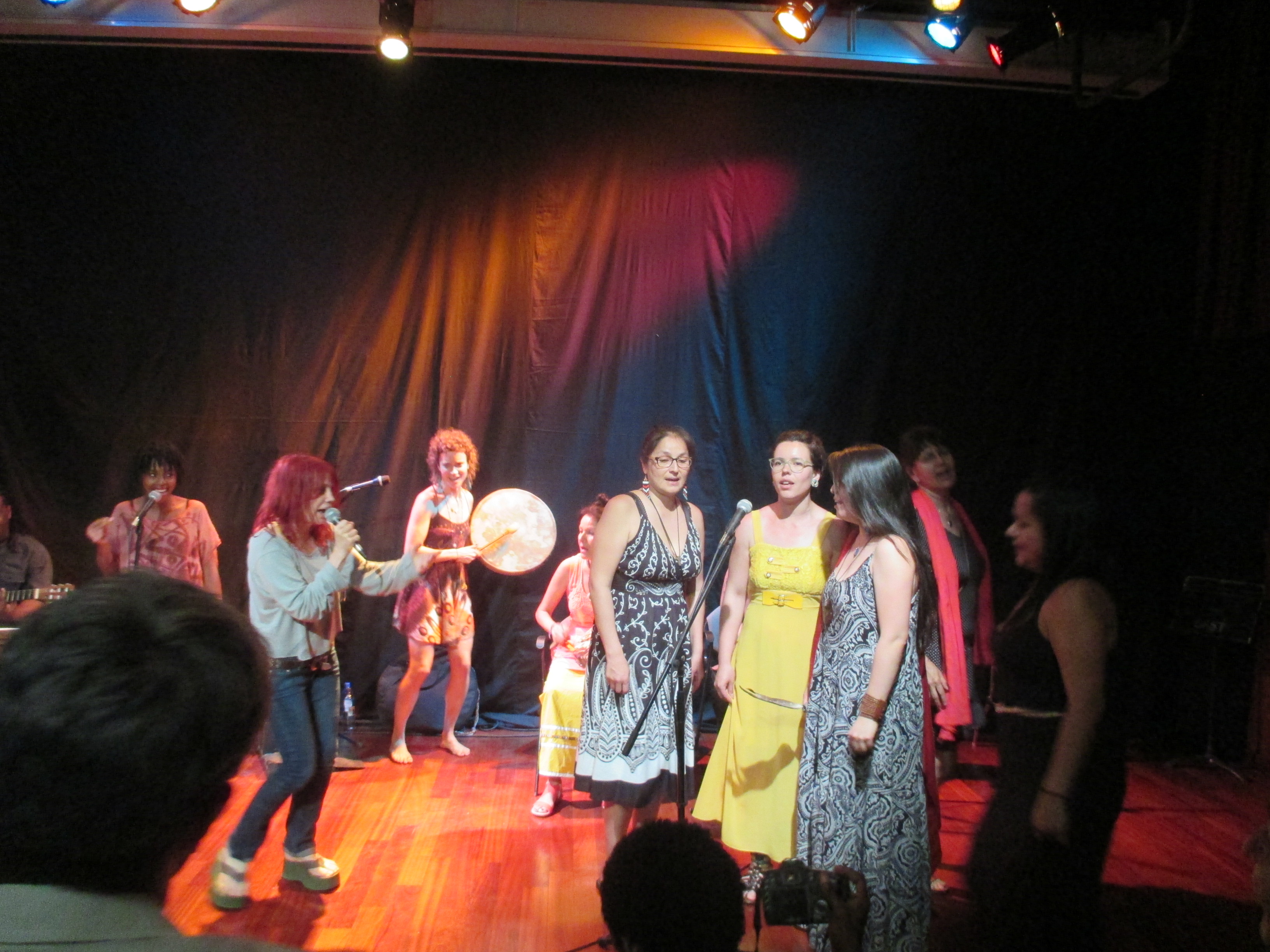
    Les nuits amérindiennes, Port-au-Prince Haiti, May 2015. Performers include: Chloé Sainte-Marie, Moe Clark, Marie-Andrée Gill, Rita Mestokosho, Natasha Kanapé Fontaine, Naomi Fontaine.

    What’s the point of going to see a poetry show if you can’t understand the text? And yet—there it is. That galvanizing, pure communication of the concerns, the beauty, the specificity of another language. The most joyful expression of it that I’ve seen so far was at an unforgettable night with the inzync Poetry sessions in Stellenbosch, South Africa. At least five of South Africa’s eleven official languages were represented onstage, with whispered translations offered by audience members to their neighbours, and whoops of recognition along the way.

    I wanted more.

    Port-au-Prince, May 2015

    I’m nearly the sole Anglophone, and definitely the only Northern Irish, at Les nuits amérindiennes, a festival of First Nations poets and artists in Port-au-Prince, Haiti, curated by the inimitable Rodney Saint-Éloi of Montreal-based publishing house Mémoire d’encrier. The Indigenous poets from Quebec include Joséphine Bacon, Guy Siou Durand, Tomson Highway, Virginia Pésémapéo Bordeleau, Louis-Karl Picard, Natasha Kanapé Fontaine, Moe Clark, Marie-Andrée Gill, and Naomi Fontaine. I’ve been sent by the Edinburgh International Book Festival to meet with Joséphine, Natasha, and Naomi for a collaborative project. This is my introduction to Canadian, to québécois, to Indigenous literature. I have no idea what’s going on, and I can barely understand anyone (my Belfast schoolgirl French being wholly inadequate in the circumstances). But at the shows, I’m electrified by the performance and the politics, the unself-consciousness, the self-awareness, the clear-eyed passion, the trickster craftiness—and well-honed craft—of the various artists.

    Nobody really understands why I’m there either, although it’s not that important—this isn’t about me. But I’m not that good at sitting on the sidelines and I’m desperate to communicate, somehow. At the second late-night session at Café Yanvalou, I sidle up to Rodney and ask, haltingly, if I can take a turn at the microphone. The words will be in English, but it’s the only thing I can think of to do. I sweat through a couple of poems, with halting introductions in French. I talk about my mother, and the sea. It works. I cannot speak, but I can extend words. The connection is made. These will become lifelong friends (and in one case, the love of my life, and the beginning of my journey to Montreal).

    Edinburgh, December 2016

    I am finishing up six years in Edinburgh, Scotland, which has mostly been consumed and absorbed with poetry, performance, promoting events, teaching workshops. It’s been a fantastic life. I have been incredibly lucky, starting from the gritty basics of open mic nights and running shows, and ending up being able to make a living, a good living, from all this. I love my community, I love my work, I love, more than anything, what happens when people get on a stage with their words, and speak them to an audience. And I’m leaving it.

    Even I’m not entirely sure why, except that there is love on the other side of the Atlantic. And there is a chance, a real chance to follow this thread of poetry and of performance, and try to understand how, if one cannot follow the sense of the words in an art form that bases its craft on the finer points of language, one can still be so affected by multilingual performances. In Quebec, my native language—which I have spent the last few years learning how to wield as a poet—becomes one among many.

    Montreal, November 2018

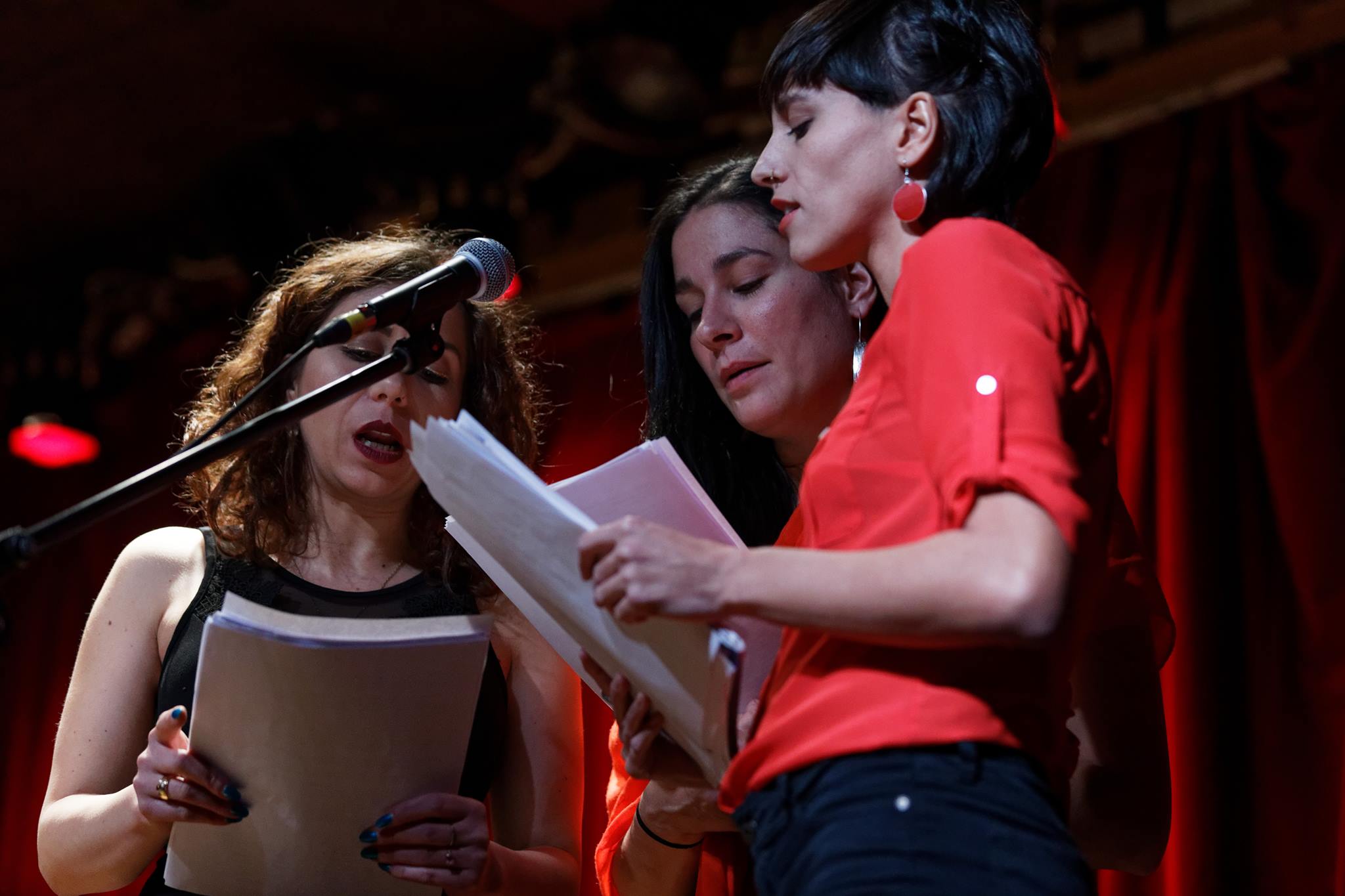
    I’m at Langues liées // Linked Tongues in La Sala Rossa, Boulevard Saint Laurent, Montreal. It’s the opening event of the Mile End Poets’ Festival, and there are ten poets on stage. There are ten languages on the stage. Aside from French and English, there is Arabic, Creole, Korean, Innu-aimun, Italian, Occitan, Persian, Portuguese, Spanish, and Wolof. These are mother tongues, and father tongues; languages of politics, of home, of love.

    Languages talk of their own concerns, at once specific and universal. Martha Tremblay-Vilão sings saudade, the Portuguese longing for a past or a home that no longer exists. Hossein Sharang talks of Iran, of democracy, of the impossibility of a country of eighty-two million terrorists. David Bouchet asks—in Wolof, with the aid of cue cards (and his fellow poets): “Where are you, who are you, how are you?” Marcela Huerta performs the stiltedness, then fluidity, of learning English as the daughter of Chilean refugees.

    The audience doesn’t understand everything that is being said, but there are ripples of comprehension when a new language is presented. There is a table of Arabic speakers, another of Portuguese. Maëlle Dupon’s mother is in the audience to hear her perform in Occitan; another supporter, a Haitian friend of Maëlle’s, is blown away when his ears catch the Creole of Chloé Savoie-Bernard.

    In La Sala Rossa, the last impressions are of joy. Of something ventured and something gained. Of respect. Everyone on that stage can do something that no one else can. They’ve worked for this show, they’ve risked, they’ve listened to one another, translated, called out and responded. And we’re here, and we will listen.


    RachelMcCrum_headshot

    Rachel McCrum is a poet, performer, and promoter—and also the Membership & Communications Co-ordinator of the Quebec Writers’ Federation.* She is originally from Northern Ireland, and has performed and taught poetry in Greece, South Africa, Haiti, Canada, and around the UK. She lived in Edinburgh, Scotland, from 2010 to 2016, where she was the inaugural BBC Scotland Poet-in-Residence, a recipient of an RLS Fellowship, and the co-host of cult spoken word cabaret Rally & Broad. Her first book, The First Blast To Awaken Women Degenerate, was published in 2017. She has lived in Montreal since January 2017, where she co-directs (with Ian Ferrier) the Mile End Poets’ Festival and curates the bilingual poetry performance series, Les Cabarets Bâtards.

    *As an employee of the QWF, Rachel has waived the fee for this article.

    Photo credits: Michael Kovacs (header image, showing Maëlle Dupon, Uasheshkun Bacon, and Martha Tremblay-Vilão reading in Occitan, Innu-aimun, and Portuguese at Langues liées // Linked Tongues); Rachel McCrum (top image); Ryan McGoverne (headshot)

  • On the Back of Turtle Island Reads—by Shannon Webb-Campbell

    On the Back of Turtle Island Reads—by Shannon Webb-Campbell

    A year ago, I’d have never believed I would be asked to advocate Indigenous literatures on CBC for Turtle Island Reads. Given that I was living in St. John’s, Newfoundland, teaching and studying in the English department at Memorial University (MUN), I had no clue I’d be islanded again, but this time in Montreal. Let alone be invited to speak about Indigenous literature on national radio.

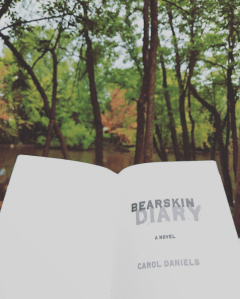
    Just over thirteen moon cycles later, after taking the first (and only) “Aboriginal Myth, Medicine, and Magic” course offered at the graduate level at MUN by Dr. Valerie Legge and co-instructor Amelia Reimer, I shared a knowing wink with Creator while sitting on the stage with my fellow Indigenous advocates. As a student of literature, I came out of the academy and into the public with Métis poet and musician Moe Clark, who advocated for Leanne Betasamosake Simpson’s This Accident of Being Lost; and Anishinaabe comedian and writer Ryan McMahon, who heralded Eden Robinson’s Son of a Trickster. I trumpeted Carol Daniels’ novel, Bearskin Diary.

    “I shared a knowing wink with Creator while sitting on the stage with my fellow Indigenous advocates.”

    We gathered at Tanna Schulich Hall at McGill University on September 20, days before the fall equinox. Our host and moderator, CBC’s Waubgeshig Rice and Nantali Indongo, facilitated a vital conversation spanning issues of storytelling, trauma, healing, and the need for Indigenous literatures. Truthfully, all three of us advocates could have sung praises for one another’s texts, as each book is made of powerful medicines and provocative storytelling, and each one embodies Indigenous knowledge systems.

    Bearskin-diaryPart of the role of advocates is to select a book, and each of us picked texts that spoke to our own craft and the relationship to our own Indigenous being. Clark was drawn to Simpson’s This Accident of Being Lost because of its poetic and sonic qualities. Much like Simpson’s work, Clark’s music breaks and beckons to tradition. Simpson doesn’t adhere to the infrastructure of the colonial English language. She avoids capitalization. Sometimes she writes in Anishinaabe, and doesn’t feel it necessary to translate. Clark approached her pitch in a similar fashion.
    McMahon highlighted the fact that each of the authors were First Nations women: “We’re in a moment now for Indigenous women artists. We need to not forget that.” He pitched Robinson’s Son of a Trickster with his trademark humour and intelligence.

    As I first encountered Daniel’s Bearskin Diary when reviewing it for The Malahat Review last year, I recognized how much the novel has shaped my own work. Not only did I feel a strong kinship with the novel’s protagonist, Sandy, a Cree journalist and TV reporter for CBC who comes into her Indigenous culture through telling other people’s stories, but also with the book’s relationship to the ongoing genocide of Canada’s Missing and Murdered Indigenous Women, Girls, and Two-Spirits.

    “I feel a strong kinship with … the book’s relationship to the ongoing genocide of Canada’s Missing and Murdered Indigenous Women, Girls, and Two-Spirits.”

    My own work spans genre, as I began my writing career as a journalist. Much like Sandy, I became comfortable asking questions and conveying the narratives of other people’s lives. Criticism has always been equal parts discovery and intellectual engagement. It’s a place to find and be found. From there, I became a poet (Daniels writes poetry, too). My forthcoming book, Who Took My Sister? (BookThug 2018), is a collection of poems and texts that hold and carry trauma. These poems are contemporary poetic strategies, both haunting testaments and a mix of Indigenous medicines. Who Took My Sister? is a rally cry, a space for raising awareness and cutting truths. It bears witness to the national genocide of Indigenous Women, Girls, and Two Spirits, whose lives are cut short due to the colonial agenda.

    “Criticism has always been equal parts discovery and intellectual engagement. It’s a place to find and be found.”

    Who Took My Sister? is also being transformed into a touring classical music piece for violin and piano composed by Melissa Hui, and will be performed by Indigenous Inuk artist Laakkuluk Williamson Bathory in spring 2019.

    Poetry has been an ongoing journey with many twists and turns. Recently, it’s led me to writing plays. I’ve been working on The Landless Band, a theatre show about a character who grows up in the suburbs, then learns she’s Indigenous. Tying back to Daniel’s work, while her protagonist Sandy was visibly Indigenous with darker skin, her storytelling techniques overlap with mine: we both draw from a personal narrative and explore it through characterization. The Landless Band is being presented in a workshop form at LSPU Hall in St. John’s, Newfoundland in spring 2018 by Eastern Edge Gallery.

    “The most exciting writing in this country is rooted in Indigenous writers, playwrights, and poets.”

    While Turtle Island Reads promotes Indigenous literatures, it also honours the advocates and their practice. Having only recently arrived in Montreal, to find myself in a room full of avid readers who are excited about Indigenous writing was an honour. It’s a testament that we’re ready to step beyond the canon, and unpack Canadian literature. We’re making room for new voices. Perhaps I’m biased, but the most exciting writing in this country is rooted in Indigenous writers, playwrights, and poets.


    Webb-Campbell by Dayna DangerShannon Webb-Campbell is a mixed Indigenous (Mi’kmaq) and settler poet, writer, and critic currently based in Montreal. Her first book, Still No Word (2015), was the inaugural recipient of Egale Canada’s Out in Print Award. She was the Canadian Women in the Literary Arts (CWILA) critic-in-residence in 2014, and sits on CWILA’s board of directors. Her work has appeared in many anthologies, journals, and publications across Canada, including the Globe and Mail, Geist magazine, The Malahat ReviewCanadian Literature, Room, and Quill and Quire. In 2017 she facilitated a book club-style reading of The Final Report of the Truth and Reconciliation Commission of Canada at Atwater Library. Who Took My Sister? is her second book.
    Photo credits: Courtesy of the CBC (header banner); Shannon Webb-Campbell (Bearskin Diary); Dayna Danger (headshot)

  • ‘Just Do It’ for Writers—by Carolyne Van Der Meer

    ‘Just Do It’ for Writers—by Carolyne Van Der Meer

    The thing about writing fiction is you need to know what kind of writer you are. The kind who needs a plan, or the kind who doesn’t. I was convinced I needed a plan. Lori Weber taught me I didn’t.

    Earlier this year, I was chosen as one of the mentees in the QWF’s annual mentorship program. The goal was to work on my young adult fiction novel with Lori, a prolific children’s writer and YA fiction novelist. I’ve been at this novel—my first—for a few years. I’ve worked with other mentors, attended workshops, and been part of writing groups. But I was stuck. And Lori, using wisdom gleaned from writing ten books, unstuck me. It has been euphoric.

    Prior to beginning the mentorship in February, I handed more than 100 pages over to Lori, written over the last three years. Chapters, scenes, flashbacks, character sketches—and a plan. A plan that outlined my novel in thirty-three chapters. This novel was planned to the hilt. Every move was carved out. So why couldn’t I write it?

    “I’ve been at this novel—my first—for a few years. I’ve worked with other mentors, attended workshops, and been part of writing groups. But I was stuck.”

    At our first mentorship session—a two-hour foray into scones, homemade jam, and Earl Grey—Lori asked me to tell her my goals for the four-month mentorship. Of course I wanted to advance my novel. But I wanted to talk about craft. I wanted to pick her brain. Hey, here I had, right in front of me, a very fine YA novelist, a successful one with some ten books to her credit—one, Yellow Mini, even written in verse. I’m a poet first—so Lori became my hero pretty fast. I wanted to understand how she does it. How does she hammer out all those words and weave them into a believable story, one that young people will not be able to put down? I wanted to know her secret.

    “This novel was planned to the hilt. Every move was carved out. So why couldn’t I write it?”

    It was simple: drop the plan.

    What? Yes, I had heard right. Get rid of that bloody plan.

    So as much as our mentorship together was about writing, it was also about teaching me something I didn’t at first believe I needed to learn—and something I doubted I was capable of learning. How?

    Well, she asked me, why did this novel need to be mapped out so tightly? I had a general idea, didn’t I, of where I wanted to go, so why not run with that? It didn’t seem to me to be enough. But Lori had plenty of examples, the most significant one being that she was hard at work on her eleventh book, one that she was mapping out—as it got written—on the wall in multi-coloured post-it notes. The plan didn’t come beforehand: it was being developed as she wrote.

    This was a completely foreign notion to me. I was used to writing poetry, where the idea could be banged out in a few minutes. I knew from minute one what my storyline would be and I could get it out in one sitting. Of course, then I would spend hours reworking and reworking—until I had something that I was convinced was jolting. Something that would move the reader in some way. And then Lori asked me the question that changed everything: why was writing my novel any different?

    Of course I had lots of reasons for her: because I didn’t know what the outcome would be; because I didn’t know how to deal with the passing of time; because I need to describe what happens in every second of every minute; because I need a plan to get from A to B.

    You just believe, she said. And you write. It was like the Nike slogan. Just Do It.

    Over the next few months—over many cups of Earl Grey and too many scones, Lori taught me how to “let go” and believe that I don’t need a prescription. If I had a strong general notion of the plot and of the various climaxes on the plotline, I could simply start writing and gently push myself towards the outcome. Her mantra of “just write it” became my own. Simple but true. Lori kept telling me that if I didn’t write it, there would be nothing to work with, nothing to fix. Just like the poem I could write in a few minutes and rework and rework.

    “Her mantra of ‘just write it’ became my own. Simple but true.”

    So apart from some very concrete accomplishments, such as a general plot overview, a complete character tree, the necessary historical research—and five completed chapters—I have come away from this mentorship with a new skill: being able to let go and just believe. Lori showed me how to work with intuition, energy, even faith. She claims she doesn’t know what will come out until she writes. So writing is the key. I believe her now. And I got rid of the plan. Really.


    If you are a Quebec-based English-language writer and you’d like to apply for mentor, or to be a mentor, visit the call for applications for the 2018 program.

    Carolyne Van Der Meer-4308

    Carolyne Van Der Meer is the author of Motherlode: A Mosaic of Dutch Wartime Experience. Her second book, a collection of poetry called Journeywoman, will be published by Inanna this fall.

    Photo credit: Bassam Sabbagh (headshot)

  • Gadfly at the Festival by Peter Richardson

    Gadfly at the Festival by Peter Richardson

    In the hospitality room at the Hôtel Gouverneurs in Trois-Rivières, you are greeted by two perky volunteers whose first question after introductions is: “Will you three be reading the French translations of your poems yourselves, or will you be requiring the services of a French reader?” Oh, my, you think. What translations? The hotel carpet begins to yaw under your chair. What was I thinking coming to a poetry festival in a city whose population is 97 percent French—without translations?

    Ahhh,” your hand goes up, feigning nonchalance, “I don’t have any translations with me.” The two other English-language poets and the volunteers swivel their heads in your direction as if you had just morphed into a large red crustacean whose claws and antennae waved merrily in their direction. “Can I give a short explanation of my poems in fluent French and then read them in English?” One of the cordial volunteers laces her fingers together and lowers her voice: “You see, people reserve restaurant tables months ahead to hear our guests read in French. It would be unfair, don’t you think, to subject them to English, when most people here rarely speak it?”

    How could you have not foreseen this eventuality? For the next twenty-four hours, you huddle with a hotel dictionary, churning out translations and cross-checking these with your translator sweetheart via long distance telephone. You thank fate that years before, you earned a university certificate in French-English translation. Although that hardly qualifies you as an ace in Gallic syntax, it limits the number of world-class howlers you’re likely to churn out. You are going to have to revise up to the wire. And once a reading is finished, there will be no stopping off for sparkling conversation with fellow scribes in downtown Trois-Rivières. It’ll be back to your room to crank out more translations. There are four readings a day in restaurants, bars, parks, and libraries; you’ll have to furnish two poems, four times a day.

    Accordingly, you show up for each venue as if this were a lark, your fraudulent grin assuring audiences that you’re dishing up the real thing, the slaved-over equivalents they’ve come to expect. The rest of the time you are a mole, looking up words like “dip” or “wobble” in a battered Robert-Collins. At readings, you unfold two sheets of spiral notebook paper and smile at your hash-marked, arrow-filled texts as if it were normal to achieve verbal legerdemain with the French versions overnight.

    You can’t point to the Russian poet, Evgeny Tchigrinne, huddling by the hotel elevator in a rumpled hockey team manager’s parka, and say to his interpreter companion: “It’s not fair. He should have to read his stuff in French too.” You can’t complain that Andrés Morales—one of the leading poetic lights in Chile, a man who also speaks Croatian and English—should be prevailed upon to read his translator’s French versions. His credentials precede him, and plus, with his dark suits, Brylcreemed hair, and killer smile, he is a serious candidate for the festival’s Mr. Cordiality Award.

    “At readings, you unfold two sheets of spiral notebook paper and smile at your hash-marked, arrow-filled texts as if it were normal to achieve verbal legerdemain with the French versions overnight.”

    The other English-language poets seem like consummate professionals. The Canadian geneticist-poet, Jan Conn, for instance, looks you straight in the face and says: “Months ago, I commissioned someone to translate twenty of my poems. I knew I’d have to have this stuff ready. I practiced it for weeks.” When she says this, you feel as though you’ve been transported back to that fourth-grade field trip to the Hayden Planetarium in New York City, where, standing in the cafeteria’s lunch line, you reached into your pants pocket for change and pulled out pebbles. Earlier in the day, while waiting for your mother to drive you to school, fearing you would miss the bus from school to the planetarium, you found yourself scooping up pebbles and chucking them by the handful, and some of these found their way into your pockets. But so what if you’ve spent a lifetime picking nickels out of the pebbles in your pockets?

    Does it stop you from making interesting acquaintances? No. And your readings manage to clear those imaginary telephone wires at the opposite end of an airfield that is a reader’s five minutes at the microphone. Your cloth-and-wire craft ascends. It swoops up to a reasonable height in the short runway’s space over the tilted beer glasses and stilled bar chatter and its undercarriage avoids calamity. But without good conversational French, without a chameleon-like ability to don an entertainer’s alter ego at brasserie readings, without a knack for chuckling your way through introductions which contain a reference to the dog-eared papers you clutch, you shudder to think how this forty-eight-hour period might have transpired, and how close you came to earning the title: Worst Anglo Festival Invitee Ever.


    IMG_1483Peter Richardson is the author of four collections of poetry: A Tinkers’ Picnic (1999), finalist for the Gerald Lampert Award; An ABC of Belly Work (2003), short-listed for the Acorn-Plantos Award; Sympathy for the Couriers (2007), winner of the QWF’s 2008 A. M. Klein Award; and Bit Parts for Fools (2013), which was short-listed for the Archibald Lampman Award. A retired airline worker, he lives in Gatineau, Quebec.

    Photo: Via Flickr; no changes made (top); Martine Chapdelaine (headshot)

    Peter Richardson, Jan Conn, and a small group of other authors will be reading on April 11, 2016 at the launch party of Vallum Magazine‘s Issue 13:3. The Brass Door Pub (2171 Crescent Street, Montreal), 7:30 p.m.