Tag: writers

  • Writing Fiction in the Age of Artificial Intelligence—By Duncan Hart Cameron

    Writing Fiction in the Age of Artificial Intelligence—By Duncan Hart Cameron

    Has it all been for nothing? 

    All of the hours that I have spent in front of my computer, rising at dawn to be at my station, pounding out stories, working through the fear of not being good enough, of not being able to put something great on the page, something that is part of me, that is me. The scrawls in my notebook, the daydreaming when I walk. The small steps and incremental gains. The steady getting there.

    All for naught.

    Because ChatGPT or something like it—an artificial intelligence—will one day write a poem or a short story or even a novel that is as compelling as one of my own. Somewhere, a bunch of programmers are laughing at me: “You think what you do is special? I can make an app for that.” And they have.

    So why should I bother to write at all?

    Because it is not just about the result or the finished product. Not even close. I’m sitting here, holding one of my books in my hand, an anthology of short stories that I helped edit and to which I contributed. I admire the cover that took so many hours to format and the font that we debated for far too long. I flip to my piece, about falling in love in Paris while on exchange, and I remember when I wrote it. The feeling of gliding across the keyboard because I was on a roll. The delight I took in capturing a tender, painful moment in my life in words. Giving it existence and conveying it to others.

    The process I went through to publish the story imbued the entire project with meaning, like looking down a trail that you have hiked and taking pride in the work that it required to get there. That sweaty, joyful glow. The trail is just a trail, a path in the woods, until you have walked every foot of its length. Then it becomes something more. Something that is part of you. Imagine being plunked down at the end and looking back. Would you feel the same pride? Of course not. The trail would be meaningless, and your only relationship would be with the shortcut. (Which, in the case of AI, is very short indeed!) Likewise, a book is not just the words on the page. It is the physical manifestation of our grit and our pain and our faith. It is a symbol of our effort to impose meaning on our lives. Because that is what writing does. It gives us purpose. I know where I will be tomorrow morning and the morning after. I organize my social life, my diet, my sleep, and my family time around this central goal. There is clarity and comfort in that, not to mention satisfaction. I don’t think us writers can imagine living any other way.

    And what about the reader? Reading is about the writer, not just about the book. We read to be entertained, sure, but we also read to have a kind of communion with the author. We want to hear their voice in our minds and to know what they know. We want to taste their insight and their imagination and their courage. A bot could theoretically write a book like One Day in the Life of Ivan Denisovich or The Gulag Archipelago. But would those bot-made pieces really have the same meaning as Aleksandr Solzhenitsyn’s work, published after having spent eight years in a Russian prison? Of course not.

    Incidentally, ChatGPT can “write” in the style of Solzhenitsyn, or Ernest Hemingway, or Jane Austen, because their books already exist. It is essentially a massive synthesizer of existing data, improved by constant refinement of its answers to prompts, and it predicts what is likely to be the next sentence based on billions of previously written texts. Without authors (without us!) producing real work, Chat GPT, and other AI models like it, have nothing to say.

    And that’s the core of it, isn’t it? You can’t untether art from the world. Art is inextricably linked to human experience and to human will. Otherwise, what the heck is it? Writing is not plagiarizing thoughts and feelings, it is confronting our own inadequacy, our fears, our yearnings and spilling it on the page in a way that resonates with others. The catalyst is empathy, which links the reader and the writer together. Bots do not know what it is like to lose a loved one or to suffer rejection or to yearn for revenge. Only humans do. And it is that knowledge that readers seek when they open a book. 

    In the end, bots will produce cool stuff, even great stuff, things we could never have imagined before (check out DALL-E); but writers will continue to write, and readers will continue to read human work, because the process itself makes the act and the result meaningful. If anything, we will start to see more novels that explore the ways that AI intersects with and changes art, rather than rendering that art extinct.

    As that unfolds, you know where I’ll be. In front of my computer toiling away, or daydreaming on a walk.
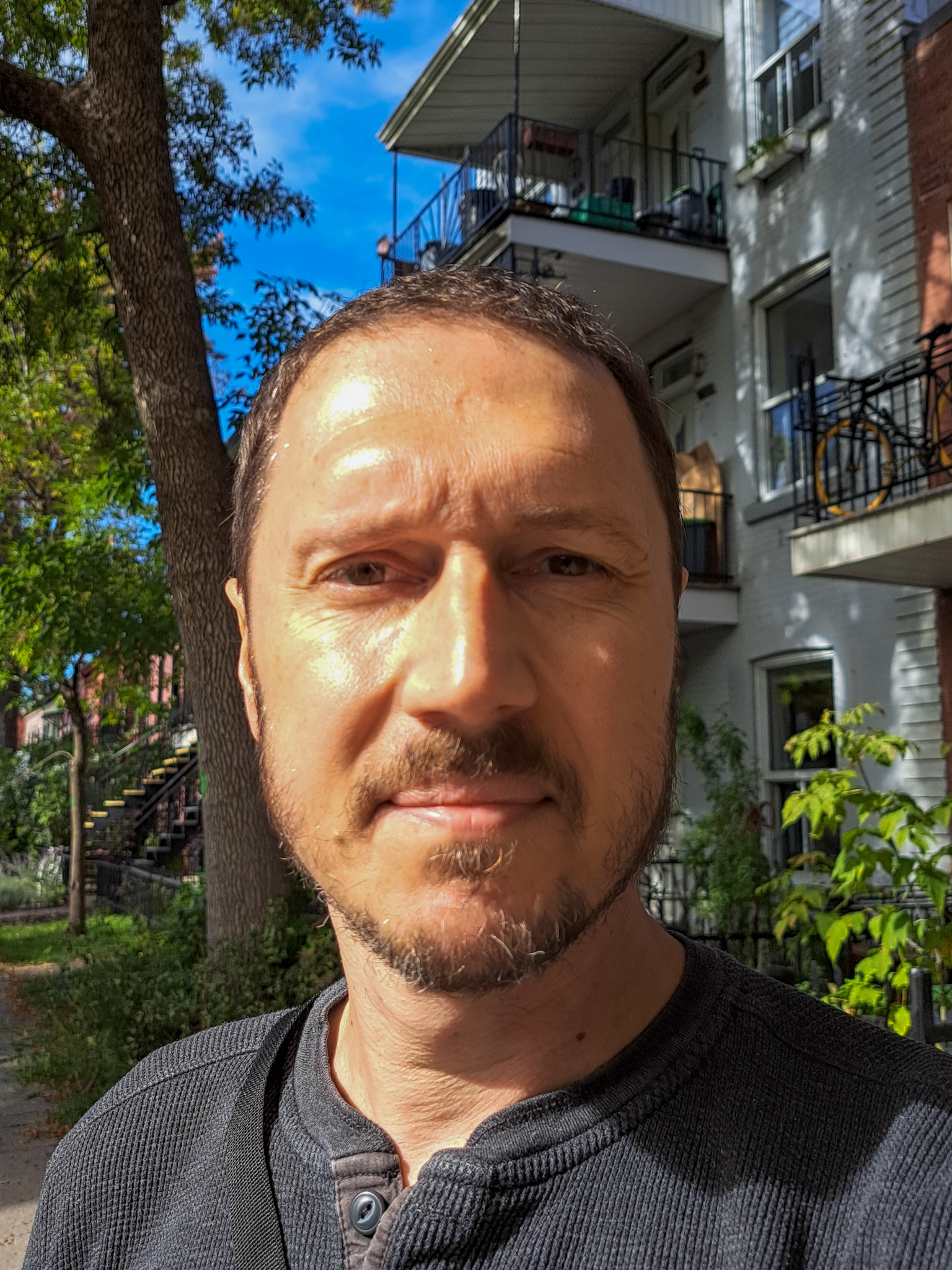

    Duncan Hart Cameron has taught college-level philosophy in Quebec for over twelve years. Born in Ontario, he lived in BC before moving to Montreal in 2001 to pursue a Master’s in Philosophy. A passionate writer and editor, he recently helped found Les éditions comme au vingtièmea bilingual literary review and independent publisher focused on supporting emerging writers, poets, and screenwriters living in Montreal and the Laurentians. His first novella, Eclipsed, is set to appear in the Fall of 2023 and explores the hold that our past can have on our present, especially in our most intimate relationships.

    Photos: Loz Pycock via Flickr (header banner); Duncan Hart Cameron (headshot)
  • Writing, Mothering, and the Wild In-Between—By Gillian Sze

    Writing, Mothering, and the Wild In-Between—By Gillian Sze

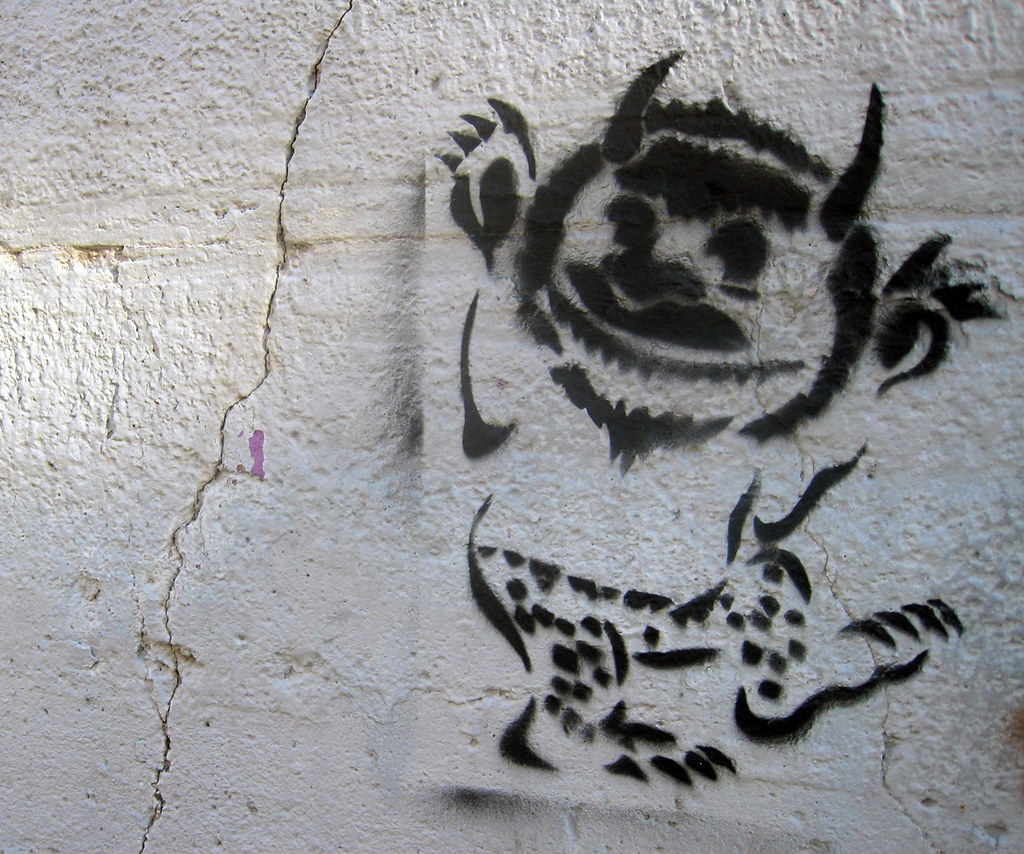
    My first reading of Maurice Sendak’s Where the Wild Things Are was as a parent. Growing up, I somehow managed to miss this childhood classic, which I now recognize as surprising given its widespread popularity. I was given the book as a gift when I was pregnant with my son, and even then I didn’t read it until after he was born. I kept it safe, waiting on a bookshelf along with the other picture books we received.  

    After my son was born, we were advised that it was never too early to start reading to him. We filled those tiny periods when he was awake with reading. I reacquainted myself with books I hadn’t picked up in years: Mercer Mayer, Robert Munsch, Margaret Wise Brown, Eric Carle. My husband, who took the advice to heart, started with Beezus and Ramona, Charlotte’s Web, and The Hobbit. (It took weeks but we eventually completed them in small increments.) Included in our stack was, of course, Where the Wild Things Are. 

    I was struck by the sparsity of the opening pages of text, words just hanging on their own like Sapphic fragments, sentences spilling across pages. With each page turn, the white frames of the illustrations shrink, the images fill up each page until we follow Max into his dream. When Max announces the commencement of the wild rumpus, what follows is three illustrated spreads of the boy reigning over the beasts. Time passes on those pages, without a single word in sight. 

    *

    When I entered motherhood, I simultaneously found myself entering a period of wild wordlessness. Bleary eyed, I was keenly aware of time and sleep. I saw time racing along as my son filled out his onesies. I saw time cherished as much as it was squandered as I lay beneath my sleeping son, not daring to move lest he wake up again for the thousandth time. I saw time slipping away as more (if not all) of it became devoted to caring for him. I oscillated between too little time (his naps were either short or nonexistent) and too much (nursing in the dark, exhausted and impatient as each passing minute stole from what was left of my own slumber). Moreover, I struggled with how to use my time as both a writer and a mother—the former of which I had identified with for much, much longer. I didn’t know how to fill—or not fill—that time with words as I once had. 

    Sendak’s illustrative spreads in the middle of Where the Wild Things Are remind me of what Anne Carson says about the middle section of To the Lighthouse. Carson describes Woolf’s book as “a novel that falls asleep for twenty-five pages in the middle” (22). Set at night, Part II of To the Lighthouse is entitled “Time Passes,” and describes the changes that affect the characters, their lives, and the house. As the characters in both Sendak’s and Woolf’s works go through their necessary transformations, I realized how possible it was to hold these books and sense Time passing both in words, as Woolf had written, and wordlessness, as Sendak had drawn.  

    In truth, I didn’t know how to “read” those illustrations when I flipped to them with my son. At first I felt compelled to fill the silence with my own commentary, and so I did. “Howling at the moon! (page flip) Swinging! (page flip) Marching!” Eventually, I learned just to observe my son take in the pages, looking at the images without my input.

    However which way Time moved (Mr. Ramsey stumbling in grief along a passage, or little Max riding triumphantly on a wild thing, or my son letting go of the table edge for his first steps), it just did. My anxiety about never writing again lived along with me through those day naps and night feedings. I accepted that becoming a mother meant having to lose myself as a writer. This primal and sleepy period of adjusting to a new person was tinged with mourning. My husband, supportive if exasperated, would remark on my melodrama. But at the time it felt true. It’s only now as my son is approaching six and his toddler-sister is starting to sleep through the night, that I recognize this tumultuous era as something transformative for me as a writer. I think of Carson’s wise assertion of the chapter “Time Passes”: “Virginia Woolf offers us, through sleep, a glimpse of a kind of emptiness that interests her. It is the emptiness of things before we make use of them, a glimpse of reality prior to its efficacy” (23). 

    Words, much like Max voyaging towards wakefulness, eventually “sailed back over a year and in and out of weeks and through a day.” It may have taken a little longer, but we arrived together… changed, relieved, and a little sleepier. 

    Works Cited 

    Carson, Anne. Decreation. Vintage Canada, 2005. 

    Sendak, Maurice. Where the Wild Things Are. Fiftieth Anniversary ed., Harper Collins, 2013.


    Gillian Sze is the author of multiple poetry books, including Peeling RambutanRedrafting Winter, and Panicle, which were finalists for the QWF’s A.M. Klein Prize for Poetry. Her forthcoming prosimetrical collection, Quiet Night Think, explores the early shaping of a writer, the creative process, and motherhood, and will be published next spring with ECW Press. Since becoming a mother, Gillian has started writing picture books and has two books forthcoming with Philomel Books (Penguin Random House USA). Her first picture book, The Night Is Deep and Wide, was recently released in March. www.gilliansze.com

    Photo credit: “Where the Wild Things Are” by Skinned Mink is licensed under CC BY-SA 2.0 (header banner); Nadia Zheng (headshot)

  • From Tragedy to a Book—By Catherine McKenzie

    From Tragedy to a Book—By Catherine McKenzie

    I’ve always thought of writers as magpies—we’re known for thievery, and that’s often what we do. We steal little parts of life, sometimes from our own experiences, but often from other people. A conversation overheard in a restaurant. A fight observed in the street. A line of dialogue said by a friend. We’re always collecting, gathering, storing so that we can use what we’ve gathered later, at the appropriate time. Sometimes the connection in the finished work is obvious and sometimes more tenuous, but if you know where to look it’s there.

    This happened to me in a direct way a year and a half ago when my brother-in-law’s mother was suddenly diagnosed with brain cancer and given six weeks to live. The whole family was shocked and saddened, me included. We’d all spent a lot of time together over the years, and she was a vibrant woman in her late sixties who seemed to have boundless energy. How could she be gone so fast?

    As I watched this real-life tragedy play out, my writer’s brain started cataloguing things and asking myself questions. For instance: faced with the same stark deadline, would I spend time going through my things and giving them away? Or would I speed away to a beach somewhere and leave the sifting to others? Would I make a general announcement on social media or through email, or leave it as a family secret that would come as a shock to many once the inevitable happened? Would I try to investigate how this had happened to me—what had been missed, how had it progressed so quickly—or put down my questioning brain and let it all go? And most importantly, was six weeks enough time to leave the world at peace, or was that impossible?

    This is what it’s like to be a writer! Or at least, this writer. In all of these questions, an idea formed. I write suspense, so what was the suspense twist to this premise—a woman given six weeks to live? I researched glioblastoma and found that in some cases, it might be linked to exposure to certain toxins. Aha! Maybe this woman—this theoretical woman, not the sweet woman I knew—had been exposed to a toxin. And maybe this exposure had been on purpose. Maybe someone wanted to get rid of her and they’d tried to poison her? But the poisoning hadn’t worked and here she was, a year later, with an unintended consequence? Interesting, interesting. The idea was sticky—it stayed with me—but, to be honest, it scared me. Was spinning a book out of something so close to me wrong? Was it the right way to honor her? I struggled with that.

    But I also had to propose some book ideas to my new editor. I had two—another idea that I’d been thinking of for longer that was more fleshed out, and SIX WEEKS TO LIVE. I sent them off, and soon I heard back. Oddly, another one my editor’s writers had a similar idea to my “other idea” and she’d already approved that. But she was intrigued by Six Weeks. Write that one, she said. So, I started to. Nervously. I came up with the plot—a woman trying to solve her own murder before she passed away. I added suspects to her life—a soon-to-be ex-husband, her adult daughters. I made sure to make my main character as different from the real woman as possible. In fact, by the time the manuscript was done, the only similarity between them was the diagnosis. But the book was for her. Because of her. I wanted to honor that. I dedicated the book to her, and I let my brother-in-law know what the book was about. He was gracious—as he always is—but part of me still wonders if he’s truly okay with it. 

    But this is what writers do. We’re magpies. We steal things. Hopefully what we give back is enough compensation.


    Catherine McKenzie was born and raised in Montreal, Canada. A graduate of McGill in History and Law, Catherine practiced law for twenty years before leaving the practice to write full time. An avid runner, skier and tennis player, she’s the author of numerous bestsellers including Hidden, Fractured, The Good Liar, and I’ll Never Tell. Her works have been translated into multiple languages and The Good Liar, You Can’t Catch Me and I’ll Never Tell have all been optioned for development into television series.

    Visit her online at www.catherinemckenzie.com, on Facebook at http://www.facebook.com/catherinemckenzieauthor, on Instagram at @CatherineMcKenzieAuthor and on Twitter @CEMckenzie1

    Six Weeks to Live publishes April 20, 2021 in Canada. Join Catherine for the Canadian launch! Event Link: https://www.facebook.com/events/276347913828110

    Photo credit: Jyrki Salmi (header banner)

  • How Podcasting Took Over My Life—By Catherine Austen

    How Podcasting Took Over My Life—By Catherine Austen

    If a podcast airs in a forest but there’s no one there to hear it, did it really make a sound?

    I started a creative-writing podcast in August to take the place of school visits during COVID-19. I write for children and teens, and I do a lot of writing workshops in normal years. During the pandemic, I’m offering teachers a podcast instead: “Cabin Tales: Spooky Stories for Young Writers.” Each episode tackles one creative writing topic (setting, point of view, etc.) and features stories, writing exercises, interviews, and prompts to help listeners write their own tales. It’s fun, it’s informative, it’s consuming my life.

    I fall asleep muttering my next intro. I walk my dog composing commentary. I blurt, “I forgot to normalize the volume!” in the middle of dinner. And on Sunday nights, I sit at my desk and edit “um”s from interviews instead of writing fiction. My family has never seen me so devoted to a pastime. If only she’d work that hard on a new book, they think.

    I’m disciplined about getting episodes planned and podcasted—far more than I am about finishing books. In part, that’s because of the weekly deadline and public face. (If I don’t revise a work-in-progress, no one cares because no one knows. If I don’t upload a promised episode, my subscribers will call me on it.) But mostly, I’m working so hard on the podcast because it’s fun. Creative fun. Challenging fun. The same sort of fun that writing fiction can be.

    Have you ever had a story in a literary journal that you’re pretty sure no one read except the editor? But you didn’t care because you knew it was a good story? My podcast is like that. There may be only two classes tuning in, but I don’t care because it’s a pleasure to make, and my listeners like it.

    “You should put your podcast on YouTube to get more listens,” my son says. Like I’m not already spending Saturday mornings making audiograms for guest authors. There is only one Saturday morning in the week. I used to spend it housecleaning. Someone else had better change the cat box because I’m doing a podcast now.

    Recording interviews; editing audio; fixing voice-to-text transcription—those tedious chores take far more time than coming up with content. But should the time-consuming nature of podcasts stop you from starting your own? No. If you have something to say, say it loud. (But normalize the volume before you upload.)

    There is something deeply satisfying about having one week to create something and never having to recreate it. A podcast isn’t like the short story you revise each time it gets rejected, or the novel you repeatedly edit, or the poetry collection you add to for years. You plan; you create; you upload; and then you move on. It’s like being a kid again.

    So I encourage you to join the podverse. There are 1,000,000 podcasts already out there—but that shouldn’t stop you from starting a new one, any more than 100,000,000 books stop you from writing. Just know that, like any creative endeavour, it will take more time than you expect. And your few hundred downloads might feel like boxes of self-published books in your garage. But there’s a pandemic of loneliness in the world right now, so grab a mic. Even if you only find a few ears.

    My podcast has allowed me to reach the teachers whose classes I can’t visit this year, and help them help their students write. It has brought two dozen YA and children’s literature authors together virtually.

    The best thing, though, is that writing fiction is now a reward instead of a chore. I spent half of Thursday on the podcast, so Friday I had time to write. Hurrah! Before “Cabin Tales” consumed my time, I felt burdened by the to-do: “Write.” I’ve rediscovered writing for the fun of it. My podcast taught me that.


    Catherine Austen writes short stories for adults, novels for children and teens, and reports for corporate clients. Her stories have appeared in The Fiddlehead and The New Quarterly. Her books have won the CLA Young Adult Book Award and the QWF Prize for Children’s and YA Literature. Listen to her podcast, Cabin Tales: Spooky Stories for Young Writers, at CabinTales.ca. 

    Photo credits: Catherine Austen

    If you’re interested in podcasting, check out a 2-part QWF workshop this November: https://qwf.org/activity/the-essentials-of-starting-your-own-podcast

  • Creating Community with Disabled Writers—By seeley quest

    Creating Community with Disabled Writers—By seeley quest

    Now is a time to gather disabled writers and our allies in direct community together. Writing practice shared in company among disabled people expands our consideration of how embodied variations inform our writing perspectives, and how our writing helps us understand embodiment. Whether virtually through videoconferencing or in person, I am keen to encourage events specifically centering disabled writers.

    Bodies and minds are linked; psychological and other cognitive differences manifest through a brain’s interactions with its bodily systems, so all of our experiences are fundamentally embodied. Our unique body-minds are what our writing comes through; let’s celebrate how the written word can share our particularities with the world.

    Writing practices that occur when we’re solitary can be powerful and necessary lifelines. Many people, disabled or not, get satisfaction and relief from journaling, “morning pages,” and other forms of writing for themselves; sometimes there’s no need to connect output to a larger community.

    Yet, sharing creative writing via virtual platforms can be particularly important to people who have less access to public spaces physically or cognitively. Familiar with social isolation, linking ourselves through correspondence helps sustain us. When health conditions permit them, more in-person gatherings are also valuable to grow the collective body of our writing work.

    Part of my agenda is to uplift disabled writers who are sharing work in public events and productions. The essay “My Arrival at Crip” makes excellent observations on becoming attentive to the presence and impact of disabled, chronically ill, and Deaf writers assembling in civic spaces. For writers with a newer relationship to disability, it’s especially profound to learn how poets who are “out” as disabled can change the political possibilities for everyone. Public notions of “ableness” are shifting, as living conditions shift during the pandemic, challenging our mental and physical health. The legacies of fierce “out” writers can offer guidance.

    Language is fundamental to how we conceptualize disability. Word choices undermine or reinforce associations that valorize hyper-ability, and have consequences. We have the option of using more neutral vocabulary instead of terms freighted by stigma like “handicapped” or “deficient.” “Atypical” is one option, and “atypique” in French is emerging as a descriptor chosen by the disabled community in Quebec. For more on how to shift from oppressive choices, there are great resources like this one: https://www.autistichoya.com/p/ableist-words-and-terms-to-avoid.html.

    Our work may get special attention in the frame of “disability arts” or “disability aesthetics,” a category for funding support. However, defining such writing as separate from and more worthy of recognition than art therapy, stream-of-consciousness writing, or fan fiction by disabled authors doesn’t serve the whole. Our future lies away from capitalist divisions. We must embrace arts practices associated with therapy. The need for therapeutic pursuits and for accessible arts engagement will grow. In workshopping and community spaces, I invite those with different experience levels of writing. Whether we are neurodiverse, are experiencing new or episodic disabilities, or are a language and sensory minority like the Deaf: all our work has value. People who aren’t sure of applying the term “disability” to their experiences are welcome comrades too!

    When we don’t shy away, there’s so much to explore of what our body-minds might know in common: those considered able and typical, those that vary and diverge, writing both from individual experiences and in relationship to each other. Let our texts layer into expanding knowledge to enrich the entire writers’ community.


    Photo credit: Coral Feigin

    seeley quest is a trans disabled writer, organizer, and environmentalist, in Montreal since 2017. Sie has made literary and body-based performance since 2001, and presented in Vancouver, Toronto, Ottawa, and many U.S. cities. Sie has poems in the book Disability Culture and Community Performance: Find a Strange and Twisted Shape, and in Fiction International. Hir playscript Crooked will be published in September in At the Intersection of Disability and Drama: A Critical Anthology of New Plays. Recent appearances include reading at le Salon du livre de Montréal and leading workshops with QPIRG-McGill, articule, and Head and Hands. Not on social media, sie email connects with comrades: find more at https://questletters.substack.com.

    Look for an announcement soon about new plans in 2021 for seeley’s QWF workshop; visit https://qwf.org/activity/poetry-and-prose-writing-from-the-body-mind.

  • Poetry via Videoconference—By Louise Carson

    Poetry via Videoconference—By Louise Carson

    Back in the old days—pre-March 2020—we used to have these literary events called book launches, festivals, and poetry readings, which often included open mics. People would gather at little cafes downtown, and/or, in my case, on or off the West Island of Montreal, or in art galleries, book shops, even people’s homes. Sometimes, authors and poets would travel long distances to attend such events in other regions, provinces or (rarely) countries. Sometimes we’d get paid, sometimes not. But it was all stimulating. Nerve-wracking until one had completed one’s contribution to the evening, but enjoyable.

    Now, after a tentative, sometimes fumbling start, the various hosts who were willing to make the transition to virtual events have made it, and we have a plethora of online events to choose from. As I write this mid-July, I am registered to attend before the end of the month: two open mics, a workshop, and a literary group’s business meeting. And because I’m a writer and notice things, and because these video conferences put us all into a fishbowl, it’s become evident that we are still on the upward slope of a pretty steep learning curve vis-à-vis etiquette.

    One of my regular Zoom poetry groups is made up of very docile members. When the moderator says mute, we mute. Well, most of us mute—there’s always one, isn’t there? The idea being, and this may or may not be true, that mics left open weaken the signal for receiving the one mic that should be open. Many open mics are certainly distracting. A sneeze or cough can displace the crucial emotional moment of a poem.

    Another of my groups is the opposite of the one above. About half of us mute. The other half, not so much. Some of the participants are married couples who chat with each other; others have, on occasion, set up their computer at the kitchen table, where they can be observed preparing snacks, moving from fridge to sink, muttering, laughing. The poor designated reader struggles on, their voice fading, returning, fading, returning.

    At one conference, there was an attack. A poet, possibly frightened of participating in her first live video presentation, and unable to make herself visible (although it was not her turn to read), panicked and, unfortunately, made herself only too audible as she accused the moderator of purposely shutting her out. “How could you do this to me?” and other similar comments were made. The moderator didn’t even blink. Peace was eventually restored, and we finally saw the unabashed poet smirking, preening for the camera.

    Then there are the readers who start each line strongly, only to fade away, so you get the verb perhaps or the subject, but not the object or conclusion. It’s most frustrating for the listener. We, as a group, don’t like to interrupt the reader. Sadly, in one instance the partially inaudible poet was the first reader of the night. I just assumed it was me alone who couldn’t hear him. Everyone else did likewise, I guess, as each subsequent reader was quite audible. We had inadvertently conspired against him. At least I didn’t have the nerve to praise him after the reading—like some. I honestly hadn’t heard enough to have an opinion.

    We must now turn to the visual component of Zoom. Where should I look when reading? At myself? At various members of the audience as I do when reading in person? Or at the camera above my screen? If I look there, I have to raise the text from which I’m reading, which then obscures my face. My compromise is to pretend it’s a live reading. I study my text and look up briefly—only to be distracted by a comment box from the chat stream briefly popping into view at the bottom of my screen. I know it’s about me and my words, so I want to look, but if I look I’ll lose my spot. I only did this once. Now it’s “Look away! Look away!”

    Another visual consideration is how do I and my room look to others? I tend, in life and online, to go for neat. I rejoice in the fact that I don’t need to wear a bra for Zoom. I’ve got a nice picture-free pale green wall behind me, which could function, I sometimes imagine, as a green screen, whereon a clever computer manipulator, which I’m not, could project anything. I could be underwater, in outer space, in a monkey house…

    At last night’s Zoom I noticed my floor fan, cooling my back, had made it onto the set and appeared to be attached to my left shoulder, lending it a larger than normal appearance. Innocuous, I thought, and shrugged. But then, more than once, I caught a glimpse of one of my cats, desiring to position himself in the room’s one window, there to view the chipmunks and robins and chickadees in the large cedar outside, leaping from my bed through the air, also behind my left shoulder—a ginger blur. So not monkeys, fish, stars—but cats.

    Let us now discuss Zoom visual no-nos. Please don’t recline while you’re listening to others. It’s too intimate, like we’re all in bed, or soon to be, together. Please, please, if you’re male and wearing short shorts, don’t sit on the sofa with your legs on the coffee table facing your computer. Avert eyes, all.

    It’s time to mention the hosts. With grace and persistence, you are allowing us to connect, not only within our local groups but with far-flung writers and poets, some of whom join us in the middle of their nights. From South America, Nepal, or even, far off Kingston (Ontario). So hats off to you, hosts, as you pilot us through this strange new literary landscape.


    Louise Carson’s latest books are Dog Poems (Aeolus House 2020) and The Cat Possessed, a mystery (Signature Editions 2020). She lives in St. Lazare, Quebec.

    Photo credit: Yasmine Carson (headshot)

  • The Importance of Being Silent—By John Arthur Sweet

    The Importance of Being Silent—By John Arthur Sweet

    A DIALOGUE. Persons: John Arthur and Pal.

    Scene: A deck in Hochelaga-Maisonneuve, one summer day.

    JOHN ARTHUR: Would you like some more kombucha? No? … Hey, I’ve got a little story for you. A while ago, I submitted one of my monologues to a theatre festival where I was hoping to perform it. The comment I got back from the Artistic Director was that the show had too few words in it, relative to the show’s length. He estimated, based on the word count, that the show should take thirty-five minutes, but I’d indicated that it takes sixty minutes in performance, and he said that twenty-five minutes of non-verbal action is too much. Can you believe that?

    PAL: Well, yeah. I mean, people are busy these days. If you give them silence, they’ll just start checking their phones. How many words was it, anyway?

    JOHN ARTHUR: According to the appropriately named Word, it was 4,522.

    PAL: So, that’s a lot of words. Get them out, and let your audience get on their way. Don’t be precious! Everyone has their story to tell, opinions to deliver. But you don’t need to milk it. Get your message across, and then make room for others.

    JOHN ARTHUR: But … First of all, I’m not delivering opinions. It’s a piece of theatre.

    PAL: That’s fine, but there’s a point to it, I imagine. You just need to make your point without dragging things out.

    JOHN ARTHUR: Why does everyone assume that everything has to have a point?

    PAL: You’re a writer, yeah? So when you sit down to write, you must have some point you want to get across.

    JOHN ARTHUR: I have something to communicate, yes. But it’s not necessarily a “point,” as you call it. I’m not a journalist.

    PAL: Okay, let’s say you have an imaginative notion—how’s that?—an imaginative notion to transmit. So, in the monologue you were just telling me about, you had—what was it?—4,522 words by which to transmit that notion. That’s a lot of words! There’s no need to then drag it out—

    JOHN ARTHUR: If you say “drag it out” one more time! Anyway, all this “dragging out,” as you call it, is what is otherwise known as Life.

    PAL: Oh no, please, don’t get all metaphysical on me, it’s ten o’clock in the morning. What I’m saying is, words have meanings. You’re a writer, so express your meaning in words and then leave it at that, don’t dr—

    JOHN ARTHUR: Oh no, stop! Words, words, words!! It’s not all about the words. There’s another way of looking at this. Look, if that artistic director is right, and my monologue features twenty-five minutes where I’m not speaking, then that means a group of people who mostly don’t know one another are sitting in a darkened room together in quasi-silence for twenty-five minutes. When else does that ever happen?

    [Silence.]

    PAL: Look, I’m sorry that guy didn’t want your show. But I don’t really understand what point you’re making here.

    JOHN ARTHUR: The point I’m making, since you’re so fond of “points,” is that we’re drowning in words. As a society, we are gasping for air, desperately thrashing around for a glimpse of the sun as we go under, dragged down beneath a tidal wave of words. Listen, back in about 1999, an editor I worked with raised tired eyes from her computer screen one afternoon and said to me wryly, “I’ve just been dealing with my e-mails. God help us, there is not a thought these days that is allowed to go unexpressed!” That was twenty years ago she said that, and all we were dealing with then was e-mail. Now it’s social media, smartphones, apps, and they’re all talking to us all the time, in words. We have words coming out of our mouths and entering our ears, we’ve got earbuds stuck in our ears to replace some words with other words, we’re writing like mad in the virtual world, tweets, posts, blogs, vlogs. Everybody’s a writer! We’ve got words seeping out of our—

    PAL: Don’t be vulgar.

    JOHN ARTHUR: No, but honestly, how many more words do we need?

    PAL: Right! So don’t do your show at all. That’s 4,522 fewer words in the world.

    JOHN ARTHUR: But I’m a writer-performer! And also an editor. I live by words.

    PAL: Sweetie, you’re getting all worked up and not making any sense. So you’re a writer and you want to make words. But, you insist, there are too many words in the world. So what can I do to help you? You seem to be at an impasse. Would you like some lemonade?

    JOHN ARTHUR: I guess what I’m asking is, are we simply aiming to cram as many words into our lives—into the available time, be it sixty minutes or sixty years—as possible? Or does silence (or, at the very least, word-free time) have a place? I just think that maybe, in 2020, one should have an opinion about this—especially if one is a writer. As writers, maybe we have a responsibility to write less and better, and even to think sometimes about what maybe doesn’t need to be expressed in words. What opinion or thought or observation can we just let sit, without formulating it in prose and then putting it out there? Do people really need to know that I thought Call Me By Your Name was a shitty film? Centuries ago, Saint John of the Cross wrote to a correspondent: “It was not from want of will that I have refrained from writing to you, for truly do I wish you all good; but because it seemed to me that enough has been said already to effect all that is needful, and that what is wanting is not writing or speaking—whereof ordinarily there is more than enough—but silence and work.”

    [Silence.]

    PAL: Um … did you just deliver a fairly lengthy quote from Saint John of the Cross?

    JOHN ARTHUR: I did.

    PAL: Do people even do that in real life?

    JOHN ARTHUR: No, but in literature they do.

    PAL: Okay … So, we’ll just sit with that, then, shall we?

    JOHN ARTHUR: Why not?

    [Silence, broken only by the bells of the church of Très-Saint-Nom-de-Jésus.]

    NOTE: This dialogue was inspired by the form used by Oscar Wilde in “The Critic as Artist.” It may or may not have actually taken place.


    John Arthur Sweet usually writes words that he expects to speak, as opposed to words he hopes others will read. In other words, he is a monologist and occasional spoken word poet. If we were living normal lives, he would currently be in England, performing at three theatre festivals. As it is, his last full-length show (Running to Saint Sebastian) was last year, at the Montreal Fringe, and before that, at the Prague Fringe (where he has performed four shows). He is a regular invited artist at Words and Music, most recently for a live-streaming edition in May. www.johnarthursweet.online

    Photo credits: John Arthur Sweet

  • A Body Divided—By Joe Bongiorno

    A Body Divided—By Joe Bongiorno

    In April 2020, we invited writers in Quebec to submit a story of a single day during the strange, uneasy time of coronavirus and pandemic, of social distancing and self isolation, of lockdown and quarantine.

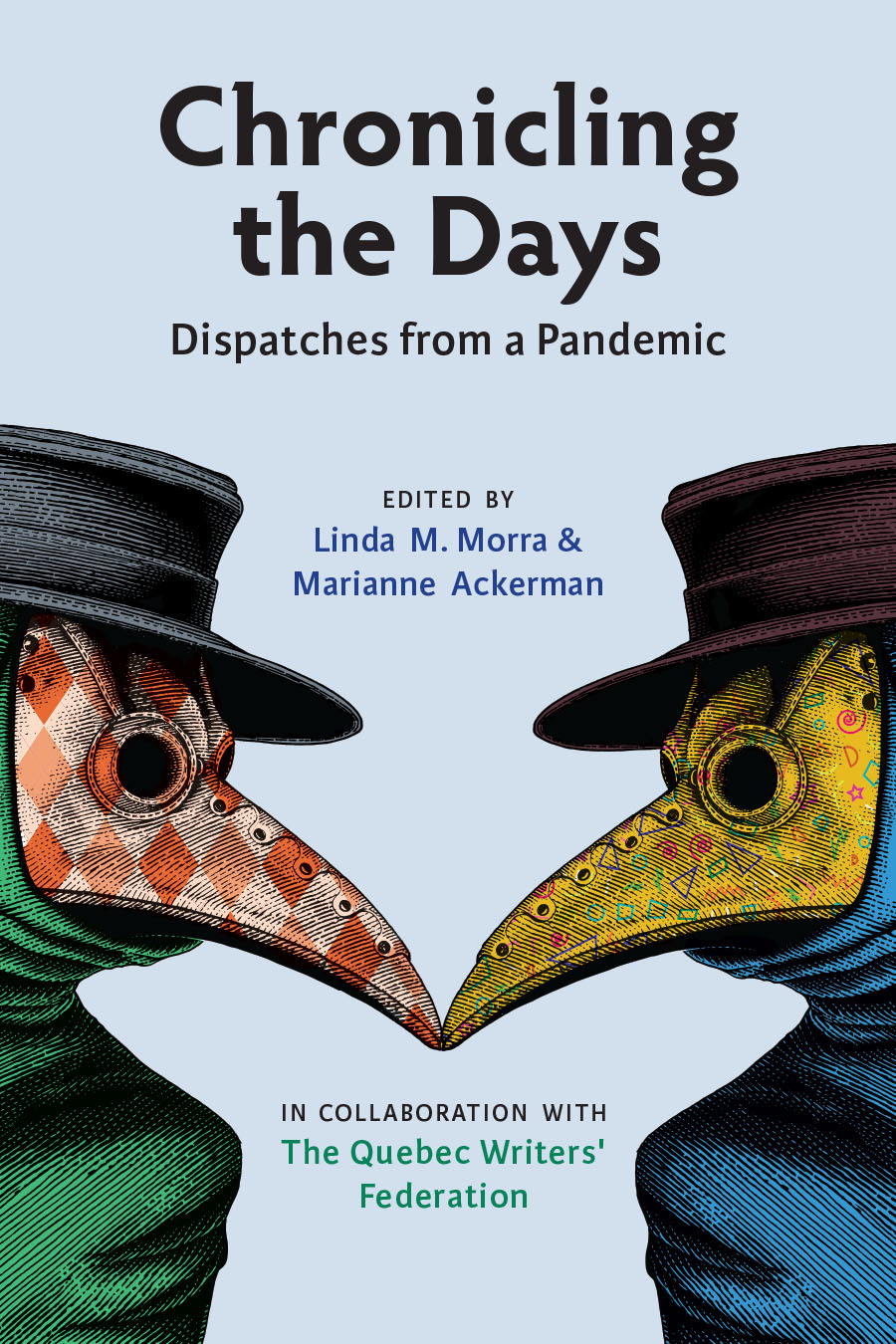
    We’re thrilled to announce that these stories have been gathered in Chronicling the Days: Dispatches from a Pandemic (Guernica Press). To learn more and buy the book, please visit https://www.guernicaeditions.com/title/9781771836579.

    Please also join us on the QWF FB Community page, and let the authors know if their words resonated.

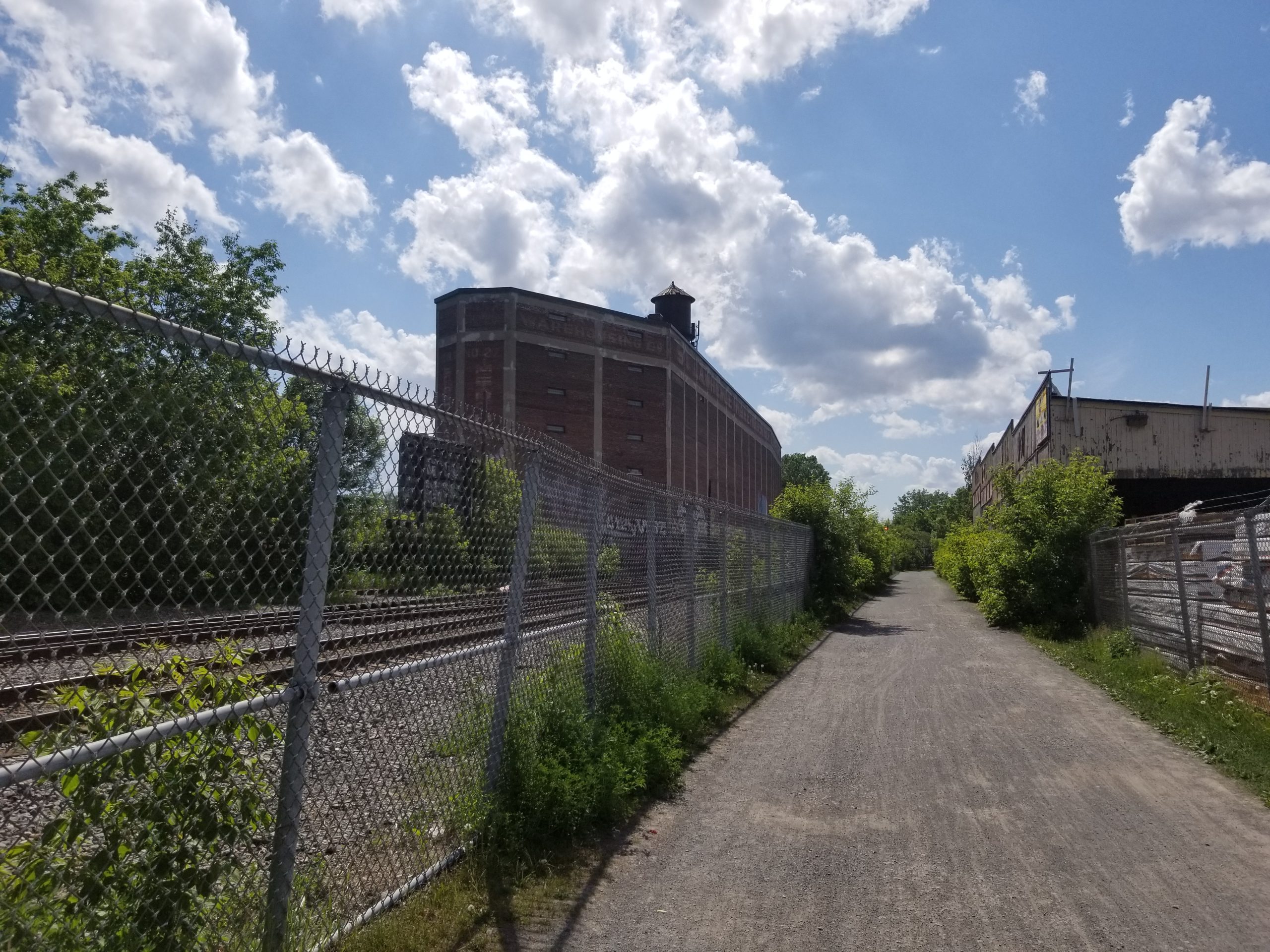
    I jog on the gravel path along the train tracks. I readjust my surgical mask and stray off into the grass to maintain a two-metre distance from a cyclist. My butt throbs. Pain gives way to numbness. Hamstring nerve pinched. I’m out of breath. My lungs open up to the cool air, fortunate to be left breathless by exercise and not COVID-19.

    To read the rest of the story, please support our community and check out Chronicling the Days: Dispatches from a Pandemic

  • The View From My Living Room—By Ariela Freedman

    The View From My Living Room—By Ariela Freedman

    In April 2020, we invited writers in Quebec to submit a story of a single day during the strange, uneasy time of coronavirus and pandemic, of social distancing and self isolation, of lockdown and quarantine.

    We’re thrilled to announce that these stories have been gathered in Chronicling the Days: Dispatches from a Pandemic (Guernica Press). To learn more and buy the book, please visit https://www.guernicaeditions.com/title/9781771836579.

    Please also join us on the QWF FB Community page, and let the authors know if their words resonated.

    The term “living room” came into common use after the First World War. Before the living room, there was the front parlour. This room was a formal showpiece, and before the proliferation of funeral homes, they were used to lay out the dead. After the many deaths of the First World War and the Spanish Flu, the front parlour became a haunted space. As early as 1910, the Dutch-born editor of Ladies’ Home Journal published an article titled “A Living Room is Born,” suggesting it was time to revive the staid front parlour; that is, it was time for the room to come back to life. The living room was a rebranding of a space where the dead were once venerated, at a time when they were so many that the house could no longer hold them.

    To read the rest of the story, please support our community and check out Chronicling the Days: Dispatches from a Pandemic

  • The Art of Connecting—By Joel Yanofsky

    The Art of Connecting—By Joel Yanofsky

    In April 2020, we invited writers in Quebec to submit a story of a single day during the strange, uneasy time of coronavirus and pandemic, of social distancing and self isolation, of lockdown and quarantine.

    We’re thrilled to announce that these stories have been gathered in Chronicling the Days: Dispatches from a Pandemic (Guernica Press). To learn more and buy the book, please visit https://www.guernicaeditions.com/title/9781771836579.

    Please also join us on the QWF FB Community page, and let the authors know if their words resonated.

    This self-isolation business is playing right into my hands. From the time I started thinking of myself as a writer, some forty years ago now, I knew my main talent for the job lay in my ability to cut myself off from other people. In fact, it seemed to be the whole point of the endeavour.

    To read the rest of the story, please support our community and check out Chronicling the Days: Dispatches from a Pandemic