Tag: Books

  • Keep Calm, Shut Up, and Write—By Lea Beddia

    Keep Calm, Shut Up, and Write—By Lea Beddia

    One full-time teaching job (hybrid online teaching included), three school-aged children (complete with homework, lunches and the occasional emotional meltdown), and one pandemic (anxiety I never thought I’d have, a bonus). Add a house to help maintain, and there’s no time for a creative outlet. It’s enough to turn me into a Netflix zombie. You may be busy like me, but even if you’re not, you may find your creativity stifled, vacuum-packed, and freeze-dried during this whole soul-sucking, stay-at-home-and-don’t-come-out situation. The state of the world is so real, yet surreal and heart-breaking, that my aspirations for all my wonderful ideas and plots are twisted up with anxiety, sleeplessness, and an obsession with watching the news. Enter Shut Up and Write.

    Shut up and Write: the name says it all. We really just shut up and write, for twenty-five minutes at a time followed by five-minute breaks. I don’t know about other writers, but in twenty-five minutes of absolute silence, with nothing but focus and my fingers tapping away, I’m more productive than during a full weekend in front of the television with my kids on my lap spilling popcorn all over me. It’s such a great stress-reliever to know I’m prioritizing myself ahead of my to-do list. I commit to be present when all my best-laid schemes have gone awry, and it’s the only chance for the stories swarming my head.

    I myself never attended the in-person sessions. I live an hour out of the city, and taking a Saturday morning away from busy mom life was not feasible. But since the sessions have moved online, we’re only limited to the distance our laptop charges will allow us to roam. I started attending after my QWF mentorship ended last June. I was so close to finishing what I had started and needed a little extra push to get my manuscript done. The result, for me: a manuscript completed and queries written.

    More importantly for my soul and morale, however, are these tenacious people, who like me, are ignoring real life for a little while to meet online and pursue personal or professional writing. Every time I sign up for a session, there’s this excitement: I’m going to see other people, and they’ll be writing, because their writing is important to them, too!

    I miss meeting with my writing critique group: an ensemble of talented, funny women who I met during a workshop, now almost two years ago. We still keep in touch, but each of us admits to lacking the energy and/or time for our writing, because “How can I not place my family, health, work, fresh air, and rabbit hole of online shopping ahead of writing?”

    SUAW is my antidote to isolation. I have something to look forward to in a time with no appointments or visits. I’ve found a community of writers willing to have my face in a two-inch square on their screen for two and a half hours a few Saturdays a month. Loneliness is at bay when I write during these sessions. There’s camaraderie in knowing we’re all struggling for time to be creative. I am grateful for the connections I’ve made.

    In our five minutes off, we chat, and in a short time, we share what we’re working on, or talk about recipes and make each other laugh. We’re all starving for positive human connections to people with a common interest and here it is, at my fingertips! When those five minutes are up, I’m like a superhero, relinquishing the destructive powers of procrastination because I’ve got twenty-five minutes to make the rest of my story shine, or at least get it from my head to my screen. Good enough.

    We may all be “Zoomed-out” and tired of hearing “You’re on mute” or “Can you mute yourself, please?” But to be honest, I kind of like it when someone forgets to turn off their mic and I can hear their keyboard clicking. It’s not a race, but it gets me going every time.


    Lea Beddia is a high school teacher, writer for young adults, and mom of three. She grew up in Montreal and now lives in the woods, on top of a mountain. She’s published short stories for young and old and you can find her work @LeaBeddia or www.leabeddia.com. In her free time (those rare, glorious moments), you can find her with her nose in a book, tuning everything out.

    Photo credits: Header banner is licensed under CC BY-NC-SA 2.0; Sarah Fortin Photographe (headshot)

  • Realists of a Larger Reality (Or Why I Read and Write Science Fiction)—By J. DeLeskie

    Realists of a Larger Reality (Or Why I Read and Write Science Fiction)—By J. DeLeskie

    I started reading science fiction young, before realizing it wasn’t suitable material for a girl with aspirations of fitting in with her fourth-grade contemporaries. It was the genre my dad and older brother favoured, and the surfaces of my childhood home were littered with paperbacks with lurid covers: a dinosaur riding an ichthyosaur across the desert (Jack Chalker’s Midnight at the Well of Souls); or a humanoid cat glowering over a worried-looking, two-headed tripod (Larry Niven’s Ringworld). Who could resist opening these books to see what tales lay inside? Not I.

    I soon discovered that the sex scenes in these books were way more interesting than the chaste kissing and petting the kids at Sweet Valley High were up to (albeit in a Dürer’s Rhinoceros sort of way; in retrospect, many of these old-school SF authors did not appear to possess firsthand knowledge of female anatomy or— you know—the actual mechanics of sex). Soon I was hooked, and not just for the salacious content. When the reality of being an introverted, slightly awkward kid attending Catholic school in rural Ontario became unbearable, I’d escape to Arrakis and lose myself in the messianic journey of Maud’Dib, or follow the adventures of a resurrected Richard Burton (the explorer, not the actor) as he searched for the source of the great river on Riverworld.

    By my teens, I contained within me an archive of worlds, characters, concepts, and stories that enriched my life immeasurably. The trade-off—a sense of not quite existing on the same planet as many of my peers—was worth it, even if it didn’t always feel that way. Not only did science fiction provide escape, it was an antidote for religious indoctrination, challenging the conservative, Catholic vision of the world I had been raised to accept as my own. My allegiance was to a universe far bigger and weirder than anything Christian dogma could encompass.  

    At some point in my early twenties, however, I stopped reading science fiction. I lost patience with the flat characters, clunky prose, and outright misogyny that typifies so much of the genre. My reading began to veer toward realism and non-fiction. In retrospect, I think I was trying to accept the world as it was, to put away childish things. I went to law school, got married, had kids, and embarked on a career as a corporate lawyer. I felt I no longer had the luxury of questioning the world as it was; my job as an adult was to succeed according to its metrics.

    Yet gradually, as my kids grew older and began asking the thorny questions that kids ask, I started to wonder if my acceptance of things had gone, perhaps, too far. It took a few years, but I managed to find my way out of the corporate cul de sac. And slowly, I found science fiction again. I rekindled a childhood love for Ursula K. Le Guin and was dazzled by her ability to imagine less destructive ways of organizing society. I read Octavia Butler for the first time and was astonished by her depiction of society collapsing into a racialized dystopia— and then being rebuilt, one community at a time. These authors and others—Marge Piercy, Kim Stanley Robinson, Corey Doctorow, Karel Čapek, etc.—eroded the shell of cynicism I’d formed over my conscience by insisting that there was nothing inevitable about environmental degradation, white supremacy, capitalism or misogyny.

    Thus, when I decided to try my hand at writing, it was science fiction that called to me. I’m now in final revisions of my first novel, Everclear, a coming-of-age story set in the near future in northern Quebec. The act of imagining this future feels laden with responsibility, and I’m attempting to construct this story with great care. I believe firmly that our words bring potential worlds into being.

    In her brilliant and fearless acceptance speech at the 2014 National Book Awards, Ursula K. Le Guin put out a call to “realists of a larger reality” who “see alternatives to how we live now and can see through our fear-stricken society […] to other ways of being, and even imagine some real grounds for hope.” The call is increasingly being answered by Indigenous, Black, and LGBTQIA writers of science fiction such as jaye simpson, Cherie Dimaline, Nnedi Okorafor, and N.K. Jemison— writers who, because of their lived experiences, assemble the pieces of our shared reality in unexpected ways. To me, this is the opposite of escapism; it’s an invitation to see the world with new eyes and answer the moral imperative this vision affords us. This is why I read science fiction, and why I write it: not to escape this world, but to re-imagine it.

    And, of course, for the cringy sex scenes.

    Suggested Reading List

    Love After the End: An Anthology of Two-Spirit & Indigiqueer Speculative Fiction, edited by Joshua Whitehead, 2020

    The Dispossessed: An Ambiguious Utopia, by Ursula K. Le Guin, 1974

    Woman on the Edge of Time, by Marge Piercy, 1976

    The Parable of the Sower, by Octavia Butler, 1993

    Ministry for the Future, by Kim Stanley Robinson, 2020


    Jennifer DeLeskie is a former lawyer and new writer, currently revising a draft of her first novel. Her non-fiction piece, “April 2, 2020,” will appear in Chronicling the Days (Guernica Editions), forthcoming in Spring 2021. Jennifer volunteers on the board of the Quebec Writers’ Federation.

    Photo credits: Header banner is licensed under CC BY-SA 2.0; Annabel Simons (headshot)

  • Writers Need Libraries; So Do Our Children—By Deborah Ostrovsky

    Writers Need Libraries; So Do Our Children—By Deborah Ostrovsky

    Not long ago, during the Before Times, I received a small award to pursue a non-fiction project. I planned to dedicate an entire week, maybe two or three, to writing without interruptions.

    The morning I opened my laptop to begin—it was World Book Day, which seems ironic now—I found an email from my daughter’s primary school. They needed a parent to volunteer at the library.

    Our primary school is fortunate to have a library at all. Many schools don’t have libraries. A primary school a few blocks from ours recently turned their library into a supply closet. Over 20 per cent of Laval’s public schools are without libraries, or enough books in classrooms.

    Radio-Canada reports that a quarter of all school boards in Quebec don’t have librarians. Our library is run by volunteers. We shelve. We search for lost books. Like a team of amateur first responders in an emergency room that should be staffed by qualified surgeons, we learn to repair the broken spines of bandes dessinées from video tutorials.

    The email from the school said that a few classes hadn’t been able to borrow books for months. Could you come today, maybe now, to turn on the computer and let the kids finally take some out?

    So I did what any emerging writer starved for time to write would do. I closed my laptop. I put on my coat. I rushed to the school. I stayed all morning and returned in the following weeks until the pandemic shut everything down. 

    Writing, editing, and translating are jobs that can sometimes feel easy to walk away from. This is especially so when other urgent business gets in the way—like helping to provide literacy and library resources for kids when neoliberal education budgets consistently sap them dry.

    It’s overwhelming to try and comprehend all the ways the arts, books, and writing are shaped by government policy. Even more overwhelming is the thought of my own personal luck at being born at the twilight of a golden age of state interventionism—right before the neoliberal assault on education. The idea of dedicating a life to writing would have never been possible for someone of my family’s background without policies that made public libraries, and librarians, part of every school.

    “Books have their sources in, are made from readers (would-be writers) reading other people’s books,”muses Kate Briggs in her book This Little Art. “All books are made from other books,”she writes. Anything I have ever written, then, has come in some way from other books, and in turn from a childhood of reading books that had date due slips glued to the back cover, and which were tucked under my pillow at night. The stories within these books made their way into my dreams. These books were always borrowed. They belonged to my public school.

    Now school libraries only open when parents have the income and the time to spend mornings taping together torn pages of Astérix.

    It’s okay, a parent told me a while ago when we talked about this. We have plenty of books at home.

    Lucky you, I thought. And what about those who don’t?  

    Lucky me, though. I get to write. It’s a privilege, in today’s economy, to do this thing with my life. But access to a school library should be a right, and not a privilege. The deep connections between my privilege and this right are buried somewhere within the early manifestations of my own creative desires over which I can take some measure of ownership; but they were undeniably helped along by state policy, making it possible for the artistic inclination and writerly imagination to be fostered by something other than luck, wealth, or family. It can’t be denied. My writing life is a result of private ambitions but also public will.

    For now, I’ll keep writing until the school library finally reopens, when the pandemic is under control. Then the school will call and say that they need somebody to help the kids take out books. I should really say no, and stay at my desk, to avoid more interruptions.

    But I will say yes. I will do this until something in the system changes radically, so kids can get their hands on more books. Maybe some of those kids can write in the future, too. In the meantime they’re waiting, hopefully not for long.


    Deborah Ostrovsky is an editor, writer, and translator. Her work has been generously supported by the Barbara Deming Memorial Fund, the Marian Hebb Research Grant, the Banff Centre for Arts and Creativity, and the Writers’ Trust of Canada.

    Photo credit: Gopesa Paquette

  • On Best-of Lists and How We Actually Read—By Genny Zimantas

    On Best-of Lists and How We Actually Read—By Genny Zimantas

    I am a big believer in lists. Grocery lists. To-do lists. Lists on phones and bits of envelopes and bills. Lists are satisfying to write, and even more satisfying to work through. But best-of lists, the kind of lists which flood journals and newspapers towards the end of each year, summarising “The 10 Best Books of 2019” or “The 100 Best Books of the 21st Century”—even though we’re only a fifth of the way through that century—are a pet peeve of mine.

    It’s no secret that yearly best-of lists are a marketing tool: for specific books, and publishers, and the journals or newspapers in which they appear. Few journalists, after all, can boast of having read every book they enumerate come December, let alone the thousands of other titles published in English and translated into English each year. The “best” books are usually chosen from an already shallow pool of previously successful titles, titles already supported by big marketing machines.

    That best-of lists so often equate financial success with literary value can be deflating, but my problem with best-of lists isn’t the “best” books themselves. It isn’t even whatever methods the list-makers use to arrive at their final selections. Instead, my issue with year-end best-of lists is how they dominate mainstream readerly conversation and keep us so focused on the immediate past—on the latest publishing triumph or controversy. To be clear: at this point in history, more books have been published than any of us could feasibly read in a dozen lifetimes. So why restrict our focus to the last year, or even fifty? Best-of lists help solve the problem of picking a next title out of overwhelming choice, but they distort perceptions of how we can (and do) read.

    In what I like to think of as defiance of market-driven, “of the moment” reading, booklovers around the world have come up with inspiring and invigorating criteria for deciding what to read next. UK-based reader and author Ann Morgan launched a project called “A Year of Reading the World” in 2012, embarking on a mission to read one book from each of the “196 independent countries—plus one extra territory chosen by blog visitors.” Making a similar readerly commitment the year he turned 25, Jerome Blanco decided to “stop reading white people,” in the process discovering more about himself, reorienting what he thought of as “real” literature, and revaluing his own work as a writer, too.

    These selection methods are, of course, restrictive in their own ways, and both readers relinquished complete adherence to their own rules after the periods in question. Both also maintained, however, that their reading habits were more open and varied after their readerly experiments than they had been before. Other bibliophiles set themselves more pointed challenges, like reading all of Proust during lockdown or responding to each of Emily Dickinson’s 1789 poems (from the Franklin variorum edition) online. Perhaps the most prominent rebellion against “best-of” reading, though, comes in the form of the counter list.

    Claiming to present “The Best Overlooked Books of 2019” or “The 13 Most Underrated Books of All Time,” counter lists seek to redress the presumed authority of yearly best-of lists and to expand our horizons beyond the already popular. They are, however, comparable to their more mainstream analogues in several key ways. Like year-end lists, they select and elevate specific titles. Also like year-end lists, they make an authoritative claim for quality, privileging not just books they identify as great, but books they claim are better than all the other great books. Counter lists thus fall into the same myopic trap: they claim objectivity and project a knowable universe of reading, where neither objectivity nor comprehensive knowledge exists.

    I’m not trying to suggest that best-of lists should be discarded, or even that we should shift our focus away from popular contemporary authors. We owe a certain responsibility, I think, to read work that is being produced now, to engage with our world and support living writers—especially writers from continually underrepresented backgrounds and marginalized groups. Best-of lists do, of course, bring attention to deserving new titles, and so have an important role to play. But a list, any list, is first and foremost a way to collect and categorize information, to make that information seem manageable, finite, knowable, known. Fortunately, if overwhelmingly, that just isn’t how the catalogue of 21st-century reading works.

    So, this year, I’ve started making my own lists, of books I want to read but also of new routes to discovery: talking to independent bookstore owners, and librarians, and friends; reading non-list articles; consulting catalogues from local small presses; seeking out books written in languages I’ve never read in translation before. I’ll be looking for books I can share with hundreds of thousands of other readers around the world, but also books few other people have read, books from two thousand years ago and books written this year, but from perspectives unlike my own. Best-of lists are fine, of course, but books are just so much cooler than “best.”


    Genevieve Zimantas is a writer and educator from Montreal whose poems and essays have appeared in journals across North America. She holds degrees from McGill University, Dalhousie University, and the University of Cambridge. In 2018, she was pleased to have been selected as the QWF’s poetry mentee and had the privilege of working with poet Peter Richardson. She now lives and reads in the United Kingdom.

    Photo credit: Lewis Weinberger

  • Copyright: What’s the Big Deal?— By Julie Barlow

    Copyright: What’s the Big Deal?— By Julie Barlow

    The Federal government is in the process of revising the Copyright Act. If you don’t think that matters to writers, think again.

    I’m always surprised to see blank stares on writers’ faces when I launch into a speech about copyright. Some of them aren’t clear why copyright really matters. Others aren’t sure what copyright even is. Fair enough—it’s not the sexiest topic in the writing world. But even if you don’t notice it, it’s fundamental to our business.

    Here’s why. I am a non-fiction author of six books and a magazine writer. To earn my living I sell the right to use my work, either to publishers who pay me advances and royalties or to magazines who pay me fees to publish my articles. For most of my twenty-five-year career, this revenue has constituted most of my income.

    Simply put, copyright law is what makes it possible for me to get paid for my work. The Oxford dictionary defines copyright as: “The exclusive and assignable legal right, given to the originator for a fixed number of years, to print, publish, perform, film, or record literary, artistic, or musical material.” That’s me—the originator. The Copyright Act is what legally makes my work mine as soon as I create it, and mine to sell.

    It sounds solid in principle, and I wish it was. Unfortunately, it’s getting harder and harder to enforce my copyright and get paid for it. So I jumped at the opportunity to attend a hearing hosted by the federal government’s Standing Committee on Industry, Science and Technology, held May 8 in downtown Montreal.

    First, let me explain why it’s getting harder to make money from copyright. The reason, in a nutshell, is the Internet and digitization. By making it easier to “publish” and “distribute” creative work, the Internet has made many, many consumers of culture think they should get what’s online for free. The ripple effect in the publishing industry has led to dramatically less revenue for publishers, magazines, and of course writers.

    “By making it easier to “publish” and “distribute” creative work, the Internet has made many, many consumers of culture think they should get what’s online for free.”

    Magazine revenues fell when advertisers turned to online outlets. So magazines are trying to increase their profits by demanding (and the word is not too strong) more copyright from writers, but for the same fee. Whereas the standard when I started publishing in 1995 was to sell first publication rights (giving the magazine the right to publish it once), I now have to sign contracts in which I hand over the right to resell my articles in any form, in any language, anywhere on the planet, sometimes for periods longer than the rest of my life. I used to resell my pieces, sometimes up to five times. Now that’s impossible. Some magazines have even demanded I give them “moral rights” to my work, which means they can alter my work any way they want without my permission – or even take my name off it (I don’t work for those ones).

    The case in book publishing is a little harder to explain. The industry as a whole is suffering from the forces of technology and book advances to authors are falling. When I Google my own work, I discover so many sites offering free (i.e., illegal) PDFs of my books that I can’t keep track of them anymore. And neither can my publisher.

    In 2012, the Conservative government recognized that the Internet and digital economy were changing the dynamics of publishing, so it set out to revise the Copyright Act, originally passed in 1921, to take digital realities into account. But the resulting revisions made it harder for both writers and publishers to earn money. The Act already stipulated situations when consumers don’t have to pay creators. For example, “fair dealing” allows you to share one of my articles with a friend for personal consumption without infringing my copyright. The 2012 revisions broadened fair dealing to include situations like “education.” The problem was, the revised Copyright Act didn’t stipulate how much of the work could be used without infringement. The result? Universities and schools across Canada have been refusing to pay fees for copies of my articles or excerpts from my books. Since 2013, the revenue that Access Copyright collects from universities, schools, and other institutions to distribute to writers has declined by 80 percent.

    As a writer, what do I want the government do to about this? I’m not expecting them to turn back the clock—the Copyright Act has to be adapted to work in the digital world. But most writers would agree that in this already difficult context, we deserve at least as much protection as we had before, not less.

    “As a writer, what do I want the government do to about this?”

    Today, the government appears to recognize the 2012 revision was a misstep. One committee member told me in private that the previous committee let copyright users like universities pretty much dominate the agenda during the last reform, while we creators had little say. So this year the government decided to go back to the drawing board and start by asking for our input.

    At the Standing Committee on Industry, Science and Technology meeting on May 8, about thirty-five creators spoke during the “open mic session.” We each got two minutes to make our case. The vast majority told their own variation on a common tale: over the last 20 years it’s become dramatically more difficult to earn money from our work because it’s harder to get anyone that should pay for the privilege of reading (writers’) or listening to (musicians’) or looking at (photographers’) work to actually pay for it.

    Creators are looking to the government to strengthen the copyright law so it protects our interests. For example, this means minimizing exceptions to fair dealing. I told the committee: “Some people own real estate and make money by selling it. I own copyright and make money by charging magazines and publishers for the right to publish my writing. Why would I be expected to donate my work for free to people who are making money using my work?” (Last time I checked, universities weren’t charities and professors didn’t work for free.)

    “Why would I be expected to donate my work for free to people who are making money using my work?”

    I actually feel a strange kinship with the taxi drivers and hotel owners out there whose livelihood is threatened by digital technology in the form of Uber and Airbnb. The difference, of course, is that the general public seems to get why taxi drivers and hotel owners ask for protection, whereas few understand how infringing on copyright takes money directly out of creators’ pockets.

    This time, I hope the government listens to creators. If they don’t, I’m not sure how we can be expected to make all the stuff people want to copy in the first place.

    I encourage other QWF members and all creators to draw on their own experience and submit a brief to the Standing Committee on Industry, Science and Technology, explaining why copyright is important to creators. Here’s the link.


    JulieBarlow_headshot

    Julie Barlow is a Montreal-based magazine writer and author of books on language and France, including her latest, The Bonjour Effect: The Secret Codes of French Conversation Revealed (St. Martin’s Press) and The Story of French, winner of the 2007 Mavis Gallant Prize for Non-Fiction. She teaches the Quebec Writers’ Federation workshop, Narrative Non-Fiction: Finding the Story Among the Facts. Visit her at nadeaubarlow.com.

    Photo credits: Nick Youngson CC BY-SA 3.0 Alpha Stock Images (header banner); Julia Marois (headshot)

  • On the Back of Turtle Island Reads—by Shannon Webb-Campbell

    On the Back of Turtle Island Reads—by Shannon Webb-Campbell

    A year ago, I’d have never believed I would be asked to advocate Indigenous literatures on CBC for Turtle Island Reads. Given that I was living in St. John’s, Newfoundland, teaching and studying in the English department at Memorial University (MUN), I had no clue I’d be islanded again, but this time in Montreal. Let alone be invited to speak about Indigenous literature on national radio.

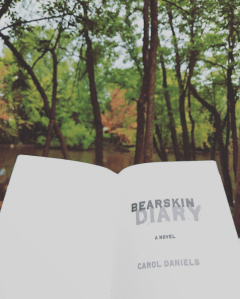
    Just over thirteen moon cycles later, after taking the first (and only) “Aboriginal Myth, Medicine, and Magic” course offered at the graduate level at MUN by Dr. Valerie Legge and co-instructor Amelia Reimer, I shared a knowing wink with Creator while sitting on the stage with my fellow Indigenous advocates. As a student of literature, I came out of the academy and into the public with Métis poet and musician Moe Clark, who advocated for Leanne Betasamosake Simpson’s This Accident of Being Lost; and Anishinaabe comedian and writer Ryan McMahon, who heralded Eden Robinson’s Son of a Trickster. I trumpeted Carol Daniels’ novel, Bearskin Diary.

    “I shared a knowing wink with Creator while sitting on the stage with my fellow Indigenous advocates.”

    We gathered at Tanna Schulich Hall at McGill University on September 20, days before the fall equinox. Our host and moderator, CBC’s Waubgeshig Rice and Nantali Indongo, facilitated a vital conversation spanning issues of storytelling, trauma, healing, and the need for Indigenous literatures. Truthfully, all three of us advocates could have sung praises for one another’s texts, as each book is made of powerful medicines and provocative storytelling, and each one embodies Indigenous knowledge systems.

    Bearskin-diaryPart of the role of advocates is to select a book, and each of us picked texts that spoke to our own craft and the relationship to our own Indigenous being. Clark was drawn to Simpson’s This Accident of Being Lost because of its poetic and sonic qualities. Much like Simpson’s work, Clark’s music breaks and beckons to tradition. Simpson doesn’t adhere to the infrastructure of the colonial English language. She avoids capitalization. Sometimes she writes in Anishinaabe, and doesn’t feel it necessary to translate. Clark approached her pitch in a similar fashion.
    McMahon highlighted the fact that each of the authors were First Nations women: “We’re in a moment now for Indigenous women artists. We need to not forget that.” He pitched Robinson’s Son of a Trickster with his trademark humour and intelligence.

    As I first encountered Daniel’s Bearskin Diary when reviewing it for The Malahat Review last year, I recognized how much the novel has shaped my own work. Not only did I feel a strong kinship with the novel’s protagonist, Sandy, a Cree journalist and TV reporter for CBC who comes into her Indigenous culture through telling other people’s stories, but also with the book’s relationship to the ongoing genocide of Canada’s Missing and Murdered Indigenous Women, Girls, and Two-Spirits.

    “I feel a strong kinship with … the book’s relationship to the ongoing genocide of Canada’s Missing and Murdered Indigenous Women, Girls, and Two-Spirits.”

    My own work spans genre, as I began my writing career as a journalist. Much like Sandy, I became comfortable asking questions and conveying the narratives of other people’s lives. Criticism has always been equal parts discovery and intellectual engagement. It’s a place to find and be found. From there, I became a poet (Daniels writes poetry, too). My forthcoming book, Who Took My Sister? (BookThug 2018), is a collection of poems and texts that hold and carry trauma. These poems are contemporary poetic strategies, both haunting testaments and a mix of Indigenous medicines. Who Took My Sister? is a rally cry, a space for raising awareness and cutting truths. It bears witness to the national genocide of Indigenous Women, Girls, and Two Spirits, whose lives are cut short due to the colonial agenda.

    “Criticism has always been equal parts discovery and intellectual engagement. It’s a place to find and be found.”

    Who Took My Sister? is also being transformed into a touring classical music piece for violin and piano composed by Melissa Hui, and will be performed by Indigenous Inuk artist Laakkuluk Williamson Bathory in spring 2019.

    Poetry has been an ongoing journey with many twists and turns. Recently, it’s led me to writing plays. I’ve been working on The Landless Band, a theatre show about a character who grows up in the suburbs, then learns she’s Indigenous. Tying back to Daniel’s work, while her protagonist Sandy was visibly Indigenous with darker skin, her storytelling techniques overlap with mine: we both draw from a personal narrative and explore it through characterization. The Landless Band is being presented in a workshop form at LSPU Hall in St. John’s, Newfoundland in spring 2018 by Eastern Edge Gallery.

    “The most exciting writing in this country is rooted in Indigenous writers, playwrights, and poets.”

    While Turtle Island Reads promotes Indigenous literatures, it also honours the advocates and their practice. Having only recently arrived in Montreal, to find myself in a room full of avid readers who are excited about Indigenous writing was an honour. It’s a testament that we’re ready to step beyond the canon, and unpack Canadian literature. We’re making room for new voices. Perhaps I’m biased, but the most exciting writing in this country is rooted in Indigenous writers, playwrights, and poets.


    Webb-Campbell by Dayna DangerShannon Webb-Campbell is a mixed Indigenous (Mi’kmaq) and settler poet, writer, and critic currently based in Montreal. Her first book, Still No Word (2015), was the inaugural recipient of Egale Canada’s Out in Print Award. She was the Canadian Women in the Literary Arts (CWILA) critic-in-residence in 2014, and sits on CWILA’s board of directors. Her work has appeared in many anthologies, journals, and publications across Canada, including the Globe and Mail, Geist magazine, The Malahat ReviewCanadian Literature, Room, and Quill and Quire. In 2017 she facilitated a book club-style reading of The Final Report of the Truth and Reconciliation Commission of Canada at Atwater Library. Who Took My Sister? is her second book.
    Photo credits: Courtesy of the CBC (header banner); Shannon Webb-Campbell (Bearskin Diary); Dayna Danger (headshot)

  • ‘Just Do It’ for Writers—by Carolyne Van Der Meer

    ‘Just Do It’ for Writers—by Carolyne Van Der Meer

    The thing about writing fiction is you need to know what kind of writer you are. The kind who needs a plan, or the kind who doesn’t. I was convinced I needed a plan. Lori Weber taught me I didn’t.

    Earlier this year, I was chosen as one of the mentees in the QWF’s annual mentorship program. The goal was to work on my young adult fiction novel with Lori, a prolific children’s writer and YA fiction novelist. I’ve been at this novel—my first—for a few years. I’ve worked with other mentors, attended workshops, and been part of writing groups. But I was stuck. And Lori, using wisdom gleaned from writing ten books, unstuck me. It has been euphoric.

    Prior to beginning the mentorship in February, I handed more than 100 pages over to Lori, written over the last three years. Chapters, scenes, flashbacks, character sketches—and a plan. A plan that outlined my novel in thirty-three chapters. This novel was planned to the hilt. Every move was carved out. So why couldn’t I write it?

    “I’ve been at this novel—my first—for a few years. I’ve worked with other mentors, attended workshops, and been part of writing groups. But I was stuck.”

    At our first mentorship session—a two-hour foray into scones, homemade jam, and Earl Grey—Lori asked me to tell her my goals for the four-month mentorship. Of course I wanted to advance my novel. But I wanted to talk about craft. I wanted to pick her brain. Hey, here I had, right in front of me, a very fine YA novelist, a successful one with some ten books to her credit—one, Yellow Mini, even written in verse. I’m a poet first—so Lori became my hero pretty fast. I wanted to understand how she does it. How does she hammer out all those words and weave them into a believable story, one that young people will not be able to put down? I wanted to know her secret.

    “This novel was planned to the hilt. Every move was carved out. So why couldn’t I write it?”

    It was simple: drop the plan.

    What? Yes, I had heard right. Get rid of that bloody plan.

    So as much as our mentorship together was about writing, it was also about teaching me something I didn’t at first believe I needed to learn—and something I doubted I was capable of learning. How?

    Well, she asked me, why did this novel need to be mapped out so tightly? I had a general idea, didn’t I, of where I wanted to go, so why not run with that? It didn’t seem to me to be enough. But Lori had plenty of examples, the most significant one being that she was hard at work on her eleventh book, one that she was mapping out—as it got written—on the wall in multi-coloured post-it notes. The plan didn’t come beforehand: it was being developed as she wrote.

    This was a completely foreign notion to me. I was used to writing poetry, where the idea could be banged out in a few minutes. I knew from minute one what my storyline would be and I could get it out in one sitting. Of course, then I would spend hours reworking and reworking—until I had something that I was convinced was jolting. Something that would move the reader in some way. And then Lori asked me the question that changed everything: why was writing my novel any different?

    Of course I had lots of reasons for her: because I didn’t know what the outcome would be; because I didn’t know how to deal with the passing of time; because I need to describe what happens in every second of every minute; because I need a plan to get from A to B.

    You just believe, she said. And you write. It was like the Nike slogan. Just Do It.

    Over the next few months—over many cups of Earl Grey and too many scones, Lori taught me how to “let go” and believe that I don’t need a prescription. If I had a strong general notion of the plot and of the various climaxes on the plotline, I could simply start writing and gently push myself towards the outcome. Her mantra of “just write it” became my own. Simple but true. Lori kept telling me that if I didn’t write it, there would be nothing to work with, nothing to fix. Just like the poem I could write in a few minutes and rework and rework.

    “Her mantra of ‘just write it’ became my own. Simple but true.”

    So apart from some very concrete accomplishments, such as a general plot overview, a complete character tree, the necessary historical research—and five completed chapters—I have come away from this mentorship with a new skill: being able to let go and just believe. Lori showed me how to work with intuition, energy, even faith. She claims she doesn’t know what will come out until she writes. So writing is the key. I believe her now. And I got rid of the plan. Really.


    If you are a Quebec-based English-language writer and you’d like to apply for mentor, or to be a mentor, visit the call for applications for the 2018 program.

    Carolyne Van Der Meer-4308

    Carolyne Van Der Meer is the author of Motherlode: A Mosaic of Dutch Wartime Experience. Her second book, a collection of poetry called Journeywoman, will be published by Inanna this fall.

    Photo credit: Bassam Sabbagh (headshot)

  • A Book Fair to Emulate by Connie Guzzo McParland

    A Book Fair to Emulate by Connie Guzzo McParland

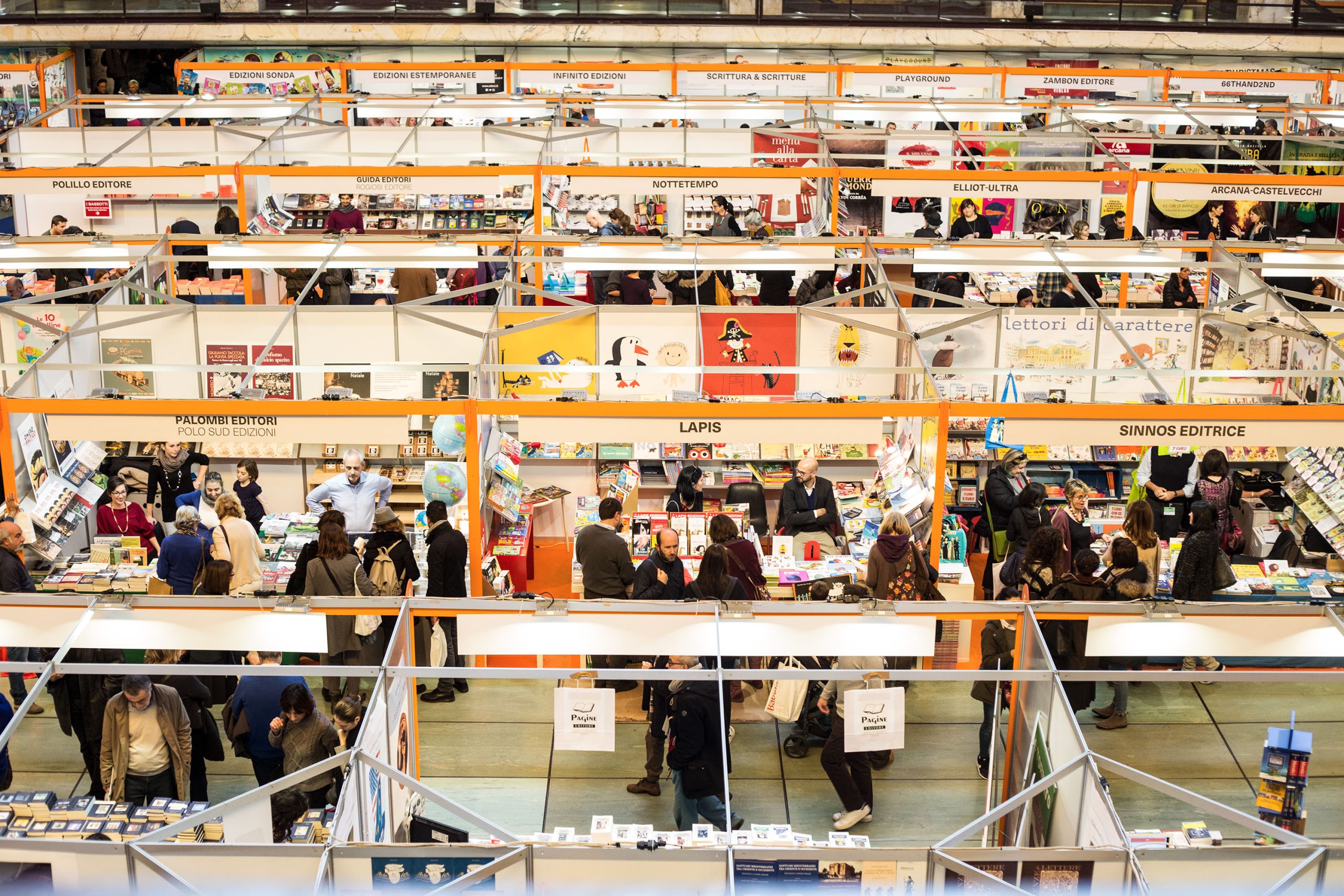
    Più libri più liberi: more books, more freedom. Unlike Frankfurt, London, or Torino, Rome’s book fair has been designed for small- and medium-sized publishers. Big fairs like Frankfurt can be overwhelming for a small publisher. You do meet a lot more people there, but by the end of it, it’s all a haze. As the publisher of Guernica Editions, I participated last December in the Rome fair’s Fellowship Program, an opportunity for foreign publishers to strike deals with Italian publishers.

    What did I learn? Bigger isn’t necessarily more productive.

    In the outskirts of Rome, Più libri più liberi’s 400-plus exhibitors were packed in a maze-like configuration in the Palazzo dei Congressi—an imposing marble building on the aptly-named Viale Della Letteratura. What makes this fair unique may be the smaller, more manageable scale that renders it less intimidating and more accessible to small independent publishers, but public attendance is huge and so are book sales. Più libri più liberi, which has been organized by the Association of Italian Publishers since 2002, has become an important event in Italy and Europe, and it receives a lot of press and attention. Held every year just before the Christmas shopping spree, it attracts 50,000 attendees over five days. Besides the book exhibits, this year there were over 1,000 participants in various events, some televised, all well-attended: readings, launches, and discussions with Italian and foreign authors, including Quebec’s Dany Laferrière, who was a featured author. As in Canada, children’s books are of great interest, as well as crime fiction and graphic novels, but the full range of literary genres is represented in Rome.

    “Bigger isn’t necessarily more productive.”

    I was one of sixteen foreign participants in the fellowship program. Others came from the USA, UK, Israel, Portugal, Turkey, Latvia, Poland, and Greece. Because we were put up in the same hotel in the centre of Rome, we shuttled back and forth and lunched together. It was easy to connect and network with each other, and meetings with Italian publishers were also pre-arranged by the organizers.

    As stated, the aim of the program is to promote internationalization of the Italian publishing industry, but there are opportunities for Canadian publishers to promote their own authors. Many Canadian publishers may not know that Italians read a lot more foreign authors in translation than we do in North America.

    In the past, while browsing in Italian bookstores, I had noticed the proliferation of translated foreign authors, both classic and contemporary. As I visited the various book kiosks at the Rome fair, I also noticed the many publishers who specialize in translations of work from particular niche regions: the Slavic countries, Chile, etc., with Canada seemingly underrepresented. For sure, bestselling Canadian authors are pitched in the more prestigious fairs like Torino and Bologna, but I believe that there are as-yet untapped opportunities for interesting exchanges between smaller publishers.

    At Più libri più liberi, there are big players represented by medium-sized publishers, but giant houses like Feltrinelli, Mondadori or Rizzoli aren’t here to overshadow independent publishers. The exhibitors are all given the same space and importance. No one dominates the scene.

    I don’t believe there’s anything like it here in Canada, apart from the Salon du Livre de Montréal, which caters to French-language publications. Just consider what happened to the Inspire Book Fair experiment in Toronto. When the first edition closed and the big conglomerates failed to renew their participation for the following year, the organizers were forced to cancel.

    “I don’t believe there’s anything like it here in Canada.”

    So what event looks after the interest of independent English-language publishers in Canada?

    The Rome Book Fair is not Frankfurt, but it serves independent publishers well. It puts them and their authors at the forefront during the busiest book buying season of the year, and gives them an opportunity to interact with their foreign counterparts. Canadian publishers’ organizations should take notice. This fair is one to emulate.


    connieguzzomcparlandheadshotConnie Guzzo McParland has a BA in Italian Literature and a Master’s degree in Creative Writing from Concordia University. Her first novel, The Girls of Piazza d’Amore, published in 2013 by Linda Leith Publishing, was shortlisted for the Concordia First Novel Award by the Quebec Writers’ Federation. The sequel, The Women of Saturn, will be published by Inanna Publications in April 2017. Since 2010, she has been co-director and president of Guernica Editions. She lives in Montreal. www.conniemcparland.com
    Photo credits: Sara Cervelli (top banner); Anthony Branco (author’s headshot)

  • Empathy by the Book: How Fiction Affects Behavior by Susan Pinker

    Empathy by the Book: How Fiction Affects Behavior by Susan Pinker

    When I want to escape I pick up a good novel. But does this habit provide more than a quick getaway?

    We’ve long known about the collateral benefits of habitual reading—a richer vocabulary, for example. But that’s only part of the picture. Mounting evidence over the past decade suggests that the mental calisthenics required to live inside a fictional character’s skin foster empathy for the people you meet day-to-day.

    In 2006, a study led by University of Toronto psychologists Keith Oatley and Raymond Mar connected fiction-reading with increased sensitivity to others. To measure how much text the readers had seen in their lifetimes, they took an author-recognition test—a typical measure for this type of study. “The more fiction people read, the better they empathized,” was how Dr. Oatley summarized the findings. The effect didn’t hold for nonfiction.

    Still, no one knew whether reading fiction fostered empathy or empathy fostered an interest in fiction. Other factors could have been at play too, like personality.

    So, in 2009, part of the Oatley-Mar team involved in the 2006 study reproduced it with a sample of 252 adults—this time controlling for age, gender, IQ, English fluency, stress, loneliness and personality type. The researchers also assessed participants’ “tendency to be transported by a narrative”—the sense that you’re experiencing a story from within, not watching it as an outsider.

    Finally, participants took an objective test of empathy, called the Reading the Mind in the Eyes Test. The aim of all of this was to see how long-term exposure to fiction influenced their ability to intuit the emotions and intentions of people in the real world.

    The results? Once competing variables were statistically stripped away, fiction reading predicted higher levels of empathy. Such readers also lived large in the flesh-and-blood social sphere, with richer networks of people to provide entertainment and support than people who read less fiction. This finding put to rest the stereotype of bookworms as social misfits who use fictional characters as avatars for real friends and romantic partners.

    Later studies confirmed that reading fiction does cause a spike in the ability to detect and understand other people’s emotions—at least in the short term. In a series of experiments published in 2013 in Science, social psychologist Emanuele Castano and David Comer Kidd of the New School for Social Research tried to figure out whether the type of fiction mattered.

    “This finding put to rest the stereotype of bookworms as social misfits who use fictional characters as avatars for real friends and romantic partners.”

    The researchers handed subjects—in groups ranging in size from 69 to 356—different types of genre fiction, literary fiction or nonfiction, or nothing to read at all. They then assessed participants on several measures of empathy. Nonfiction—along with horror, sci-fi or romance novels—had little effect on the capacity to detect others’ feelings and thoughts. Only literary fiction, which requires readers to work at guessing characters’ motivations from subtle cues, fostered empathy.

    In these studies, the reading of nonfiction not only failed to spur empathy but also predicted loneliness and social isolation, especially among men. Of course, nonfiction reading has its virtues. Other research suggests that various kinds of nonfiction can prompt empathetic feelings—as long as the narrative is moving and transformative.

    In recent studies, neuroscientist Paul Zak at Claremont Graduate University and colleagues showed participants heartfelt stories, such as a video narrated by a father of a toddler with brain cancer. The video induced a spike in observers’ levels of oxytocin—a hormone that promotes trust, nurturing and empathy—and larger donations to charity. Watching a straightforward travelogue-type video of the same father and son visiting the zoo didn’t have that effect.

    Apparently, what matters is not whether a story is true. Instead, as Dr. Oatley says, “If you’re enclosed in the bubble of your own life, can you imagine the lives of others?”


    susanpinker-by-susie-loweSusan Pinker is a Montreal-based psychologist, writer and columnist for the Wall Street Journal. Her most recent book is The Village Effectwww.susanpinker.com

    This piece was originally published in The Wall Street Journal.

    Photo Credits: Zak Greant (top); Susie Lowe (headshot)

  • Ghostwriter by Peter McFarlane

    Ghostwriter by Peter McFarlane

    Working as a ghostwriter is not something you plan for; it is something you stumble into. In my case, it began when an old friend, a political activist who had long spoken about wanting my help in putting a book together, called to say he had found a private source of funding for it. Was I interested in writing it?

    It was a subject I had some a background in so I was able to rough out an outline in a couple of weeks. We got together every couple of months for two-day work sessions and within a year we had a manuscript and a publisher. While I was wrapping up that project, another friend recommended me to someone else who had a story they wanted told, and some funding for it.

    This time the world I would be writing about was one I was unfamiliar with, but I liked the subject of the book and I decided to give it a shot. It was during this project that I began to understand what a privilege it can be to tell someone else’s story. I had written biography before, but this was a strange hybrid: a first-person biography. In a very real sense, you become the person you are writing for, internalizing their thoughts and feelings as you use all of the tools at your disposal to tell their story as if was your own.

    “I began to understand what a privilege it can be to tell someone else’s story.”

    Part of the job is also putting the subject and their life in a larger context. This means researching time and place and weaving their narrative into the world they inhabit. In this, you can allow yourself a measure of literary freedom, secure in the knowledge that the character whose life you are temporarily inhabiting will get a chance to look over your shoulder and make whatever corrections are necessary.

    In this case, the book was for someone who had a brief media fame but for the most part lived under the radar. And it was an admirable life. A man with principles and convictions and an unwavering sense of solidarity, moving through a world that was often unwelcoming and at times outright hostile. But he stood his ground and pushed forward and through the force of character made a success of things. That is how the story played out. An honest man confronting his times without compromising his principles. I was pleased that the first publisher I approached picked it up. The experience confirmed to me the truth of the cliché that everyone has a book in them—at least in the sense that all of our stories are worth telling. And for a writer, telling those stories can be as rewarding as any other literary form.

    “The experience confirmed to me the truth of the cliché that everyone has a book in them—at least in the sense that all of our stories are worth telling.”

    About ghosting in particular, I learned that even what was supposed to be a negative turned out to be a positive. I am speaking about the fact that your work goes unrecognized by the larger public. This might have mattered when I was twenty-five but now that I am over sixty it is a hidden benefit, as I discovered at the launch of my activist friend’s book. It was a relatively big event, with about 200 people packing a hall in Toronto for an on-stage interview. I sat near the back and it was one of the most pleasant literary events I ever attended. I had dinner with my friend before the event and we went out later with others to celebrate. The next day, my friend left for a long but low-budget book tour. I returned to my home in the Laurentians, realizing that I had the best of both worlds: the satisfaction of having written a decent book that was off to find its public and freedom from the obligations that accompany book publishing.

    So when the publisher of the recently completed book asked if I would like him to add my name on the cover, I unhesitatingly declined. When the work is finished, better to be free to move on to the next project while someone else has the chore of flogging it. Ghostwriting a book, I discovered, can be a bit like ghosting a party. When you have had your fill, and your fun, you can slip away without stopping for those awkward good-byes.


    Peter McFarlane has written five books of nonfiction, including two ghostwritten books, as well as more than 100 newspaper and magazine features. He has specialized in Indigenous history and politics and has worked on several CBC radio programmes as a researcher and on-air contributor. He is currently completing another ghostwritten book and a new work of non-fiction.

    Photo: Flickr