Tag: Books

  • Don’t Blink by Marianne Ackerman

    Don’t Blink by Marianne Ackerman

    Choosing a book title and cover is a lot like naming a baby. Quite a few people tend to weigh in, so the process can be a serious source of anxiety. Yet somehow, once you settle, the choice seems obvious.

    In the case of my new short story collection, Mankind and Other Stories of Women, the title was spontaneous. The title story, “Mankind,” first saw the light of day last Christmas as a monologue directed by Harry Standjofski, performed by the wonderful Leni Parker at Centaur Theatre’s annual Urban Tales event. For Leni’s character, a lonely woman enduring Christmas Eve with her box of wine and chocolate, the word mankind is a euphemism for the scent of a man. It’s very much a woman’s story. So are the other nine, hence the title. I made a conscious effort to focus on women this time after my last collection, Holy Fools + 2 Stories (Guernica 2014), was full of male characters—puzzling, since I thought I’d won the struggle over the animus-domination of my imagination ages ago.

    The cover was not obvious. On a brief trip to Calgary in April, I discovered an amazing sculptor at the Trépanier Baer Gallery. Walking through the door, I was hit by the super elongated shape of a very thin, nearly naked corpse behind glass: Evan Penny’s Homage to Holbein, an eerie rendering in silicone and real hair of a Christ-like figure, almost fourteen feet long and chillingly life-like. My first thought was, this work belongs at the entrance to a church. It’s a religious experience.

    Days later, the images were still strong. Perusing the gallery website, I settled on Marsyas (Model), a twenty-four-inch high sculpture of a male torso, inspired by a Greek statue, which was part of the exhibition. Covers are traditionally the publisher’s domain, with input from the author. But I’ve known my publisher Mike Mirolla for a long time. I know he’s a dark soul. He loved the image immediately. Thus began the dance by which a raw visual idea and text become one.

    I could not explain why that image worked with my stories, which tend to be airy, urban, sometimes playful, and, some people say, funny. Maybe the figure’s vulnerability, resistance or air of fatalism speak to the tragic thread found in all comedy. As I revised the manuscript for publication, I found myself working him into the first story, “Mina,” which is about a friendship of rivalry and complicity between two women, their creative struggle, and one crazy night.
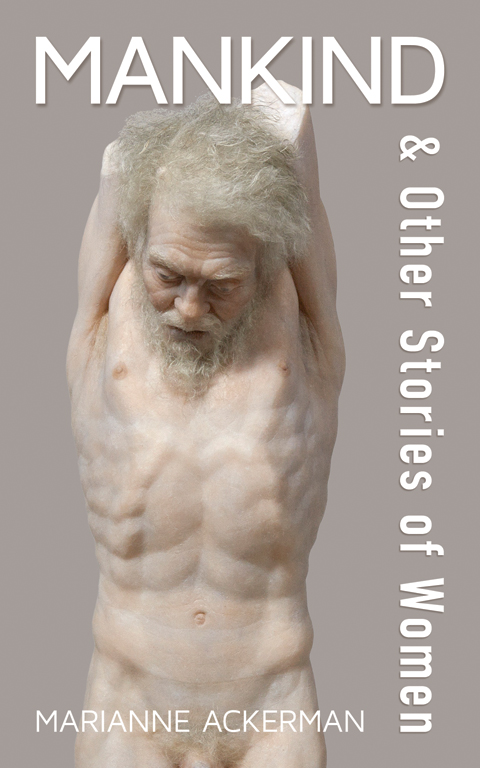
    mankind-final-cover

    “As I revised the manuscript for publication, I found myself working him into the first story…”

    After the normal back and forth, designer David Moratto’s concept was finalized. I slapped the cover up on Facebook, eagerly announcing my forthcoming fall book. It was mid-winter. The response was pretty well total negativity. Some of my dearest friends, smart people, said it was awful, scary, repellent. Nobody would touch this book!

    I was not prepared. I threw myself on the bed, lamenting once again my weakness for getting over-involved in practically everything. Now I’d have to face Mike and David with bad news, not to mention the gallerist, Yves Trépanier, and the artist, whose work I love.

    Mike did not share my panic attack, but held back. Yves did not. “Don’t listen to them! It’s a strong cover,” he barked via email. “You were right the first time. Don’t blink.”

    “The response was pretty well total negativity. Some of my dearest friends, smart people, said it was awful, scary, repellent. Nobody would touch this book!”

    Next to my control freakishness, impulsiveness is probably my greatest flaw. Here was somebody I respected telling me to trust my impulse. I looked at the cover again. At the other options I was trying to like. I asked Yves what his wife thought. He assured me she loved it. So I decided to take his advice, remain faithful to my first impulse. Well, except for a last-minute tussle over (ahem) how much “cleavage” should appear below my name. I did not want readers to be distracted by a dangling sack of flesh.

    Now that a stack of books is sitting on the dining room table, I can’t imagine a better cover than Evan Penny’s classy, classical all-too-human torso. I have no idea what readers will think, how it will affect their desire to pick up this book. But the baby isn’t mine any more. It is thoroughly herself.


    Mankind and Other Stories of Women will be launched along with three other local titles from Guernica Editions at Montreal’s Atwater Library (1200 Atwater Ave.) on Thursday, September 29, 6 p.m. The event is co-sponsored by the QWF. Click here for more information on the launch.
    ma-for-qwf-piece-sept-7

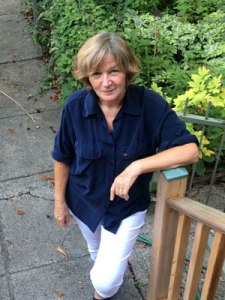
    Marianne Ackerman writes plays and novels. marianneackerman.com

    Photo credits: Photo of Evan Penny’s Marsyas Model (2016) courtesy of Evan Penny, and Kevin Baer – TrépanierBaer Gallery; Lesley McCubbin (headshot)

  • Literary Influences: E. L. Doctorow’s Lives of the Poets by John Goldbach

    Literary Influences: E. L. Doctorow’s Lives of the Poets by John Goldbach

    The first time I read E. L. Doctorow’s wonderful Lives of the Poets: A Novella and Six Stories (1984) was in early 2001, after picking up a used hardcover copy at City Lights Bookshop in London, Ontario, at 356 Richmond St. Not City Lights Bookstore, the famed bookstore in San Francisco, California, at 261 Columbus Ave—City Lights Bookshop (the one in London ON) is one of my favourite used bookstores ever, a small but dense and rich oasis of books and comics and records, etc.

    A few years later, after reading Slavoj Žižek’s Iraq: The Borrowed Kettle (2004), I reread Lives of the Poets. Much to my surprise, Žižek references Doctorow’s collection in his second book about 9/11 and its aftermath (namely, the illogic of the Bush administration’s reasons for invading Iraq). I was surprised to learn Žižek uses Doctorow’s collection as a sort of model. Žižek writes,

    The hidden literary model for this book is what I consider E. L. Doctorow’s masterpiece, the supreme exercise in literary post-modernism, far superior to his bestselling Ragtime, or Billy Bathgate: his Lives of the Poets: Six Stories and a Novella—six totally heterogeneous short stories (a son is set to the task of concealing his father’s death; a drowned child is callously handled by rescuers; a lonely schoolteacher is shot by a hunter; a boy witnesses his mother’s act of infidelity; a car explosion kills a foreign schoolgirl) accompanied by a novella which conveys the confused impressions of the day-to-day life of a writer in contemporary New York who, as we soon guess, is the author of the six stories. The charm of the book is that we can reconstruct the process of the artistic working-through of the raw material of this day-to-day life.

    As soon as I’d finished Iraq: The Borrowed Kettle, I reread Lives of the Poets, my engagement with the book deepening.

    I’ve read the Doctorow collection twice since then. About a decade later, in 2015, I used it as an oblique model for organizing a book of my own fiction, It Is an Honest Ghost, which consists of six stories and a novella (Hic et Ubique). There was something about how Doctorow’s stories stood alone—were “totally heterogeneous,” in Žižek’s words—but nevertheless informed one another, that I found haunting.

    My new collection was originally made up of eight stories and a novella but for myriad reasons I cut two stories, not the least of those reasons being for the sake of uniformity, a loose strange symmetry—a uniformity and symmetry impressed upon my mind by Doctorow.

    And then I read Lives of the Poets for a fourth time in July 2016, while working on this short appreciation. Lives of the Poets remains politically perspicacious, deeply insightful, and contemporary.

    Here’s Doctorow on US immigration, and mass migrations in general. The writer, the narrator of the novella, emerges from the NYC subway, and observes the new waves of immigrants to the city. He writes,

    Dear God, let them migrate, let my country be the last best hope. But let us make some distinctions here: The Irish, the Italians, the Jews of Eastern Europe, came here because they wanted a new life. They worked for the money to bring over their families. They said good riddance to the old country and were glad to be gone. They did not come here because of something we had done to them. The new immigrants are here because we have made their lands unlivable. They have come here to save themselves from us.

    Lives of the Poets continues to shed light on the present for me. Out of Doctorow’s impressive and celebrated oeuvre, it’s often overlooked. But it remains an insightful and inspiring collection, chock-a-block with strange echoes and resonances.


    KateHutchinson19webJohn Goldbach is the author of The Devil and the Detective (Coach Books, 2013), a novel, which was an Amazon Best Book of 2013; Selected Blackouts (Insomniac Press, 2009), a story collection; and, most recently, It Is an Honest Ghost (Coach House Books, 2016), a collection of six short stories and a novella (Hic et Ubique).
    Works Cited: Žižek, Slavoj. Iraq: the Borrowed Kettle. New York: Verso, 2004, p. 7.

    Photo: Kate Hutchinson (headshot)

  • I Didn’t Want to Write This Book by Elise Moser

    I Didn’t Want to Write This Book by Elise Moser

    I didn’t want to write this book.

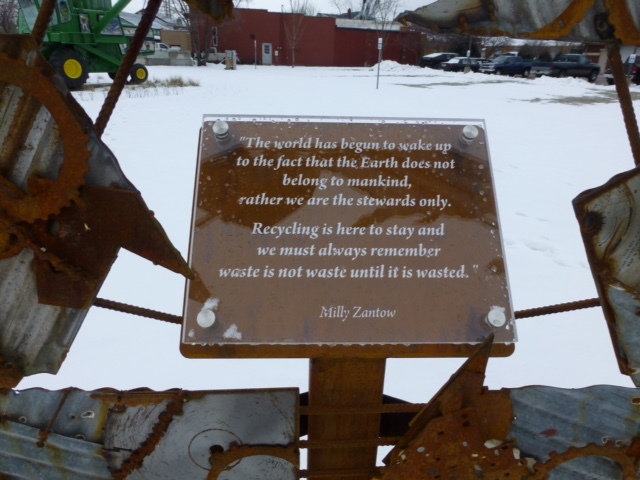
    I first heard Milly Zantow’s story in Sauk City, the small Wisconsin town where my sweetheart lives. Someone from the local historical society mentioned that the woman who invented the recycling symbol was from there.

    A woman did that!

    A woman from Sauk City!

    I figured everyone else in town must know this astounding fact. But no.

    I Googled her. I found a wonderful short video in which she explained how she kick-started plastics recycling in 1978, although the experts told her it couldn’t be done. I thought kids should know a woman did this.

    I tried to get someone else to do it.

    I ran into a Wisconsin publisher I knew and told her the story. “I don’t have an author to write it,” she said.

    I couldn’t do it. I’m a fiction writer. And I write for adults and teens, not kids.

    I talked about Milly to everyone I met, at dinners and parties and bookstores.

    Everyone agreed it was an amazing story, but no one wanted to take it on.

    Eventually I decided I’d better do it myself. I already knew the narrative; it would only take me a few months. Then I could get back to writing fiction.

    It took me three years. (That’s what happens when a fiction writer veers off into the wilds of non-fiction.)

    Milly bench med res

    I wrote a draft, but there were a few pesky details to clarify. I didn’t know if Milly was alive. I couldn’t find an obituary, but I couldn’t find contact info, either. I spent a week hunched over microfilm at the library, reading back issues of our small-town paper, the Sauk Prairie Star. I found a letter from Milly thanking the public for their support of the International Crane Foundation. There was a letter from Vietnamese boat people thanking Milly and her husband for sponsoring them so they could leave their overcrowded Arkansas refugee camp for a new life in Wisconsin. I found articles about the landfill where Milly sat one day and watched the trucks dump garbage—“plastic, plastic, every kind of plastic.” My mental picture of Milly was getting richer, but my story was also getting more confusing.

    “That’s what happens when a fiction writer veers off into the wilds of non-fiction.”

    Some articles said the landfill was full; others claimed toxins were leaching into the water table. The woman from the historical society had said that Milly invented the triangular recycling symbol, but Wikipedia said it was a guy from California. In the videotaped interview, Milly mentioned putting the numbers 1-7 inside the triangles on plastic goods, but gave no specifics. Who thought of the idea?

    Elise Milly Memorial
    Elise Moser

    I began to realize just how slippery facts were, and how the passage of time greased them further. People made mistakes, misunderstood things, left out the complicated parts. I’d written about this kind of thing in fiction, but it felt very different when I was trying to track down real facts and tell the real story of a real person—someone whose friends and neighbours might read it. I was used to being in control of the narrative (sort of). It’s so much easier to make stuff up!

    “I began to realize just how slippery facts were, and how the passage of time greased them further.”

    But research has its own satisfactions. I found someone who had worked with Milly thirty-five years ago, someone who knew that the landfill was leaching toxins and that it was too full. She also gave me a (totally unexpected and very useful) feminist perspective on the history of garbage and recycling.

    I knew that if Milly were alive she’d be very elderly. I couldn’t wait any longer to find her. In April 2014 I flew to Wisconsin.

    If necessary, I was prepared to cold-call all the Zantows in the phone book. But first I went to the local nursing home to visit a friend who was recuperating from a serious accident. Walking the corridor, I happened to glance over, and there I saw it: Mildred Zantow. I knocked, and she graciously invited me in to talk, even though she had just been given the news that her brain cancer had gotten worse.

    I asked her my questions, but as she answered, I began to realize that the things that were important to her about her experiences were not necessarily the things I thought I needed to know for my account. Her story was not the same as my narrative.

    “I knocked, and she graciously invited me in to talk, even though she had just been given the news that her brain cancer had gotten worse.”

    The following year I had the privilege of interviewing two of Milly’s sons. I mentioned that I’d met her in the nursing home, and they asked me when. I told them, and there on the screened porch in Sauk, Jim and Todd looked at each other.

    “That was probably her last lucid day,” Jim said.

    Milly plaque

    Since I started this book, things I’d confirmed have changed. In three years, technologies for recycling or replacing plastics have advanced. The environmental impact of plastic pollution has intensified, as has research on the subject. The information available on the history of recycling has improved; more than once during the process of editing I had to change wording or go back and re-research to be sure that what the book said was as true as we could know it to be.

    Now that the book is printed, I’ve been telling people about it. The sporting goods manager at the local hardware store/agricultural machinery dealership, where there is a little book display next to the hunting supplies, remembers Milly. “Thank you for doing this,” he said.

    Ironically, it’s easier to write fiction that is true, and that will always be true, than it is to write non-fiction. Fiction only has to express a truth; it can do that by any means, whereas non-fiction is expected to tell the literal, verifiable truth about the material world, and as we all know, there is nothing constant in the material world but change.

    Another thing that’s changed: I’m so glad I wrote this book!


    Author Photo 1

    Elise Moser is the happy author of What Milly Did: The Remarkable Pioneer of Plastics Recycling (2016), Lily and Taylor (2013), both from Groundwood Books, and Because I Have Loved and Hidden It (2009), published by Cormorant Books. She has published short stories, edited anthologies, and led short story workshops and mentored for the QWF. She serves on the board of PEN Canada and is an associate editor with Linda Leith Publishing.

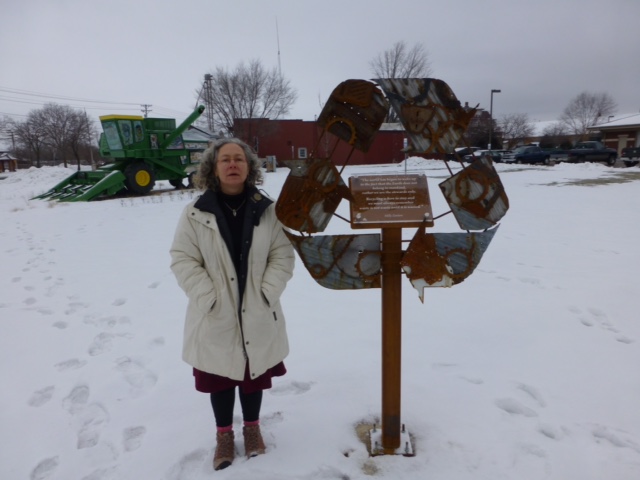
    Photo credits: Fred Lauing (headshot; photo of Elise Moser next to the Milly memorial), Elise Moser (the other two)

  • That Sense of Not Belonging by Adam Leith Gollner

    That Sense of Not Belonging by Adam Leith Gollner

    The Quebec Writers’ Federation hosted its 17th annual gala on November 18, 2015. Author Adam Leith Gollner opened the ceremony with this remarkable meditation on how a writer seesaws between isolation and community, and on what it means to be a writer, right here, right now.

    (more…)

  • Hello Baby, Bye Bye Books by Mike Steeves

    Hello Baby, Bye Bye Books by Mike Steeves

    Man holds baby while reading a book

    My daughter was born on August 25, 2014, and during the interminable lead-up to her birth I was, like all new parents, subject to a deluge of unsolicited advice, warnings and thinly-veiled threats from family, friends and complete strangers about what I could expect as a new parent. One of the warnings I heard most often was that the time I had for reading was going to be severely curtailed.

    Maybe my friends didn’t appreciate how dedicated I was to my routine, because I soon discovered that it was actually pretty easy to carve out the three hours I needed in order to stay on top of the steady stream of books that I had begun purchasing early on in my wife’s pregnancy as a way of offsetting my anxiety over not reading enough.

    For starters, I used to bike to work. But once I realized that I could eke out at least forty minutes of reading on my daily commute, I started taking the metro to work, thereby forgoing the last form of physical activity I practiced with any sort of regularity.

    Another threat to my reading habit was the immense amount of time required to help my daughter sleep. Newborns spend a lot of time sleeping, but they are notoriously bad at it and require assistance (referred to as ‘soothing’). This basically amounts to walking the streets of your neighbourhood with your baby stuffed into one of those obnoxiously priced “carriers.” Once I was over the new-dad jitters and was no longer trying to impress passersby with the baby I had strapped to my chest, I got into the habit of doing laps around the pond at Parc Outremont while reading from a book that I held in front of me. I made my way through Michael Hamburger’s translations of Paul Celan this way, and while I typically have little memory for poetry, many lines from this work are now frozen in place, triggered every time I pass a fountain or leafless tree. And one of the most memorable reading experiences of the last few years is the time I spent on a cold bench at Parc Saint-Viateur with my daughter sleeping in the carrier as I read the final pages of Peter Handke’s A Sorrow Beyond Dreams while kids dressed up as penises made their way to Halloween parties.

    Happy Halloween

    ” …the time I spent on a cold bench at Parc Saint-Viateur with my daughter sleeping in the carrier as I read the final pages of Peter Handke’s A Sorrow Beyond Dreams while kids dressed up as penises made their way to Halloween parties.”


    My aforementioned friends, the ones who warned that I would have to sacrifice my love of reading to my role as a new dad, were also an enormous tax on the time I had for reading. By refusing dinner invitations, birthday party invites, brunch for babies, etc., typically blaming my absence on my daughter, I was not only able to keep up my reading schedule, but, after I had refused enough of these kind invitations, they no longer came in with any regularity, which also spared me the enormous time-suck of responding in a considerate manner something to the effect that “I would love to! But…”

    While it turns out that my friends were wrong about finding the time to read, there is one aspect of parenthood they were right about, but that I’d never taken very seriously: I may still manage to find a comparable quantity of time, but the quality of that time has been seriously degraded. I can sit for hours with Knut Hamsun’s Pan in front of my face, but I regularly find myself rereading the same line over and over again. Or an hour passes and I don’t even make it to the bottom of the page I started on. I’ve managed to read an impressive number of excellent and difficult works, but I’ve hardly retained anything. Within a week or so of finishing a book, I even struggle to remember what I had just read (except for the Celan). So while I have plenty of time to read, I can’t maintain the level of focus and attention I had in my pre-paternal reading sessions.

    Which brings me to the final obstacle to my reading habit – writing. Before my daughter was born I used to try to write at least a few lines every night, but even this small commitment now seems to take an inordinate amount of time away from doing the thing that I really enjoy (it would be quite a stretch to say that I enjoy writing). On account of the soul-wearying exhaustion I feel at the end of every day, I find it pretty easy to excuse myself from writing for the night and to settle into a good book. And by “settle into a good book” I mean “read the same line over and over again until I eventually pass out on the couch.” My friends say that it’s perfectly natural to neglect my writing for the next year or so, and that eventually I will find the time and energy to start up again. I hope they’re right. Goodnight moon.


    Bookjacket_M Steeves

    Mike Steeves lives with his wife and child in Montreal, and works at Concordia University. Giving Up is his first full-length book of fiction. Connect with Steeves on Twitter @SteevesMike.

    Photos: Via Flickr; no changes made (top); Mike Steeves (Halloween); Nikki Tummon (headshot)

  • Bye Bye Darlings: The Editing Gauntlet by Alice Zorn

    Bye Bye Darlings: The Editing Gauntlet by Alice Zorn

    Farine Five Roses
    Alice Zorn’s new novel, Five Roses, is named after the FARINE FIVE ROSES sign that marks the southwest horizon of Montreal and Pointe St-Charles, where the novel is set. Photo: Alice Zorn


    You’ve finished your novel manuscript and you even – finally! – get a publisher. It took ten years. You have Neanderthal muscles across your brow from frowning at the computer screen. But now you’re home-free. Bingo!

    Then you get the first slew of comments from your editor. She’s the objective eye who sees what the book can be, but isn’t yet. Does it begin in the best possible place? Is there too much exposition? Does it have structural integrity? What about the ending? She tells you all the darlings you cherished while you were writing don’t belong unless they serve the book. The clever turns of phrase, the crisp dialogue, the research that shows off your erudition, the quirky events that really happened. Your clean manuscript pages are tattooed with strokes and question marks. Some editors slash with red pen. I’m so glad mine used pencil.

    With my first novel, Arrhythmia, I was advised to lop two main characters, cut ninety pages and replace them with new writing. I couldn’t believe it. Hadn’t the publisher already accepted the book? My editor was firm. I had to learn how to rethink developments in the novel as narrative choices. I reminded myself that my editor, like me, only wanted what was best for the book. After all, she brought the manuscript to the acquisitions table, arguing that – out of all the other manuscripts being vetted – mine should be published.

    I rewrote those ninety pages because I realized the change was structurally necessary to the novel. And I rewrote them, yes. My editor didn’t tell me what to write, only that the direction I’d originally taken wasn’t the best option. However, I did not lop those two characters. I made them stronger and more integral to the novel. Writing the novel was hard, but editing it might well have been the more profound learning-about-writing experience.

    “Writing the novel was hard, but editing it might well have been the more profound learning-about-writing experience.”

    My second novel, Five Roses, will be published by Dundurn Press in 2016. I’m at the copy editing stage now. This is the finicky time when syntax, word choice and punctuation come into question. I open the document and scroll through 320 pages with red commas added, words underlined and lassoed to dialogue bubbles. Individual words are highlighted in yellow. A character is cycling along a city street, alert to the nervous rush hour traffic, as she thinks about the police sending out an alert to catch a criminal. I swear at myself for not having noticed. I must have read this page twenty times already! But my brain was in a groove. And as I’ve repeatedly witnessed, my brain is willful in its fondness for repetitions, internal rhymes and alliteration.Now, too, is when I discover that grammatical niceties aren’t as ingrained as I assumed they should be after five decades as a voracious reader. Shouldn’t I simply know all these distinctions by now? Seems not.

    And so I learn that there’s a difference between hanged and hung when it refers to a human body that is being put to death. I hung a picture on the wall. The executioner hanged a man. However, a human body that was already dead hung from a hook. I need to know that for this novel, since a character was hanged.

    6777082592_d2ba71334d

    I had to teach myself the farther/further dance after having worked with a copy editor who changed all my farthers to furthers. He thought further sounded more posh. Fine, I thought. He’s the copy editor. Maybe it’s one of those UK vs US things. For a couple of years I banned all farthers from my writing. Then I had a story returned from a copy editor who had changed some of my furthers to farthers. That was more curious. I finally pulled a tome of grammar off the shelf and discovered there’s a rule. Farther is for physical distance. Further is the abstract concept. You might think that I would already have known this, but I didn’t. And I’m not the only one. I continue to see farther and further misused in books published by reputable houses. (If you want a trick to remember which to use when, think far > farther. Thank you to Carol Weber for this tip.)

    You aren’t the best judge of your work, because you’re too close to the writing.You need an editor. Not your partner nor your best friend, who won’t want to hurt your feelings, but an experienced and discerning professional who will help you realize the full potential of the book.

    I’m now at the last read-through before Five Roses goes to the design people. I’ve rewritten the manuscript three times since I thought it was finished in 2013. Cutting, puzzling, moving pages around. Lots of darlings sent marching to the recycling bin. At each stage of editing, the book becomes more of an entity that lives separate from me. Which is what it will have to be when it’s sent off into the world.


    for QWFAlice Zorn’s book of short fiction, Ruins & Relics, was a finalist for the 2009 Quebec Writers’ Federation McAuslan First Book Prize. In 2011 she published a novel, Arrhythmia, with NeWest Press. She has twice placed first in Prairie Fire’s Fiction Contest. Her second novel, Five Roses, will be published with Dundurn Press in July, 2016. She lives in Montreal and can be found at http://alicezorn.blogspot.ca

  • Hadassah Arms and Other Quandaries: Translating Cultures by Anna Leventhal

    Hadassah Arms and Other Quandaries: Translating Cultures by Anna Leventhal

    douce-sweet

    In early 2015, I stood in front of a window at Renaud-Bray, looking at a poster that was taller than I was. The poster had my name on it – it was the cover of the French translation of my first book. More than amazement, more than excitement, I felt bemused. This isn’t my book, I thought. Is this my book? Ceci n’est pas mon livre.

    Translation seems to be on everyone’s langue these days, with Kim Thuy’s translated Ru winning Canada Reads, several new translations of Nelly Arcan hot off the presses, and a renewed curiosity about cultural hybridity in the air. The ethical and aesthetic considerations of moving between languages seem like fertile ground for conversations we ought to be having, especially in Quebec.
     

    “Translation seems to be on everyone’s langue these days””


    When I found out that there would be a French translation of my newly published book, I was thrilled; as a transplanted Winnipegger, I felt it implied a level of acceptance in a city where I’m still considered “an outside eye” after fifteen years. I was excited to think that my stories, most of which are set in Montreal, would be accessible to the roughly two-thirds of the city’s population that read in French. But the work of translation isn’t just about making stories accessible. It’s about making them legible: creating a context so that they don’t just exist in another language, they live in it.

    In Neil Smith’s funny and pointed column on this blog from February 2013, he writes about the dangers of translating English Montreal into France-French, where, as he says, a dépanneur becomes chez l’Arabe and câlisse becomes putain de merde. The result: a work that’s as absurd as Duddy Kravitz sipping Earl Grey and exclaiming “jolly good, old fellow!” There was no danger of this for my book, as its translator, Daniel Grenier, is a Québécois writer. Any fears I had were laid to rest when I saw he had titled one story “Un hostie de câlisse de gâteau” (“A Goddamn Fucking Cake”). It’s a richly Québécois translation, a translation full of pis and vinegar. Grenier gamely took on an exhausting number of puns, cultural references, word-plays, and dumb inside jokes, and made them legible to a Franco-Québec audience.

    Some of the equations were simple, he told me. One of my friends wondered how the translator would handle a sign held by an environmental protestor that read ASBESTOS? ASWORSTOS! Easy, Grenier responded: AMIANTE? ENNEMIANTE! He turned a porn star named Iona Dildo into Jaymon Dildo and some misread graffiti from AUNT to FLOTTE. He may have been having almost too much fun.

    But there were complications. At one point, Grenier wrote me to ask about the expression “Hadassah arms.” How to go about making it legible for a Québécois audience?

    Now, even among Jews, “Hadassah arms” isn’t especially well-known. It’s a mean and fairly misogynistic way of naming that particular upper-arm sag/jiggle – so called because Hadassah, a Zionist women’s organization, mainly consists of older women. But it’s not a Jewish term that’s been popularized, like chutzpah or schlemiel. I know it because my friend’s dad used to tell us to lay off the Doritos or we’d end up with Hadassah arms. It may have been specific to her family; I’ve never heard it since. But I stole it for a family I was writing about, because I liked the specificity of it, the suggestion of a family joke or family mythology. Grenier could either do some creative idioming and write “bras style-Hadassah” or something like that, or find a new way of saying it that would make the image clear, but lose the Jewishness of the phrase.

    So what to do? Keep the image, lose the Jewish? Or the other way around?

    How important is it to make your work accessible to an audience unfamiliar with your culture, whether it be ethnic, geographic or social? Do you want your readers to immerse themselves in a warm bath or a cold lake? In a sense this is what writers are always doing: walking the line between over-explaining your characters’ world, and letting the world speak for itself.


    “How important is it to make your work accessible to an audience unfamiliar with your culture, whether it be ethnic, geographic or social?”

     
    In the end, I told Grenier that, in this case, the image was more important. I didn’t want readers to trip over an unfamiliar word and fall out of the story’s world; there would be other opportunities for them to be seduced by unfamiliar expressions and identities.

    The solution? Les gras de bingo. Equally mean, and equally evocative, but of a slightly different family than the one I wrote. In a small way, my characters lost a bit of their identity, and were given a new one, as though they had passed through the Ellis Island of literature. This, I’ve decided, is what I love about translation. My book; not my book. My city; not my city. A beautifully imperfect balance.


    Anna LeventhalAnna Leventhal‘s short story collection Sweet Affliction was published in 2014 (Invisible Publishing). It won the 2014 Quebec Writers’ Federation Concordia University First Book Award, and the French translation (Douce détresse) came out in 2015 with Marchand de feuilles. She lives in Montréal.

  • Running a Small Press in 2015 by Guillaume Morissette

    Running a Small Press in 2015 by Guillaume Morissette

    Located in Montreal, Canada, Metatron is a small, independent press that publishes contemporary literature and works by new and rising authors. Almost all of its authors are under thirty years old, and their works reflect concerns such as love and relationships in the age of social media, existential angst, reconciling the spiritual with the digital and MySpace-era nostalgia, among others. Along with Ashley Opheim, who founded the press, I currently serve as co-editor of Metatron. We’re both writers with good intentions but limited time, and we have no concrete experience running a business. Metatron Press started with no safety net, investors or carefully thought-out business plan. Yet so far, everything is going great. When I joined Metatron in 2014, the press had already published six titles and received positive media coverage.

    I met Ashley in 2011, through Concordia University’s Creative Writing program. Our literary tastes overlapped, so we became friends and began working together on countless projects. We organized several well-attended readings in Montreal, a little miracle as we had virtually no budget. Later, in the fall of 2013, Ashley applied for a small grant from Emploi Québec’s Jeunes Volontaires program. At the time, I was living in Toronto, so I could only follow her progress through the grant application system from a distance. Though I knew she might receive money in the end, it didn’t feel like a game show, where you spin a wheel and win thousands of dollars and maybe a cruise, but more like something procedural and mysterious, as if she was defending herself in a court of law, trying to argue that she deserved retribution.

    The grant wasn’t an overwhelming amount of money, but it was enough for Ashley to start experimenting with different ideas. She made good use of this initial flexibility. It helped Metatron exit the grant stage and become a self-funded, independent entity. When I moved back to Montreal in 2014, it seemed perfectly natural for me to start helping Ashley with Metatron

    A few lessons from Metatron’s journey so far:

    1) Leverage pre-existing chemistry. My friendship with Ashley (pictured below) is a huge asset for Metatron, I feel, as we can pitch ideas to each other quickly, delegate tasks knowing the other will get things done and generally feel good when working together on projects. The sub-text of mutual respect and trust in our communications can only be earned through years of working together, and sometimes failing together. And countless other friends (and friends of friends) have helped Metatron. Ridiculously talented (and busy) local graphic designers Freyja & Zamudio, for example, took the time to create two high-quality book covers for the press. Metatron has also received a lot of support from Montreal artists like Claire Milbrath, Rachel Shaw and Rebecca Storm, and bookstores like Drawn & Quarterly. These contributions, big or small, are all invaluable. I am often surprised by how eager our friends are to pitch in.

    Ashley Opheim

    2) Work fast. One advantage of running a small indie press is that we’re usually able to fast-track the typical production cycle of a book. Instead of a book coming out a year or more after the initial publishing agreement is signed, it can come out a few months after work begins. This can give the final product an increased sense of urgency, though it also means there will be less time to let the work “rest” and to return to it later with fresh eyes.

    3) Build your community. Metatron doesn’t present itself as a literary press that takes itself very seriously, but rather as something artistic powered by positive energy and good intentions. It doesn’t only publish books and booklets – it also promotes the work of local writers, artists and musicians on its blog, fostering good vibes and a sense of community. This, I feel, gives the press a distinct flavour. In addition to being thought-provoking, literature can be entertaining, welcoming and serve as the basis for a strong community.

    Metatron pin

    4) Keep things small. Metatron’s finances often feel like an aquarium to me, like a delicate ecosystem. All profits made by the press are pumped right back into reprinting current titles or publishing future ones. To keep costs down, it’s been helpful to focus on smaller print runs, and to keep distribution entirely in-house. Moreover, some of Metatron’s titles are booklets rather than books. The booklets are a little bigger than your average chapbook, but more compact than a full-length, perfect-bound book. I really like this format, as it allows us to work with a lot of new and rising authors who haven’t been published in print before. Since booklets are also cheaper to produce and ship, they can also be sold for less.

    5) Have no idea what you’re doing. And finally: it’s okay to try new things, or figure them out as you go. In Spring 2015, Metatron will publish the full-length, perfect-bound debut of Toronto-based writer Sophia Katz, a big release for us. If we have to change our methods to produce and ship more copies, we’re confident that we’ll be able to figure out a way to adapt. Metatron has also announced the inaugural 2015 Metatron Prize for contemporary writers. The winner will receive $150, a publication deal with Metatron and a selection of past Metatron titles. Before announcing the contest, it seemed impossible for us to estimate how many submissions we would be receiving for something like this, so we simply decided to go for it and see what happened. In the end, we were blown away by the quality, quantity and diversity of manuscripts that we received, and we are now hoping to do the prize on a yearly basis. 

    Though not all of Metatron’s experiments will pay off, they should all prove valuable in some way, and it seems likely that this willingness to be playful and try out new ideas will remain an important part of the press’s identity.

    Metatron Books


    Guillaume MorissetteGuillaume Morissette is the author of New Tab (Vehicule Press, 2014), which was shortlisted for the Paragraphe Hugh MacLennan Prize for Fiction. You can find him on Twitter at @anxietyissue

  • Nature’s Way of Getting Books Written by Raquel Rivera

     A couple of years ago I was cycling around the ex-garbage dump that is the St-Michel Environmental Complex in Montreal North, collecting details for a scene in my novel.

    I pedaled across the street from the Complex’s Cirque du Soleil headquarters, and peered through the windows of the National Circus School. Inside was a highly padded gym-like space, full of pulleys and ropes – and some very fit teenagers. Not wanting to be taken for a peeping-creep, I dashed around to the front reception and asked if they offered tours.

    I attended the school’s open house the following week, hoping to gather useful tidbits to feather my scene’s nest. As it happens, I was also stepping into my next crazy-making topic of all-consuming passion: a creative non-fiction book for children, featuring the lives of students at the National Circus School. My next Great Idea.

    I surprised myself as I blustered my way into the institution through emails, meetings and follow-up proposals. They had a responsibility to share their story with the world, I insisted. The guilt-trip finally seemed to convince the school’s extremely busy (and intimidating) directors. They were swayed by my conviction: this was a Great Idea.

    Everyone will want to read about these young superheroes, facing down risk and their own limits every day. They’ll be charmed by the gaspésien who left home to pursue juggling. They’ll be impressed by that skinny little twelve-year-old who boards at the school, so he can train twenty hours a week in addition to his full academic schedule. Readers will gasp as the eighth-grader makes her first tightwire jump; they’ll wince as the cruel wire tries to bisect her feet. Ultimately, just like me, readers will be fascinated by an inside peek at the tremendous efforts these young people make so that their performances can look easy to the rest of us.

    Topsy-turvy
    Topsy-turvy: You don’t need to turn yourself inside-out trying to sell a beloved manuscript – it just feels that way sometimes.

    As I began my visits and interviews, “Why not?” seemed to be the motto of the school. It’s what they tell one another in response to every new and impossible notion. (Stand on your partner’s shoulders, jump into a back flip and land back on – why not? Now do it en pointe, in ballet toe-shoes – why not?)

    “Why not?” It’s what the aerial instructor said when I asked if someone like me (old and untrained) might learn rope. I signed up for aerial classes at my local community centre and, week after demoralizing week, was the sole student unable to pull herself off the ground. Yet somehow, when it was finally over, I signed up with a private trainer at a circus studio and carried on. If nothing else, my acrobatics training would make me better equipped to relay The Great Idea to a waiting world. Publishers would scramble for my original material, appreciating its historic value and the uplifting message that we may achieve the impossible, whatever that means to each of us. This Great Idea was a winner – a shoo-in.

    Now I’m thinking, passionate belief like this is just nature’s way of getting books written. I wish it got them published, too.

    But that’s the other part of the writing life: when I gain new perspective on The Great Idea. Over lunch, one editor speculated on the cost of producing my full-colour, fully illustrated Idea. Responses came in from more editors: “The circus school certainly seems like an interesting place,” (but no thanks). “I loved your proposal, but that wasn’t enough to convince the powers that be.” Passion died, and determination stepped up, struggling against quaking doubt. Would anyone want my Great Idea? Would it receive the blessings of timing and dumb luck that brought past manuscripts to print? Or had my portion of blessings run out?

    At this stage, keeping faith is huge: you have to believe that one day all this thinking and writing will be a real book. This requires that my ears and my mind stay open – and that I conserve effort, to avoid burnout. I listen to feedback; I try to be flexible because The Great Idea deserves to be among readers. But there’s any number of great ideas floating around out there, looking for a publisher. (Which is actually a comfort, when I’m feeling more mature.)

    throw2catchduotissu
    Julie gives Natalia a hand during warm-ups for RESET, the latest show by acrobatic troupe THROW2CATCH

    Maybe this pause in progress (I won’t call it a halt) is a necessary stage in the forging process. Maybe it will shape up my Idea and make it stronger. I remind myself of the reason these circus kids inspire me so – they push their limits, they never give up.

    After the latest rejection, I transformed disappointment, frustration and the urge to throw a hissy fit into a new series of emails. I sought publishing leads, editors’ names, introductions to agents – anything to get The Idea some notice. And it worked. I still don’t have a book contract, but I have more leads to pursue, and the support and interest of fellow writers. It’s enough; for now, it’s everything.


    raquelrivera_smRaquel Rivera is the author of three books for children, and the aspiring author of four more. Her author website is at www.imho-reviews.com/raquel. Photo credits: Raquel Rivera