Tag: Montreal

  • Writing on the Edge—By Lise Weil

    Writing on the Edge—By Lise Weil

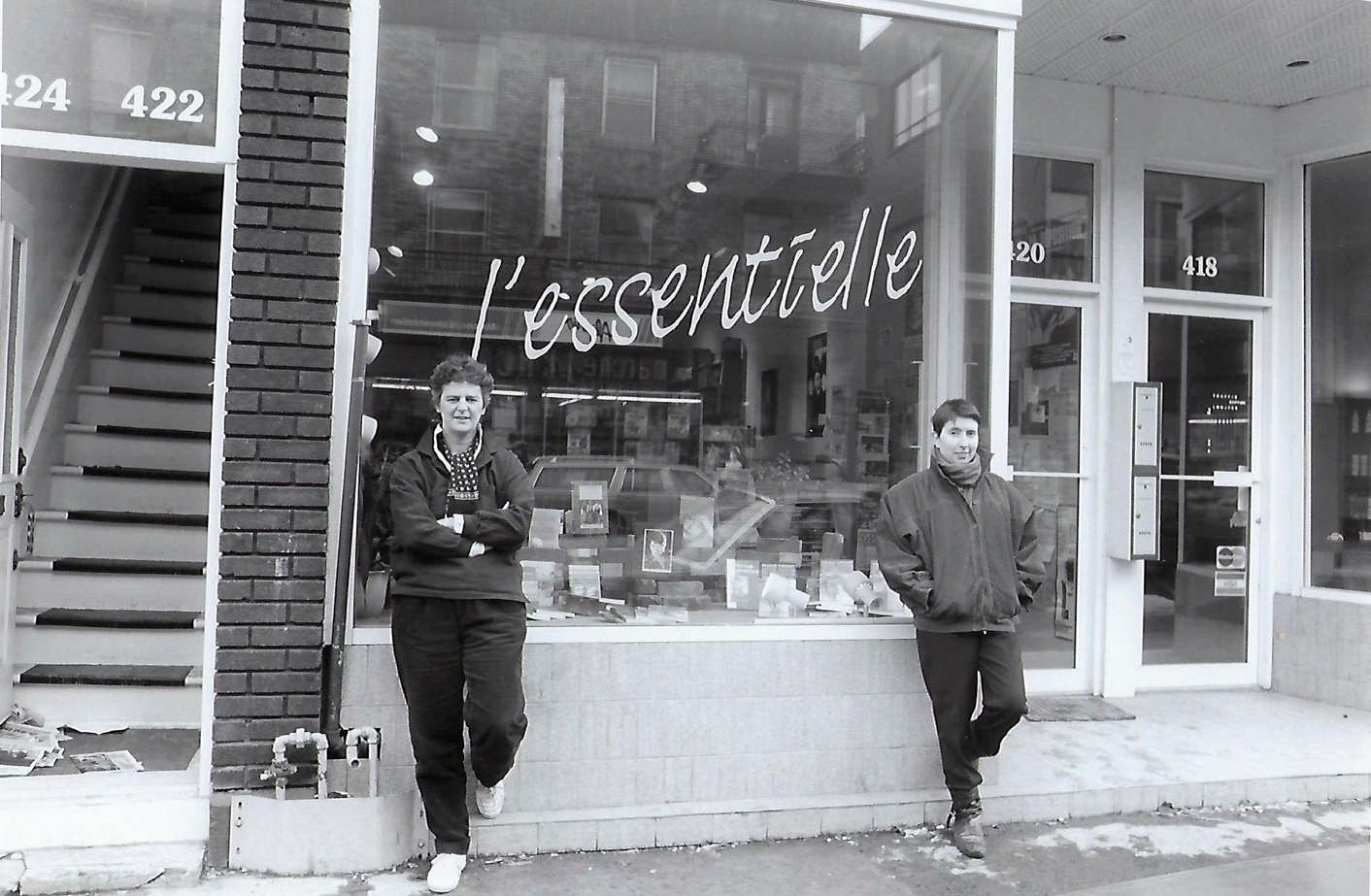
    Odette DesOrmeaux and Martine Huysmans, two members of the l’essentielle collective which also included Ariane Brunet and Harriet Ellenberger, 1988.

    Just over thirty years ago, in June of 1988, I drove up to Montreal from my home in Montague, Massachusetts to attend the Third International Feminist Book Fair. At the time I was editor of the feminist literary review Trivia: A Journal of Ideas; we had a table in the exhibit hall, alongside books, presses, and journals from all over the world. The Fair, housed on the Université de Montréal campus, was attended by some 8,000 people, featured over 300 authors, and hosted the largest gathering ever of Indigenous women writers from Canada. Coming off three days of head-spinning, exhilarating, often revelatory panels, readings and conversations, co-editor Linda Nelson and I decided to devote the next two issues of Trivia to the event.

    Trivia 13 focused on the feminist writers of Quebec and those influenced by them: Nicole Brossard, Gail Scott, Erín Moure, Louise Cotnoir, Michèle Causse (France), and Betsy Warland (BC).[i] The energy and vision of this community of feminist writers (which also included Louky Bersianik, France Théoret, Louise Dupré, and Daphne Marlatt) had provided much of the impetus for the Fair itself.[ii] In my editorial I attempted to name what it was about these writers that excited me so much. It had to do with their understanding of language as transgressive, and as material. With their exuberant flouting of genre boundaries—poetry becoming essay, fiction theory (“fiction/theory” – Brossard’s term)—all in deference to their insubordinate, uncooptable female bodies (“The breasts refuse”—Warland). And it had to do with the edge they/we were all on—as women claiming space for our own bodies and thoughts for the first time ever.

    Just over a year before the Book Fair I had driven up for the opening of the bilingual bookstore l’essentielle, a word Brossard coined in her epic poem “Sous la langue/Under Tongue.” A bilingual edition of that poem was being launched to mark the occasion. The little store on Rachel was spiffy, with hot pink shelves and track lighting. I remember women in dress shirts and bright scarves hoisting glasses of white wine. I remember Brossard and her translator Susanne de Lotbinière-Harwood taking turns reading the stanzas. On ne peut vas prévoir / You cannot foresee, each verse began, crescendoing as the lover’s mouth approached the body she desired, launching her into the unknown.

    You cannot foresee so suddenly leaning
    towards a face and wanting to lick the soul’s
    whole body till the gaze sparks with furies and yieldings. . . .
    Desire is all you see.

    And I remember walking into my study one Sunday morning not long after that launch to find Linda with Brossard’s chapbook in her lap, weeping. “We don’t write like this here,” she said. “No one writes like this here.” Eros: words embodied it in Quebec women’s writing. Words were marks of possibility, thrusting us out to a precipitous edge where nothing was foreknown… No, there was nothing like this in our feminist world. Plus the lesbians I hung with favoured jeans and flannels.

    Some two years after the Book Fair I moved to Montreal, in part drawn by that subversive brew of Quebec au féminin, wanting to be immersed in it (and yes, admittedly, wanting to be among women who dressed up for each other). Beneath all this was a desire to write… in order to do which I knew I needed to get away from the home that was Trivia’s operating base. But weaning myself from the role of editor and translator took more than a physical move. It was thirteen years before I found myself in the grip of a long writing project: a memoir that began—not surprisingly—as a meditation on lesbian desire and that chronicled a series of disastrous love adventures that drove me, heartbroken, to this foreign city where I finally learned to abide—in love, and in place. A QWF mentorship with Elaine Kalman Naves in 2003-4 was foundational to this project. It would take me another twelve years to complete the memoir, but I wrote some two-thirds of a first draft in those months. Elaine’s encouragement and her insight were just the spurs I needed.
    l'eugelionne2
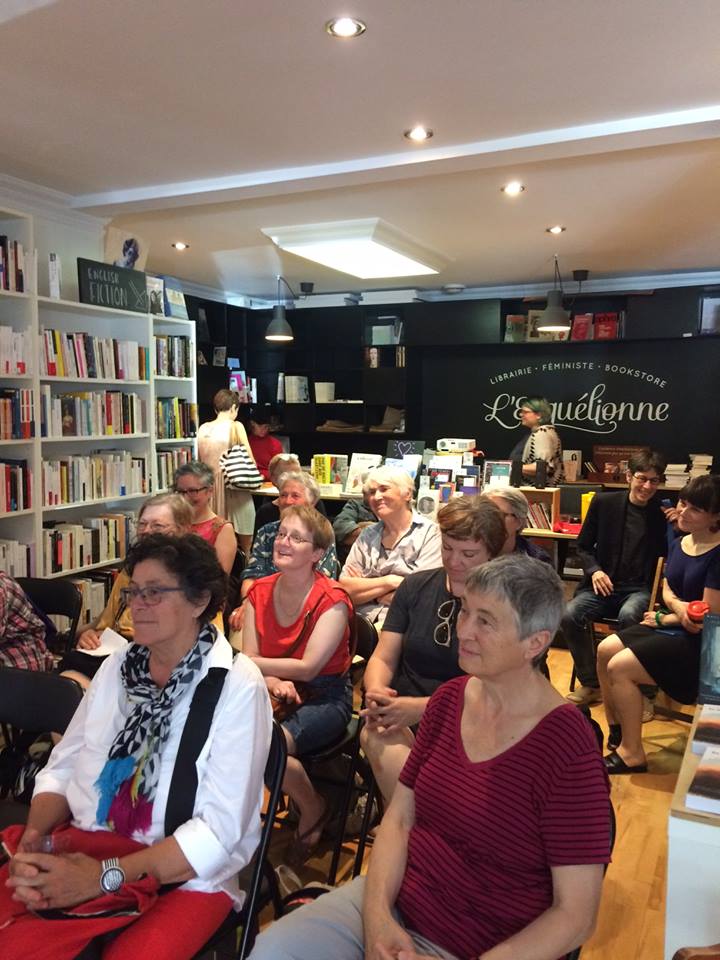
    Launch of “In Search of Pure Lust” at L’Euguélionne, June 2018.

    But it is also true that my memoir, In Search of Pure Lust, would not exist in its present form were it not for my immersion in Quebec au féminin (where the last section of the memoir is set) and its climate of formal permissiveness and political passion, its celebration of language as erotic. I imagine many literary products of this century, not only here in Quebec but throughout North America, owe a similar debt. So it’s both surprising and dismaying to me that nowadays in Anglophone literary contexts there is so little acknowledgement—or even knowledge—of these Quebec writers and their pioneering body of work. Even when the topic is formal innovation.[iii] Even in Montreal.[iv] At least here in Montreal, as of two years ago, we have a monument to this genealogy in the form of the bilingual feminist bookstore L’Euguélionne—named after Louky Bersianik’s kickass, visionary feminist novel. Long live L’Euguélionne!

    I can’t help longing for the kind of literary community that first drew me to this city, a locus for deep conversation revolving around a common cause that felt urgent enough to unite writers of different cultures and languages. What might that common cause be today? As global forces thrust us towards a darker precipitous edge, and an endless expanse of unforeseen. . . .


    Lisebookstore

    Lise Weil’s memoir, In Search of Pure Lust (Inanna Publications, 2018), is a finalist for an International Book Award and winner of an Ippy Award. Her essays, literary non-fiction, and translations have been published widely in Canada and the U.S. She was founder of the feminist review Trivia: A Journal of Ideas (1982-1991) and its online offshoot, Trivia: Voices of Feminism (2003-2011)She is currently editor of Dark Matter: Women Witnessing, which publishes writing and artwork created in response to an age of mass extinction and ecological collapseShe teaches in the Goddard College Graduate Institute. www.liseweil.com

    [i] Contributors to Trivia 14, “Language and Difference,” included Lee Maracle, Jeannette Armstrong, Gloria Anzaldua, and Jewelle Gomez. Copies of Trivia 13 and 14 can be ordered for $5 plus postage. lweil22@gmail.com

    [ii] Six of these writers met on Sundays every three months in Montreal to talk about feminism and theory. Theory, A Sunday (Belladonna, 2013), a recent translation of La théorie, un dimanche (1988), collects the writings that emerged from these conversations.

    [iii] See, e.g., Bending Genre: Essays on Creative Nonfiction (eds. Margot Singer and Nicole Walker, Bloomsbury, 2013). Much of the bending and unsettling described in these essays was being performed by the writers of Quebec and was addressed explicitly in Gail Scott’s “Shaping a Vehicle for Her Use” (Spaces Like Stairs, Women’s Press, 1989).

    [iv] Not even at a recent reading by a visiting Canadian author from a work of fiction titled Theory.

    Photo credits: Marik Boudreaul (header image); Favor Ellis (headshot)
  • A Connected World—By Christopher DiRaddo

    A Connected World—By Christopher DiRaddo

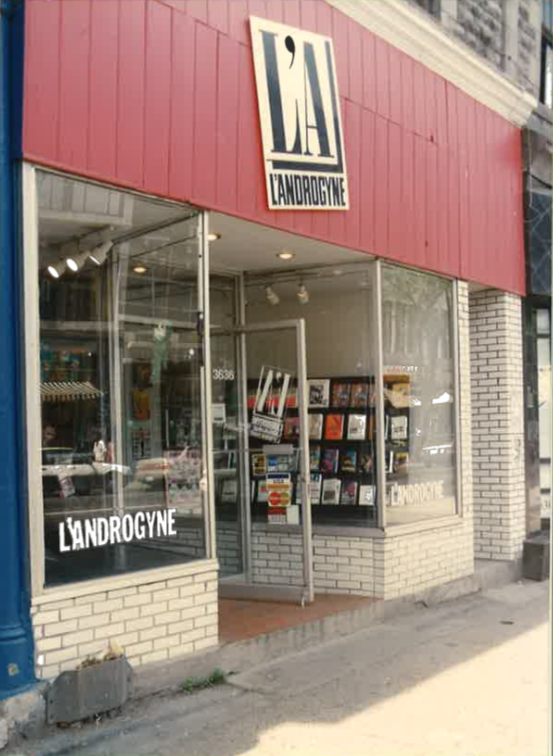
    Montreal’s gay, lesbian, and feminist bookstore, L’Androgyne, closed for good in 2002. At the time, I knew I was going to miss it, but even now, some seventeen years later, I still feel its loss.

    I don’t remember the first time I went inside, but I remember being nervous about it. Who would see me go in? And what would I find there? I still remember its address: 3636 St. Laurent. I remember its smell too: the books, the paper, the glue that held everything together. The place was small, a mere 1,200 square feet, with three rows of white bookshelves all built by hand. It was here where I discovered my favourite authors, where I first picked up copies of books by Armistead Maupin, Ethan Mordden, Sarah Schulman, Andrew Holleran, and Sarah Waters.

    It was also here where I found community. Where I made friends—France, David, and Johanne—all working behind the counter. I’d visit several times a week, if I could, leaving not only with books or magazines but with stories about real people’s lives and the places and events and collected history that were all a part of this exciting community I had just found. Before the Internet, a city’s LGBTQ bookstore was where you got your news. It was where you could pick up queer publications like Fugues or Xtra or the Guide, flyers for parties, maps for marches. And it was also a place where you could develop a crush among the stacks, where you could smile and flirt and finally meet others who shared your interests.

    Walking down the aisles, I’d sometimes imagine my own book on the shelves. At that time, I’d been writing for years with no indication that anything would ever come of it. How great would it be, I’d think, to see a book I had written alongside these legends (under D, somewhere between Delaney and Donoghue)? Sadly, I never got to know that feeling. By the time my first book was published, L’Androgyne was twelve years cold in the ground.

    I’m sure many of you can relate to losing your favourite bookstore. L’Androgyne was not the only one to lose out as the world moved online. For the LGBTQ community, though, there was a moment when the arrival of the Internet held such promise. It meant that people could have more access to resources and information (especially those who didn’t live in urban areas). It was a place where we could congregate easily, expand our networks, and make connections. Yet something authentic was lost. Gone was the human touch, the spontaneity, the chance for discovery, the surprise of the unknown. Sure, I could Google “new gay fiction” if I wanted to know what to read next. I could add “booklover” to my dating profile. But gone were the deep conversations, the quiet browsing, the raucous laughter, the looking for friends, lovers, and other limited editions in the aisles.

    When my book finally came out in 2014, I was disappointed there wasn’t a home for it. I did a few public readings in straight spaces, but rarely sold copies. There was no forum in Montreal for me to introduce my book to my community. And it wasn’t just me. All around I was seeing Canadian writers continuing to publish LGBTQ books and they too struggled to reach an audience.

    So, I decided to start my own reading series. I figured, if Montreal didn’t have an LGBTQ bookstore, I’d make one—at least for a few nights a year. Now, every two months, the Violet Hour takes place in a bar in Montreal’s gay village. And not just any bar, but Stock—a gay male strip club. Why a strip club? Because I wanted a place with a different energy, one where writers could feel like they could take risks with their work. I also wanted to host something in the village because that neighbourhood too had suffered from the shift online and I wanted to bring back some culture to the place that had given me life in my twenties. Above all, I wanted my series to be more like a party, more social. I wanted there to be music and drinks and fun and laughter. Like it was back in the good old days of L’Androgyne. I wanted to unite LGBTQ booklovers in one room and get them talking—about their favourite books, about their favourite writers, about themselves.

    To date, there have been more than twenty events and more than a hundred writers who have taken to the stage. That’s hundreds of new connections made between writer and audience. Montreal may not have a dedicated English-language LGBTQ bookstore anymore, but I’d like to think the Violet Hour is the next best thing. And I hope, as long as this country continues to publish LGBTQ literature, that I can provide it with a stage.


    unnamed

    Christopher DiRaddo is the author of The Geography of Pluto and president of the Quebec Writers’ Federation. You can find out more about future Violet Hour events here. The next event is at the Montreal Fringe Festival on June 5, 2019 at 6 p.m. (Mainline Theatre, 3997 St. Laurent).

    Photo credits: France Désilets (header banner), Paul Specht (headshot)

  • Writing by Numbers—by B.A. Markus

    Writing by Numbers—by B.A. Markus

    1. Show Up

    A link to the Spoken Word residency at the Banff Centre shows up in my feed. I didn’t get a teaching contract with the English Montreal School Board in the fall so I’m not feeling too enthusiastic about spending the $65 non-refundable application fee. I’ve applied to the Banff Centre residencies at least six times and never gotten in. And I’m not convinced that what I’m working on, a collection of dramatic monologues based on interviews with mothers called “What Mommy Needs,” is even a spoken word piece. Most of all, I’m not ready for another rejection. In the end I justify spending the money because it counts as “Doing something about my writing.”

    2. Pay Attention to What Has Heart and Meaning

    In January, I get offered a contract at the school board that’s going to last until the end of June. The application for Banff is out there but I know my chances of getting into the residency are even less than my chances of getting a permanent teaching gig in Montreal. It’s amazing I got the contract for six months. Money is important to me. I’m two kids beyond not worrying about heat, secure housing, and groceries. But I haven’t given up on “What Mommy Needs.” I’m doing interviews when I can. And I’ve started to tell stories at Confabulation and Yarn in Montreal. It’s great to be performing again. I start to think about how I could use storytelling in the mommy monologues. Maybe my project is spoken word after all.

    3. Tell Your Truth as You Understand It

    A month into my teaching contract I get the acceptance letter from Banff with an offer of financial aid. In ten seconds I go from delight to despair. I can’t go to Banff. I just signed a contract. Two days later it occurs to me that I could ask the principal if there is any way I could leave my job for two weeks to do the residency. But I have my doubts. He’s young and ambitious. He likes to follow the rules. And there are fifty teachers who would gladly grab my contract if I left. I practice my speech, aiming for the sweet spot. Somewhere between grovelling employee and self-assured writer. He cuts me off mid-grovel. He says I can go.

    banff residencycohort
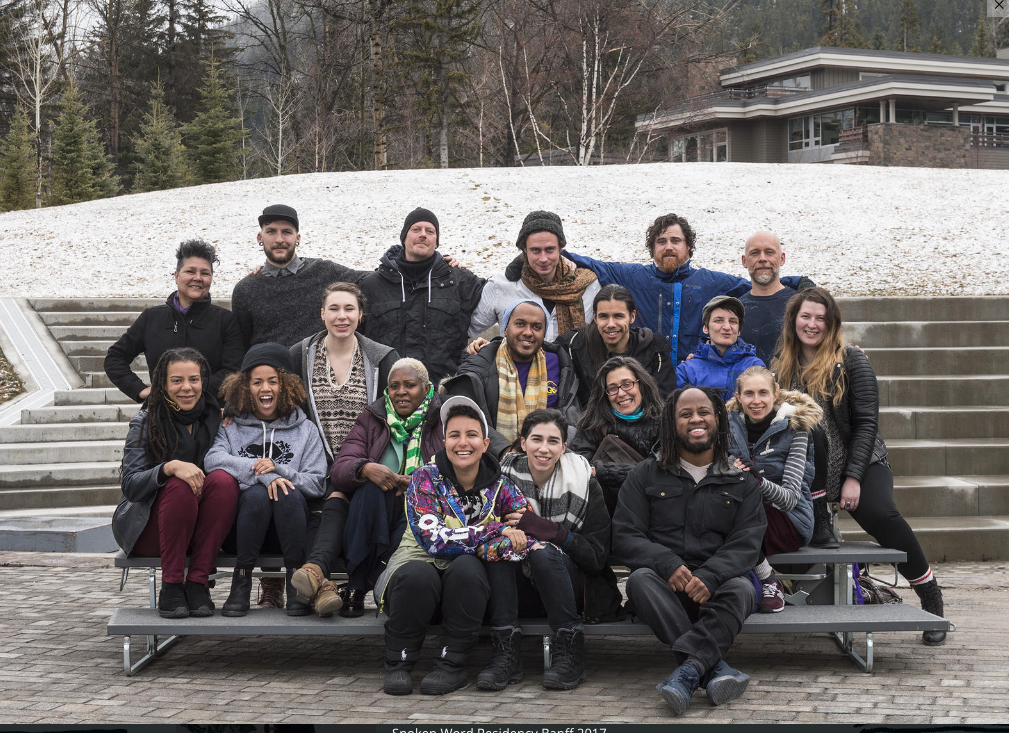
    My cohort: participants and faculty of the 2017 spoken word residency at the Banff Centre (I am in the second row from the bottom, second from the right). The photo above this essay shows me performing at Confabulation, a storytelling series in Montreal.

    4. Remain Open to Outcomes

    Waiting for the plane to Calgary, I download the schedule for the residency. I’d assumed that my time at Banff would be two weeks of uninterrupted writing time. Now I see that most of my days at the residency will be filled with workshops led by the faculty. Attendance is compulsory. I vow that I will spend all my unscheduled time either working on “What Mommy Needs” or getting regular exercise in the pool at the Banff Centre.

    At the end of the first day, one of the faculty members asks if anyone plays the piano and I put up my hand. He’s doing a poem at the faculty show in a couple of nights and he wants some simple piano in the background. In Montreal, I live surrounded by professional musicians. Now I feel like an amateur. I practice for the show on a Steinway grand because that’s the kind of piano you get to play at the Banff Centre. The show goes well. Afterwards, one of the other residents asks me if I’d like to collaborate with her and play piano while she performs her poem. She wants to record us in the studio.

    Despite my promise to devote my unscheduled time to “What Mommy Needs,” I spend many hours in my hut playing piano and singing Jewish prayers, Christian spirituals, and French cabaret songs.

    My plans for daily swims are also squashed, by the appearance of a giant sty that swells my right eye shut.

    We are going to do a show at the end of the residency. I intended to perform an excerpt from “What Mommy Needs,” but instead I write a story about identity that includes three sung sections. I’ve never sung while telling a story. I start to think about how I could integrate music into “What Mommy Needs,” which is now definitely a spoken word project.

    “This writing project has transformed me. And all I had to do was follow the numbers.”

    On the last day of the residency, I meet with one of the faculty members, a historian and dub poet whose work weaves together poetry, performance, and primary research. When I start describing my ideas for enhancing the performance experience in “What Mommy Needs,” she starts shaking her wise head. “No, no,” she says. “‘What Mommy Needs’ is a book.”

    I come back to Montreal with a musical story about identity, a professional recording of me playing piano behind someone else’s poetry, and the possibility that I’m actually writing a book. This writing project has transformed me. And all I had to do was follow the numbers.

    The four “rules” I followed are by Angeles Arrien.

    You can watch an example of my spoken word performance below:

    [vimeo 108630079 w=640 h=360]


    bamarkusphotoB.A. Markus is a writer, teacher, and performer living in Montreal. She is an award-winning creative nonfiction writer, a Grammy- and Juno-nominated songwriter, and her reviews, essays, and stories can be found in anthologies and publications such as Carte Blanche, Queen’s Quarterly, and The Montreal Review of Books. She tells stories live at the Confabulation and The Yarn storytelling events and is currently writing a series of monologues, entitled “What Mommy Needs,” about what mothers do to survive the realities of motherhood. BAMarkus.com

    Photo credit: Jean-Sébastien Dénommé (header banner)

  • On the Back of Turtle Island Reads—by Shannon Webb-Campbell

    On the Back of Turtle Island Reads—by Shannon Webb-Campbell

    A year ago, I’d have never believed I would be asked to advocate Indigenous literatures on CBC for Turtle Island Reads. Given that I was living in St. John’s, Newfoundland, teaching and studying in the English department at Memorial University (MUN), I had no clue I’d be islanded again, but this time in Montreal. Let alone be invited to speak about Indigenous literature on national radio.

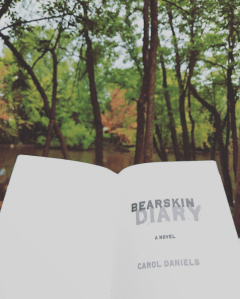
    Just over thirteen moon cycles later, after taking the first (and only) “Aboriginal Myth, Medicine, and Magic” course offered at the graduate level at MUN by Dr. Valerie Legge and co-instructor Amelia Reimer, I shared a knowing wink with Creator while sitting on the stage with my fellow Indigenous advocates. As a student of literature, I came out of the academy and into the public with Métis poet and musician Moe Clark, who advocated for Leanne Betasamosake Simpson’s This Accident of Being Lost; and Anishinaabe comedian and writer Ryan McMahon, who heralded Eden Robinson’s Son of a Trickster. I trumpeted Carol Daniels’ novel, Bearskin Diary.

    “I shared a knowing wink with Creator while sitting on the stage with my fellow Indigenous advocates.”

    We gathered at Tanna Schulich Hall at McGill University on September 20, days before the fall equinox. Our host and moderator, CBC’s Waubgeshig Rice and Nantali Indongo, facilitated a vital conversation spanning issues of storytelling, trauma, healing, and the need for Indigenous literatures. Truthfully, all three of us advocates could have sung praises for one another’s texts, as each book is made of powerful medicines and provocative storytelling, and each one embodies Indigenous knowledge systems.

    Bearskin-diaryPart of the role of advocates is to select a book, and each of us picked texts that spoke to our own craft and the relationship to our own Indigenous being. Clark was drawn to Simpson’s This Accident of Being Lost because of its poetic and sonic qualities. Much like Simpson’s work, Clark’s music breaks and beckons to tradition. Simpson doesn’t adhere to the infrastructure of the colonial English language. She avoids capitalization. Sometimes she writes in Anishinaabe, and doesn’t feel it necessary to translate. Clark approached her pitch in a similar fashion.
    McMahon highlighted the fact that each of the authors were First Nations women: “We’re in a moment now for Indigenous women artists. We need to not forget that.” He pitched Robinson’s Son of a Trickster with his trademark humour and intelligence.

    As I first encountered Daniel’s Bearskin Diary when reviewing it for The Malahat Review last year, I recognized how much the novel has shaped my own work. Not only did I feel a strong kinship with the novel’s protagonist, Sandy, a Cree journalist and TV reporter for CBC who comes into her Indigenous culture through telling other people’s stories, but also with the book’s relationship to the ongoing genocide of Canada’s Missing and Murdered Indigenous Women, Girls, and Two-Spirits.

    “I feel a strong kinship with … the book’s relationship to the ongoing genocide of Canada’s Missing and Murdered Indigenous Women, Girls, and Two-Spirits.”

    My own work spans genre, as I began my writing career as a journalist. Much like Sandy, I became comfortable asking questions and conveying the narratives of other people’s lives. Criticism has always been equal parts discovery and intellectual engagement. It’s a place to find and be found. From there, I became a poet (Daniels writes poetry, too). My forthcoming book, Who Took My Sister? (BookThug 2018), is a collection of poems and texts that hold and carry trauma. These poems are contemporary poetic strategies, both haunting testaments and a mix of Indigenous medicines. Who Took My Sister? is a rally cry, a space for raising awareness and cutting truths. It bears witness to the national genocide of Indigenous Women, Girls, and Two Spirits, whose lives are cut short due to the colonial agenda.

    “Criticism has always been equal parts discovery and intellectual engagement. It’s a place to find and be found.”

    Who Took My Sister? is also being transformed into a touring classical music piece for violin and piano composed by Melissa Hui, and will be performed by Indigenous Inuk artist Laakkuluk Williamson Bathory in spring 2019.

    Poetry has been an ongoing journey with many twists and turns. Recently, it’s led me to writing plays. I’ve been working on The Landless Band, a theatre show about a character who grows up in the suburbs, then learns she’s Indigenous. Tying back to Daniel’s work, while her protagonist Sandy was visibly Indigenous with darker skin, her storytelling techniques overlap with mine: we both draw from a personal narrative and explore it through characterization. The Landless Band is being presented in a workshop form at LSPU Hall in St. John’s, Newfoundland in spring 2018 by Eastern Edge Gallery.

    “The most exciting writing in this country is rooted in Indigenous writers, playwrights, and poets.”

    While Turtle Island Reads promotes Indigenous literatures, it also honours the advocates and their practice. Having only recently arrived in Montreal, to find myself in a room full of avid readers who are excited about Indigenous writing was an honour. It’s a testament that we’re ready to step beyond the canon, and unpack Canadian literature. We’re making room for new voices. Perhaps I’m biased, but the most exciting writing in this country is rooted in Indigenous writers, playwrights, and poets.


    Webb-Campbell by Dayna DangerShannon Webb-Campbell is a mixed Indigenous (Mi’kmaq) and settler poet, writer, and critic currently based in Montreal. Her first book, Still No Word (2015), was the inaugural recipient of Egale Canada’s Out in Print Award. She was the Canadian Women in the Literary Arts (CWILA) critic-in-residence in 2014, and sits on CWILA’s board of directors. Her work has appeared in many anthologies, journals, and publications across Canada, including the Globe and Mail, Geist magazine, The Malahat ReviewCanadian Literature, Room, and Quill and Quire. In 2017 she facilitated a book club-style reading of The Final Report of the Truth and Reconciliation Commission of Canada at Atwater Library. Who Took My Sister? is her second book.
    Photo credits: Courtesy of the CBC (header banner); Shannon Webb-Campbell (Bearskin Diary); Dayna Danger (headshot)

  • Writing Between Languages—by Veena Gokhale

    Writing Between Languages—by Veena Gokhale

    What do you do when a lot of the reality you portray in your fiction does not take place in English? Easy answer: you sprinkle your prose with words from other languages. As it turns out, this is not without its problems.

    Growing up in India, I learned my first language, Marathi, at home. I was sent to an English school right from kindergarten, where I had also learned Hindi, the language of the state I lived in. In the Indian Constitution, Hindi and English are designated languages of the Central Government. Presently, India has twenty-one other “official” languages. Generally speaking, every time you cross a state boundary you are in another “language territory.”

    English, though not my mother tongue, is nevertheless my “principal” language. I was in my twenties when I came across an essay by a Hong Kong-born writer of Chinese origin who described English as his principal language. I cannot thank him enough for giving me a way of describing the place of English in my life!

    When I became a journalist, I worked for an English-language magazine in India. But I had always loved mixing languages, using non-English words when I spoke in English. As a writer, I exuberantly introduced some Hindi words into my English articles. This was around the time that Salman Rushdie “decolonized the English language,” as he put it, through the innovative use of multiple languages that included sprinkling Hindi and Urdu words throughout the English text of Midnight’s Children, his groundbreaking Booker Prize winner. He did not translate the words.

    “But I had always loved mixing languages, using non-English words when I spoke in English.”

    I, on the other hand, was immediately challenged by my editor when I employed Hindi words. She came from southern India and knew little Hindi. Reluctantly, she allowed me to retain a few words, with the English translation in brackets.

    Fast forward to Canada in 2012. Guernica Editions had accepted my manuscript entitled Bombay Wali and other stories. Characteristically, the book contained some Hindi, Urdu, and Marathi words. I suggested putting an asterisk next to the words and explaining them in footnotes. My editor, Michael Mirolla, rightly protested. Some pages then would have had five asterisks or more! A solution was found by explaining a word here and there in the main text itself and adding a glossary explaining other words and phrases.

    In my forthcoming novel, Land for Fatimah, the protagonist takes a posting in Kamorga, an imaginary east-African country. This time, I introduced a made-up language for Kamorga, and named it Morga. Despite knowing five other languages to some degree, Anjali, the Indo-Canadian protagonist, is struggling with Morga.

    I used words in Morga in much of the dialogue. I italicised the “foreign” words and phrases and put the translations right next to them. For example: Kabari ani? How are you? Hoori. Good. Perhaps this is awkward and breaks the not-to-be meddled-with flow of the text. But to hell with it!

    Why this insistence on using words from other languages? As I explain in a note on language in Land for Fatimah, “I strongly believe in using non-English words and phrases in my fiction to bring home to the reader, directly and tangibly, the fact that s/he is reading about a non-Anglo culture.”

    “Why this insistence on using words from other languages?”

    There is a much-quoted speech by Indian freedom fighter, Bal Gangadhar Tilak: “Swaraj (self rule) is my birthright and I shall have it.” This original quote has gone around translated as “Freedom is my birthright and I shall have it.”

    Why couldn’t they have let the word “swaraj” be? Some might argue that keeping “swaraj” is awkward and unnecessary, and that freedom resonates more than self-rule. But such misquotation can be seen as a form of linguistic colonialism.

    Inspired by Tilak, I have my own writerly warrior cry: multiple languages are my blessed heritage and reality, and I shall flaunt them! Back when I lived in India, I loved switching between English and Hindi in mid-sentence. Now that I live in Montreal, I use French words when speaking English. Old habits die hard!

    I end Land for Fatimah’s note on language with these words: “Long live the diverse languages of the world! They bring us unfathomable riches.”

    I would love feedback on how other writers deal with the use of non-English words in their text and how readers respond when they come across them. Thanks in advance. Merci. Shukriya.


    VG wt flowersVeena Gokhale, an immigrant shape-shifter, started her career as a journalist in Bombay. This tough, tantalizing city inspired Bombay Wali and other stories, published by Guernica Editions in 2013. Veena first came to Canada on a fellowship, then came back again to do a master’s degree. After emigrating to Canada, she worked for non-profits. Land for Fatimah (to be published in 2018) is partly inspired by the two years she spent working in Tanzania. Veena has published fiction and poetry in anthologies and literary magazines and received writing and reading grants. veenago.com

    Photo credit: Shawn Leishman (header banner)

  • The Art of Mentorship: An Interview with Robert Edison Sandiford

    The Art of Mentorship: An Interview with Robert Edison Sandiford

    Every couple of weeks, Robert Edison Sandiford calls me from Barbados. Robert is one of this year’s QWF fiction mentors, and I am his protégé. We’ve made arrangements to speak at 5 p.m. via Skype so this interview would feel more face-to-face. At 5:10, we still have no audio so he switches from his desktop to his laptop. At 5:25 the recording app on my phone stops working. At 5:37 we decide we’ll have to hobble back and forth between the computers, a phone, and another phone app to somehow make it work. Afterwards, when it’s all sorted, he says: “Well, there’s a lesson about tenacity.”

    Robert was born in Montreal to Barbadian parents. He is the author of nine books that range in form from short and long fiction to memoir, graphic novels, and erotica. Over a period of four months, he’s worked with me on my own collection of stories and we’ve talked about many things: process and voice, the German writer Jenny Erpenbeck, and how baking helps to reduce stress. Robert answers my questions below.

    —Pamela Hensley

    Fairfield Cover

    PAMELA HENSLEY

    Let’s start with a quote from Fairfield, your most recent collection of short stories. In reference to engaging fiction, you say: “All that matters… is the individual and the moment.” Can you expand on that?

    ROBERT EDISON SANDIFORD

    In the context of the collection, it had to do with making the most of art. It had to do with knowing when something is ready or when an artist has what it takes. It comes from a quote by Matthew Arnold [“For the creation of a masterwork… two powers must concur, the power of the man and the power of the moment, and the man is not enough without the moment”]. How do you know when you’ve got what it takes? All we are is who we are and the talent that we have. My contention is that most people are a little better than they think they are. They can do better than they’ve done.

    HENSLEY

    Besides being a mentor, you’re an editor and teacher. How does one turn a good manuscript into a great one? Or a good writer into a great writer?

    SANDIFORD

    There has to be that spark within the work itself, or within the writer. There has to be something inside that person already that lends itself to greatness. And it may depend on how we define greatness. There are a lot of artists, not just writers, people who never enjoyed recognition while they were alive or young enough to enjoy it. So there’s that question again, of the individual and the moment and the individual and talent. There are certain things you can teach people to make them better writers but that sort of greatness, that may also depend on them.

    HENSLEY

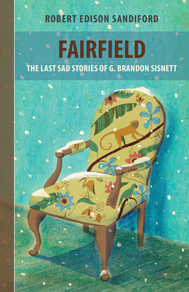
    In Fairfield, a fictional editor writes that the character G. Brandon Sisnett borrowed from other authors, including one from Montreal who wrote Caribbean fiction on the themes of “familial loss and managing the pain of living.” Which are themes that recur in your work. Would you like to talk about theme?

    SANDIFORD

    I’m curious about theme. Both of us are writing from a particular place. Germany finds its way into your stories, as well as Canada. For me, it’s Barbados and Canada. Theme is distinct from subject matter but they inform each other. I write out of where I am but also where I come from. I do believe that all writing is regional, in a sense. People talk about things being universal but I think it goes to honesty. If you write in a way that is honest, the regional will get you to the universal. Someone will pick up the story halfway around the world and say, “I relate.”


    “There are certain things you can teach people to make them better writers but that sort of greatness, that may also depend on them.”


    HENSLEY

    Is place a detail?

    SANDIFORD

    Place is a necessary detail: your characters have got to be somewhere. But it’s more than that. It’s a space in which you invite the reader to share an experience. It’s about learning, actually. If I write about a particular place, I want you to feel that place. I want you to experience it as if you were actually there. Unless having a non-descript setting is important to telling the story, then why have this non-descript thing? I get the answer, “But I want it to be universal.” I just say, “Stop. What you may be doing is taking out the necessary edges that people need to relate to the story even more.”


    “I do believe that all writing is regional, in a sense. People talk about things being universal but I think it goes to honesty. If you write in a way that is honest, the regional will get you to the universal.”


    HENSLEY

    What’s the difference between style and voice?

    SANDIFORD

    Style and voice tend to be synonymous. But to make a differentiation, when writers are starting out I like to talk about approach. I used to talk about style but I think writers get confused. They say, “But the way I put it down is a style. I like to use all these ellipses when I write, that’s my style.” And I say, “No, that’s more of an approach and it may even be a bad approach.” Style is something that you develop over time. Voice is all those things combined. It’s reading a work and recognizing who it is. Ultimately, it’s telling a story in a particular way. It can’t be told by anybody else.

    HENSLEY

    You published your first story collection more than 20 years ago. Does it get any easier?

    SANDIFORD

    Hell, no! Publishing is more difficult now than it was before. Coming up with a story, I don’t know that that gets any easier. What gets easier, maybe, is knowing what works and what doesn’t. But I wake up every morning doing what I do and I have no regrets. Ever. That’s a hell of a thing to be able to say.


    On June 4, the 2017 QWF mentors and mentees will present new writing at the annual public reading in Montreal. Click here for more information.

    Rob Profile, ACA Painting BackgroundRobert Edison Sandiford is the author of nine books, most recently Fairfield: The Last Sad Stories of G. Brandon Sisnett. He is the founder, with the poet Linda M. Deane, of the cultural forum ArtsEtc Inc. A recipient of Barbados’ Governor General’s Award for his fiction and the Harold Hoyte Award for newspaper editing, he has also worked as a teacher and video producer.


    Pamela Hensley is new to Montreal, having relocated once again after returning from Germany to Ontario. She was selected to participate in the 2017 QWF Mentorship program and is currently attending her first QWF workshop. You can read her stories in Canadian journals, including The Dalhousie Review and EVENT magazine, and are invited to hear her read with other QWF mentees at The Comedy Nest, Montreal Forum on Sunday, June 4 at 2 pm.


    Photo credits: Pamela Hensley (top banner); Aeryn Sandiford (Sandiford headshot); Gordon Hensley (Hensley headshot)

  • Why I Loved Editing a Small Canadian Online Magazine, and Why I’m Leaving—by Laurence Miall

    Why I Loved Editing a Small Canadian Online Magazine, and Why I’m Leaving—by Laurence Miall

    Before I ever joined a magazine, or published a novel, for that matter, here’s how I imagined people who had responsibility over publishing texts. They were working in fancy university offices or in stylishly decorated apartments in artsier parts of town than my own, smoking cigarettes and drinking wine, sporadically casting a disdainful eye toward the “slush pile” (in my mind’s eye, the slush pile was either physically manifested, or online, it didn’t make a difference insofar as the disdain goes). And here’s what would happen if ever they came across my submission. They’d read a line, chortle to themselves, and say, “This poor, desperate bastard. Why does he waste our time?” Then all the editors would say in unison, “Let’s publish one of our friends, instead!”

    That’s how I imagined it.

    Maybe some literary journals are nepotism-only zones, I don’t know. I’ve only ever worked for carte blanche. I joined as fiction editor in 2014 and the first issue I worked on was Issue 20. Our most recent issue is #29, so that’s ten issues in total. As of Issue 23, I took on more responsibility for the magazine, taking over from our illustrious founder, Maria Turner, first in partnership with Ben Spencer, then with Gregory McCormick.

    Though the years, I have come to enjoy my vexed relationship with the slush pile. Every time I sit down to read, I want to love the next piece I’m going to discover. One of the very first stories I ever picked was Matthew di Paoli’s “Other Forms of Life,” and I found it so funny and quirky that I immediately started reading it aloud to Monika, my partner. I invited Matthew to read his story at a carte blanche event we were doing at the Blue Metropolis Literary Festival in Montreal, and he couldn’t come, so I read out parts of his story in his place. I loved the texture of someone else’s sentences coming from my lips, and the rhythm—almost like a form of breathing that was not my own.

    So yeah, the slush pile wasn’t like I’d imagined it, not at all. It was sometimes a source of some frustration, but also of great excitement and pleasure.

    Over the years, the comradeship of the entire carte blanche crew, and the support of the Quebec Writers’ Federation, was constant, making me realize that one of the biggest benefits of the literary life is not the writing itself but the community of other writers, editors, publishers, curators, and do-it-all’ers who keep culture humming along and livening up lives that would otherwise be lived in dank, solitary darkness.

    “I loved the texture of someone else’s sentences coming from my lips, and the rhythm—almost like a form of breathing that was not my own.”

    Chalsley Taylor, above all, has made the magazine the beautiful online presence it is today, and so it’s to her I would like to express my biggest THANK YOU. We started this journey at pretty much the same time. It’s no overstatement to say that this magazine would not be in the fine shape it is without her. With Cason Sharp now on the team, I believe carte blanche is going to keep on kicking ass in its cool, classy way. How can it not, with Nicola, Georgia, Bronwyn and the two Gregs bringing their brilliance to each and every issue?

    I am shortly going to be leaving the team in my official capacity as editor. I do so with mixed feelings. Once upon a time, I honestly felt I could tackle any amount of work that was thrown at me. The days seemed elastic. I could stretch them at either end, conjuring up just enough minutes or hours to always get things done. But I don’t feel that way anymore. I am trying to figure out how big each relative part of me is, and how to accommodate all those parts within a finite body. What’s the size of the editor in me, compared to the writer? And more importantly, the loving husband? The communications director? The friend? The son? The cooker and eater of meals, and the drinker of ales, and the sporadic watcher of Liverpool FC, and everything else?

    A few weeks ago, my second oldest friend disappeared from social media. In recent years, we hadn’t established any other form of communication except for Twitter and in-person visits. I had no phone number or email address for him. I started to wonder, nervously, if he was still alive. In 2016, I lost a dear friend to suicide. Another of my friends has struggled with brain cancer. These experiences and many others made me think dark and fearful thoughts.

    Day after day, my friend didn’t reappear. There was an envelope icon lit up in Twitter, indicating a message from him, but the message was an old one, and because his account was deactivated, the message itself had ghosted away. I tried to figure out what was the best course of action. Should I just show up at his house to check on him? No, I told myself. It wasn’t time for that. He’s not dead, I said to myself. He’s just taking a break from Twitter. Who can blame him? Donald Trump is president.

    My friend eventually reappeared, thank God. He found my email address and wrote to me. I was relieved, and felt a little foolish for my quiet panic.

    “I am trying to figure out how big each relative part of me is, and how to accommodate all those parts within a finite body. What’s the size of the editor in me, compared to the writer? And more importantly, the loving husband?”

    Realizing just how agitated I had become gave me yet another confirmation that I need to reappear—to myself. Working sixty- to seventy-hour weeks means you’re obliged to run on adrenaline and anxiety half the time. I get bent out of shape easily. I sometimes get inordinately fearful about small things. It’s time to slow down a little. Time won’t be warped and woven into shapes that better accommodate me. I must accommodate to time.

    Whatever happens, I am going to remain a friend to the carte blanche crew. I became an editor at approximately the same time as I had my first novel accepted for publication, so the two experiences effectively took me from zero to one as a literary person, according to my own weird binary measurement. I am enormously grateful to have had such opportunities.

    I still send stories to magazines sometimes, and I get my share of rejections, but I don’t get resentful about them. I am pretty sure that the people at the magazines are just that: people. Maybe some of them have similar traits to me. Maybe they’re a bit fucked up. Maybe they’re anxious, maybe overworked, maybe worrying about a loved one—like us all.


    miall-authorphoto-1Laurence Miall is a Montreal-based writer and communications expert. His first novel, Blind Spot, was published by NeWest Press in 2014.

    Photo credits: Ben Brooksbrank; Owen Egan (author headshot)

    Apply to be carte blanche’s new editor.

  • Monique Polak Reflects Back on Being the Inaugural CBC/QWF Writer in Residence

    Monique Polak Reflects Back on Being the Inaugural CBC/QWF Writer in Residence

    Deadline to apply for the 2017 position is Thursday, October 13

    MoniquePolak_credit-Studio Iris

    I don’t know about you, but when I’m in a rough spot or running out of steam, looking back at a joyful moment helps.

    For me, one of those moments happened last November, when I learned I’d been selected to be the CBC/QWF’s first writer-in-residence. I still grin when I remember jumping up from my chair when my name was called during the QWF Literary Awards Gala.

    In a time when freelance journalism opportunities have been drying up, it was great to have a home for my stories. I was delighted to have the chance to write five columns that were featured on CBC Montreal’s website. I also enjoyed working closely with CBC’s editorial team. They helped me fine-tune my ideas for the columns, as well as the columns themselves. At the same time, CBC encouraged me to follow my own instincts. In every column I wrote, I started with a personal story, but then moved on to interview other Montrealers about subjects that moved me—the role of objects in our lives, finding love later in life, juggling two careers, telling lies, and the stories we tell ourselves.

    For me, stories are a way of making sense of our lives, and connecting with others. I connected with the Montrealers I interviewed by listening to their stories, and by sharing those stories through CBC Montreal, I like to think that I connected with readers across the province.

    If you’re thinking about applying for the 2017 CBC/QWF writer-in-residence gig, go for it! I look forward to seeing where the next writer-in-residence takes the column.

    All applications for the 2017 CBC/QWF Writer-in-Residence program must be submitted by 11:59 p.m. on October 13, 2016.

    For more information, and to submit your application, visit the QWF Submittable page.

    Photo credit: Studio Iris

  • That Sense of Not Belonging by Adam Leith Gollner

    That Sense of Not Belonging by Adam Leith Gollner

    The Quebec Writers’ Federation hosted its 17th annual gala on November 18, 2015. Author Adam Leith Gollner opened the ceremony with this remarkable meditation on how a writer seesaws between isolation and community, and on what it means to be a writer, right here, right now.

    (more…)

  • Bye Bye Darlings: The Editing Gauntlet by Alice Zorn

    Bye Bye Darlings: The Editing Gauntlet by Alice Zorn

    Farine Five Roses
    Alice Zorn’s new novel, Five Roses, is named after the FARINE FIVE ROSES sign that marks the southwest horizon of Montreal and Pointe St-Charles, where the novel is set. Photo: Alice Zorn


    You’ve finished your novel manuscript and you even – finally! – get a publisher. It took ten years. You have Neanderthal muscles across your brow from frowning at the computer screen. But now you’re home-free. Bingo!

    Then you get the first slew of comments from your editor. She’s the objective eye who sees what the book can be, but isn’t yet. Does it begin in the best possible place? Is there too much exposition? Does it have structural integrity? What about the ending? She tells you all the darlings you cherished while you were writing don’t belong unless they serve the book. The clever turns of phrase, the crisp dialogue, the research that shows off your erudition, the quirky events that really happened. Your clean manuscript pages are tattooed with strokes and question marks. Some editors slash with red pen. I’m so glad mine used pencil.

    With my first novel, Arrhythmia, I was advised to lop two main characters, cut ninety pages and replace them with new writing. I couldn’t believe it. Hadn’t the publisher already accepted the book? My editor was firm. I had to learn how to rethink developments in the novel as narrative choices. I reminded myself that my editor, like me, only wanted what was best for the book. After all, she brought the manuscript to the acquisitions table, arguing that – out of all the other manuscripts being vetted – mine should be published.

    I rewrote those ninety pages because I realized the change was structurally necessary to the novel. And I rewrote them, yes. My editor didn’t tell me what to write, only that the direction I’d originally taken wasn’t the best option. However, I did not lop those two characters. I made them stronger and more integral to the novel. Writing the novel was hard, but editing it might well have been the more profound learning-about-writing experience.

    “Writing the novel was hard, but editing it might well have been the more profound learning-about-writing experience.”

    My second novel, Five Roses, will be published by Dundurn Press in 2016. I’m at the copy editing stage now. This is the finicky time when syntax, word choice and punctuation come into question. I open the document and scroll through 320 pages with red commas added, words underlined and lassoed to dialogue bubbles. Individual words are highlighted in yellow. A character is cycling along a city street, alert to the nervous rush hour traffic, as she thinks about the police sending out an alert to catch a criminal. I swear at myself for not having noticed. I must have read this page twenty times already! But my brain was in a groove. And as I’ve repeatedly witnessed, my brain is willful in its fondness for repetitions, internal rhymes and alliteration.Now, too, is when I discover that grammatical niceties aren’t as ingrained as I assumed they should be after five decades as a voracious reader. Shouldn’t I simply know all these distinctions by now? Seems not.

    And so I learn that there’s a difference between hanged and hung when it refers to a human body that is being put to death. I hung a picture on the wall. The executioner hanged a man. However, a human body that was already dead hung from a hook. I need to know that for this novel, since a character was hanged.

    6777082592_d2ba71334d

    I had to teach myself the farther/further dance after having worked with a copy editor who changed all my farthers to furthers. He thought further sounded more posh. Fine, I thought. He’s the copy editor. Maybe it’s one of those UK vs US things. For a couple of years I banned all farthers from my writing. Then I had a story returned from a copy editor who had changed some of my furthers to farthers. That was more curious. I finally pulled a tome of grammar off the shelf and discovered there’s a rule. Farther is for physical distance. Further is the abstract concept. You might think that I would already have known this, but I didn’t. And I’m not the only one. I continue to see farther and further misused in books published by reputable houses. (If you want a trick to remember which to use when, think far > farther. Thank you to Carol Weber for this tip.)

    You aren’t the best judge of your work, because you’re too close to the writing.You need an editor. Not your partner nor your best friend, who won’t want to hurt your feelings, but an experienced and discerning professional who will help you realize the full potential of the book.

    I’m now at the last read-through before Five Roses goes to the design people. I’ve rewritten the manuscript three times since I thought it was finished in 2013. Cutting, puzzling, moving pages around. Lots of darlings sent marching to the recycling bin. At each stage of editing, the book becomes more of an entity that lives separate from me. Which is what it will have to be when it’s sent off into the world.


    for QWFAlice Zorn’s book of short fiction, Ruins & Relics, was a finalist for the 2009 Quebec Writers’ Federation McAuslan First Book Prize. In 2011 she published a novel, Arrhythmia, with NeWest Press. She has twice placed first in Prairie Fire’s Fiction Contest. Her second novel, Five Roses, will be published with Dundurn Press in July, 2016. She lives in Montreal and can be found at http://alicezorn.blogspot.ca