Tag: writing

  • Writer’s Block in the Time of Corona—By Carolyn Marie Souaid

    Writer’s Block in the Time of Corona—By Carolyn Marie Souaid

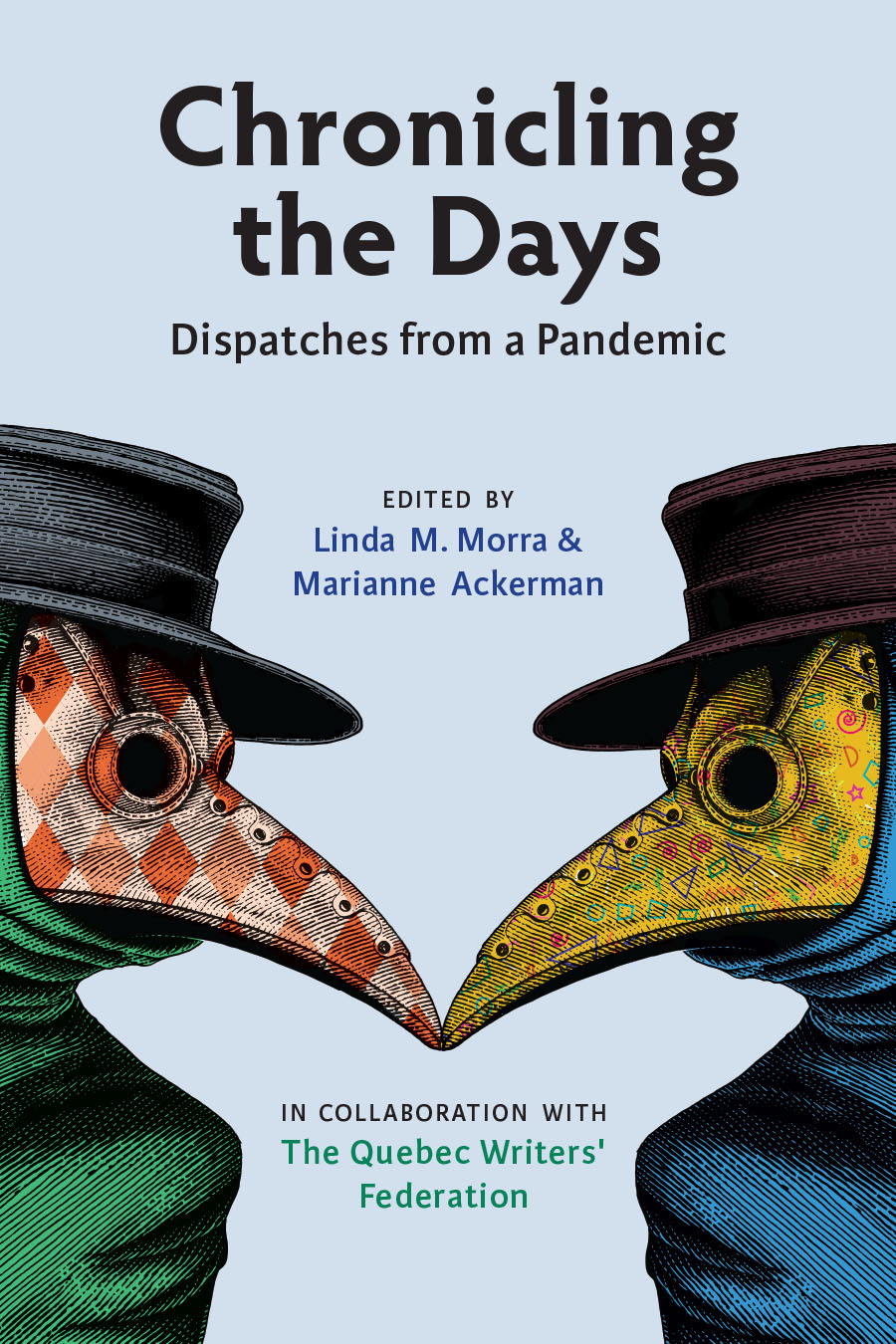
    In April 2020, we invited writers in Quebec to submit a story of a single day during the strange, uneasy time of coronavirus and pandemic, of social distancing and self isolation, of lockdown and quarantine.

    We’re thrilled to announce that these stories have been gathered in Chronicling the Days: Dispatches from a Pandemic (Guernica Press). To learn more and buy the book, please visit https://www.guernicaeditions.com/title/9781771836579.

    Please also join us on the QWF FB Community page, and let the authors know if their words resonated.

    In mid-March, COVID-19 was getting out of hand, according to Premier Legault. There was too much handholding, not enough handwashing. I was sent home on a paid, two-week hiatus while they rejigged my job to allow me to work from the confines of my condo.

    Wait, what?

    To read the rest of the story, please support our community and check out Chronicling the Days: Dispatches from a Pandemic

  • Living and Writing in The Country—By Angela Leuck

    Living and Writing in The Country—By Angela Leuck

    In April 2020, we invited writers in Quebec to submit a story of a single day during the strange, uneasy time of coronavirus and pandemic, of social distancing and self isolation, of lockdown and quarantine.

    We’re thrilled to announce that these stories have been gathered in Chronicling the Days: Dispatches from a Pandemic (Guernica Press). To learn more and buy the book, please visit https://www.guernicaeditions.com/title/9781771836579.

    Please also join us on the QWF FB Community page, and let the authors know if their words resonated.

    “We’re thinking of moving to the country,” I told mystery writer Louise Penny when I bumped into her at the Knowlton Literary Festival in 2010, adding that my husband and I weren’t sure if it was the right thing for our writing careers. Penny was enthusiastic: “Do it,” she said, “while you can!” A few months later, we bought a 200-year-old farmhouse in the tiny hamlet of Hatley.

    To read the rest of the story, please support our community and check out Chronicling the Days: Dispatches from a Pandemic

  • Writing After A Concussion—By Pearl Pirie

    Writing After A Concussion—By Pearl Pirie

    The first year after I had a concussion was a blur. I was dead to the world for three months, going in and out of sleep, exhausted. I had vertigo and difficulties with light, sound, and language. No reading. No computers. No writing. Definitely no multitasking. I had to rest for far more hours than seemed viable and consequently had to suddenly quit a few organizations I led, with no succession plan in place. I closed my small press, or as it turned out, put it on hiatus. I simply had no choice.

    As with a stroke or cancer, a traumatic brain injury can be an opportunity to reexamine one’s life and priorities.

    I had been heading towards burnout, and my concussion forced me to adopt a more balanced life, once I’d recovered enough. Now, when I overdo it, I go on concussion protocol: no screens, no concentration, less activity. The concussion encouraged me to do fewer things better, to slow down, to spend more time in nature and quiet and with friends. To go deeper, not further.

    I stopped attending so many activities. I moved out of the city and started working on editing more, writing deeper. This concussion changed my capacities. I still can’t concentrate for those fourteen-hour editing and writing days like I used to. After one or two hours I need a full break. But I can go deeper because of the slowness and the focus needed to keep on a track.

    You probably had a concussion as a kid. About six out of a thousand people per year get one. After a light bump you may see stars but not black out and feel fine within fifteen minutes. That’s a mild, or Grade 1, concussion. If you’re knocked out and lose memory from the time around the impact, it’s severe, or grade three.

    The kicker is, each time you get a concussion, the next will be worse. I think I’ve had four or five of them, with two at a grade-three level. The one that tipped me over was a Grade 2 concussion.

    I now know of a dozen poets with lasting effects from concussions. Some struggle with physical balance, some with emotional balance, others with energy. Laura Stanfill writes eloquently of how her concussion brought aphasia. A.H. Reaume describes how brain trauma affects her writing. As she makes her way through the brain fog and frustrations of not “getting it,” there are days with spoons and days when she says: “there is no way I can push myself past my capacity even though I desperately want to.” Jane Cawthorne has been compiling interviews which will come out as a book in mid-2021: Impact: The Lives of Women After Concussion.

    The brain is a complicated thing. It follows that traumatic brain injury is as well. Some patients with severe injuries rapidly recover from symptoms, while some with mild injuries have severe, long-term post-concussion symptoms that disrupt daily functioning for weeks or months. When it’s longer, it’s called post-concussion syndrome, which is what I have. (If you’re curious, there’s a scale here.) I’ve always been called out for persistence. I guess sticking to things is on a cellular level.

    My reading rate is slower. I’m impatient for speed, but because life feels more fragile, I have to balance being present with resting enough. I can’t do extended concentration like I used to, and I have to switch up my routine more since extended reading or writing or editing isn’t given carte blanche bodily clearance anymore. So, I compose in my head. Instead of moving ideas visually or digitally, I compose by rolling things around in my mind, editing there first. And by letting things go, instead of making precious and publishable the minutiae. My memory is short, and my working memory is small.

    I try to treat myself as I would a pet. Soft voice, kind acts, clean water, good food. It takes more energy to do things, so I am more conscious of investing or calling it a waste and cutting losses. I prioritize a few people more because I have fewer spoons to go around or to do All The Events. I give myself permission to leave early, to show up late or to not show up, instead of being the first one to come and the last one to go. I socialize mostly though my computer since outings are more taxing. During outings, I take more breaks, pressure myself less. I float and accept catching less than I did.

    Perhaps in combination with anxiety meds, the concussion means I’m better at being methodical and tracking deadlines and calls. Who knows? I may write less, but I get published more. My writing is different, at least. I’m a different person, and so I can resonate with different people. But would I opt to get a concussion? A big no to that.


    IMG_E4449Pearl Pirie’s fourth collection, footlights, comes out in fall 2020 from Radiant Press. Her newest chapbooks are Call Down the Walls (Frog Hollow Press, February 2019) and a haibun collection, Eldon, letters (above/ground, August 2019). Her next chapbook will be Not Quite Dawn, out from Éditions des petits nuages in the spring of 2020. Her next epistolary haibun chapbook, Water loves its bridges: Letters to the dead, is due out in December 2020 from The Alfred Gustav Press, by subscription.

    Photo credits: Pearl Pirie (header banner); Brian Pirie (headshot)

  • Why You Should Apply for a Canada Council Grant Every Year until You Die.—By Sherwin Tjia

    Why You Should Apply for a Canada Council Grant Every Year until You Die.—By Sherwin Tjia

    It is a truth universally acknowledged, that a writer in possession of a good idea, must be in want of a grant. Last year I was on a Canada Council granting jury, and it not only enlightened me as to how the whole process works, it also renewed my faith in the Canada Council in general, and in the granting process in particular.

    Over the years some of my writer friends had gotten the distinct impression that the Canada Council was this edifice of insiders. Those who got grants kept getting them, and those on the juries awarded grants to their writer friends. And this bitter conviction stopped many of them from applying. “I’m not going to win anyway, so why try?” It doesn’t help that by default, a writer’s life is an incessant litany of rejection.

    But after having been on the jury, I’m now convinced we all should apply annually. The truth is that just by applying you help all writers because the Council takes those numbers and brings them to the government to ask for more funding for future years. Even if unsuccessful, those applications demonstrate a clear need.

    Though I’ve applied and been rejected in the past, the biggest eye-opener for me was seeing just how high my chances of getting a grant had always been. Out of the 150 applications my jury read (including fiction, poetry, graphic novels, short stories, literary non-fiction, YA and kid’s books), fully forty writers, give or take, got grants. That’s a win rate of around twenty-six percent, or one in four. No lottery has ever been so generous.

    And that’s the thing. It is a lottery. You can’t control who’s on the jury. If their tastes don’t align with your proposal one year, you’ll just have to apply again the next. I’ve now seen firsthand how jurors agonize over their decisions. We champion the diamonds that are rough, hopeful that grant-sponsored time can polish a great idea. We eloquently counterpoint prevailing opinions. Various members bring unique insight from their respective specialties. And though we were all quite diverse (in terms of geography, language, gender, race, sexual orientation, and writing genres), more often than not I was surprised to discover how much we concurred on our final assessments.

    So take it from a fellow writer who is deeply skeptical and always expecting rejection: the Canada Council has your best interests at heart, and every year runs a lottery that you are uniquely qualified to enter. So enter!

    To help you, I have some advice to offer:

    DO START EARLY. The application is almost its own writing genre. It needs time to simmer. Go through at least several drafts. A friend should read it over. Any initial questions they have should be answered, because it’s likely the jury will harbour those same questions. Similarly, anything confusing should be re-written to be clear.

    DO BE STARTLINGLY ORIGINAL. Easier said than done, of course, but it pays to go far afield with your concept. If you have the misfortune to be the fourth applicant with a post-apocalyptic road trip underpinning your plot, the jury may be inclined to favour the best of the bunch.

    DON’T GET TUNNEL VISION ABOUT PITCHING JUST YOUR STORY. Discuss the larger impact of it on you and on the society it will go on to live in. Why does it matter to you? Is it personal? Will it matter to other people? Are there themes that will resonate in the larger world?

    If rejected, DO CALL THE CANADA COUNCIL. The program officer takes notes during the jury discussion of your project, and they’ll relay these to you. But only if you call them for feedback.

    If rejected, DO RE-APPLY the very next year. You may want to tweak the same application, or apply with a whole new project. But don’t not apply.

    If successful (yay!), APPLY THE VERY NEXT YEAR WITH ANOTHER PROJECT. Now, in the past, if you got a grant, you were prevented from applying again until your final report for that grant was submitted. But in the current system, you can apply every single year, even if you already got a grant and are currently working on something, as long as it’s for a new project, and there’s no overlap in the project dates you’re proposing.

    DO ALWAYS INCLUDE A SAMPLE FROM YOUR PROPOSED PROJECT. Even if you have a more refined short story that you think will show off your writing chops from a couple years back, take the time to also write up a small sample of the actual thing you’re pitching. It helps the jury see it. Juries are unkind to sample-less applications.

    And that’s it! Vow to apply every year. Think of it like voting, but you’re the candidate. It’s your civic duty to your art! The world needs all the odd and diverse projects it can get! Be the strange you want to see in the world.


    SherwinTjia_PLZdontcrop

    Sherwin Tjia is a Montreal-based writer and illustrator. Their latest book PLUMMET is a graphic novel about a woman who wakes up one day to find herself in freefall forever. It was named one of CBC Book’s 20 Best Graphic Novels of 2019. Their Choose-Your-Own-Adventure style book from the POV of a housecat, You Are a Cat!, published in 2011, was the winner of that year’s Expozine Award for best English Book, and has never been out of print. Their collection of 1,300 haikus, The World Is a Heartbreaker, was a finalist for the 2006 A.M. Klein Poetry Award. And their first graphic novel, The Hipless Boy, was a finalist for the Doug Wright Award for Best Emerging Talent, and also nominated for four Ignatz Awards.

    Photo credits: Sherwin Tija (header image & headshot)

  • The Honeymoon Phase—By Ann Cavlovic

    The Honeymoon Phase—By Ann Cavlovic

    Someone with two decades of experience getting critiques of their writing shouldn’t curl into a ball after an editor’s comments, right?

    Then why, after receiving a developmental edit on my first attempt at a novel, did I find myself in such a pit of despair? (Yes, that pit, that ball; I was every cliché imaginable.)

    The simplest explanation involves basic math: a novel is about twenty times the length of a short story, so you have twenty times the problems to fix. On top of this, the stakes for me were especially high: I’d taken a year off work to complete the draft on a small grant, and circumstances left me a single mother, all of which necessitated a weekly budget of $330. Just my son’s weekly piano lessons cost $50.

    After taking this big leap and working so hard, I wanted accolades. Instead, the editor posed neutral questions that my anxious mind could easily un-neutralize: ‘What governed your decision to include character X?’ became ‘Why did you even write this useless asshole?’ She didn’t trust the perceptions of the character whose purpose was to explore the nature of human perception, which sent me into an epistemological head explosion about my own perceptions. Sure, many of us ignore positive feedback and focus on the negative (and I hold a PhD in Catastrophizing). This cognitive distortion comes readily when the things working well are described in one page, and the things that aren’t take up fifteen.

    It wasn’t so much like I felt this editor had seen me naked. It was as if she’d seen me naked upon return from a ten-day backwoods camping trip and offered logical and helpful observations like: ‘Have you considered taking a shower?’ and ‘But first perhaps another go with some toilet paper?

    Naturally, my first inclination was to troll the editor on the internet to find evidence of her incompetence. Instead, I rediscovered her facility for insight, nuance, and skilful prose. Dammit.

    Yet as I followed the advice of friends and allowed myself a break, ideas started popping up in my mind. How to fix this. How I really could cut that. Yes of course that part was misleading. And I really have no idea how to deal with that subplot but perhaps it will become clear after I fix fifty other problems. These were the kind of blind spots my critique circle might have pointed out on a short story too. Maybe, after such a long period of isolation, I was out of the feedback-receiving habit?

    Now my draft manuscript sits on my desk in a neat pile, with dozens of paperclips—all red, I have my standards!—holding together scenes that have literally been cut and collated over months of arduous writing, reworking, and organizing. The day I got back to work, I glanced at my manuscript, and realized the little bubble of joy I’d cradled in my bosom during the brief honeymoon between completion and feedback had popped.

    But it probably had to. When I initiated my de-catastrophization protocol and mulled over places to begin, I saw how the editor’s interventions saved me from spending more energy in fruitless directions. I need that energy, because there is a lot, a whole lot, of work still to be done. Instead of resentment or embarrassment, I’m starting to feel appreciation and even something close to affection for this woman I’ve never even met in person. A stranger who’s seen my work, by necessity, at an earlier stage than I’d ever shared work before. There’s a strange intimacy to this.

    Speaking of intimacy, I met a wonderful man when finalizing the draft (which is, by the way, not ideal timing for a wannabe novelist, but I’ll take it). Months in, we are still in our honeymoon phase and I am enjoying it fully. Surprisingly, I see that phase more positively than ever, whether it’s for a manuscript or a partner. You need it. You need to build up a reserve of good feelings to get you through the work to come.

    Looking at my manuscript now, I realize maybe it was okay how stupidly in love I was. Maybe my delusional vision that my first draft would turn out like a fifth draft wasn’t all bad. Maybe, in part, I needed my delusion to get me through.

    Some relationships break down. Some manuscripts never get published. Don’t even try to tell me it’s the journey, not the destination; to deny the cost of failure is to deny the courage involved in trying. But with both my manuscript and my new relationship, deep down I have a strong sense of potential. So I will again pour my heart into both, with all the attendant hard work and brutal vulnerability.


    Headshot1 - AnnCavlovic - Irvine2017-crop all black

    Ann Cavlovic’s fiction and creative non-fiction have appeared in EventThe FiddleheadThe Globe and Mail, Little Bird Stories, PRISM international, Room, SubTerrain, the anthology This Place a Stranger (Caitlin Press), and elsewhere. She wrote Emissions: A Climate Comedy, which won “Best in Fest” at the 2013 Ottawa Fringe theatre festival. If the heart-pouring works, her novel Count on Me will one day see the light of day. Find her in the Gatineau Hills and at: anncavlovic.com.

    Photo credits: Ann Cavlovic (header image); David Irvine (headshot)

  • The Art of Embarrassing Oneself at Public Readings—By Renée Cohen

    The Art of Embarrassing Oneself at Public Readings—By Renée Cohen

    Giving public readings is crucial to establishing oneself as an emerging writer. After attending a diverse array of Quebec Writers’ Federation (QWF) workshops—from food and travel writing to literary fiction—it became clear that regardless of the writing genre, workshop leaders often proffered those same words of advice. For years, I avoided ‘open mic’ nights. I slid under the table when called upon to read. In my defense, I am not alone in the belief that any form of public speaking is nightmare-inducing—regardless of the circumstances. Introverted, I’d always hoped that becoming a writer would require less speaking and more silent solitude.
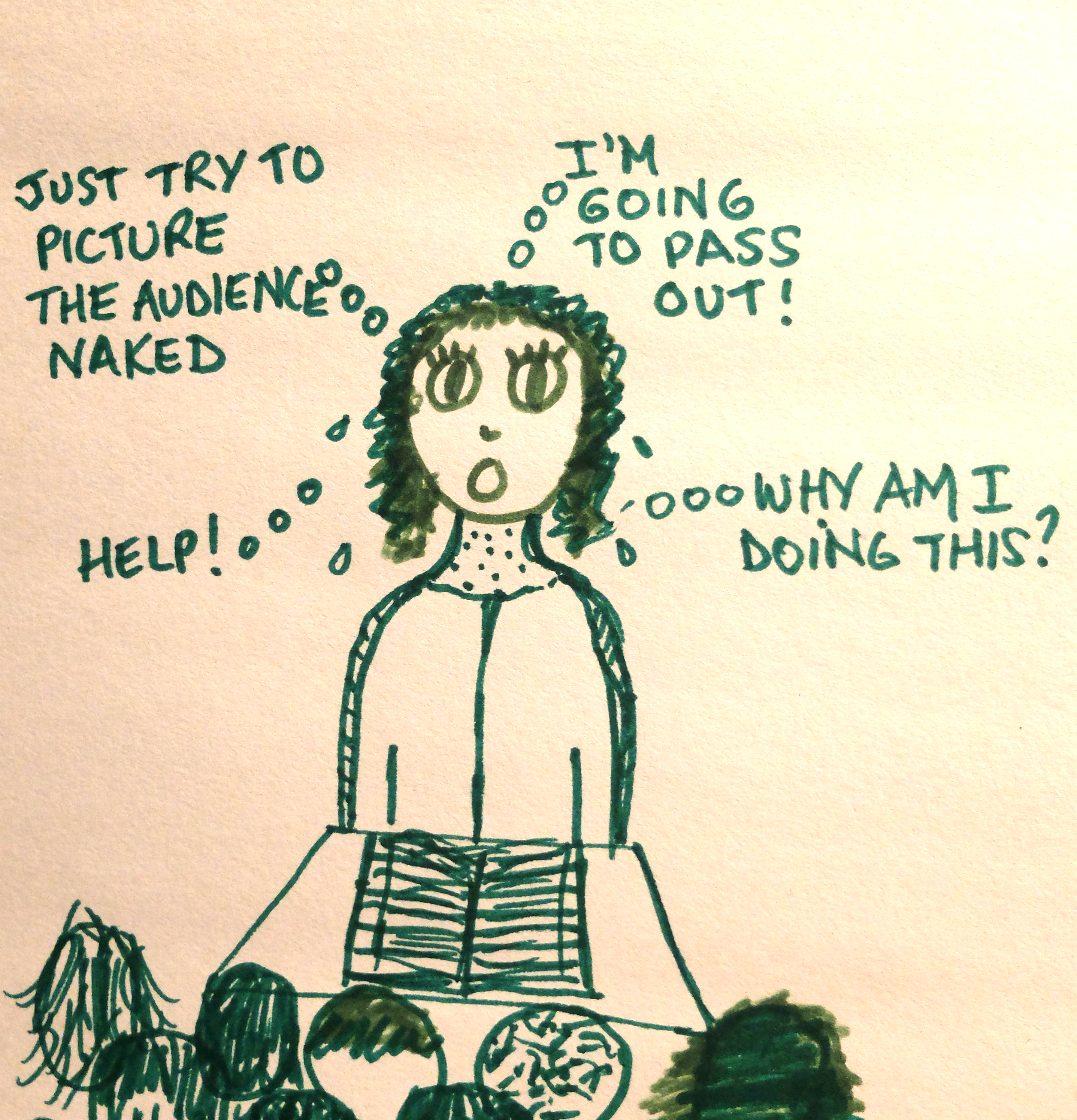
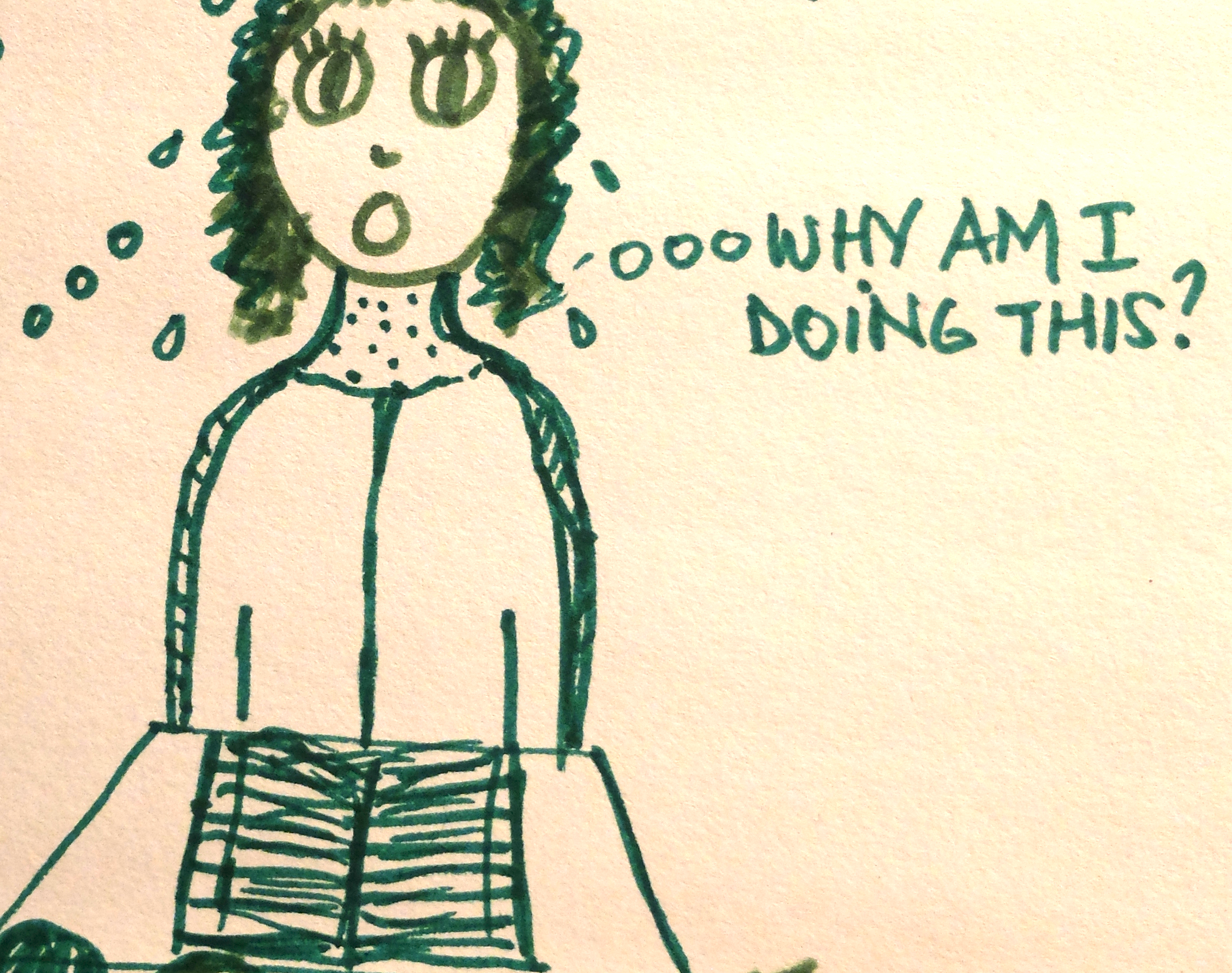
    *Embarrassment and Bloating Cartoon R. CohenUnlike the act of writing, which allows for the deletion of words before they’re read, speaking before a live audience isn’t as forgiving. There’s no delete button one can press to make oneself disappear.

    So, uncharacteristically, when one of my flash fiction pieces was recently published in the My Island, My City chapbook, I accepted the invitation to read it at a gala. Since proceeds from the event would benefit the QWF’s Writers in the Community program, I reasoned that service to the cause was far more important than my own aversion to public speaking.

    As I was about to leave the house on the night of the gala, my face suddenly bloated like a pufferfish, my neck erupted in itchy hives, and my nose bled. Apparently, my anxiety about the reading was manifesting itself physically.

    “How can you be nervous? It’s a flash fiction story that will take you forty-eight seconds to read!” my partner said after I’d gently dissuaded him from joining me. Why was I so nervous? I was honored to be involved in the charitable event!

    Then, when a roadblock prevented my cab driver from turning on de Maisonneuve Boulevard, he stopped the car. “Walk from here!” he firmly suggested. Too anxiety-ridden to protest, I passively agreed. The moment I exited the vehicle, a freak snowstorm hit. Within seconds, my freshly-coiffed hair was drenched.

    Along the closed street, massive pieces of concrete lay strewn about. People loitered, examining the detritus.

    Inspired by the scene, I compiled mental notes for a future work of fiction.

    I then realized that my imagination was partially to blame for my current state of anxiety—If not for my vivid imagination, I wouldn’t be compelled to write. If I didn’t write, I wouldn’t have to worry about giving public readings.

    After wiping a snowflake from my eye, I discovered that my black mascara and eyeliner were not as waterproof as advertised.

    Looking like a wet raccoon, I cut through Westmount Park, which was eerily desolate save for a lone teenaged boy smoking under a snow-covered gazebo.

    I paused briefly to scratch my hives.

    I reflected upon traumatic incidents from my past that contributed to my fear of appearing before an audience: during a figure skating competition in my teens, someone clapped after I completed a movement that was undeserving of applause. I scanned the audience, only to discover the culprit was my father. Distracted by his misplaced burst of applause, I fell. (Needless to say, I didn’t win that competition). From then on, I dissuaded (nay, banned) family members from attending any competitions or events that required me to appear in front of an audience. That longstanding ban has carried over to include my partner and friends.

    When a recipe of mine was included in a cookbook, I was invited to prepare it on live TV during a pledge drive to benefit public television. Nervous during the shoot, I momentarily lost my ability to speak and instead, flapped my arms in a futile attempt to generate words.

    Finally, I arrived at the gala venue. Soaking wet, freezing, hive-covered, my makeup smeared, my face bloated, and blood caking in my nose. While attempting to compose myself in the foyer of the church hall, I was shocked to see one of my friends enter the building. “Surprise!” she squealed upon seeing me. Moments later, another good friend showed up unexpectedly. Both explained that upon seeing my name in the ad, they’d reserved tickets to support me (and the cause)!

    Chatting with them, I gradually felt my fear dissipate. Believing that friends and family were stress-inducing distractions had been a mistake. The opposite was true! Their supportive presence was comforting.

    After my reading, I returned to sit with my friends in the audience, relieved that I hadn’t thoroughly embarrassed myself. Courtesy of the resulting adrenalin rush, I contemplated the advice of my writing mentors. I decided I would bravely endeavor to give public readings in the hopes of becoming an emerging writer.

    My thoughts were interrupted when one of my friends gently tugged on my sleeve.

    “Did you know that your sweater is on inside out?” she giggled.


    Pic. Cohen_Y. PelletierRenée Cohen is a freelance writer for numerous international charitable organizations. Her personal essays, prose, and flash fiction have appeared in Accenti MagazinePrairie Fire, Litro UK, The Globe and Mail, the Montreal Gazette, Reader’s DigestZvona i Nari’s ZiN Daily, Croatia, and in numerous volumes of the Canadian Authors Association anthologies, in the My Island, My City chapbook, and elsewhere. Her artwork has been exhibited in group and solo shows and featured in Montreal Writes Literary Magazine, Headlight 22, 3Elements Review, Spadina Literary Review, Flash Frontier New Zealand, and Sonic Boom Journal (India). She recently won The Fieldstone Review’s Banner Art Competition.

    Photo credits: Renée Cohen (header image); Y. Pelletier (headshot)

  • Dear Everyone I’ve Ever Known: Thank You. This Book Is Dedicated to You.—By April Ford

    Dear Everyone I’ve Ever Known: Thank You. This Book Is Dedicated to You.—By April Ford

    I’m two seasons away from the release of my debut novel. This will actually be my third book publication, yet there are elements of the publishing process that still intimidate me. Two I believe I’ve mastered by now are how to dedicate a book, and how to thank people who’ve helped me along the way—“mastered,” that is, until I start imagining how Person A might feel when she doesn’t see her name on the “Acknowledgements” page even though she treated me to coffee during a rough patch in my life, or when I finally admit I don’t want to dedicate my debut novel to my ex-husband even though, while we were married, I said I would.

    For all the slow writers out there like myself—and this isn’t counting the time it takes for a book to go through the publishing process—a lot can happen between the first and final drafts. It can be startling to see how these changes manifest on paper, especially if you’ve told someone you’re going to mention them in your book but you change your mind. So while you’re fantasizing about eloquent dedications and thorough acknowledgements (a fun and necessary exercise), why not keep a list to help you remember whom to thank and whom not to thank? There will always be someone’s name you add to the list and then remove. And then add again out of guilt. Seeing this name next to the ones you’re 100 percent certain you want to thank might clear your doubt. Update the list as needed, right up until the day your publisher asks for the final iteration. And do not to show it to anyone before your book is published. This is your list. Writing the book was your experience. You owe no explanation for why you did or didn’t thank someone, in the end.

    Being a writer means skillfully riding the constant waves of people’s ideas about what a writer is, does, and how we do it. For example, a past partner of mine used to urge me to write whenever I felt unhappy. He couldn’t seem to accept that it was the last thing on earth I wanted to do when I was troubled (it’s when I produce my most unsalvageable work), and he seemed truly dissatisfied by the fact that I don’t write every day. I wasn’t adhering to his vision of the writer’s life and how he might play a role in it—later to be thanked. It’s worth considering people’s motivations when you’re crafting dedications and acknowledgements. No matter how thoughtfully you execute those pages, there will always be someone who feels slighted for not receiving public recognition from you. While in your mind, all Person B did was occasionally ask you questions about the book you’d been writing “forever,” in Person B’s view, they supported you by expressing ongoing interest in your work (but mostly talked at length about themselves, their darling children, and their even darlinger Shih-Poo named Ackerly).

    Historically, the dedication page was a siren’s call to potential benefactors. Writers dedicated their works to significant public figures and sometimes even entire cities, with the goal of attracting funding for their future publishing endeavors. Today’s dedication page is more of a forum for displays of affection (“For my spouse and children: You are my life.”) or an opportunity for the author to give readers an intimate glimpse of their personality by acting as a micro-autobiography (“I dedicate this novel to my iguana, because why not?”). When it was time for me to dedicate my short story collection, my then-husband graciously helped me brainstorm (it didn’t make sense to dedicate the book to him, since I had started it years before we met). Together we came up with “for the poor children,” the title of the collection, which sets an ironic, somewhat glib tone—and as it turns out, I’m a somewhat glib person who uses irony to process the world around me.

    The “Acknowledgements” page is a demonstration of good literary citizenship. Here, you thank people by order of importance, starting with your agent (if you have one), editor, designer, publicist. Without these hardworking allies, your book would still be a MS Word file. You want to also mention sources of funding you received while you worked on the manuscript, public readings you gave from your book to be, extracts (poem, story, essay, chapter) that were published elsewhere, and peers who read and critiqued your work. Then you can start on that fantasy list you’ve been keeping! In the case of my forthcoming novel, I’m attempting to make amends for not dedicating it to my ex-husband by thanking him high up on the page, right after my publishing team and before everyone else. Were his feelings hurt when I first told him about my change of heart? Of course. We had a long conversation about it by telephone and this was when I gained a deeper appreciation for the responsibility that comes with writing dedication and acknowledgements pages: they’re meaningful and symbolic not only to the author but also to those mentioned—and to those not mentioned. 


    Nicolas01April Ford is a genderfluid author living in Montreal, Quebec with her rescue family. Her fiction, poetry, and essays have appeared in print and online journals in Canada, the United States, Mexico, Germany, and Scotland. She is the recipient of a Pushcart Prize for her short story “Project Fumarase,” and has held fully-funded residencies at Virginia Center for the Creative Arts and Ucross Foundation. Her books include Death Is a Side-Effect: Poems (Frog Hollow Press, 2019) and the award-winning story collection, The Poor Children (SFWP, 2015). Her debut novel, Carousel, is forthcoming in Spring 2020 with Inanna Publications. www.aprilfordauthor.com

    Photo credits: “Cliche: Have a Heart”by Carol (vanhookc) is licensed under CC BY-SA 2.0 (header image); Bernardo Fernandez, Verdun, Quebec, 2019 (headshot)

  • Writers: The Truth Can Set You Free—By Tamara Jong

    Writers: The Truth Can Set You Free—By Tamara Jong

    Ma was so many things; a Jehovah’s Witness preacher, an alcoholic with a troubled past, and an avid reader, poet, and writer. When she was sober she was engaged, a bright star in our neighborhood and religious community. But then she was also a yeller: when she kicked her sisters out of her life, she literally cut them out of any photos she had. Ma would punish me because I chatted in class, ate pumpkin seeds during Halloween, and was sent to the corner by the teacher. Lying wasn’t an option to save my own hide.

    TamaraJongreadingyouth
    A younger Tamara Jong.

    I escaped by reading fiction. Little Bear by Else Holmelund Minarik was an early favorite for me. In the first set of stories, little bear’s mum makes him clothes when he is cold and throws him a birthday party. Nine-year-old Pippi Longstocking took me on all her adventures with her monkey Mr. Nilsson on the South Seas. Although she was parentless, she seemed resilient and nothing could stop her. I related to A Wrinkle in Time’s Meg: she never seemed to fit in anywhere and was devoted to her father; my dad was my idol until Ma kicked him out for his infidelities. I moved on to the worlds of the Brontës and Austen, where I felt safe and where the ending always seemed to work out. I would write and draw pictures of my stories and plays. There was no such thing as writer’s block.

    My first attempt at writing fiction as an adult came under the guise of autobiographical fiction. I mixed up truth and fiction so no one would know that it was mostly me I was writing about. My story was about Keaton, a suicidal fourteen-year-old. Keaton’s angelic mother worked all the time, made a hell of a bunch of tea, and didn’t really know her kid or see her for who she was. Keaton wrote lousy poetry, had a bestie, and obsessively liked a boy named Josh. She ended up getting help after being hospitalized, taking anti-depressants, and undergoing extensive therapy. I wrote it after my own stint in the hospital after a suicide attempt. But there were truths missing in the story that I couldn’t write down yet. I made the father the alcoholic and the mother a loving TV mom, a cardboard cut-out of a mother. There was nothing about religion anywhere. Then I got stalled and didn’t work on it.

    Things didn’t really click for me until two year later, when I decided to try out a non-fiction writing course with Ayelet Tsabari. God, she made me fall in love with it. I wrote and wrote and wrote. I couldn’t stop. The words came easier than in fiction for me. The only things that interfered with my writing were my day job and sleep. Ayelet introduced me to her stories and so many other great diverse writers and made me realize that there were so many ways to spin a story.

    I took a second course with her, and then another. It was the first time I had written about being a Jehovah’s Witness and my parents, my siblings, and our lives. Once I had a taste for non-fiction, I didn’t want to let go. I started reading less fiction and more non-fiction. I submitted to contests and literary magazines, and revised my stories. When my creative non-fiction piece, “Father Hallowed Be Thy Name” got accepted at RicepaperMagazine, I was ecstatic. Ayelet encouraged me to write a memoir. I had only started writing non-fiction in her classes and she believed in me! Something had started shifting for me.

    In an earlier creative writing class, I had written fiction about a Catholic girl who got pregnant, a dog called Jehovah, and Medusa. Nothing was really wrong with those stories but they lacked a depth of what I really wanted to say. They were starting points that were necessary for me to get where I had to go. Testing out the waters until I could go in myself, immerse myself in the work.

    I realized I had been hiding behind fiction so no one would know about my real life and who I was. What if others judged my life choices or no one wanted to read my stories, or they thought that I had nothing original to say? I was terrified of people’s reactions. I had been so good at hiding my trauma. When I was penning fiction, I could take those risks. After all, it was imaginary. No one would ever know it really happened.

    When I shelved the idea of writing a fiction novel, non-fiction stories emerged in its place. I’ve been working with them for months now, reading them, revising them, losing and finding Ma, collecting our stories together. Non-fiction freed me to tell my real-life story on the page in a way that fiction couldn’t. When I was growing up fiction had protected me by letting me escape in stories, to live another’s narrative.


    Tamara_Jongph_Photo_Credit_Charles _MarschuetzTamara Jong is a Montreal-born mixed-race writer of Chinese and European ancestry. Her work has appeared in Ricepaper, Room, carte blanche, The New Quarterly, Invisible Publishing, and Body & Soul: Stories for Skeptics and Seekers. She is a graduate of The Writer’s Studio (Simon Fraser University) and recently had her piece “Thanks for All the Lice, Pharaoh” longlisted in The New Quarterly’s 2019 Edna Staebler Personal Essay Contest. You can find her on Twitter @bokchoygurl.
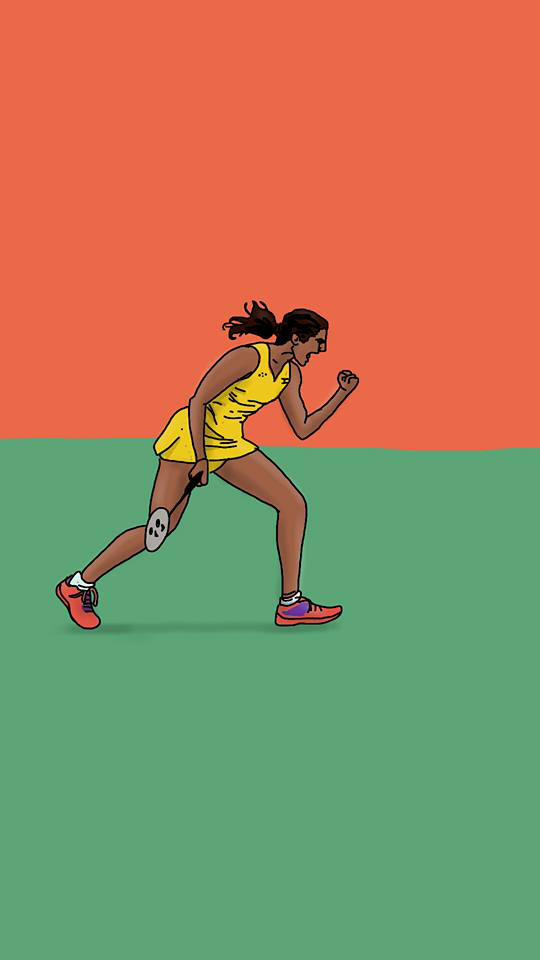
    Photo credits: Tamara Jong (header image); Charles Marschuetz (headshot)

  • To Write Well, Learn from the Badminton Court—By Pascale Duguay

    To Write Well, Learn from the Badminton Court—By Pascale Duguay

    “Don’t rush your serve,” I called to an enthusiastic senior student during our badminton match.

    “But Miss, I can catch people off guard this way.”

    “Don’t rush your serve,” I insisted.

    “But Miss, I’m ready!”

    “No, you’re not. Your feet are still moving. You’re off balance. Your shot is off. You’re not focused.”

    A glare. An audible sigh.

    I could tell she wanted to tell me to mind my own business and go back to the library where I belonged, but I stood my ground.

    Most of the high school students I see on a daily basis don’t think of me as anything more than their librarian. I totally get that, since I used to be a teen. When I impulsively asked the coach if I could join the kids at practice, I didn’t know if my body would be up to the challenge, but I allayed my fears by telling myself that even if I couldn’t perform at the level of my youth, I could at least share some of the dusty bits of knowledge stored in my brain. Even though I had not played badminton seriously in at least twenty years, I still remembered how to hit a proper serve.

    “Don’t rush your serve,” I repeated again and again throughout our match.

    What my opponent didn’t know was that I needed the reminder as much as she did. In the heat of the moment it’s easy to get carried away, to want to speed things along. Although badminton is a fast sport, it’s not about rushing. It’s about being in control—of yourself, not your opponent. If you can control yourself, you can dictate the pace, the direction, the energy, the flow, and eventually the outcome. And it all starts with your serve.

    That night, as I checked my alarm clock, I was tempted to set it for later than usual to give my aching muscles a couple of hours of extra rest. But that meant I would have to skip my morning rituals. As I pondered the pros and cons, I realized that my writing life also needs a solid foundation. It can’t get off to a good start if I don’t first make sure everything I need is in place. For me, this means starting my day at 5:15 so I can do my morning pages à la Julia Cameron. I use this moment to cleanse my mind as I write down everything that enters my head, from the most mundane (I need to stop by the post office after work), to the most brilliant flashes of genius (I could write an essay about badminton). No matter where my thoughts begin, they inevitably point me to how I can best use my writing time later on.

    As I scribble away, I underline important thoughts and ideas so I can easily find them again when I review my musings. Three full pages later and I feel like a brand new me, ready to face the day and with my mind open to any guidance I might receive from my muse or fellow earthly beings.

    When my three pages are done, I move on to my workout. In a way, it’s the physical equivalent of my morning pages. It helps me stay grounded and strong so that I have the energy I need to write in the evenings.

    Once these two things are taken care of, I can start my day fully in control. I know what I wish to achieve and the path I will take to get there, while feeling confident that I will have the stamina to see it through. Just as preparing for the serve lays the foundation in badminton, my morning rituals stop me from blindly rushing into the day. They help me stay on course so my writing doesn’t get permanently buried under the day’s demands and distractions, but can resurface when the time finally comes for me to grab my writing tools and let the words fly.


    Pascale Duguay

    Pascale Duguay is a freelance writer, high school librarian, and translator (French/English). She resides in the lively bilingual community of Quebec’s Eastern Townships. Pop in for a visit at pascaleduguay.com, where you can sign up for her sporadic but fantastic newsletter on the writing life.

    Photo credits:
    “Olympics 2016 Sindhu”by chaitanyak is licensed under CC BY-NC-SA 3.0
    (header image); Jennifer Brown (headshot)


  • The Circle of Mentorship—By Shelagh Plunkett

    The Circle of Mentorship—By Shelagh Plunkett

    Linda Kay—author, journalist and teacher—died last October. In 2006 she was assigned to mentor me by the Quebec Writers’ Federation, and in the twelve years that followed became a great friend as well as remaining a generous-hearted and gracious advisor. In the months since she died, during the hundreds of times I’ve missed being able to email or call her, I’ve thought often about what I’ve lost without her in my life and what I learned from having her in it. Perhaps most importantly, Linda showed me how essential mentorship is for a writer.

    Linda Kay
    Linda Kay

    Linda’s achievements as a writer and teacher were impressive (including no less than a Pulitzer won as part of a team early in her career), but recording them here would leave nothing more than a superficial sketch that failed to convey who she was. Similarly, outlining the empty space that her death has opened in my life would leave a hollow impression of our friendship. I’m left wanting to convey one of the most important things I learned from Linda: that mentorship is essential for a writer.

    When I moved to Montreal, I joined the QWF to meet writers. I applied to the mentorship program and was introduced to Linda. The first time we met she brought the essay I’d submitted with my application—a short piece about growing up in Guyana, in South America. “Send this in to the CBC Literary contest,” she urged me.

    I’d written it in a flurry of frustration one afternoon. It was the sort of writing I wanted to do but was unlike anything I’d ever tried, because it was not the kind of piece my freelance clients were interested in publishing. I didn’t know if the piece was good or bad, but I’d had fun writing it. Linda was adamant, so I took her advice.

    She was right; the essay won the CBC Literary Award for creative non-fiction. Linda told me my life would change, and it did. With that award to reflect on and with her encouragement, I began to think I could write more than just simple news pieces, arts profiles, or lifestyle columns. I began to think I might have the chops to string a few words together that might have a deeper purpose, that might offer something more to a reader than a few minutes of entertainment. Linda suggested I approach publishers. “They’ll pay attention to you now,” she said. She was right. Penguin signed a contract with me and my memoir of adolescence overseas—born out of the essay I’d written—was published in 2013.

    In the years that followed, Linda continued to inspire me to take the work of writing seriously, because that’s what she did. She applied all her skill, insight, and effort to everything she did, from writing to teaching to friendship; to every assignment, be it a book or a short piece for Costco Connections. Ultimately, what we try to do as writers is communicate. Linda showed me that without giving one’s full passion, focus, and commitment, communication isn’t worth the effort.

    Linda didn’t tell me she was sick until quite close to her death, but in her last months we wrote often and our conversations continued to ramble around writing, family, new and old loves, life. She remained as she’d always been, even in our last correspondence, an email sent less than a week before her death from her hospital bed. Linda wrote that she’d passed on my name and the title of my book to a Guyanese intern she’d met, encouraging the woman to seek out my writing. Right to the end, Linda remained a supporter and mentor.

    It is not an exaggeration to say I would not be a published author, and would not be writing still, if not for Linda. And now, things have circled back for me: I’ve been hired by the QWF to fill the role for someone else that Linda did for me when we first met. As I key these words, I am embarking on three months of mentoring a promising writer in our community. Though I miss Linda immensely and often, I’ve not lost the gifts she was lavish in bestowing. I will turn to my memories of Linda now and into the future, knowing that by doing so I’ll be motivated to achieve much more than I imagine myself capable of. More significantly, her memory will inspire me to pass on to my mentee what Linda gave me as a mentor.


    ShelaghPlunkett_photocredit-NiamhMalcolmShelagh Plunkett is a past winner of the CBC Literary Prize for creative non-fiction. In 2013 her memoir, The Water Here is Never Blue, an extension of her winning essay, was published by Penguin Canada. It was shortlisted for both the QWF Mavis Gallant Prize for Nonfiction and the QWF Concordia University First Book Prize. Shelagh now lives in Montreal, where she is at work on too many projects. Her past hometowns have included Georgetown, Guyana; Kupang, Timor; Vancouver, Victoria, and Toronto; Ricón-de-la-Victoria, Spain; and Salt Spring Island.

    Photo credits: Flickr (header banner), Courtesy of Emily Kay-Rivest (photo of Linda Kay), Niamh Malcolm (headshot of Shelagh Plunkett)