Tag: writing

  • Slow Writing by Chris Galvin

    Like bread dough, my writing seems to require time to rise in a warm, draft-free place. The long proofing period is necessary; turn up the heat to hurry the rising, or don’t leave it long enough, and I get a stodgy, dense loaf.

    Under ideal conditions – solitude, free time and excitement about what I’m writing – the words pour forth quickly. It’s exhilarating. But normally, I write when I can. I like to have control over an essay or story as it forms, and I edit as I write, considering each sentence as I put it to paper – does it say what I want it to say, or does it imply something else? I read what I’ve written aloud – does it have the right rhythm?Is my translation of Vietnamese dialogue as true to the original as possible? Does it sound natural?

    The second proofing of the dough is as important as the first. Even when the writing happens quickly, I know from experience that it’s best to put it away overnight before taking another look at it, and then to put it aside again for at least a few days, or better yet, weeks. Sometimes it takes years. My essay Floating Life began as a food and travel vignette about visiting a family in the Mekong Delta. It worked, but it was bland. The recipe was missing something.

    Chris bakes muffins too

    I kept looking for directions in which the essay might develop. I didn’t find the core of the piece, the defining ingredient, until a few years later when a friend read it and asked me how flooding in the delta affected the farmers. Coincidentally, I was reading about how the delta is one of the areas most adversely affected by sea level change in the world. I realized that this was what I wanted to write about. The words flowed and the essay doubled in length. The anthology that was to publish it, Foreign and Far Away, limited submissions to 1,200 words, but time had given me the distance to recognize that some of my words added nothing and stole space from important details. Rereading my essay with fresh eyes, I was able to see what needed to be added or culled.

    Sometimes, the needed words, the mots justes, can be stubborn. They elude me; they won’t be forced out. I need almost as much time away from a piece, not writing it, as I need for writing it. As with a crossword puzzle, I put it away for a while, think of something entirely different, walk by the lake or try out a new recipe, and suddenly, the words come to mind.

    When I’m struggling with a piece, wondering if it will ever be ready, I remind myself that the long proofing time that frustrates me so much is often just what my essays need to rise properly, to develop their best texture and to emerge from the oven tempting and toothsome.


    Chris Galvin divides her time between Quebec and Việt Nam. She writes mostly about food, travel and nature, and sometimes pens short fiction. Her writing and photography have appeared in various anthologies and literary journals, including DescantPRISM InternationalAsian ChaThe Winnipeg Review, and others. She has written in Vietnamese and English for several Vietnamese publications. Chris is currently working on a collection of essays about living in Việt Nam.

  • Writing Post-Partum by Darrah Teitel

    I have this memory that I can’t shake. It is from a time of rebellion. I was in university, a baby feminist, aspiring playwright and general know-it-all. I was listening to Tori Amos’s latest album, Scarlet’s Walk, written post-partum. It stank, I declared to my roommate. Tori had lost her edge. She was writing about domestic themes, instead of masturbation and hating God. I began cultivating a theory: babies killed the cool in female artists.

    A few years later, I was in Montreal studying playwriting at The National Theatre School and Maureen Labonté was giving a class on this Canadian playwright none of us had ever heard of, Gwen Pharis Ringwood. Ringwood had written the award-winning Still Stands the House before getting married in 1939 and having four children. Although she continued to write, her main commitment, until the 1970s, was her family. A mother herself, Maureen raised her eyebrows at me. She knew it would plague me. The next few plays I wrote were explorations of why maternity and feminism were incompatible. I wrote one play about the contempt that ambitious, public women have for maternal, domestic women. I wrote another about how cool and sexually experimental Mary Shelley was before she accidentally had babies. And then, because I had tempted fate, I fell pregnant myself.

    And then, because I had tempted fate, I fell pregnant myself.

    What I knew of parenthood was that it is exhausting; I’d be harried with responsibilities but also full of joy. Though I wished this joy for myself and ultimately chose it, a fear began to grow alongside my fetus. I had learned that in order to write, a girl needs time, money and a room of her own. But I work for the federal Status of Women Critic, and I know the statistics. They show that the gender wage gap grows exponentially as soon as women become parents.

    Even if I tried to ignore the socio-economic barriers, I couldn’t help but notice the interpersonal ones. Many of my childless friends stopped inviting me to hang out, just assuming I was never doing drugs or having hot sex again. The fact that these assumptions were largely correct for the time being didn’t make them less upsetting. I found community elsewhere, which is to say online. One third of the blogosphere is composed of mommy blogs. Many mommy bloggers are really good writers who are totally obsessed with the experience of motherhood. They made me feel less lonely and for that I am thankful. I’ll digress to note that there is no daddy blogosphere.

    When I became a parent, I discovered that there is a fourth thing a girl needs in order to write. She needs something to write about. The greatest threat to my writing career was actually myself, or loss thereof. My plays usually discuss liberated feminine bodies, and they make my parents blush from their seats in the audience. Since having my son, I can’t even watch upsetting scenes from Game of Thrones without covering my eyes. I am not who I used to be.

    The greatest threat to my writing career was actually myself, or loss thereof.

    It’s hard for me to admit that I’ve changed. I’m not sure that I’m okay with it. But now, for the first time in two years, I have managed to get the time, money and space to write. I have a residency at a supportive theatre company, and my wonderful boss is willing to give me some time off to write. These opportunities are essential to writers like me, and are also so infrequent that I feel like the luckiest girl in the world. That’s three out of four. As for number four, it’s coming. I find myself faking it a little, but starting to feel glimpses of the real thing. Like learning to have an orgasm with a new partner, I must familiarize myself with a new body and for the first time, the new body is my own.

    I have come to realize that there are women with small children working, writing. When I was at rehearsals for my play, The Apology, I had a nursing five-week-old in a sling. Joan MacLeod came up to me and welcomed me to the club. On Mother’s Day she sent me a section of Kim Collier’s Siminovitch Prize acceptance speech from 2010: “In a lot of ways I felt like a pioneer – creating ways for these two huge commitments to live together. And I believe one of the great gifts Jon and I gave to our theatre community was an example that it was possible, that family can be the centre of your life while your theatre work is too. To all women director/creators with children: bravo, be brave and break the mould – carry them in the hall, breastfeed between the seats, go on tour together, whisper about process and actors and what worked and what didn’t. Include your kids in your life, let them learn from your passion.”

    And so this is where I am at: I have vowed not to confuse first words or breastfeeding with interesting material for plays, and this article is the closest I plan to come to mommy blogging myself. But I’m writing through my fears. And sometimes, I even write about the kid.


    Darrah Teitel is a playright and graduate of the University of Toronto and the National Theatre School of Canada’s Playwriting program. Her plays have been produced across Canada and her journalism, fiction and poetry have appeared in various periodicals and journals throughout the country. Darrah’s play Corpus is the winner of the Calgary Peace Play Prize, the In The Beginning Playwriting Award and the 2011 Canadian Jewish Playwriting Award. Her play The Apology was nominated for the Dora Mavor Moore Award and the Betty Mitchell Award for best new play. The Apology won the Calgary FFWD Audience Choice Award for 2013. She was a member of the Banff Playwrights Colony in 2007, 2011 and 2012, and was a 2010 MacDowell Colony Fellow. Darrah is currently the playwright-in-residence for the Great Canadian Theatre Company and is working for the NDP Status of Women Critic. Corpus will be produced by Teesri Duniya Theatre in November 2014 in Montreal.

  • I Do Not Write Alone by Gina Roitman

    Some people maintain that writing is a lonely business. In my experience, that’s not necessarily true. When I sit down to write, I am joined by a crowd of internal negative voices: the infernal censor, the cranky critic, and the whiner who keeps reminding me of all the other things I could or should be doing.

    About once a month, however, I escape that crowd when I meet with my writing group to refresh my creative energies. I am not alone in this pursuit. Read the acknowledgements of first-time authors and you’re likely to find shout-outs to the people in their writing groups. For the past ten years, I have been a member of a critique group that meets to break bread, gossip, and review current work. It was with the help of this group that I crafted many of the pieces which appear in my book of nine linked short stories, Tell Me a Story, Tell Me the Truth.

    The original group, which we eventually dubbed MontrealWrites, first met while taking a QWF workshop given by Ami Sands Brodoff. Ami laid down the rules for critiquing that we use to this day. Over the years, we have acknowledged our good fortune at coming together as we did. It was one of those remarkably synchronistic occasions: people of like minds but different talents found themselves, over the course of two months, sitting in a room together for two hours a week.

    When the workshop session ended, eight of us did not want the experience to end. We had found a pleasant camaraderie despite the differences in our ages and styles. Initially, we thought we’d need a fearless leader to guide us but soon realized that we had all the skills and experience we needed. Some of us were good at analyzing the themes while others were meticulous about storylines.

    In our original group, we had mostly short story writers as that was the focus of the workshop we had signed up for. However, as some members moved away or moved on and others came in, many of us explored other genres including children’s stories and picture books, personal essays, travel writing, screenwriting, poetry and, of course, novels.

    Why does our group dynamic work so well? We are all blessed with a general lack of ego and we have ‘grown up’ together as writers. It is the love of the process, I believe, that nurtures our commitment to each other. As a result of reading so much of each other’s work, we have formed a collective memory from which to draw on when discussing any new work.

    Elizabeth Ulin could be our poster child. Her story exemplifies how the influence of the group comes into play. She wrote a short story geared to middle grade children starring a young girl named Mitzi and a host of spiders. The group became so enamored with Mitzi that we suggested Liz might want to expand the short story to book length. In the end, she was accepted by the QWF Mentorship Program and turned Mitzi’s story into a screenplay. Elizabeth has now adapted three of her pieces for presentation at Centaur Theatre.

    In my case, when a publisher indicated interest in my work, I made certain to have the group vet the material I had selected before sending it off. Their input was invaluable in keeping the linked stories relevant and on track.

    The members of MontrealWrites continue to evolve as writers as well as friends. We work well as a team. We organized, publicized and orchestrated two public readings with great success. And even now, through all the exigencies of life – births, weddings, work deadlines and far-flung travel – we find it hard to let go of each other.

    How we have grown together and challenged each other, and what we have accomplished as individuals as well as a group, give the lie to the “lonely-business” theory.


    Gina Roitman is a writer, editor and author of the acclaimed short-story collection Tell Me a Story, Tell Me the Truth, and the co-producer, co-writer and subject of the award-winning documentary My Mother, the Nazi Midwife and Me. www.ginaroitman.com

    Learn more about MontrealWrites by clicking here. MontrealWrites will be celebrating their 10th anniversary with readings from most of the group members at the next QWF membership schmoozer in May 2014. Date TBA soon.

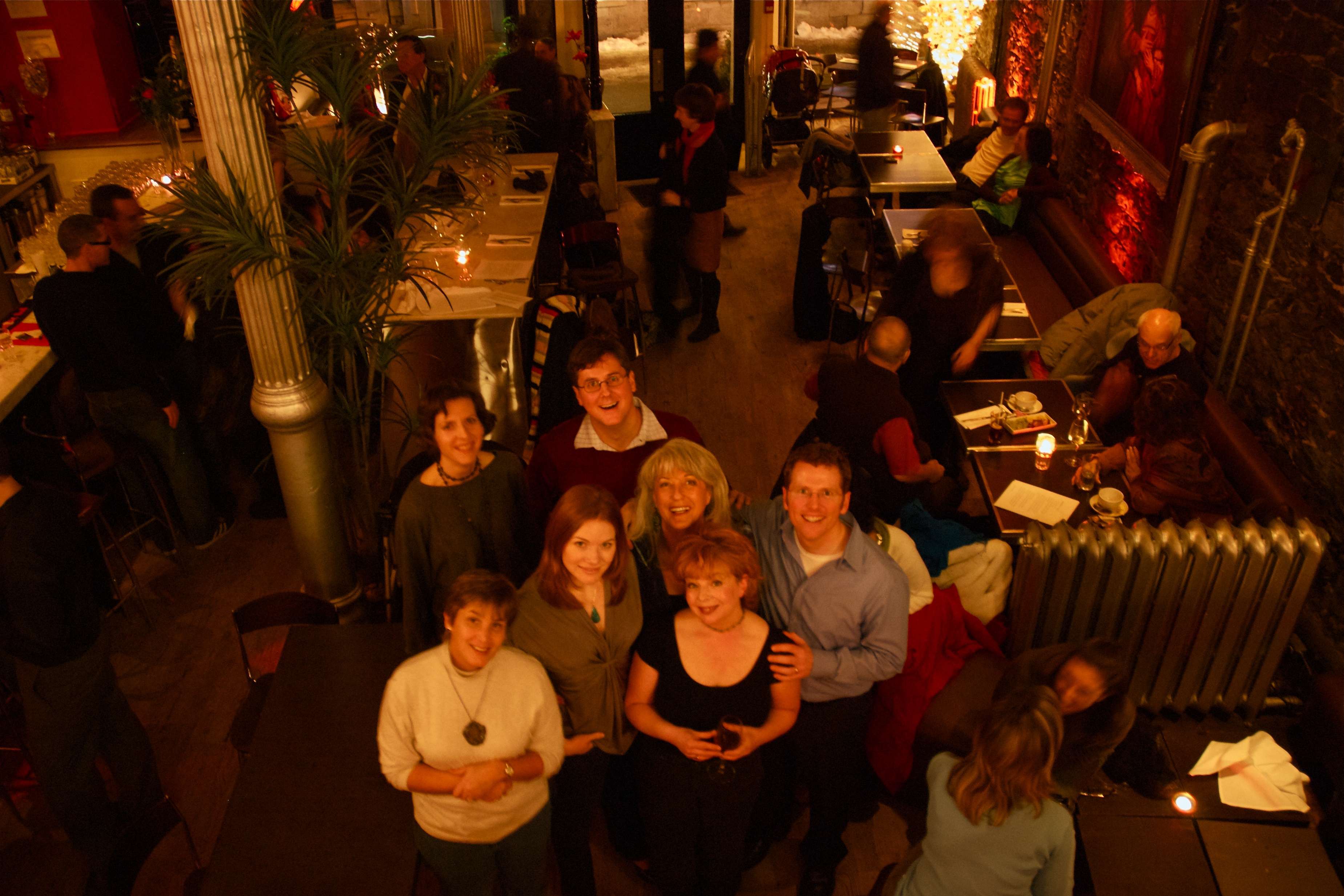
    Pictured from left to right—Front row: Elizabeth Ulin, Sarah Lolley, Gina, Maggie Kathwaroon and Paul Edmond Robichaud; Back row: Jane Affleck and Derek Webster.
    MontrealWrites
    Pictured from left to right – Front row: Elizabeth Ulin, Sarah Lolley, Gina, Maggie Kathwaroon and Paul Edmond Robichaud;
    Back row: Jane Affleck and Derek Webster.

    Do you write alone? Is writing is a lonely business?

    Have you been part of a writing group? Why?

    Not in one yet? Do you want to be?

    QWF would be happy to help bring together people who are eager to start/join a writing group. Please contact Lori at admin@qwf.org if you’re interested.