Tag: writing

  • Hello Baby, Bye Bye Books by Mike Steeves

    Hello Baby, Bye Bye Books by Mike Steeves

    Man holds baby while reading a book

    My daughter was born on August 25, 2014, and during the interminable lead-up to her birth I was, like all new parents, subject to a deluge of unsolicited advice, warnings and thinly-veiled threats from family, friends and complete strangers about what I could expect as a new parent. One of the warnings I heard most often was that the time I had for reading was going to be severely curtailed.

    Maybe my friends didn’t appreciate how dedicated I was to my routine, because I soon discovered that it was actually pretty easy to carve out the three hours I needed in order to stay on top of the steady stream of books that I had begun purchasing early on in my wife’s pregnancy as a way of offsetting my anxiety over not reading enough.

    For starters, I used to bike to work. But once I realized that I could eke out at least forty minutes of reading on my daily commute, I started taking the metro to work, thereby forgoing the last form of physical activity I practiced with any sort of regularity.

    Another threat to my reading habit was the immense amount of time required to help my daughter sleep. Newborns spend a lot of time sleeping, but they are notoriously bad at it and require assistance (referred to as ‘soothing’). This basically amounts to walking the streets of your neighbourhood with your baby stuffed into one of those obnoxiously priced “carriers.” Once I was over the new-dad jitters and was no longer trying to impress passersby with the baby I had strapped to my chest, I got into the habit of doing laps around the pond at Parc Outremont while reading from a book that I held in front of me. I made my way through Michael Hamburger’s translations of Paul Celan this way, and while I typically have little memory for poetry, many lines from this work are now frozen in place, triggered every time I pass a fountain or leafless tree. And one of the most memorable reading experiences of the last few years is the time I spent on a cold bench at Parc Saint-Viateur with my daughter sleeping in the carrier as I read the final pages of Peter Handke’s A Sorrow Beyond Dreams while kids dressed up as penises made their way to Halloween parties.

    Happy Halloween

    ” …the time I spent on a cold bench at Parc Saint-Viateur with my daughter sleeping in the carrier as I read the final pages of Peter Handke’s A Sorrow Beyond Dreams while kids dressed up as penises made their way to Halloween parties.”


    My aforementioned friends, the ones who warned that I would have to sacrifice my love of reading to my role as a new dad, were also an enormous tax on the time I had for reading. By refusing dinner invitations, birthday party invites, brunch for babies, etc., typically blaming my absence on my daughter, I was not only able to keep up my reading schedule, but, after I had refused enough of these kind invitations, they no longer came in with any regularity, which also spared me the enormous time-suck of responding in a considerate manner something to the effect that “I would love to! But…”

    While it turns out that my friends were wrong about finding the time to read, there is one aspect of parenthood they were right about, but that I’d never taken very seriously: I may still manage to find a comparable quantity of time, but the quality of that time has been seriously degraded. I can sit for hours with Knut Hamsun’s Pan in front of my face, but I regularly find myself rereading the same line over and over again. Or an hour passes and I don’t even make it to the bottom of the page I started on. I’ve managed to read an impressive number of excellent and difficult works, but I’ve hardly retained anything. Within a week or so of finishing a book, I even struggle to remember what I had just read (except for the Celan). So while I have plenty of time to read, I can’t maintain the level of focus and attention I had in my pre-paternal reading sessions.

    Which brings me to the final obstacle to my reading habit – writing. Before my daughter was born I used to try to write at least a few lines every night, but even this small commitment now seems to take an inordinate amount of time away from doing the thing that I really enjoy (it would be quite a stretch to say that I enjoy writing). On account of the soul-wearying exhaustion I feel at the end of every day, I find it pretty easy to excuse myself from writing for the night and to settle into a good book. And by “settle into a good book” I mean “read the same line over and over again until I eventually pass out on the couch.” My friends say that it’s perfectly natural to neglect my writing for the next year or so, and that eventually I will find the time and energy to start up again. I hope they’re right. Goodnight moon.

    Bookjacket_M Steeves

    Mike Steeves lives with his wife and child in Montreal, and works at Concordia University. Giving Up is his first full-length book of fiction. Connect with Steeves on Twitter @SteevesMike.

    Photos: Via Flickr; no changes made (top); Mike Steeves (Halloween); Nikki Tummon (headshot)

  • Bye Bye Darlings: The Editing Gauntlet by Alice Zorn

    Bye Bye Darlings: The Editing Gauntlet by Alice Zorn

    Farine Five Roses
    Alice Zorn’s new novel, Five Roses, is named after the FARINE FIVE ROSES sign that marks the southwest horizon of Montreal and Pointe St-Charles, where the novel is set. Photo: Alice Zorn


    You’ve finished your novel manuscript and you even – finally! – get a publisher. It took ten years. You have Neanderthal muscles across your brow from frowning at the computer screen. But now you’re home-free. Bingo!

    Then you get the first slew of comments from your editor. She’s the objective eye who sees what the book can be, but isn’t yet. Does it begin in the best possible place? Is there too much exposition? Does it have structural integrity? What about the ending? She tells you all the darlings you cherished while you were writing don’t belong unless they serve the book. The clever turns of phrase, the crisp dialogue, the research that shows off your erudition, the quirky events that really happened. Your clean manuscript pages are tattooed with strokes and question marks. Some editors slash with red pen. I’m so glad mine used pencil.

    With my first novel, Arrhythmia, I was advised to lop two main characters, cut ninety pages and replace them with new writing. I couldn’t believe it. Hadn’t the publisher already accepted the book? My editor was firm. I had to learn how to rethink developments in the novel as narrative choices. I reminded myself that my editor, like me, only wanted what was best for the book. After all, she brought the manuscript to the acquisitions table, arguing that – out of all the other manuscripts being vetted – mine should be published.

    I rewrote those ninety pages because I realized the change was structurally necessary to the novel. And I rewrote them, yes. My editor didn’t tell me what to write, only that the direction I’d originally taken wasn’t the best option. However, I did not lop those two characters. I made them stronger and more integral to the novel. Writing the novel was hard, but editing it might well have been the more profound learning-about-writing experience.

    “Writing the novel was hard, but editing it might well have been the more profound learning-about-writing experience.”

    My second novel, Five Roses, will be published by Dundurn Press in 2016. I’m at the copy editing stage now. This is the finicky time when syntax, word choice and punctuation come into question. I open the document and scroll through 320 pages with red commas added, words underlined and lassoed to dialogue bubbles. Individual words are highlighted in yellow. A character is cycling along a city street, alert to the nervous rush hour traffic, as she thinks about the police sending out an alert to catch a criminal. I swear at myself for not having noticed. I must have read this page twenty times already! But my brain was in a groove. And as I’ve repeatedly witnessed, my brain is willful in its fondness for repetitions, internal rhymes and alliteration.Now, too, is when I discover that grammatical niceties aren’t as ingrained as I assumed they should be after five decades as a voracious reader. Shouldn’t I simply know all these distinctions by now? Seems not.

    And so I learn that there’s a difference between hanged and hung when it refers to a human body that is being put to death. I hung a picture on the wall. The executioner hanged a man. However, a human body that was already dead hung from a hook. I need to know that for this novel, since a character was hanged.

    6777082592_d2ba71334d

    I had to teach myself the farther/further dance after having worked with a copy editor who changed all my farthers to furthers. He thought further sounded more posh. Fine, I thought. He’s the copy editor. Maybe it’s one of those UK vs US things. For a couple of years I banned all farthers from my writing. Then I had a story returned from a copy editor who had changed some of my furthers to farthers. That was more curious. I finally pulled a tome of grammar off the shelf and discovered there’s a rule. Farther is for physical distance. Further is the abstract concept. You might think that I would already have known this, but I didn’t. And I’m not the only one. I continue to see farther and further misused in books published by reputable houses. (If you want a trick to remember which to use when, think far > farther. Thank you to Carol Weber for this tip.)

    You aren’t the best judge of your work, because you’re too close to the writing.You need an editor. Not your partner nor your best friend, who won’t want to hurt your feelings, but an experienced and discerning professional who will help you realize the full potential of the book.

    I’m now at the last read-through before Five Roses goes to the design people. I’ve rewritten the manuscript three times since I thought it was finished in 2013. Cutting, puzzling, moving pages around. Lots of darlings sent marching to the recycling bin. At each stage of editing, the book becomes more of an entity that lives separate from me. Which is what it will have to be when it’s sent off into the world.


    for QWFAlice Zorn’s book of short fiction, Ruins & Relics, was a finalist for the 2009 Quebec Writers’ Federation McAuslan First Book Prize. In 2011 she published a novel, Arrhythmia, with NeWest Press. She has twice placed first in Prairie Fire’s Fiction Contest. Her second novel, Five Roses, will be published with Dundurn Press in July, 2016. She lives in Montreal and can be found at http://alicezorn.blogspot.ca

  • Busting the Myth of Work-Life Balance by Susan Olding

    Inside the Cardinal Studio, one of the Leighton Studios at Banff Centre for the Arts.

    About a year ago, I was invited to give a talk to some graduate students at Queen’s University about what was billed as “work-life balance.” Sure, I said. Why not? That should be easy.

    There was only one small problem. For me, “work-life balance” is an unattainable mirage. I am the farthest thing from an expert on the topic.

    The truth is, most of my days pass in a blur of immediate “to-dos.” And the hours that I so carefully set aside for creative work often go instead to the unanticipated trip to the doctor, the emergency phone call from the school or the rush-rush project for the paid job.

    I used to spend a lot of time feeling resentful, inadequate and guilty about that. Because other people seemed to combine their creative work with the rest of their lives successfully. Other people seemed to have some magical ability that allowed them to flourish in the face of constant interruptions and distractions.

    Except, when I questioned them, these paragons of multi-tasking all felt exactly the same as I did: weary, overwhelmed and vaguely at fault for failing to maintain their inner equilibrium in the face of multiple competing demands.

    “Other people seemed to have some magical ability that allowed them to flourish in the face of constant interruptions and distractions.”

    Those of us who don’t blame ourselves for this state of affairs sometimes blame the pace of contemporary life. After all, we’re all juggling numerous roles, and we’re all subject to the relentless beeps, pings and dings of our various devices. No wonder we feel beleaguered.

    But what if the problem is less about us, less about the world and more about our basic expectations? What if the language we use contributes to our sense of failure? What if the problem is the metaphor itself?

    What does “work-life balance” even mean?

    Imagine a seal, spinning a ball on its nose. Stop that insane momentum and the whole thing comes crashing down over its head.

    Is that how we want to construct ourselves – as performing circus animals? Is that how we want to conduct our writing lives?

    Consider other images of “balance” – say the scales of justice… or a teeter-totter. Load up one side and the other comes crashing to the ground. The whole apparatus seems so precarious! No wonder we feel so inadequate. No wonder we fear the possibility that something might shift.

    Yet shift it must. Change it must. For “balance” implies stasis – and stasis is antithetical to the creative life.

    What if, rather than “balance,” we spoke instead in terms of dynamic harmony, or cycles, or an ebb and flow? That way, we might not feel so guilty or inadequate whenever we had to give one role or another precedence in our lives for a period of time. Say the first few years of our son’s life, or the first few months of a new paid job, or the last few months of work on a novel, when nothing and nobody in the world matters so much as those characters, and we can barely pull ourselves away from our created world to face the real one.

    Thinking in terms of ebb and flow rather than “balance” has made it a little easier for me to give myself fully to whatever role is demanding most of me that moment – whether that be partner, wage-earner, teacher, parent, friend, writer.

    Outside the Cardinal Studio, one of the Leighton Studios at Banff Centre for the Arts.
    Outside the Cardinal Studio, one of the Leighton Studios at Banff Centre for the Arts.

    It has also helped me recognize the enormous value of writing retreats. I’ve been privileged to participate in several formal residencies, at places like the Banff Centre for the Arts, the Vermont Studio Center, Wintergreen Studios in Ontario and Sage Hill and Stegner House in Saskatchewan. Each of these provides a different kind of experience, but every one offers uninterrupted time and quiet – two of the most precious and hard-to-source ingredients for the creative stew.

    Of course, it’s fun to travel, exciting to stare out at different views and blissful to let somebody else do the shopping and cooking and cleaning for a change. But retreats don’t have to be formal or lengthy or costly to be valuable. In fact, some of my most memorable or useful retreats were short, cheap and close to home. Like the weekend I spent in an absent friend’s house powering through the final edits on an important manuscript. Or the day the rest of my family went to Toronto and left me digging in our back garden. In the process, I uncovered the seed of the next book.

    Alas, I never did manage to tell those Queen’s students anything helpful about “work-life balance.” Instead, I read them some poetry that I wrote while crouched on one side of the work-life teeter-totter. And dared to suggest that if we’re lucky, there’s no real dichotomy, and “balance” is beside the point. Work is part of life, not separate from life, and life means growth – and change.


    Susan Olding

    Susan Olding is the author of Pathologies: A Life in Essays, winner of the Creative Nonfiction Collective’s Readers’ Choice Award for 2010, and selected by 49th Shelf and Amazon.ca as one of 100 Canadian books to read in a lifetime. Her writing has won a National Magazine Award, two Edna Awards and many other honours. A graduate of UBC’s MFA program, she lives with her family in Kingston, Ontario. In the spring of 2016, she’ll facilitate a one-day workshop for the QWF called “Telling It Slant,” where she’ll share some strategies for adding depth and originality to your memoirs, personal essays and short fiction. You can find her at www.susanolding.com.

    Photo (top): Inside the Cardinal Studio, one of the Leighton Studios at Banff Centre for the Arts.

  • My Invincible Summer: Rebooting My Writing Purpose by Susan Doherty Hannaford

    My Invincible Summer: Rebooting My Writing Purpose by Susan Doherty Hannaford

    In the midst of winter, I found there was, within me, an invincible summer.
    Albert Camus, Return to Tipasa

    In May 2014, I learned that the publication of my debut novel, A Secret Music, would be delayed by twelve months. It was heartbreaking news, but not unusual coming from a small Canadian publisher who grooms first-time authors.

    During the interim, I began what would become my second book, The Ghost Garden – a deep-in-the-trenches, creative non-fiction work about one woman’s forty-year struggle with schizophrenia. I spent my days researching. I even worked in the field: I volunteered at group homes, in the Douglas Hospital and at Nazareth House, a shelter for homeless men. I worked with those suffering from extreme psychosis, and many people shared the heart-breaking stories of their volcanic lives with me.

    Then, finally, my box of books arrived this May. It was one of the most gratifying moments of my fledgling career as a writer. But as Claire Holden Rothman told me, “This is just the beginning, not the end.” Days later, I had my Montreal book launch, quickly followed by a Toronto launch and several library readings, book talks, radio interviews. Somehow the euphoria of my launch allowed me to cartwheel over a dire condition that was progressing in the most virulent way. My adrenaline overshadowed the symptoms that persisted all of May and June and July.

    “Somehow the euphoria of my launch allowed me to cartwheel over a dire condition that was progressing in the most virulent way.”

    I had migraines, fevers, night sweats and swollen lymph nodes. The radiologist who examined the CT scan pointed out a possible lymphoma that would need to be confirmed by neck biopsy. (Take that off your bucket list.) The results of the biopsy came back inconclusive. The lymph nodes were necrotic, meaning that all cells were dead. I was back to waiting and wondering what was wrong.

    On August 1, my condition became acute and I was hospitalized for what turned out to be a month at the Jewish General Hospital. My fevers were raging around the clock, reaching over 40.5 degrees. I had biopsies, MRI and PET Scans, and a lumbar puncture. The good news was that I was cancer-free, but the diagnosis – a rare illness called adult-onset HLH – seemed just as ominous.

    HLH is an autoimmune disease where the immune system goes psychotic. It never turns off. It hunts your body for tumors and bacteria and viruses, and when it finds nothing, it destroys your blood cells. (Think of a John Deere mower in your beautifully groomed garden, without a driver, operating in tenth gear.) The treatment protocol is aggressive. Chemotherapy. Corticosteroids. Antibiotics. Neupogen. I needed twenty-two blood transfusions before beginning chemo.

    I began chemo on August 6 at 7 p.m. At 9 p.m. HLH launched its final spear. For seven hours I had convulsive chills, fevers, profuse sweating… but also, visions. I saw the cells that were dying. I saw the macrophages leaving the bone marrow. I saw my deceased father agonizing over me. When the fever finally ended, the gratitude I felt was overwhelming. I felt the weight of a thousand hands lift me back up.

    “For seven hours I had convulsive chills, fevers, profuse sweating… but also, visions.”

    As sick as I was, I saw my purpose as a writer. I’d written A Secret Music to heal a part of myself, but in The Ghost Garden, I saw an opportunity to enlighten a society where the everyday violence of movie theatre shootings and Greyhound bus beheadings had stigmatized the mentally unwell more than ever. I wanted to be a voice for those who had none. The Ghost Garden needed to be written. My ambition as a writer would be re-focused on a higher purpose. From that exact moment, I began my recovery with positivity and the certainty that my health would return.

    I consider myself lucky. The diagnosis for HLH is most often missed until it’s too late. I was diagnosed within the two-month fatal cut-off. Writing is a passion, and faith is a grace note. Blissfully, all my passions are still intact.


    Susan Doherty HannafordSusan Doherty Hannaford is a Montreal writer. Her debut novel, A Secret Music was published by Cormorant Books in May, 2015

    Photo (headshot): Kathy Slamen

  • A Café of One’s Own by Deborah Murray

    I love to write in the mornings. With breakfast finished and my son off to school, I look forward to playing with words, a turn of phrase, an unfolding story. Distraction, though, can thwart my best intentions.

    When I am about to sit down and write, I’ll do the dishes, the laundry or any other household task begging for my attention. Once I do sit down, the wobble of my chair or the pitter-patter echo of the toddler downstairs seeps deep into my consciousness. Distraction can be insidious. When settling in proves a dismal failure, I know to pack my bag and venture out to find inspiration at a local café.

    “Distraction can be insidious. When settling in proves a dismal failure, I know to pack my bag and venture out to find inspiration at a local café.”

    In my neighborhood, there are many cafés that fit the bill. There are independently run cafés for the “shop local” crowd, and fair-trade cafés for the environmentally conscious. Parisian-style cafés have their lure, and fast-food dark roasts vie with hip whipped lattes to quench any caffeine craving. One greasy spoon will let you while away a few hours with free refills if you order something to eat. There’s the cash-only café, another that refuses to offer Wi-Fi and a tiny patisserie that charges you 20% extra to sit in.

    I have days when I pass up more than one before walking in. I can even get inside and decide: no, not here, not today. Sometimes it’s the coffee: too bitter, too weak. Sometimes it’s the atmosphere, too trendy, too quiet, too empty, too full. But eventually, the pressure of time to get something, anything, written will suck me into the nearest door.

    To write in, I like a cafe with wooden floors, high ceilings and tables with ample space. Once committed, I make the place my own. I give myself over to a familiar wafting aroma. I order an Americano, no milk, no sugar please. I arrange my piping hot coffee and writing accoutrements on my “desk,” and then I take in the sounds around me. An espresso maker sputters and whirs to an undercurrent of percussion-driven electronic beats and the indiscernible vocalizations of a female singer. Voices murmur, mostly in French, some in English and a spattering of other languages, about travel plans, relationships in crisis, business.

    Distractions, yes, but I am not compelled to do anything about them. They become a backdrop, an entryway into an ongoing narrative. I listen to the tap-tapping sounds around me of others engaged in their own interior monologues and I, finally, begin mine.


    Deborah MurrayDeborah Murray is an editor and playwright’s assistant. Finding the time and means to write is her ongoing occupation.

  • A Memoirist’s Dilemma: Telling the Truth Without Betrayal by Karen Zey

    A Memoirist’s Dilemma: Telling the Truth Without Betrayal by Karen Zey

    In another life, I worked in schools as a special education teacher and administrator. I gathered stories for thirty-five years, and as a writer, I wanted to recapture my classroom days so that readers would land in the scene and see a flicker of universal truth. But as a teacher with a longstanding commitment to confidentiality, sharing my insider’s view was sticky.

    I was a newcomer to memoir, and I faced the usual hurdles. I had an imperfect memory and was still developing my craft. But in addition to juggling voice, scene, structure and imagery, I wrestled with divulging personal attributes. Advice from the sages of creative non-fiction – don’t add or embellish, don’t deceive – was not particularly helpful here. The discussion about naming real people usually focuses on possible fall-out from family and friends. Writers of memoir are urged towards honesty and disclosure. Yet I had a moral and legal obligation to protect the privacy of my former students and their families. How do teachers (and nurses, psychologists and social workers) write about their working life while respecting professional obligations?


    “Writers of memoir are urged towards honesty and disclosure. Yet I had a moral and legal obligation to protect the privacy of my former students and their families.”


    In my first published story about a student, I was able to get the family’s permission to use their son’s name. “Lessons from my Favourite Student” recounted my experience teaching a child with Down syndrome. Mark, now in his forties, loved having his story appear in his community newspaper. His parents, both teachers, were thrilled that their son was the subject of a teacher’s fond memories.

    But as I dug deeper and began writing about vulnerable students, difficult parents or my floundering efforts as a young teacher, the dilemma of what to divulge and what to keep hidden soon emerged. Were pseudonyms enough? Was it okay to change physical features, like hair colour or age, to hide a child’s identity? Were fictitious locales and made-up school names sometimes necessary? I wanted to remain faithful to what happened, but I was walking a tightrope between revelation and secrecy.

    Altering names was an immediate decision. What did it matter if an eight-year-old student was called Matthew or Jake? As a story developed and I imagined someone – a parent, a colleague, a former student now an adult – reading what I’d written, I realized I had to avoid causing hurt. I had a responsibility to safeguard privacy. While presenting authentic details about people and what they said, I needed to keep my characters anonymous.

    If the child is in grade one rather than two, if she’s blonde not brunette, if the family has three kids, not four – do these tiny changes undermine the truth of what happened? No. Since I taught fewer than seven students a year in my Special Ed. classes, will naming the school make identities too obvious? Sometimes. If I write about the boy with autism who hated parachute games – the flapping cloth, the descent of the dark billowing shape – and confessed he threw out his sneakers to avoid gym class, should I modify parts of the scene? No. I don’t want to obscure any precious moments of insight or connection. To ensure confidentiality, should I use the disguise of a composite character? Never. This would dishonour the individuality of the people who came into my life.

    A few months ago, I had lunch with a former colleague who thought she recognized a troubled boy in one of my stories. “I presume he was one of ours,” said Kathy. She pushed me for details, but I just smiled. As she reached for her coffee, she added, ”Well, it doesn’t really matter, does it? We knew so many students like him. Too many. And you’ve captured what it was like for us.”

    For many years, a village of special children taught me how to be a better teacher and a better human being, and I’m deeply grateful. Now I’m a writer. I don’t change facts for the sake of art. I try to write the truth while avoiding betrayal. I hope no one can say for sure who “Michael,” “Jimmy” or “Tina” are, or where they went to school. They deserve privacy. But when I write about how our paths crossed, I hope my readers will recognize every one of their souls.


    Karen ZeyKaren Zey is a writer and full-time student of life who treasures her past career in special education. Her stories and essays have appeared in Artsforum Magazine, Gazette Vaudreuil-Soulanges, Hippocampus Magazine, Prick of the Spindle and The Globe and Mail. Karen lives in Pointe-Claire, Quebec, and is currently working on a school-based memoir.
  • Three-Legged History: Paul Almond on Researching Historical Fiction

    By Paul Almond

    With an introduction by Barbara Burgess and David Stansfield

    Paul Almond

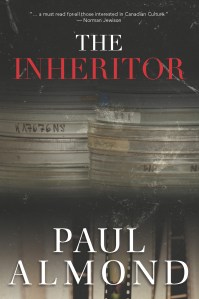
    On April 8, Paul Almond’s last book, The Inheritor, an autobiographical novel, was published by Red Deer Press. Almond, a member of the Quebec Writers’ Federation, intended to meet many of his fans and fellow writers this spring and summer, but he passed away on April 9.

    Almond spent the last twenty-five years of his life researching and writing The Alford Saga, the eight-volume series of adventure novels which culminated in The Inheritor. The series depicts the lives and loves of his Gaspesian ancestors. Even in his eighties, Almond crisscrossed North America, talking about his books on radio and TV. He did over 100 book launches in the last five years of his life, often donating half the proceeds to charity. But what about all the months and years of research that precedes the writing?

    Almond consulted Canadian historians, linguists and scholars; combed through Library and Archives Canada; pored over Canadian soldiers’ diaries and his ancestors’ letters; read archived newspaper columns and essays; and even referred to daily weather reports recorded by historians. For the autobiographical The Inheritor (book eight), Almond also returned to his own letters to his mother.

    On October 30, 2013, Almond drafted the following piece for QWF Writes, sharing his vision and experience of historical research in writing The Alford Saga. Barbara Burgess, Almond’s publicist, recently found the piece among her letters from Almond. She and David Stansfield, one of Almond’s main literary consultants, prepared this piece for publication. Paul Almond:

    “I have been asked how I do my research. This Saga, written over the last dozen years, has indeed taken a lot of research, mostly arduous and thorough. I liken it to looking through binoculars based upon a tripod of three legs: Oral Tradition, Documents, and Intuition.

    Oral tradition

    In rural communities all across Canada, the oral tradition is strong: grandparents love to tell stories of their own grandparents. In cities, such a thing may not be possible, but in tiny Shigawake, Quebec, we have many such stories.

    About fifty years ago, an aged cousin told me shortly before he died that the first Almond climbed through a porthole of a British battleship in Port Daniel Harbour. That intrigued me. I did more research. (The story of the porthole is in the beginning of The Deserter – book one.)

    The Inheritor - Paul AlmondDocuments

    Now, as anyone might imagine, almost no English documents from 1800 exist on that largely unexplored coast off modern-day eastern Quebec. Archival material tells only of prime ministers, treaties and so on. Nothing explains exactly how a farmer drank water when clearing land. (Answer: a Piggin). But in New Carlisle, the county seat, an old box in a basement under a hat rack produced a paper from 1816, which revealed that a terrible famine had affected the Coast, caused by a volcanic explosion on Mount Tambora. A schooner had come from Quebec City to relieve the starving inhabitants; in order to get your barrel of flour to survive, you had to say who you were, how many were in your family, and so on. The paper noted that one Thomas Manning, aka James Almond,* had fought on the battleship Bellerophon, and had settled in East Nouvelle, as Shigawake was then known.

    Intuition

    In due course I discovered that behind Port Daniel, true wilderness then, a Mi’kmaq settlement thrived. If you deserted the British Navy in the early 1800s, your punishment was death. So the Marines would have chased deserter Thomas Manning. And where would he have gone? Back into the interior. What was there? The Mi’kmaqs. Bingo. There’s the story.

    This third leg of the tripod involves not just your own intuition and common sense, but advice from others. No Mi’kmaqs on this side of the Bay really knew anything about the 1800s. However, in New Brunswick, I found an Elder whose grandfather, and the grandfather before him, had been shamans. And there was an ethnologist at the Gaspe Museum, an Iroquois who had studied the Mi’kmaq all his life. And so gradually, my first book, The Deserter, grew out of their oral traditions, documents I found, and from what I intuited.

    And so I went, looking through my binoculars on their tripod. I looked into the 1850s, when my grandfather trekked on snowshoes six hundred miles to Montreal (described in The Pioneer). Then to 1900 when my uncle went to the Boer War (in The Chaplain), and from there on to 1914, when my father fought in WWI (described in The Gunner), and on…”

    * James Almond was Paul Almond’s great-grandfather. He settled in Shigawake in 1810 or thereabouts, founding the oldest homestead there.


    Paul AlmondIn addition to the eight volumes of the Alford Saga and several other books, Paul Almond produced, directed and in many cases wrote over 120 television dramas for the CBC, BBC, Granada (where he created the documentary Seven Up!) and various networks in the U.S., plus a number of feature films. www.paulalmond.com

    Photo (top) of Paul Almond © 2012 Northernstars.ca

    Photo (headshot) of Paul Almond © Joan Almond


    David StansfieldDavid Stansfield, a close friend of Paul, wrote 400 television scripts for TV Ontario in Canada, the Public Broadcasting Service in the U.S., the Discovery Channel, NHK, Encyclopedia Britannica and Time-Life, plus half-a-dozen feature film screenplays and nine books, seven of them novels. www.davidstansfield.com


    Author Barbara Burgess worked with Paul Almond for the past two and a half years, helping him arrange book launches, copy-editing and handling some of his literature-related correspondence. www.thecacounacaves.com

  • Nature’s Way of Getting Books Written by Raquel Rivera

     A couple of years ago I was cycling around the ex-garbage dump that is the St-Michel Environmental Complex in Montreal North, collecting details for a scene in my novel.

    I pedaled across the street from the Complex’s Cirque du Soleil headquarters, and peered through the windows of the National Circus School. Inside was a highly padded gym-like space, full of pulleys and ropes – and some very fit teenagers. Not wanting to be taken for a peeping-creep, I dashed around to the front reception and asked if they offered tours.

    I attended the school’s open house the following week, hoping to gather useful tidbits to feather my scene’s nest. As it happens, I was also stepping into my next crazy-making topic of all-consuming passion: a creative non-fiction book for children, featuring the lives of students at the National Circus School. My next Great Idea.

    I surprised myself as I blustered my way into the institution through emails, meetings and follow-up proposals. They had a responsibility to share their story with the world, I insisted. The guilt-trip finally seemed to convince the school’s extremely busy (and intimidating) directors. They were swayed by my conviction: this was a Great Idea.

    Everyone will want to read about these young superheroes, facing down risk and their own limits every day. They’ll be charmed by the gaspésien who left home to pursue juggling. They’ll be impressed by that skinny little twelve-year-old who boards at the school, so he can train twenty hours a week in addition to his full academic schedule. Readers will gasp as the eighth-grader makes her first tightwire jump; they’ll wince as the cruel wire tries to bisect her feet. Ultimately, just like me, readers will be fascinated by an inside peek at the tremendous efforts these young people make so that their performances can look easy to the rest of us.

    Topsy-turvy
    Topsy-turvy: You don’t need to turn yourself inside-out trying to sell a beloved manuscript – it just feels that way sometimes.

    As I began my visits and interviews, “Why not?” seemed to be the motto of the school. It’s what they tell one another in response to every new and impossible notion. (Stand on your partner’s shoulders, jump into a back flip and land back on – why not? Now do it en pointe, in ballet toe-shoes – why not?)

    “Why not?” It’s what the aerial instructor said when I asked if someone like me (old and untrained) might learn rope. I signed up for aerial classes at my local community centre and, week after demoralizing week, was the sole student unable to pull herself off the ground. Yet somehow, when it was finally over, I signed up with a private trainer at a circus studio and carried on. If nothing else, my acrobatics training would make me better equipped to relay The Great Idea to a waiting world. Publishers would scramble for my original material, appreciating its historic value and the uplifting message that we may achieve the impossible, whatever that means to each of us. This Great Idea was a winner – a shoo-in.

    Now I’m thinking, passionate belief like this is just nature’s way of getting books written. I wish it got them published, too.

    But that’s the other part of the writing life: when I gain new perspective on The Great Idea. Over lunch, one editor speculated on the cost of producing my full-colour, fully illustrated Idea. Responses came in from more editors: “The circus school certainly seems like an interesting place,” (but no thanks). “I loved your proposal, but that wasn’t enough to convince the powers that be.” Passion died, and determination stepped up, struggling against quaking doubt. Would anyone want my Great Idea? Would it receive the blessings of timing and dumb luck that brought past manuscripts to print? Or had my portion of blessings run out?

    At this stage, keeping faith is huge: you have to believe that one day all this thinking and writing will be a real book. This requires that my ears and my mind stay open – and that I conserve effort, to avoid burnout. I listen to feedback; I try to be flexible because The Great Idea deserves to be among readers. But there’s any number of great ideas floating around out there, looking for a publisher. (Which is actually a comfort, when I’m feeling more mature.)

    throw2catchduotissu
    Julie gives Natalia a hand during warm-ups for RESET, the latest show by acrobatic troupe THROW2CATCH

    Maybe this pause in progress (I won’t call it a halt) is a necessary stage in the forging process. Maybe it will shape up my Idea and make it stronger. I remind myself of the reason these circus kids inspire me so – they push their limits, they never give up.

    After the latest rejection, I transformed disappointment, frustration and the urge to throw a hissy fit into a new series of emails. I sought publishing leads, editors’ names, introductions to agents – anything to get The Idea some notice. And it worked. I still don’t have a book contract, but I have more leads to pursue, and the support and interest of fellow writers. It’s enough; for now, it’s everything.


    raquelrivera_smRaquel Rivera is the author of three books for children, and the aspiring author of four more. Her author website is at www.imho-reviews.com/raquel. Photo credits: Raquel Rivera

  • Writing with the Body by Kathleen Winter

    Writing with the Body by Kathleen Winter

    When I finished writing my novel, Annabel, in 2010, I nearly lost the use of my legs. Between books I make things by hand: hats, collages, kegs of kimchi. So I went to the friperie looking for magpie materials – and found I couldn’t walk up the stairs.

    “They feel,” I told my doctor, “like planks of rotten wood instead of legs.” I’d been sitting with them wound around each other in a Celtic leg-knot for a couple of years while I wrote the book. I knew you were supposed to get up and move around and I thought I’d done so once in awhile, but apparently not enough.

    “There’s nothing,” said my doctor, “that can be done.” She gave me a look I was beginning to recognize as that of a youngish person pitying someone over the hill. Damn that, I thought: I’m never going to sit still again. I thought of the sixteen years I’d sat still through school and university, and the decades of sitting I’d done as a writer, and regretted it.

    I walked home, cleaned off my desk, and went outdoors again. I walked to Jean-Talon Market and down Boulevard St-Laurent and through the trees on Mont-Royal. I moved down to Verdun and started getting to know the river: herons and sumacs, willows and wind. Beavers gnawing and ducks upside down in the water and red-winged blackbirds screeching holes in the living daylight. Messages from the wild flying everywhere and into my body, ideas at every turn.

    I knew about ideas coming when you get up from your desk. Annabel would still be a dead manuscript under the bed if I hadn’t budged to make soup or take a shower or walk to the café. The most important metaphors and plot developments and the novel’s deepest psychological structures came to me “out of the blue” when I escaped from my desk. I’d made those escapes as last resorts, when sitting and thinking had brought me to the end of my tether. But now, trying to keep moving to heal my ruined legs, I realized movement might be my new first line of action as a writer: I could write with the body.

    I’ve always known writers walked. One of my favourite books is Journals of Dorothy Wordsworth, in which Dorothy and her brother cover hundreds of miles of heath before collapsing to devour boiled eggs or meat pie against boulders. So I started using every hour of daylight as my personal body-writing time. When November hit and I took out my Seasonal Affective Disorder lamp as I always do in order not to become marrow-deep dismal, I realized I didn’t need it anymore: striding around the riverbank and the city streets in the daylight hours means I have so many ideas gifted to me by the light and the environs that all I have to do is spend an hour or so standing up at home in the night, scribbling it all down. My legs, after months of this, have come back to life. If ideas or images come too fast when I’m moving about, I write or sketch them in my tiny notebook, standing up, in all weather.

    woman bus stop st viateur and parcman corner St. Viateur and Parc

    “If ideas or images come too fast when I’m moving about, I write or sketch them in my tiny notebook, standing up, in all weather.”

    Drawings by Kathleen Winter

    I’ve always felt the brain organizes and computes while writing, but the body is the place where story lives. I guess I just didn’t know until I nearly lost the use of my legs that I have to forget about sitting down in a chair altogether if I want to thrive, both as a writer and as a human. I used to have posted on my wall a quote from Eugenia Zukerman: “Apply your ass to the seat.” I guess maybe that works if you’re a virtuoso flautist. I ripped that quote down – and my ass is smaller now.


    Kathleen Winter’s novel Annabel was a #1 bestseller in Canada and has been translated worldwide. Her story collection boYs, edited by John Metcalf, won numerous awards. Her Arctic memoir Boundless (2014) was shortlisted for Canada’s Hilary Weston Writers’ Trust and RBC Taylor non-fiction prizes and has been sold internationally. The Freedom in American Songs (stories, Biblioasis) also came out in 2014. Born in the UK, Winter lives in Montreal after many years in Newfoundland. http://tinyurl.com/Kathleen-Winter

  • What Writing Gives Me by Laurie Gough

    writing image

    When I was halfway through writing my first book many years ago, I remember reading in Anne Lamott’s Bird By Bird: Some Instructions on Writing and Life that the best part of being a writer isn’t getting your name in print. It isn’t all the excitement and accolades that accompany being a published author. The best part of being a writer, she said, is the writing itself.

    Damn, I thought. Writing is such hard work. How can that be?

    A year later, I realized she was right. The writing is the best part. The writing is what energizes and enriches me, deepens my life in more ways than I can count. Once you’ve finished writing your book and it’s in the hands of others – publishers, editors, the media, readers – you’re no longer behind the wheel, taking your characters places they need to go, deciding which verb conveys exactly the right mood, letting the phases of the moon dictate how the night sky looks. Once your book is out in the world it’s no longer yours. The publisher might even change the title on you, as my first publisher did.

    So the writing itself is what I always go back to – sometimes kicking and screaming and dragging my heels – but before long I remember why I write: it makes me feel good when I feel an inspiration start to grow, an image I can’t shake, an emotion or idea that desperately needs to be sculpted into words. Sometimes I don’t even realize I’m feeling a certain way about something until I start writing about it. Someone once wrote, “How do I know what I’m thinking if I haven’t written about it?” I get this. For the ideas to take shape, I need to write whatever I’m feeling strongly about. Writing organizes my thoughts and sets free my feelings, ideas and opinions. Even if nobody ever sees what I write, it doesn’t matter. It’s still liberating. It still invigorates. But I especially love the feeling of transforming something from my own experience and sending it out into the larger world. I love writing about something that, while personal, is hopefully also universal, about an experience that might induce others to nod in recognition and feel less alone.

    “Damn, I thought. Writing is such hard work. How can that be?”

    Writing is immensely cathartic. What was interior becomes exterior, and when it’s exterior it’s tangible, made more real. Writing lets me live parts of my life over again, even the painful parts. The second time around I can re-examine and reflect, work out why I took one particular road in life over another, attempt to recall who I was in the past, what I thought, and wonder if a part of that younger me still exists.

    Writing forces me to observe life in detail, to live in the moment. I find that my two passions, writing and travelling, feed off and enrich each other. When you’re on the road, everything around you takes on a vibrancy you may not have experienced since childhood. When you’re in a new place, you absorb fresh life around every corner; you see everything from a crooked angle. Time stretches and your senses sharpen. In other words, you’re paying attention. And paying attention is a writer’s job. If you intend to write about what you’re seeing, you’ll be even more aware of the details of the moment. You’ll look more closely, listen more clearly, taste more carefully and continually reflect on what you’re experiencing. All your senses are heightened. As a result, your writing – and your travels – will be deeper and richer.

    Writing also gives me a sense of accomplishment. I tried being a primary school teacher for a time and I don’t think I was very good at it. I’m terrible at any kind of retail job–  unless I can read a book behind the cash register. Writing, although hardly a profession that pays much these days, has in many ways saved me from being an aimless wanderer in this life. It roots me to solid ground. What I have not earned by way of money is more than compensated for by wealth of experience. Writing has shaped me as a person in a way no office job could.

    But above all, writing gives me redemption. If I write about an experience I can lift it up to another level, helping me and my readers understand more about the world. I thought about this recently when writing my latest book. It’s not a travel book, but it discusses a terrifying journey nonetheless. Writing about how my son developed Obsessive Compulsive Disorder in reaction to his grandfather’s death has forced me to consider how writing about a difficult and traumatic experience can bring out the truth of who we are. What we find out is not always pretty, but it’s real and it’s human.


    Laurie Gough is author of Kiss the Sunset Pig: An American Road Trip with Exotic Detours, and Kite Strings of the Southern Cross: A Woman’s Travel Odyssey, shortlisted for the Thomas Cook Travel Book Award in the U.K., and silver medal winner of ForeWord Magazine’s Travel Book of the Year in the U.S. Over twenty of her stories have been anthologized in literary travel books; she has been a regular contributor to The Globe and Mail, and has written for The L.A. Times, USA Today, salon.com, The National PostThe Toronto Star, Canadian Geographic, The Daily Express and Caribbean Travel + Life, among others. She lives in Wakefield, Quebec with her family, and has just finished writing her next book.