Tag: travel

  • Changing the Scenery to Refresh Your Writing—By Kate Hammer

    Changing the Scenery to Refresh Your Writing—By Kate Hammer


    There’s a bit of writing advice that I receive a lot: treat writing like your full-time job, sit down at the same time and place everyday, train your brain to be creative. I’ve heard it again and again, because it works. 

    For others, I’m assuming. 

    I’ve never been able to hold down a routine. Consistency makes my skin crawl, so I’ve had to find another way to inspire creativity and meet deadlines. By changing where you write, you change the way you write: it becomes varied, rooted in distinct experiences, and tonally original. And when was the last time you complained about writing too dynamically?

    Being in a different place can help our stories feel easier, inspire us to notice more, and make returning to our writing place a whole new experience. It can be as small as changing the direction of your desk, or as big as a weekend away without a whisper of internet connection. Or, you can uproot your entire life and move across an ocean.

    At the end of 2020, I moved to Scotland for a writing Master’s. I’d lived in Montreal for a few years, the longest I’d settled down anywhere for a decade, and was starting to get the itch. I was aware moving in the middle of a pandemic wouldn’t be easy, but I also knew it was the challenge I needed. Not only did I instantly become an outsider, but all the habits I’d labeled as normal in myself became something to scrutinize, something of interest.

    Without meaning to, we put our surroundings into everything we write. Maybe the sun is shining, you’ve just had an argument, or you’ve been given an eclectic mug that you know the protagonist of your story would also have; we are sponges that ooze plot. Now, I’m not trying to convince anyone to move halfway across the world like I did, but I am trying to inspire you to get out of your comfort zone. 

    Perhaps it is sitting outside, acting like a tourist in your own city, or treating yourself to a cafe that you’d normally walk past. It can be directly useful, such as visiting the same city as your character, or discovering a hobby by chance that you never thought they’d be into. 

    As soon as I landed in the UK, I knew my brain was aware in a whole new way, and I have the journal entries to prove it. From the roads never being wide enough for two cars, to the public walking paths taking you through fields of sheep who think you have food and charge towards you with impressive speed. I was learning again how I react under pressure; meeting new types of people with traits that could easily be given to characters; feeling the familiar stress of not immediately belonging.

    Putting ourselves in different environments makes us think differently about our stories, and our characters. As much as you know them on paper, knowing what they’d notice in an all-night pharmacy at 1 a.m., or who else would be there, is another matter entirely. You’re reconnecting with your world, and observing the behaviours of strangers as they unknowingly walk through your homework. Those real character actions aren’t something you can buy with money, only with your time. 

    It can take a lot of energy, to suddenly be aware of what’s around you again, or to take on new places, but alongside a healthy relationship with discomfort comes a balanced connection with rejection. As writers with a list of submission dates, we need to practice resilience against the vulnerability and fear of the job.

    The best part of switching up your space, however, is coming back home. Whenever I return to Canada, to my family farm, to my writing desk, I see everything all over again. Not as if for the first time, but I notice different things, items I’ve forgotten to look for. It’s that nostalgia of returning somewhere that makes you comfortable. I guarantee you’d describe your living room in a whole new way if you went a few days without seeing its walls, its stained carpet, how the afternoon sunshine has faded the couch.

    Changing your writing space may not always go well, but this is part of the magic: we’re rarely lost for words when complaining. Every experience feeds into your writing and characters in unexpected ways. 

    Remember that writing isn’t always putting words on paper. Even if you don’t get a lot of work done, changing the scenery can be an excuse for a vacation, a walk, or a redecoration. It’s how we turn ourselves into our own best editors, looking at things in a whole new way, as a slightly different person. And if you need to move to the UK to do that, I’ll be here to support you. 

    Kate Hammer is a writer, producer, and performer born in Canada, and living in Scotland. An award-winning playwright, director, and published writer, Kate constantly strives to create community representation in order to tell the stories that need to be heard. They now work in television development and are publishing a non-fiction book later this year called, Bruce Willis is My Dad. They are a queer, neurodivergent creator who never forgets their goat farming heritage. katethehammer.com

    Photos: Monstera via Pexels; Jeremy Cabrera (headshot)
  • All Languages / Languages All—By Rachel McCrum

    All Languages / Languages All—By Rachel McCrum

    “Les langues sont toutes les mêmes lorsqu’elles tournent ensemble.”

    —Danny Plourde

    “All languages are the same when they’re in tune.”

    —translated by Antonio D’Alfonso

    “Languages all come together when they’re dancing.”

    —same line, translated by Martha Tremblay-Vilao

    LesNuitsAmerindiennes
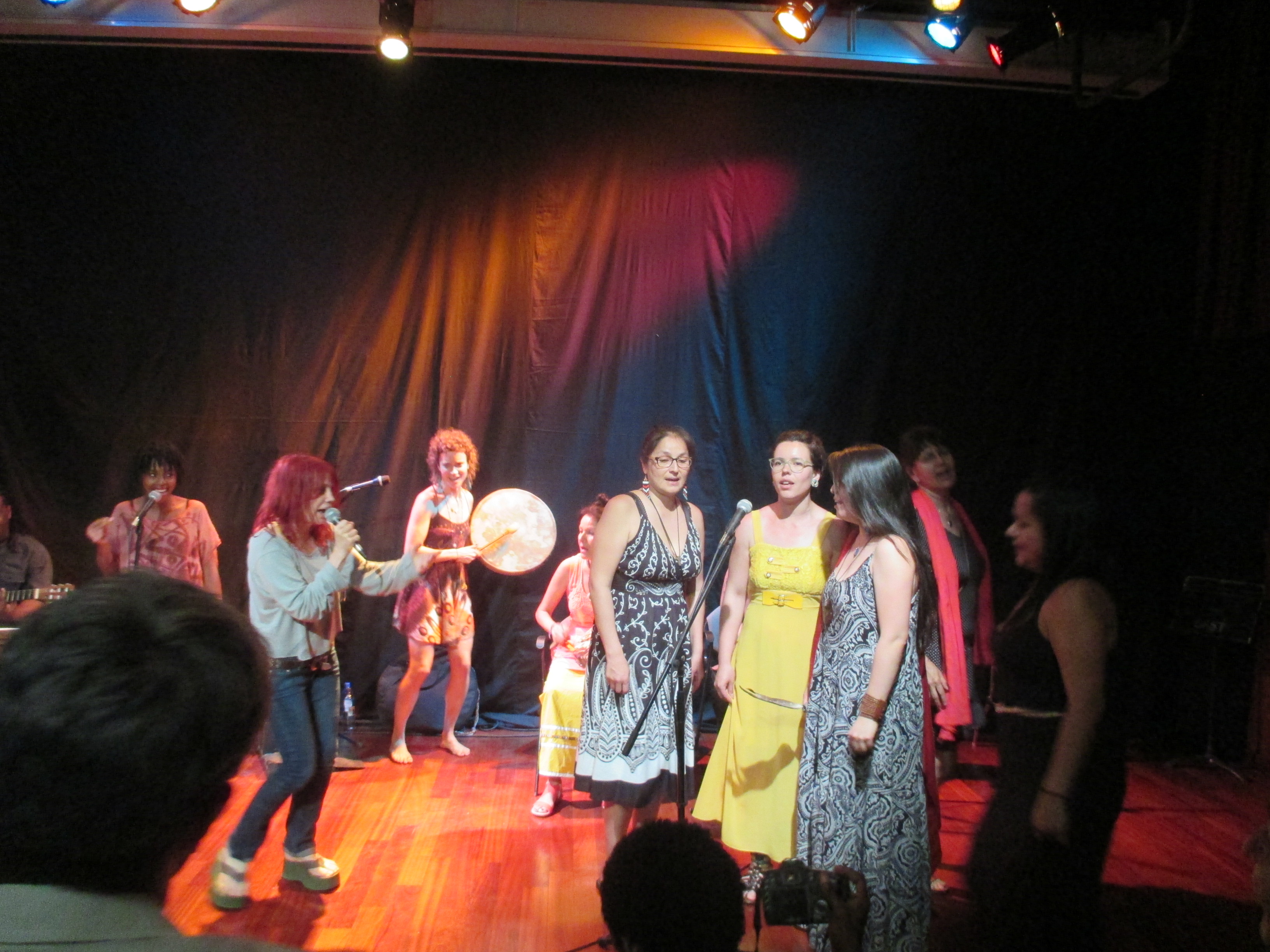
    Les nuits amérindiennes, Port-au-Prince Haiti, May 2015. Performers include: Chloé Sainte-Marie, Moe Clark, Marie-Andrée Gill, Rita Mestokosho, Natasha Kanapé Fontaine, Naomi Fontaine.

    What’s the point of going to see a poetry show if you can’t understand the text? And yet—there it is. That galvanizing, pure communication of the concerns, the beauty, the specificity of another language. The most joyful expression of it that I’ve seen so far was at an unforgettable night with the inzync Poetry sessions in Stellenbosch, South Africa. At least five of South Africa’s eleven official languages were represented onstage, with whispered translations offered by audience members to their neighbours, and whoops of recognition along the way.

    I wanted more.

    Port-au-Prince, May 2015

    I’m nearly the sole Anglophone, and definitely the only Northern Irish, at Les nuits amérindiennes, a festival of First Nations poets and artists in Port-au-Prince, Haiti, curated by the inimitable Rodney Saint-Éloi of Montreal-based publishing house Mémoire d’encrier. The Indigenous poets from Quebec include Joséphine Bacon, Guy Siou Durand, Tomson Highway, Virginia Pésémapéo Bordeleau, Louis-Karl Picard, Natasha Kanapé Fontaine, Moe Clark, Marie-Andrée Gill, and Naomi Fontaine. I’ve been sent by the Edinburgh International Book Festival to meet with Joséphine, Natasha, and Naomi for a collaborative project. This is my introduction to Canadian, to québécois, to Indigenous literature. I have no idea what’s going on, and I can barely understand anyone (my Belfast schoolgirl French being wholly inadequate in the circumstances). But at the shows, I’m electrified by the performance and the politics, the unself-consciousness, the self-awareness, the clear-eyed passion, the trickster craftiness—and well-honed craft—of the various artists.

    Nobody really understands why I’m there either, although it’s not that important—this isn’t about me. But I’m not that good at sitting on the sidelines and I’m desperate to communicate, somehow. At the second late-night session at Café Yanvalou, I sidle up to Rodney and ask, haltingly, if I can take a turn at the microphone. The words will be in English, but it’s the only thing I can think of to do. I sweat through a couple of poems, with halting introductions in French. I talk about my mother, and the sea. It works. I cannot speak, but I can extend words. The connection is made. These will become lifelong friends (and in one case, the love of my life, and the beginning of my journey to Montreal).

    Edinburgh, December 2016

    I am finishing up six years in Edinburgh, Scotland, which has mostly been consumed and absorbed with poetry, performance, promoting events, teaching workshops. It’s been a fantastic life. I have been incredibly lucky, starting from the gritty basics of open mic nights and running shows, and ending up being able to make a living, a good living, from all this. I love my community, I love my work, I love, more than anything, what happens when people get on a stage with their words, and speak them to an audience. And I’m leaving it.

    Even I’m not entirely sure why, except that there is love on the other side of the Atlantic. And there is a chance, a real chance to follow this thread of poetry and of performance, and try to understand how, if one cannot follow the sense of the words in an art form that bases its craft on the finer points of language, one can still be so affected by multilingual performances. In Quebec, my native language—which I have spent the last few years learning how to wield as a poet—becomes one among many.

    Montreal, November 2018

    I’m at Langues liées // Linked Tongues in La Sala Rossa, Boulevard Saint Laurent, Montreal. It’s the opening event of the Mile End Poets’ Festival, and there are ten poets on stage. There are ten languages on the stage. Aside from French and English, there is Arabic, Creole, Korean, Innu-aimun, Italian, Occitan, Persian, Portuguese, Spanish, and Wolof. These are mother tongues, and father tongues; languages of politics, of home, of love.

    Languages talk of their own concerns, at once specific and universal. Martha Tremblay-Vilão sings saudade, the Portuguese longing for a past or a home that no longer exists. Hossein Sharang talks of Iran, of democracy, of the impossibility of a country of eighty-two million terrorists. David Bouchet asks—in Wolof, with the aid of cue cards (and his fellow poets): “Where are you, who are you, how are you?” Marcela Huerta performs the stiltedness, then fluidity, of learning English as the daughter of Chilean refugees.

    The audience doesn’t understand everything that is being said, but there are ripples of comprehension when a new language is presented. There is a table of Arabic speakers, another of Portuguese. Maëlle Dupon’s mother is in the audience to hear her perform in Occitan; another supporter, a Haitian friend of Maëlle’s, is blown away when his ears catch the Creole of Chloé Savoie-Bernard.

    In La Sala Rossa, the last impressions are of joy. Of something ventured and something gained. Of respect. Everyone on that stage can do something that no one else can. They’ve worked for this show, they’ve risked, they’ve listened to one another, translated, called out and responded. And we’re here, and we will listen.


    RachelMcCrum_headshot

    Rachel McCrum is a poet, performer, and promoter—and also the Membership & Communications Co-ordinator of the Quebec Writers’ Federation.* She is originally from Northern Ireland, and has performed and taught poetry in Greece, South Africa, Haiti, Canada, and around the UK. She lived in Edinburgh, Scotland, from 2010 to 2016, where she was the inaugural BBC Scotland Poet-in-Residence, a recipient of an RLS Fellowship, and the co-host of cult spoken word cabaret Rally & Broad. Her first book, The First Blast To Awaken Women Degenerate, was published in 2017. She has lived in Montreal since January 2017, where she co-directs (with Ian Ferrier) the Mile End Poets’ Festival and curates the bilingual poetry performance series, Les Cabarets Bâtards.

    *As an employee of the QWF, Rachel has waived the fee for this article.

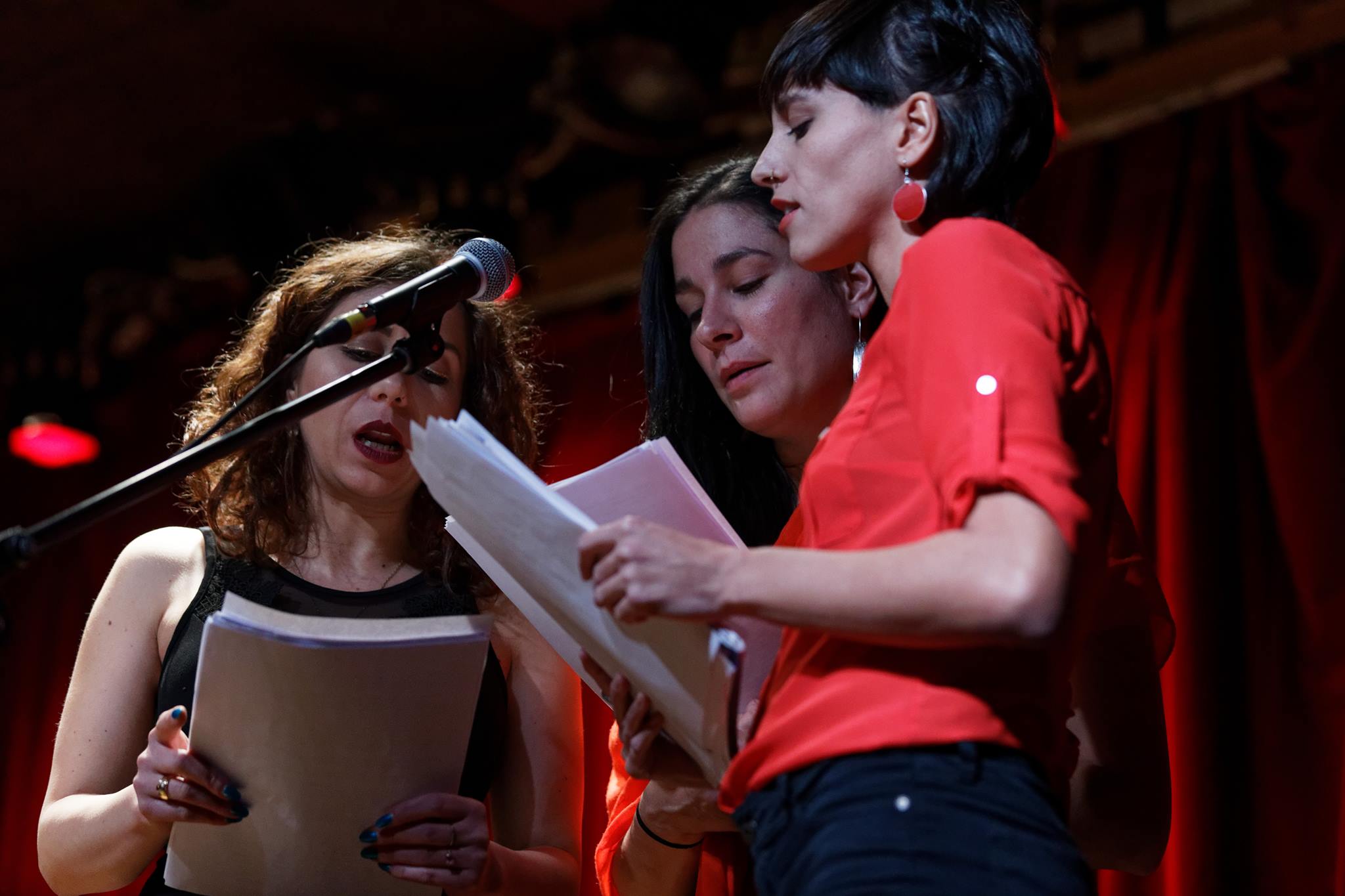
    Photo credits: Michael Kovacs (header image, showing Maëlle Dupon, Uasheshkun Bacon, and Martha Tremblay-Vilão reading in Occitan, Innu-aimun, and Portuguese at Langues liées // Linked Tongues); Rachel McCrum (top image); Ryan McGoverne (headshot)